Home Blog Page 830

Vwaere Diaso: Doctors declare strike over colleague’s death in Lagos

0

THE Lagos state chapter of the Nigerian Medical Association (NMA) has declared a strike over a colleague’s death.

The doctors’ body directed doctors working in the three government hospitals on Lagos Island to begin an indefinite strike over the death of its colleague, Vwaere Diaso.

The NMA also proclaimed five days of national mourning in the state and asked medical staff at other government-run institutions to curtail their regular schedules in remembrance of the deceased colleague.

The Lagos Island Maternity Hospital, the Lagos General Hospital, and the Lagos Massey Street Children’s Hospital are all expected to go on an indefinite strike.

According to the NMA, Diaso passed away on Tuesday at the General Hospital, Odan, Lagos, after spending more than 40 minutes locked in the lift before being rescued, and no blood was available to revive her.

The association disclosed this in a press statement signed by its state Chairman, Benjamin Olowojebutu, and Secretary, Ismail Ajibowo, on Wednesday, August 2.

“The NMA Lagos State received with rude shock the death of one of our members, Dr Vwaere Diaso, a medical house officer, whose death occurred as a result of injuries sustained when the elevator she was in crashed. This is heartbreaking, heart-wrenching, and quite unfortunate.

“We commiserate with her immediate family, her colleagues on the Island, the Medical Guild, and all body of doctors in Lagos State. The information we got was that she was trapped in the elevator for more than 40 minutes before she was rescued.

“We were also reliably informed that there was no blood available for resuscitation, and this has become a recurring issue as a result of the review made by the government on the previous policy on blood donation,” the NMA stated.

The association said the death was unfortunate, and her death pains the NMA.

They added that the elevator issue has been on for so long despite several complaints and requested an investigation into circumstances leading to her death.

“The association, however, demanded an immediate and unbiased investigation into the circumstances surrounding the incident.

“We declare a five-day statewide mourning period; we demand an immediate, unbiased investigation into the circumstances surrounding this unfortunate incident; all those found culpable in this matter, especially the General Manager of the Lagos State Infrastructure Management Agency, Ms Adenike Adekambi, are all brought to justice.

“We direct all our doctors in the three government hospitals on the Island (GH Lagos, LIMH, and MSCH) to commence indefinite strike action until the investigations are completed, and justice served; we immediately direct our doctors in all the other government hospitals to scale down activities as a mark of respect for our dead colleague. Only emergency services should be rendered for the next five days,” the NMA added.

As a matter of urgency, it urged the government to commence the complete overhaul of the house officers’ quarters on the island and all other infrastructures in government hospitals that need repairs.

In addition, the doctors association said the blood transfusion system in Lagos State needs immediate revamping for improved service.

The NMA said as a result of the incident, the upcoming Annual General Meeting will be a low-key event as a mark of respect to their colleague.

Meanwhile, the Lagos State government has reacted to the death of the doctor in a statement on its official Twitter handle on Wednesday, August 2.

In the statement, the government consoled the deceased’s family and said it has set up an inquiry to investigate the incident.

“The sad event occurred on Tuesday, August 1, 2023. The State Government, especially management and staff of the Lagos State Ministry of Health, commiserate with the family of the deceased on the unfortunate loss of their daughter, who passed on as a result of the mechanical failure of an elevator at the General Hospital, Odan, Lagos Island.

“An inquiry by a team of officials from the Lagos State Ministry of Health, Lagos State Health Service Commission, Lagos State Safety Commission and certified Lift and Vertical Transportation Equipment experts has commenced,” the Lagos state government said.

The Lagos State Government added that it will ensure that anyone found negligent by the report of the inquiry will face appropriate sanctions.
Akpabio unveils Oyetola, Bagudu, Matawalle, Lalong, 15 more ministerial nominees

0

Nineteen more ministerial nominees have been unveiled by the senate president, Godwin Akpabio.

The chief of staff to the President, Femi Gbajamiabila, presented the new batch of ministerial list to the Senate during the plenary session on Wednesday, August 2.

The Senate suspended the rules of the chamber to allow the chief of staff to enter the Red Chamber. Prior to Gbajabiamila’s arrival, ministerial nominee Lateef Fagbemi from Kwara state stood before the Senators for screening.

Unveiling the list, the senate president, Godswill Akpabio, announced an additional 19-man list. Adegboyega Oyetola, Atiku Bagudu, Bello Matawalle, Simon Bako Lalong, were part of the prominent Nigerians who made it to the new batch of nominees.

Others are: Ahmed Tijani, Bosun  Tijjani, Maryam  Shetti, Ishak Salako, Tunji Alausa, Tanko Sununu, Ibrahim Geidam, Lola Adejo, Shuaibu Aninakar, Tahir Mamman, Aliyu Sabi, Alkali Ahmed, Heineken Lokpobiri, Uba Maigari. Zephaniah Jossalo.

On Monday, July 31, the Senate commenced the screening exercise of the 28-man list of ministerial nominees. The exercise, which has lasted for three days, was to ensure the suitability and competency of those who will occupy positions.

However, The ICIR gathered that some nominees were spared of scrutiny and were instructed to take a bow and leave. 

Fourteen out of the 28 were screened on Monday, while nine other nominees underwent their screening on Tuesday. Amongst those screened on Tuesday were former Ebonyi governor and lawmaker representing Ebonyi South, David Umahi (Ebonyi); Former Kaduna governor, Nasir El-Rufai  (Kaduna), and Adebayo Olawale Edun of Ogun state. 

Some of those screened at Monday’s plenary include the former governor of Rivers State, Nyesom Wike,  Abubakar Kyari from Borno State, Nkiruka Onyejeocha (Abia State); Bello Muhammad (Sokoto State), Sani Abubakar Danladi (Taraba State) and Badaru Abubakar (Jigawa State).

Similarly, the remaining five nominees from the first batch, namely Dele Alake (Ekiti), Muhammad Idris (Niger), Ali Pate (Bauchi), Doris Anite Uzoka (Imo), and Lateef Fagbemi SAN (Kwara), were screened during today’s session.

In his appearance, Dele Alake emphasised the need to strengthen social media regulation, urging the National Assembly to amend existing laws to effectively combat the spread of fake and inaccurate information on social media platforms.

While fielding questions from senators, Alake emphasised the need to address the challenges posed by the improper use of social media, warning that social media could plunge the country into confusion if not properly checked.

Gbajamiabila had on Thursday, July 27, presented the list of 28-man ministerial nominees to the Senate President, GodsWill Akpabio.

The ICIR reports that there are 36 states in Nigeria, and the constitution makes it mandatory for the President to appoint at least a minister from each state. Of the 28 names Tinubu listed in the first nomination list, at least eight states were not on the list.

Estimated electricity billing not acceptable – El-Rufai

FORMER Governor of Kaduna State and a Ministerial nominee, Nasir Ahmad El-Rufai, said estimated billing is not acceptable, insisting that every household and business must be metered in a privatised electricity market.

The former Governor, whom many have tipped to be Nigeria’s next Minister of Power, made this submission on Tuesday, August 1, 2023, while he fielded questions at the ongoing stage Senate’s Ministerial screening exercise.

Nigeria’s Power sector has been going through numerous challenges, with its value chain of Generation, Transmission and Distribution accessing many interventions from the World Bank despite privatisation.

The former Governor also regretted that the federal government has spent more than N1.6 trillion naira intervening in the power sector, post-privatisation, due to illiquidity in the sector.

He also explained that such illiquidity would be largely addressed when people are properly metered and pay for a cost-reflective tariff.

“Without electricity, Industrialisation and even agriculture is a pipe dream. The president is committed to a stable power supply and has asked me to work with him.”

Further in his remarks, the former Kaduna State governor said Nigeria has about 13,000 megawatts of installed generation capacity but regretted that it could only produce between 4000 and 5000 megawatts for the national grid power.

Suggesting a way forward, he said, “The first step is to look at what is constraining the full production of the 13,000 megawatts of electricity that we have in installed generation capacity. Many of the generation stations cannot produce because of a poor supply of gas.

“Eighty per cent of our generation is from gas, and the balance is hydro. The gas-fired stations often don’t have a supply of gas. There are power stations that have been completed two or three years ago, and have produced nothing because there is no supply of gas.”

He explained the importance of effective collaboration of gas supply to power plants while stressing its importance in sorting the disconnect for improved power supply to consumers.

“We must ensure that gas and power are under one roof to address these issues, I have mentioned.

“Even if we are able to produce 13,000 megawatts today, our transmission infrastructure can only do may be between 5000- 6000 megawatts,” the former Governor said.

He also emphasised that Nigeria needs to close the gap in its transmission system to avoid recurrent grid collapse while stressing the importance of removing politics from transmission procurement to encourage successful power transmission.

The former governor noted that despite power sector privatisation, the government, in one way or the other keep subsidising electricity, which he said is no longer sustainable.

“The DisCos, about five of them, are under receivership because those of them who borrowed from the banks are not repaying, and the banks have taken over five or six of them,” he said.

He also disclosed that the last time a stress test was done on the DisCos, only but three of them, out of eleven, did well.

“There’s a lot of work to be done on the distribution since it is the last end of the value chain, and if they don collect money and don’t have enough metering, they would not be able to pay for Power supply by the generation companies.

“This is why the government now pays; otherwise, they will invoke a partial risk guarantee signed with the government. These problems need to be addressed.”

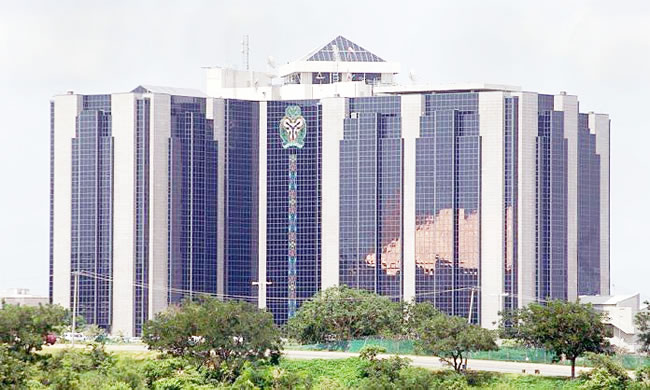
Senate to amend CBN’s act, reduce the governor’s powers

THE Senate President, Godswil Akpabio, has revealed the plans of the National Assembly to amend the acts of the Central Bank of Nigeria (CBN) as a measure to curtail what he described as ‘overbearing’ powers of the bank’s governor.

Akpabio gave this information on Tuesday, August 1, 2023, while he screened a Ministerial nominee from Oyo state, Adebayo Adekola Adelabu.

Adelabu, a former deputy governor of the apex bank, while being screened, said the country could be saved from some economic decisions of the Central Bank if minority opinions of deputy governors other than that of the governor are considered in its core decisions.

Adelabu’s submission came while he responded to a question from the Senate President who asked that “some of the decisions of the Central Bank  appear to be as if they are a government within a government, for instance, the naira redesign policy.”

Adelabu, in response to the question, said,”There are three highest decision-making bodies in the Central Bank of Nigeria- the committee of governors, the monetary policy committee and the board of Directors. The CBN governor is the chairman of these three committees.”

For Adebayo, CBN’s governance structures has to be reviewed

He noted, however, that the governor is just first among equals.

“We have a Governor and four deputy governors. The governor is like the first among equals. The appointment of the four deputy governors must be independent of the Central Bank Governor so that they wouldn’t be subservient to the governor himself,” Adelabu said.

Adelabu pointed out, that another key concern with the CBN structure was that the reporting line on some key decisions is between the governor and the Presidency.

He stressed the importance of the opinions of the deputy governors in key decisions of the apex bank.

“There should be occasions where the Country’s President needs to get see the entire committee of governors, which comprise of the deputies and hear from their own opinions,” Adelabu said.

He added, “Most of the controversial decisions in the CBN are either taken by three out of five governors. There is always a minority vote, and they should be allowed to have their say.”

He further said that the Presidency should be able to go through the minority opinions of the board of governors and even sound out some deputy governors in some key decisions.

He suggested that the economic management team of the nation, which comprises the fiance Minister, the Minister of National Planning, the CBN governor and the Accountant-General of the Federation, must have some subtle oversight of the CBN in terms of interrogating some of the decisions of the bank.

“If the CBN knows that it has to be interrogated about some of its key decisions on Forex allocation, how it arrived at monetary policy decisions, and the volume of money in circulation, it would be careful in its dealings.”

Akpabio lauded the nominee and regretted poor oversight of the apex bank by the Central Bank, which has plunged the nation into some avoidable economic decisions.

“This is a food for thought for the distinguished Senators, and that means we must revisit the Acts that set up the CBN.”

Akpabio said the nation would have been free from some of the economic hardships it faced if there was proper oversight and monitoring of the CBN through the Acts of Parliament and proper supervision.

The ICIR has earlier reported how the CBN violates the provision of its Act and lent to the Federal Government to the tune of over N25 trillion has increased Nigeria’s inflationary surge while putting the country in debt mess.

Akpabio insists the review of the Act would also check the excesses of the apex bank governor.

Drug trafficking: Nigerian court jails South American 13 years

0

A FEDERAL High Court in Port Harcourt, Rivers State, has sentenced a South American man from Suriname, Dadda Lorenzo Harvy Albert, to 13 years in prison for drug trafficking.

The ICIR reported that operatives of the National Drug Law Enforcement Agency (NDLEA) arrested 34-year-old Lorenzo at the Port Harcourt International Airport, Port Harcourt, Rivers State, for bringing into Nigeria 117 parcels of cocaine concealed in extra-large latex condoms packed inside bottles of 100ml body spray.

His arrest was announced in a statement by the spokesperson of the NDLEA, Femi Babafemi, on Sunday, April 9.


Read Also:

According to the NDLEA, “The suspect claimed he departed his country, Suriname, located in the North Eastern coast of South America on April 2 for Sao Paulo, Brazil and from Sao Paulo, he came to Nigeria on Friday, April 7, on board a Qatar Airways flight in search of his long-lost Nigerian father whom he called Omini.”

He was arraigned before the Federal High Court 2, Port Harcourt, on June 1 on two counts of importation and unlawful possession of 9.9kgs cocaine in charge number FHC/PH/181C/23.

He, however, pleaded guilty to the two-count charge. But after the review of the facts of the case on Thursday, July 20, he was convicted and sentenced to 13 years imprisonment on both counts without an option of fine. 

In his ruling, the judge, E. A Obile declared, “You, Dadda Lorenzo Harvy Albert, is hereby sentenced to 13 years imprisonment without option of fine on Counts 1 and 2 also. And both shall run concurrently.”

The trial judge also ordered the forfeiture of the sum of ninety United States Dollars and ten Brazilian Real recovered from the convict at the time of his arrest to the Federal Government.

The court equally refused the application by Lorenzo’s Counsel for him to be deported back to his country. 

As a result, the convict is now serving his term of imprisonment at the Correctional Centre, Port Harcourt, Rivers State.

NDLEA, in a statement by its spokesperson Femi Babafemi on Wednesday, August 2, said the successful prosecution and conviction of Lorenzo is one of the many drug cases concluded at the Federal High Court across the country between January and June 2023 by the Directorate of Prosecution and Legal Services of NDLEA.

 “Out of the 1,445 convicts, 221 of them are female, while the balance of 1,541 are male.

“Of the 11,166 pending cases, 10,626 of them are men while the rest, 540 are women,” the Agency stated.

The anti-narcotics agency added that the 1,445 convicts and 11,166 suspects who are still facing trial were arrested and charged to court over the seizure of 555,953.70 kilograms of cocaine, heroin, methamphetamine, cannabis, tramadol and others linked to them between January and June 2023.

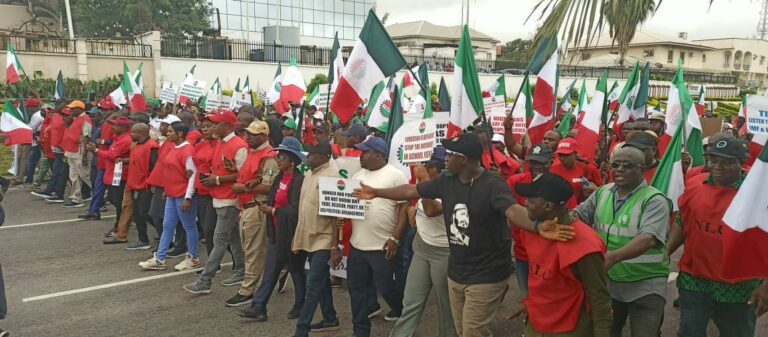
Labour protest: DSS operatives deployed at Lagos assembly

OPERATIVES of the the Department of State Services (DSS) have occupied the Lagos State Assembly complex, where members of the Nigeria Labour Congress (NLC) are currently protesting.

This protest is part of a nationwide demonstration against the removal of petrol subsidy by the Federal Government. Fuel prices and cost of transportation tripled after the President, Bola Tinubu, said his administration would no longer subsidise gasoline for citizens in June. 

As a result, on July 26, the NLC threatened to stop work in protest should the Federal Government refuse to reverse all anti-poor policies, such as the recent petrol pump price hike, within seven days.

The ultimatum expired on Monday, July 1. Labour union members have taken to the streets across states in protest as planned.


READ ALSO:


DSS operatives in Lagos were seen at the state assembly premises as the demonstrators converged at the entrance gate.

The ICIR earlier reported that police officers were deployed in Ilorin to prevent a breakdown of law and order as workers in Kwara State join the nationwide protest.

In Abuja, aggrieved protesters pulled down the National Assembly Complex’s first gate after security operatives stationed at the legislative building refused to open the gates to allow the angry workers to express their displeasure.

Senate sets up committee to dialogue with protesters

0

THE Senate has set up a three-man committee to dialogue with members of Organised Labour who stormed the National Assembly on Wednesday, July 2, to protest against economic hardship occasioned by the removal of petrol subsidy.

The committee is led by Senate Chief Whip Ali Ndume and included senators representing the Federal Capital Territory (FCT) and Anambra North Ireti Kingibe and Tony Nwoye.

While the Chief Whip addressed the protesters, a letter of protest was handed over to the Senate by the President of the Nigeria Labour Congress (NLC) Joe Ajaero.

The letter demanded an end to the arbitrary increase in the cost of fuel and education. It also called for a reduction in transport costs and the fixing of the non-functional refineries in the country.

Members of the NLC and Trade Union Congress (TUC) took to the streets of Abuja and other states across the country on Wednesday in protest over hardship faced by Nigerians following the Federal Government’s decision to discontinue subsidy on petrol.

The demonstrators have not clearly stated how long the protests would last. However, NLC President suggested on Wednesday that the demonstration could go on for as long as the Congress decides.

“It is equally in our own enlightened self-interest, based on the interest of the state, to determine whether the protest will be for today or tomorrow or next or till thy kingdom come. It is not by mere using forces to stop people from expressing their views,” Ajaero said.

The protesters pulled down one of the National Assembly Complex gates during the protest and gained access to the premises in defiance of security operatives, who earlier denied them entry.

The protests took off after negotiations between members of Organised Labour and the Nigerian government ended in a stalemate.

While Nigerian President Bola Ahmed Tinubu assured the country that measures will be put in place to mitigate the hardships during an address on Monday, July 31, NLC insisted that the promises made were not in tune with the hardships confronting citizens.

They also stated that Tinubu failed to speak to the problem of nonfunctional refineries in the country, considered to be the solution to the problems confronting the oil sector in Nigeria.

Working refineries, only solution to fuel crisis — Former NLC President Ayuba Wabba 

0

A FORMER President of the Nigeria Labour Congress (NLC), Ayuba Wabba, has stated that the only solution to the country’s lingering fuel crisis is for the refineries to begin production.

Ayuba spoke during the ongoing protest by the organised labour in Abuja on Wednesday, August 2.

He blamed the crisis on the few elites deliberately refusing to fix the refineries.

“It has been a vicious cycle, and it will continue to be a vicious cycle and will continue to affect our economy and therefore government must come up with three plans immediate, medium and long-term plans; I have not seen that on the table. 

“It’s a fire brigade approach, it’s a weak pill that will leave only pain for now, but the pain will remain with us perpetually. 

“What will address this issue is, is actually the issue of production, but the elites, not more than 10% of them, don’t want production; they want importation because why they benefit from importation, this is the real issue, and therefore we must insist, we must continue to insist that our refineries must work. Those elites must tell us when our refinery will work,” Ayuba stated.

He said past governments have promised to fix the refineries to no avail.

“They told us if we are refining, the price will not be more than, the price will not be more than N8 per litre; that is the last solution that can resolve this issue.”

He claimed that the palliatives promised by President Bola Tinubu will only serve as a temporary solution and urged the government to look more into the fuel price increase issue.

“Here we are today in the same vicious cycle, and Nigerians are suffering, we are suffering, every worker on fixed wages is feeling the impact, I didn’t see how the palliatives will address this problem because the palliative is only a temporary measure, but the issue of the price increase will be a permanent solution.

“I am telling you, once the exchange rate goes up and continues to go up, the price will increase; once the price of crude oil at the international market goes up, they will continue to increase because these are the two variables,” Ayuba added.

The ICIR reported that the protests declared by organised labour, comprising the NLC and the Trade Union Congress (TUC), over economic challenges in the country occasioned by the removal of petrol subsidy commenced in Abuja on Wednesday, August 2.

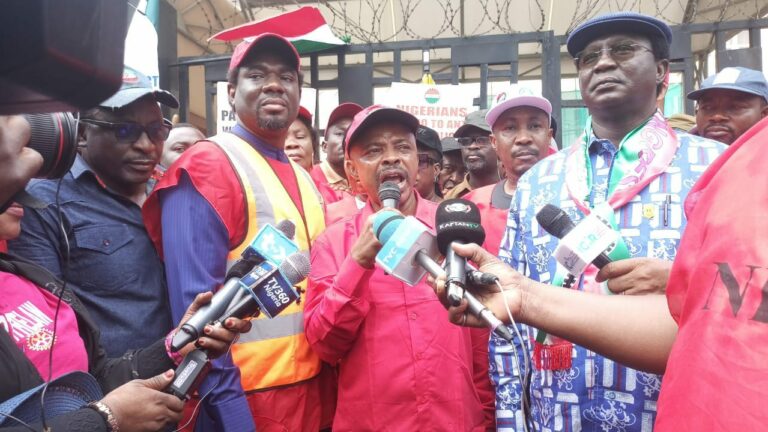
On Wednesday morning, NLC President Joe Ajaero told journalists at the Unity Fountain in Abuja that the protests have also commenced in other states nationwide.

Ajaero said the Police have tried to stop the protests in some states.

But the labour leader vowed that nothing will stop the exercise.

“The protest is on; it has taken off in all the states of the federation, barring some constraints, including police efforts to equally stop it in some areas.

“But to be candid with you, nothing is stopping the protest. Not even an overture or promise of commitment or offer from the government. So I don’t understand why people feel that it will not hold. The protest is on, and it will hold,” Ajaero said.

The NLC President did not clearly state how long the protests would last. He suggested that the demonstration could continue for as long as the Congress decides.

Ajaero noted that the protest was necessary because negotiations between the Federal Government and labour have not yielded any positive results.

“It is equally in our own enlightened self-interest, based on the interest of the state, to determine whether the protest will be for today or tomorrow or next or till thy kingdom come.

“It is not by mere using forces to stop people from expressing their views.

“So we are here for the protest and to make a statement to Nigerians that since we started even negotiations, there is nothing we have in our hands,” he said.

The protesters, including the NLC and TUC affiliate unions, gathered at the Unity Fountain in Abuja, where the protest kicked off on Wednesday.

The acting Inspector General of Police, Kayode Egbetokun, had on Tuesday, August 1, warned labour against embarking on protests that could be hijacked by hoodlums.

Egbetokun said the warning was issued due to recent unpleasant experiences with such protests in most of the country’s main cosmopolitan cities.

Protesters pull down National Assembly gate

0

MEMBERS of the Nigeria Labour Congress (NLC) and Trade Union Congress (TUC) protesting against the hardship in the country caused by the removal of petrol subsidy have pulled down the entrance gate of the National Assembly.

The protesters, led by the leaders of organised labour, Joe Ajaero of the NLC and Festus Osifo of the TUC, had asked security operatives stationed at the entrance of the National Assembly to open the gate for the angry workers to enter the complex and express their displeasure to the lawmakers.

The security operatives refused and the protesters entered the complex by pulling down the gate while chanting solidarity songs.

As of the time of filing this report, the protesters are gathered in the premises of the National Assembly complex as stern-looking security personnel look on.

The NLC commenced the protests on Wednesday, August 2, amid biting hardship caused by President Bola Tinubu’s decision to discontinue petrol subsidy.

On Wednesday morning, NLC President Joe Ajaero told journalists at the Unity Fountain in Abuja that the protests have commenced nationwide.

Ajaero said the Police have tried to stop the protests in some states.

But the labour leader vowed that nothing will stop the exercise.

“The protest is on; it has taken off in all the states of the federation, barring some constraints, including police efforts to equally stop it in some areas.

“But to be candid with you, nothing is stopping the protest. Not even an overture or promise of commitment or offer from the government. So I don’t understand why people feel that it will not hold. The protest is on, and it will hold,” Ajaero said.

The NLC President did not clearly state how long the protests would last. He suggested that the demonstration could continue for as long as the Congress decides.

Ajaero noted that the protest was necessary because negotiations between the Federal Government and labour have not yielded any positive results.

“It is equally in our own enlightened self-interest, based on the interest of the state, to determine whether the protest will be for today or tomorrow or next or till thy kingdom come.

“It is not by mere using forces to stop people from expressing their views.

“So we are here for the protest and to make a statement to Nigerians that since we started even negotiations, there is nothing we have in our hands,” he said.

The protesters, including members of affiliate unions of the NLC and TUC, gathered at the Unity Fountain in Abuja, where the protest kicked off on Wednesday.

The Inspector General of Police had on Tuesday warned labour against embarking on protests that could be hijacked by hoodlums.

Kwara govt deploys police as workers join NLC protest

0

POLICE officers have been deployed in Ilorin to prevent a breakdown of law and order as workers in Kwara State join the nationwide protest declared by the National Labour Congress (NLC) over removal of fuel subsidies.

Members of the labour union have taken to the streets across the state in protest, seven days after the national leadership of the NLC threatened a nationwide strike over the hike in the cost of living caused by the removal of petrol subsidy.

The umbrella body for civil servants and public sector workers issued a seven-day ultimatum for Federal Government to reverse all anti-poor policies, such as the recent petrol pump price hike.

“Yes, we issued the Federal Government a seven-day deadline to conclude all negotiations with labour or risk industrial action by the Central Working Committee,” said Hakeem Ambali, the NLC’s national treasurer.

In Kwara, the protesting workers were seen on Ahmadu Bello Way, Ilorin, Wednesday, August 2. At the same time, police officers have been deployed to strategic locations in Ilorin to maintain peace during the protest.

The NLC continued with the protest despite the Senate’s appeal to suspend the exercise. The action is also against the order of the Industrial Court of Nigeria, which prohibited the congress from going on strike.

A protest against subsidy removal was once planned in June. However, it was suspended after the leadership of the NLC met with government officials.