Home Blog Page 982

Foreign exchange: Nigeria, Ghana, others have shortage of US dollars – why this happens and how to fix it

0
By Christopher Adam, University of Oxford

A number of African countries, including Kenya, Egypt, Zimbabwe, Nigeria, Ghana and Zambia, are currently experiencing shortages of US dollars. The dollar is the dominant currency in international transactions. These countries rely on the US currency to pay for foreign debts, essential goods and industrial inputs. Development economist Christopher Adam explains to The Conversation Africa’s George Omondi what causes US dollar shortages and how they can be remedied.


What is a dollar shortage?

Global trade is conducted in the currencies of the world’s major economic powers, principally the US dollar, the European Union’s euro, the Japanese yen and, to a lesser extent, the Chinese renminbi and the UK’s pound sterling. Individuals, firms and government elsewhere in the world need these currencies to import goods and services and make other payments overseas.

A dollar shortage is simply a situation where the demand for this foreign currency exceeds the available supply, at the current exchange rate.

A dollar shortage is simply a situation where the demand for this foreign currency exceeds the available supply, at the current exchange rate.

Depending on how the exchange rate is determined, a dollar shortage will present itself in different ways.

In countries operating a fixed exchange rate regime – where the national currency is pegged to a hard currency – the shortage may be physical. The banks that normally supply their customers with dollars may simply have none to sell or are forced to ration their limited stock.

But most countries today operate some form of flexible exchange rate. Their central banks don’t intervene in support of a particular exchange rate. Here, there may be no actual shortage. Dollars may still be available but can only be purchased at a higher cost. There’s a shortage only in the sense that the same amount of domestic currency buys fewer imports.

Even with a fixed exchange rate, dollars can usually be obtained on the parallel or black market, though at a less favourable exchange rate. It takes more of the domestic currency to buy the hard currency.

The domestic currency’s loss of value against the US dollar is often taken as an indicator of the severity of the dollar shortage.

What causes dollar shortage and what are the impacts?

The immediate cause of a dollar shortage is a deterioration in the country’s balance of payments, meaning a country’s financial transactions with the rest of the world. This might be due to some unexpected event like a natural disaster that destroys a country’s dollar-earning tourism sector. It could also be due to increased demand for essential imports such as food and medicines. Other causes include an increase in debt service payments falling due and a fall in remittances from workers abroad. The worsening balance of payments may also reflect deterioration of the country’s terms of trade meaning the value of what a country exports relative to what it imports.

World prices are determined by the actions of the large economies of the world. Small economies – including most developing countries – are price-takers: they have little or no capacity to alter their terms of trade.

What’s behind the current dollar shortage in Africa?

Many African countries now face a combination of disrupted exports and worsening terms of trade. Exports grew substantially in the later 2010s because of high and rising world prices for primary products. Then the 2020s opened with a series of shocks that have contributed to the dollar shortage.

COVID-related lockdowns and the associated global recession drove down prices for many of Africa’s key exports. Tourism – an important source of dollar earnings – came to a halt. The resurgence of global inflation and the resulting tight monetary policy (higher interest rates) have driven up prices for key imports and the cost of foreign borrowing.

On top of this, prices for oil, food and fertiliser spiked when Russia invaded Ukraine. Rising oil prices ease dollar shortages for oil producing countries such as Angola and Nigeria but have an adverse impact on other countries.

The effect is stark. When imports are fewer and more expensive, prices rise and spending falls. When the squeeze on imports reduces investment, there is lower growth and less economic progress.

Can the dollar shortage be avoided?

The only sure-fire way to avoid a dollar shortage is self-sufficiency – referred to in economics as autarky. But this is not a realistic option and certainly not for countries at early stages of development. Low-income developing countries need not just essential imports like food, fuel and medicines. They also need imported capital goods and intermediate inputs to develop their own productive capacity.

Over the medium term, as countries become able to produce more of the goods and services people want and need, they will depend less on imports. And they will be able to export more. Their vulnerability to periodic dollar shortages will ease. But this will take time.

Dollar inflows from trade, supported by remittances and aid inflows, may be temporarily augmented by foreign direct investment and dollar borrowing from official and private lenders. But capital inflows must eventually reverse as debts are repaid and foreign investors seek dividends and repatriation of their capital. If well used, though, capital inflows can support the export-led growth strategies that the most successful developing countries have pursued.

What should be done?

The moderation of global inflation and the recovery of global growth are likely to bring an improvement in the terms of trade and the recovery in export demand. There is little domestic policymakers can do about this but wait.

While they do so, they can take policy measures to address the immediate reality of the dollar shortage. Few of these measures are easy.

The usual advice is to cut public spending. That will reduce the demand for imports. It’s politically difficult. Governments are also usually advised to encourage the production of exports and import substitutes. That is challenging and takes time.

Effective adjustment therefore will also rely on external support. This means new and additional balance of payments support from the international financial institutions and multilateral development banks. And it means debt-restructuring initiatives such as the G20’s Common Framework mechanism.

Periodic dollar shortages are an enduring fact of life for many low-income countries, even as growth and development mean they are likely to become less frequent and less severe over time. The current pressures experienced by some countries in Africa are certainly severe, but these can be managed if countries maintain the high-quality macroeconomic management that they have developed over the last decade, especially if this domestic economic discipline is accompanied by decisive support from the international financial institutions and external development partners.The Conversation

Christopher Adam, Professor of Development Economics, University of Oxford

This article is republished from The Conversation under a Creative Commons license. Read the original article.
NANS: The student body has come a long way, but has it maintained its status?

IN this Special Report, Bankole Abe and Theophilus Adedokun give an insight into the history of the National Association Of Nigerian Students (NANS), its present challenges, and solutions.


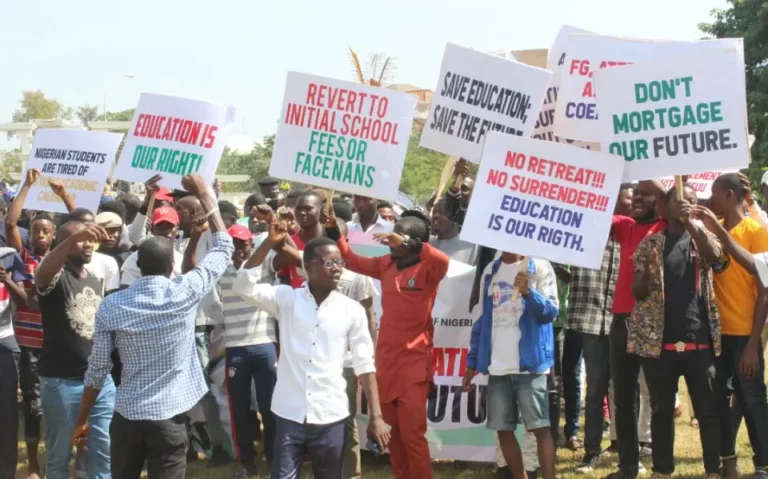
The National Association of Nigerian Students (NANS), formerly known as the National Union of Nigerian Students (NUNS), was initially set up to bring together all Nigerian Students to form a common front where issues concerning students are discussed.

The NUNS, which later transformed into NANS, was founded in 1956 after bringing together University student groups from Zaria, Nsukka and Ife.

In its earlier days, the student association was bold and helped shape the acceptance of any government in Nigeria.

The student body functioned as a pressure group that constantly pressured governments to change their political objectives, allies, and policies while also agitating against injustice in the country.

Ali Must Go Protest

The 1978 Ali Must Go” Protests was the Nigerian students’ uprising that followed an increase in fees. 


Image from the Ali Must Go Protest in 1978Credit: Yorubaness
Image from the Ali Must Go Protest in 1978
Credit: Yorubaness

Jibril Aminu, the former Secretary of the Nigerian University Commission (NUC), stated that the increase was necessary due to the “high cost of living in the country.”

The NUC said that, despite the fact that all undergraduate students will continue to receive free tuition, the cost of housing would rise to N90 per student for a session lasting 36 weeks or N30 for a session lasting three terms.

A former president of NUNS, Segun Okeowo, now late, led a nationwide student protest against this government decision.

Okeowo assembled university students from all over Nigeria in a demonstration against the military government’s perceived arbitrary increase in the price of meal tickets for students.

Ex- NUNS President, late Segun-Okeowo

After several meetings with the then Federal Commissioner for Education, Ahmadu Ali, without achieving a reversal, NUNS called out students on a national protest which was to be tagged ‘Ali Must Go.’

The widespread demonstrations created unrest among the general Public and spread beyond the schools.

The ‘Ali Must Go Protest” shook the fabric of the Nation and led to a significant challenge for the Obasanjo military administration.

In order to put an end to the rioting, the military government under Obasanjo ordered the closure of all campuses.

The protest signalled to the government the seriousness of the students to challenge any policy against them and the willingness of the students to organise subsequent demonstrations.

In addition, the “Ali Must Go Protest” helped galvanise student unionism across the Nation and created a means through which students’ voices could be heard.

The protest brought respect to the student body and provided direction for future student agitations.

Okeowo, who led the protest, was swiftly expelled from the University of Lagos; he eventually received his first degree in education from the University of Ife (now Obafemi Awolowo University) in 1980. 

Another demonstration occurred in May 1986 when some Ahmadu Bello University (ABU) students were killed by police while protesting the punishment of student leaders on a day of mourning for those who had died in the “Ali Must Go” 1978 demonstration.

Present day NANS

Recently, NANS has been accused of deviating from its original mandate and being used by selfish politicians for political gains. 

An instance is a televised promise made by the former national President of the association, Danielson Bamidele Akpan, to deliver twenty million voters among Nigerian students and youths to president Mohammed Buhari during the 2019 Presidential Election.

This made a former president of the association Abdul Mahmud renounce his membership of the students’ umbrella body over what he termed its recent ‘reckless’ activities.

Mahmud stated in a 2019 interview with the Guardian newspaper said that he thought it was inappropriate for NANS to have intervened in an ongoing strike, threatened ASUU, and been connected to President Muhammadu Buhari.

He talked about the roles played by Buhari as military President in 1984 and reminded the student union of how the administration maltreated the association.

He warned NANS not to associate with Buhari on any grounds.

“Nor does it include the visit to Buhari, the then-dictator who gave Nigerian students bullets when they asked for bread in 1984,” Mahmud said.

Mahmud said only members of the association without a historical background would associate themselves with Buhari.

Under Buhari’s watch as Head of State in 1984, the regime banned NANS, which was only four years old at the time.

At that time, the President of the student body, Lanre Arogundade, was arrested and locked up in Ife Prison. 

Towards the 2023 elections, we saw various NANS groups publicly endorsing candidates. An act that some persons say points to the fact that they are for hire.

NANS and the struggle for democracy

While speaking to The ICIR, an erstwhile National president of NANS, Yinka Dada, said NANS was relatively associated with the impactful and developmental agitation of the top leadership of the association in the 19th century.

He stated that the union collaborated with different mother associations like the Nigeria Bar Association (NBA), National Labour Congress (NLC), and Trade Union Congress (TUC) to ubiquitously express their grievances and displeasure in any national matters as they affect Nigerian masses.

Former National president of NANS, Yinka Dada
Former National President of NANS, Yinka Dada

“NANS was established by foremost Nigerian nationalists to agitate for Nigeria’s Independence, but the organisation’s strength waxed stronger after the actualisation of Nigeria Independent. It is set up to ensure every Nigerian child is educated at no cost.”

“In the late 1970s, the union staged a series of protests against the tyrannical rule of the military leaders because of the vicious policies levelled on Nigerian Students and citizens like increment in tuition fees of university students, withdrawal of students privileges and the signing of a military pact with the western allies led to the proscription of the union under the leadership of Segun Okeowo,” he said.

Also, the former leader said the union demonstrated against the structural adjustment programme (SAP) of the Ibrahim Babaginda regime because it was perceived as an imperialist-oriented programme that would take Nigeria’s economy away from its citizens.

Divide and rule/factional NANS

Since 1999 politicians have employed a divide-and-rule method against NANS, including encouraging factions in the association.

For instance, in September 2022, two factional presidents of NANS emerged.

Usman Umar of the Federal University Dutse and Umar Lawal of the Department of Library and Information Science at Bayero University, Kano, are the two candidates who emerged as the faction’s presidents.

Oladimeji Uthman, the incumbent Executive Director of Special Duties of NANS, said the issue of faction in the association is a pure distraction because a house divided against itself cannot stand.

“Factionalised leadership in NANS has made the association look irresponsible and should be stopped. Although efforts are being made by the present leadership to eradicate any factionalism in the association, yet more needs to be done.”

Dada said clashes of interest among members and the involvement of the political class regularly spike the continuous rise of factions in the once-revered association.

“What the government do is that they polarised NANS to prevent the unity of thought. Anytime you see a faction in NANS, there is somebody supporting the government while we have another group that will represent the student voices. Even as it is declining, there are still people who believe in the independence of the organisation,” Dada stressed.

Bad crop of leadership among executives

When The ICIR spoke to another former national president of the association, Tijani Usman, he stressed that the student body had been turned into a breeding ground for bad leadership because many Nigerian youths and students presently see the association as a channel to gather wealth at the expense of students interests.

“The crop of leadership produced this day by the NANS is bad. Imagine somebody contesting going to meet the President or governor for money to contest. Also, most students’ union leaders are guilty of obtaining money from the elected officials of the association by demanding money for accommodation, transportation and feeding, which indicates a sign of greediness from them.”

Snapshot of NANS members during protest
Snapshot of NANS members during a protest

“Also another case is the former national president of the association, Danielson Akpan who was impeached on allegation that he failed to disburse and utilise a sum of 200 million naira meant for the students’ community during the COVID-19 pandemic for personal purpose,” he said.

Funding is a significant gridlock in the association

Reacting to the association’s funding challenges, Dada commented that the decline in NANS started due to a lack of funding base. “If a leadership that caters for about forty million people but does not have a dime in its account, it cannot function effectively. When it was NUNS, there was funding; we didn’t solicit for support from politicians and the government for mobilisation and welfarism of the union members.”

“Imagine national presidents in Lagos and other stakeholders across the country who plan to agitate in Maiduguri without a funding based; it would be impossible to actualise his plan without seeking for external support that would have influence and reflect in our agitations.”

“IBB decree against NANS criminalise student union activities on Campuses, and that negatively influenced the self-sustainability of the union which made it lose its funding base till date,” he lamented.

He further pointed out that the participation of adults who are not youth in the activities of the body is for advisory roles, while in some situations, the older comrades take the mantle of leadership and steering its affairs.

We are not seeing NANS impact – students

A political science student at the Tai Solarin University of Education, Alabi Olarenwaju, said he is still waiting to see a positive impact from the association because they are only concerned with their pocket.

“You cannot expect people in their mid-life crisis age, especially forty and above who are married and active in conventional politics, to solicit on students’ behalf.”

He further stressed that the outrageous amount used in elections is disturbing and discouraging.

“For one to secure a post at the national level of NANS, you will spend millions of naira, and even those contesting are supported and funded by political godfathers.”

Another student Boluwatife Oluwafisayo of Ekiti State University, lamented that the impacts of NANS are not felt, and he is not benefiting from the association as an active student.

“They have not been at the forefront of the struggle for students on campuses, and I think that is one of the basic mandates they stand for. I cannot see their impact,” he said.

A student activist, Adeyeye Olorunfemi, said the government became very interested in NANS and infiltrated the student body, which crippled and destroyed it.

“Just the way other civil societies were infiltrated, the government infiltrated NANS and brought in their persons; we have PDP NANS and APC NANS. This, however, made students follow this template that has been put in place.”

“Government now sponsor agents of the government to contest in school especially the DSS and many people who are not students or people who just pick up a Diploma course or the other to contest.”

Finding a sustainable solution

To ensure that the once respected and feared body becomes more effective and active in delivering the mandate it is created for, Dada said that the amendment of the student union act is sacrosanct.

“The student union Act needs to be amended and looked upon to ensure that NANS generate funding, and this will make the union financially independent.”

Usman, on his part, believed that there is more need to enlighten and sensitise student union leaders in the country to change their perspective of the union.

 A lawyer with J. S. Okutepa, Abiola Kolawole, said the problem with NANS is simply because of the corruption in the Nigerian system. 

According to him, the association is now for hire. 

“That’s why you hardly see University students as NANS presidents. They are now old, usually in their 40’s and exposed to the corrupt system of Nigeria.”

 “The association is now for hire; any agitation brings money. Politicians now use the association for their political gains, and as we know, money is always an issue.”

 He suggested proper regulation of the association as the immediate solution.

Ondo NSCDC deploys 1,250 operatives ahead of Easter

0

THE Nigeria Security and Civil Defence Corps (NSCDC) Command in Ondo State said it has deployed 1,250 operatives to ensure smooth festivities ahead of the forthcoming Easter celebrations.

The state commandant Mr Olayinka Olatundun, said in a statement released on Friday, April 7, that the operatives would protect critical national assets and infrastructures, worship and recreational centres, shopping malls and other vulnerable places.

According to him, the operatives of the intelligence and investigation Department will mingle with members of the public, particularly at red spots to elicit useful information.

Olatundun added that its officers will be on patrol through the festival to neutralise any security threat.

“Our motorised unit will be patrolling the streets, public gatherings and motor parks to neutralise any security threat. Our marine squad will also be on high alert to secure the waterways,’’ he said.

The NSCDC boss noted that the command will collaborate with the sister security agencies to ensure safety of lives and properties throughout the festive period.

He further advised trevellers to celebrate moderately and not to forget to imbibe the virtues of Jesus Christ.

NASS to commence investigation as alleged N20bn payment to ghost consultants rattles NNPCLtd.

0

THE Nigerian National Petroleum Company Limited (NNPCLtd.) said it is ready for investigation by the National Assembly, as allegations of N20 billion payment to a ghost consultant rattles the national oil company.

The news about the allegation has already hit the media, which follows resolution by the Federal House of Representatives on April 6 to look further into the matter by constituting an ad hoc committee to that effect.

Prior to resolution by the House, the NNPCLtd. has earlier denied the allegations of payment to N20 billion to a ghost consultant in a clarification statement it officially issued on April 3, 2022.

The statement issued by the company’s official spokesperson Garba Deen Muhammad, said, “The NNPC Ltd. wishes to state that as a responsible corporate organisation, it doesn’t have or deal with ghost consultants.

“At NNPCLtd. the process of engaging consultants whenever the need arises is clear and verifiable and follow global best practices.”

Sequel to the clarification, NNPCLtd. further said it was already aware of the plan by the National Assembly to probe the allegation that it paid N20 billion to ghost consultants.

In a separate statement obtained by The ICIR, the national oil company maintained that it “received with great relief, the resolution of the House of Representatives to investigate allegation of the payment of a huge sum of twenty billion naira to so-called “ghost consultants”.

Garba Deen Muhammad, its spokesperson, noted that the company had earlier refuted the allegation that was first published by an online platform, stressing that, “it was without any iota of evidence”.

“Under the current Board and Management, NNPCLtd. has instituted a culture of transparency that includes making its annual Audited Financial Statements (AFS) public.

“It is in this light that the NNPCLtd. welcomes the resolution of the House of Representatives to investigate this very outrageous allegation,” the spokesman said.

The company expressed confidence that the outcome of any investigation into the allegation will vindicate it, and put an end to all speculations concerning the matter.

Foreign minister dismisses suspension reports

THE Minister of Foreign Affairs, Geoffrey Onyeama, has dismissed reports of his suspension from the All Progressives Congress (APC).

Onyeama was reportedly suspended by the Enugu State chapter of the party over alleged anti-party activities.

The ICIR reported that the Enugu State APC had, while announcing the suspension of the foreign minister, also expelled a former governor of the state, Sullivan Chime, the Director-General of the Voice of Nigeria (VON), Osita Okechukwu, and others over alleged anti-party activities.

The state chapter of APC had said the action taken was in line with recommendations stated in a disciplinary committee report.

The party said the minister and the others supported candidates of other political parties during the general elections.

Reacting to the development through the spokesperson for the Ministry of Foreign Affairs, Francisca Omayuli, the minister described reports of his suspension as ‘mischievous’.

He urged the public to disregard the allegation.

“The attention of the Ministry of Foreign Affairs has been drawn to a story circulating on social media that the Honourable Minister of Foreign Affairs, H.E. Geoffrey Onyeama, has been suspended by his party, the All Progressives Congress because, as alleged, ‘he was sent to the United States to blackmail Peter Obi, and he declined the request’.

“The Honourable Minister of Foreign Affairs states there is no truth to the mischievous allegations.

“The general public is, therefore, called upon to disregard the story,” the statement read.

Bandits strike again in Zamfara, abduct 80 children

0

At least, 80 children were reportedly abducted by bandits in Tsafe Local Government Area, Zamfara State on Friday, April 7.

According to BBC Hausa, some of the children, who are between the ages of 12 and 17, were kidnapped in the bush.

The children, according to the parents who spoke with BBC Hausa, were reportedly fetching firewood at about 8:00 a.m. when the assailants rounded them up and marched them away into the forest.

The abductors, however, are yet to reach the parents to make any demands as of the time BBC reported the kidnap.

This is not the first case of abduction and kidnapping in Zamfara, as bandits incessantly rampaged several communities in the state.

In 2019, armed bandits attacked the Government Girls Secondary School, Moriki, in Zurü local government area of Zamfara State, kidnapping several students and teachers.

This attack was the second when hoodlums would be attacking a secondary school and abducting students in President Muhammadu Buhari’s first term in office, in spite of the administration’s claim of having improved security across the country, according to the report.

The first was in February 2018 when 110 school girls were abducted by Boko Haram from their school dormitory in Dapchi, Yobe State. Some of the girls, numbering 104, were released a month later following negotiations between the government and Boko Haram.

However, five died in custody while one, Leah Sharibu, is still being held because she refused to convert to Islam.

There were many other cases of bandits’ attacks in the state that have claimed several lives. Despite the security operatives repelling some of the attacks, the terrorists have managed to record many feats in the state.

For instance, in February 2022, the terrorist group attacked Tsafe LGA of the state, killing 17 civilians.

Also, Aljazeera reported that an estimated 200 people were killed and 10,000 displaced in attacks by armed bandits in the northwestern Nigerian state of Zamfara following military air raids on their hideouts in January 2022.

BBC also reported in November 2022 that 130 people were kidnapped by gunmen in Zamfara, a local official.

According to the report, the state information commissioner Ibrahim Dosara, disclosed to the British media that Gunmen on motorcycles raided two areas and abducted women, children and the elderly.

Recently, On March 4, 2023, The ICIR reported how the Divisional Police Officer (DPO) of a division in the Maru Local Government Area of Zamfara State Kazeem Raheem, a sergeant and one vigilante were killed by bandits during an attack at the headquarters of the local government area.

It was gathered that on receiving news of the attack, the DPO, Kazeem Raheem, mobilised his men and some local vigilantes to protect the residents against the bandits

The DPO, a sergeant identified as Rabiu Bagobiri and a vigilante identified as Shehu Chuka, were killed during the counter-offensive.

Reps ask NDDC to halt release of N15bn to FG

THE House of Representatives has asked the Niger Delta Development Commission (NDDC) not to release the sum of 15 billion earmarked as counterpart funding to the Federal Government.

The Federal Government had requested the sum for a humanitarian intervention programme, but the House of Representatives has placed the release of the fund on hold.

The lawmakers asked the committee on NDDC to review the request and report back to the house within two weeks.


Read Also:

The House of reps passed the resolution at Thursday’s plenary.

This was after adopting a motion of urgent public importance sponsored by Unyime Idem, a Peoples Democratic Party (PDP) lawmaker from Akwa Ibom.

Unyoke said the government had requested the funds from the ministry without the parliament’s approval.

The lawmaker said the money that is to be released is recovered by the EFCC without budgetary provision.
He noted that the NDDC budget estimates for 2021, 2022 and 2023 were before the House for legislative approval.

Unyoke described the move as illegal and a breach of the Appropriation Act.

“Part of the fund available for use by the Commission is money recovered on its behalf by the EFCC and given to the Commission to ease the implementation and its financial obligations.

“The Federal Government sent a special request mandating the Ministry of Niger Delta to jointly finance an intervention and humanitarian programme of sums running into several billions of naira using the money recovered by the EFCC without budgetary provision,” he said.

Investors lose N674bn as interim govt rumour hits stocks

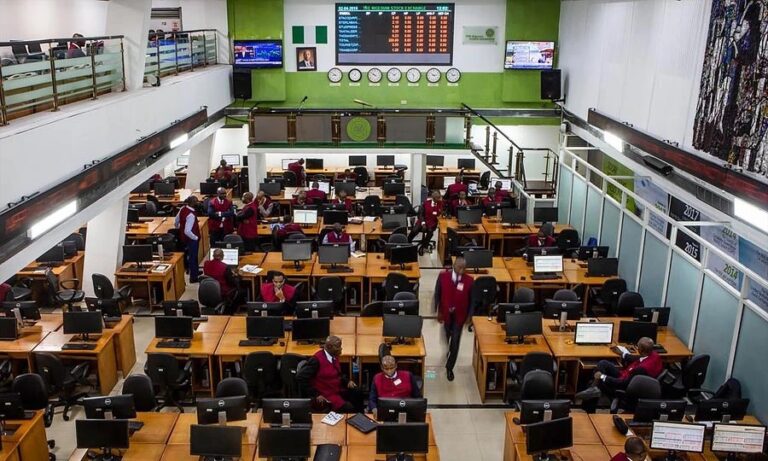
THE overall market value of stocks traded at the floor of the Nigerian Exchange Limited (NGX) fell by N674.53 billion this week, as concerns over installing an interim government triggered investment sentiments in the capital market.

Market capitalisation, the market’s total market value dropped to N28.87 trillion on Thursday, April 6, from N29.54 trillion that the market opened with on Monday, April 3.

The Department of State Services (DSS) had on Wednesday, March 29, disclosed it had uncovered a plot by some political actors to install an interim government in the country, raising dust in the political and economic space.


READ ALSO:
Investors lose over N601bn as SEC pledges to protect market confidence

Investors lose over N856bn in March as market cap falls below N30trn mark

Gain in 16 stocks fail to lift Exchange as investors lose N137bn

NGX: Investors lose N621bn to open week’s trading


The ICIR had reported that the Nigerian stock market lost N856.97 billion in the month of March.

Sharing his thoughts on what further drove the market to record a four-day straight decline in the first week of the new month, the national chairman of the Progressive Shareholders Association of Nigeria (PSAN), Boniface Okezie, told The ICIR that the uncertainty in the political space might be a deciding factor in the capital market.

According to Okezie, the Nigerian economy is still in the woods and election matters are yet to be settled by the court.

He believed that expediting action on the cases would help in bringing relief to investors.

“Let’s know the direction the economy will be moving that will give us the direction the market will head for now. The coast is not clear because the outgoing government is just standing still even when their presence has not even helped the market,” Okezie said.

He also identified insecurity as still prevalent, though it appeared it was dropping before the general elections.

“After the election we have begun to see pockets of killing here and there, and in the north,” Okezie added.

Investors are expected to trade cautiously as insecurity and political activities continue to headline Nigeria’s macro economy, analysts at Cowry Asset Management stated in their weekly market report.

“We continue to advise investors to trade on companies’ stocks with sound fundamentals and a positive outlook,” the analysts said, adding that in the week to come, they expected the “current trend of mixed sentiments to linger as the market seeks for a major catalyst that could trigger positive sentiments.”

The socio-political tension emanating from the recently-held general elections recently held is taking its toll on investors’ confidence, the chief executive officer, Highcap Securities Limited, David Adonri, told The ICIR.

“The cumulative effect of all these is that migration of financial assets from equities to the safety of debt in this quarter may be inevitable,” Adonri posited.

He noted, however, that the stock market might also be reacting to rising inflation, hike in interest rate and low capital inflow.

“Investors are also gearing up for the anticipated negative impact of the currency confiscation exercise on fundamentals of companies when Q1 (first quarter) results start hitting the market this month,” he said.

Abel Ezekiel, an investment and portfolio analyst, reminded that the rumour about an interim government remained a rumour.

Ezekiel said, “Are we now saying that President Muhammadu Buhari will install an interim government when he is to hand over to a president-elect from his party? On what basis?”

Arguing that some analysts were just making a statement outside the reality on ground, he said, “What is happening is far different from what happened in 1993 when Nigeria was forced into an interim government.

“The drop in the market value this week was as a result of the drop in the share price of Airtel Africa.

“What we saw this week is a corrective step, a kind of investors’ strategy to take dividends, and not because of the colour of the rumour of an interim government.”

Meanwhile, the local stock traded for four days as the federal government declared Friday, April 7 and April 10 public holidays to mark the Easter celebration.

Movement of stocks showed that the NGX All-Share Index depreciated by 2.28 per cent to close the week at 52,994.13 basis points (bps), leaving the year-to-date return to decline to 3.40 per cent from 7.04 per cent last week.

This caused the stock market to drop further in value as investors also reacted to the publications of economic data and dividend announcement by companies.

Part of what also played out in the market was that investors have begun to reposition ahead of the first quarter earnings season based on the current price levels that have been perceived to be an attractive point of entry.

However, the stock market trended downward as a result of sell-pressure in some of the mid and large capitalised stocks.

Across the sectors, performance was largely negative, except for the insurance sector which gained 2.19 per cent to close at 181.40bps, while all other sub-sector indices dropped in volume.

The industrial index led the pack, dropping by 3.65 per cent to close at 2,455.43bps; banking index saw a 1.05 per cent loss to 448.23bps; consumer goods index declined by 0.62 per cent to 698.37bps; and oil and gas index fell by 0.11 per cent to 510.25bps.

The share price of Airtel Africa, the most capitalised stock on the Exchange, dropped by 10 per cent to close at N1,331.10 from N1,479.00 it opened on April 3.

In the review week, a total turnover of 1.054 billion shares worth N10.05 billion in 16,155 deals was traded by investors, in contrast to a total of 2.071 billion shares valued at N17.562 billion that exchanged hands last week in 17,917 deals.

While 37 stocks depreciated in price higher than 30 in the previous week, 16 stocks appreciated in price during the week lower than 37 stocks in the previous week.

Jos DisCo interfaces with Mainstream Energy to facilitate power procurement agreements

In an effort towards repositioning Jos Electricity Distribution Plc (JED) for efficiency, its managing director, Abdu Bello Mohammed, paid a courtesy visit on April 6 to the management of Mainstream Energy in Abuja with the aim of procuring power from the company.

Mohammed said during the visit that JED Plc under his leadership would continuosly strive to deliver qualitative and reliable electricity supply to its franchise states of Bauchi, Benue, Gombe, and Plateau.

Mohammed, in a statement issued today by JED’s head of Corporate Communications, Friday Adakole Elijah, explained that the visit was centred on effective collaboration between the two companies, and emphasised the need to concretise arrangements on power procurement from a very credible and solid enterprise in order to deliver power to its franchise areas.

He assured that JED Plc would deliver efficient services in energy distribution as a result of huge investments by the new owner.


READ ALSO:


In his words, “The visit to the headquarters of Mainstream Energy was to initiate discussions on bilateral power procurement and other investment-related issues.”

Mohammed explained that the visit was consequent upon the directive by the regulator that all the Discos in the country should commence engagement with the power generation companies for bilateral power procurement, stressing, “We are here in line with this directive.“

The managing director of Mainstream Energy, Lamu Audu, responded that he was eagerly looking forward to the actualization of the bilateral discussion, and underlined his cmompany’s readiness to assist JED Plc achieve its set goals.

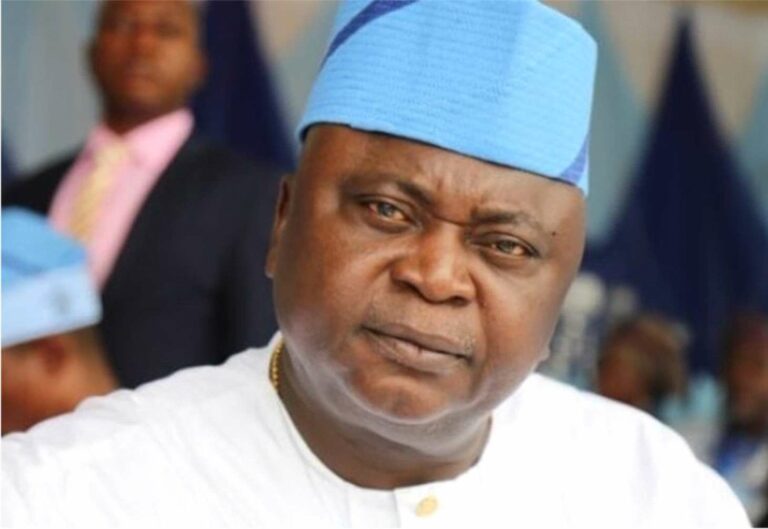
Ogun guber poll: Adebutu files petition against Abiodun’s victory

THE governorship candidate of the Peoples Democratic Party (PDP) in Ogun State, Ladi Adebutu, has filed a petition challenging the victory of the incumbent governor, Dapo Abiodun of the All Progressives Congress (APC).

Adetutu filed a petition before the Election Petition Tribunal alleging manipulation of results in the state election.


READ ALSO:

PDP reverses suspension of Anyim, Fayose, others

Benue Governor-elect warns agency against financial transactions with Ortom, PDP fumes

PDP crisis: NWC names Damagum acting chairman

PDP crisis: Court stops Ayu from parading as chairman


Adetutu and his legal team led by Gordy Uche, SAN, as well as party chieftains, visited the tribunal secretariat at Isabo Magistrate court premises in Abeokuta to submit voluminous copies of the petition.

The Independent National Electoral Commission (INEC) had declared Abiodun as the winner of the March 18 governorship election.

Abiodun pulled 276,298 votes to defeat Adetutu, who scored 262,383.

Speaking with reporters on his petition, Adebutu said his mandate was stolen.

The PDP candidate said he filed his petition on “four solid grounds”, noting that he hopes the tribunal will do its best.

“We have up to four solid grounds, but it will be sweeter when our opponent tells you the grounds.

“Our prayers are just that the right thing is done and the man who won is given the mantle of the office.

“And in the alternative, the petitioner prayed for an order of the Tribunal “directing 1st Respondent to conduct fresh election in the 99 polling units which cut across 41 wards and 16 Local Government Areas of Ogun State where elections were either not held and cancelled due to disruption and over-voting.”

In his petition, Adetutu asked that the tribunal declare Abiodun unqualified and disqualify him as a candidate for the governorship election.

He also asked to be declared the winner of the election as the candidate who has the highest number of valid votes and has satisfied the requirements of the constitution.

The reliefs sought by Adetutu include: “An order of this Honourable Tribunal setting aside the Certificate of Return dated 20th day of March 2023 wrongly issued to the 2nd Respondent by the 1st respondent.

“An order directing the 1st Respondent to immediately Issue a Certificate of Return to the 1st petitioner as the duly elected Governor of Ogun State.

“In the alternative: an order of this Honourable Tribunal directing 1st Respondent to conduct fresh election in the 99 polling units which cut across 41 wards and 16 Local Government Areas of Ogun State where elections were either not held or cancelled due to disruption and over-voting.

“An order of this Honourable Tribunal directing the 1st Respondent to conduct a fresh election for the office of Governor of Ogun State to the exclusion of the 2nd and 3rd Respondents.”