Home Blog Page 1587

Torture, modern slavery of Almajiri children in northern Nigeria

1

By Elijah AKOJI

As part of the International Center for Investigative Reporting, ICIR‘s reporting on Human Rights, across some northern states, this report looks at the increasing incidence of child abuses, molestation of children and the wrong practice of the Almajiri school system across Kano, Kaduna and Jigawa states.


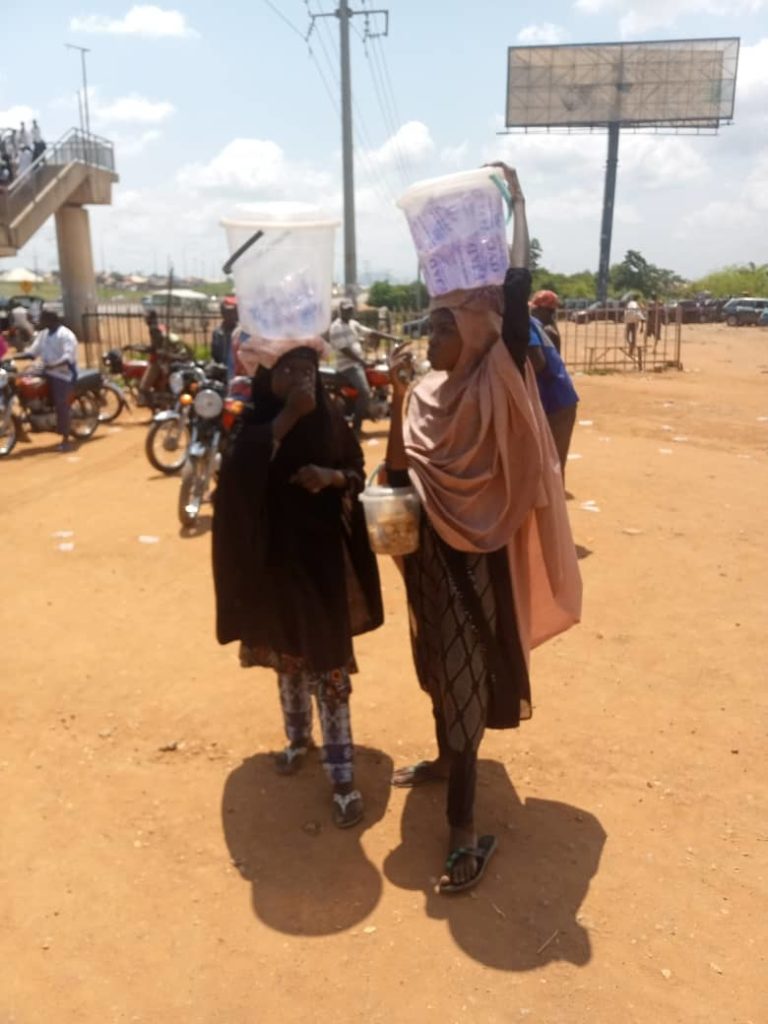
MOST cities and seminaries in northern Nigeria are populated by itinerant pupils in Qur’anic schools known as Almajirai. The image of shabby-looking street children, primarily young boys between the ages of three and12, have become a blight on the Nigerian nation.

The brood roams the street clutching plastic bowls as they beg for alms from one stranger to another.

In the evenings, they return to their masters (Mallam) to remit what was made for the day and rest to continue the same routine the next day. These are Nigerian children, popularly known as Almajiri.


KEEP READING:

We will not accept the ban on Almajiri by northern governors- Dahiru Bauchi

REVEALED: Shekau, Boko Haram’s leader, left home as an almajiri and never returned

REPORT: Abuja Almajiri school where toilets outnumber classrooms ― and they aren’t even functional


The uncertainty of street life has predisposed the Almajirai to delinquency for self-survival. In the urban spaces, the Almajirai mixed up with several youth demographic cohorts and delinquents such as the Yan-cirani (seasonal migrant youth), Yan Banga (criminal gangs), and Yan daba (violent youth delinquents). Some of them have resorted to theft and other crimes due to poverty.
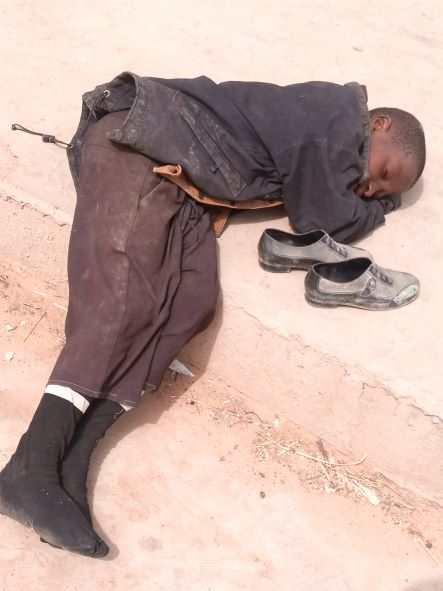
Shettim Ahmed Almajiri Student Under Mallam Idris in Kano State

Shettim Ahmed, an orphan from Katsina State, was brought to Kano by his mother at the age of 7, and since then, he has not gone back to see her. He has remained on the street of Kano, begging to survive.

“I only know my mother, who is too poor to take care of me. I want to grow up studying the Holy Quran, attend a formal school and become successful. Ahmed hopes to go back to school and own a farm in the future.

“I see myself owning big businesses and providing help to younger ones in my community back in Katsina State to help discourage their involvement in crimes,” he said.

Filled with so many painful experiences, Ahmed, who is now 12 years old, has yet to interact with formal education. Instead, he is left to beg on the streets of Kano and make remittances to his teacher (Mallam) Idris at Makaranta Islamiyyan Dakata in Kano State.

“We are more than 30 in number under Mallam Idris. We would wake up as early as 5 a.m. and immediately after our prayers,  pick up our plates and begin to beg. We knock door to door and return by 6 p.m. After that, we submit everything to Umaru, the most senior. He then proceeds to remit it to Mallam Idris,” Ahmed said.

That is not all. Ahmed and other students of Mallam Idris Islamic schools are known objects of modern slavery. They are used as sexual slaves and asked to work for people under Mallam Idris’s instruction without getting paid and missing their primary purpose.
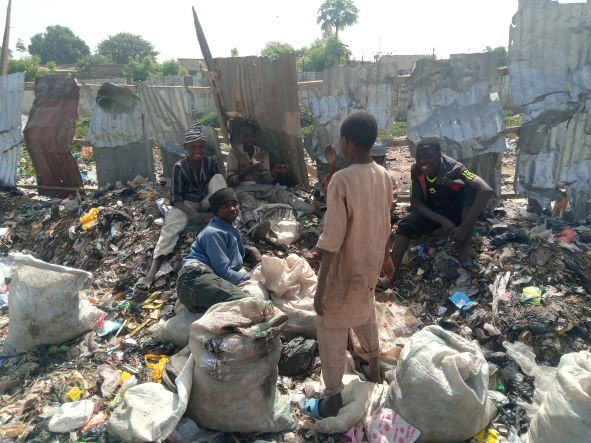
Some of the Almajiri studets under Mallam Idris picking plastics in refuge close to their Islamic School in Kano
Some of the Almajiri students under Mallam Idris picking plastics in refuge close to their Islamic School in Kano

“There is this woman staying at Bukavu Army barracks. I have always gone there to work for her under Mallam Idris instructions. She asks me to come every day, but whenever I go there to help her do her laundry, she used to ask me to touch her breast and also touch her private part, she used to give me food and then give me money to give to Mallam Idris, I have never seen her husband, but I believe he is not around in town,” Ahmed added.

Too scared to reveal some of the maltreatment they face as Almajiri students under Mallam Idris for fear of being tortured, Ahmed’s colleague, Ibrahim Allkasim, narrates how some are used as labourers on a farm downtown.

“We are often made to work on farmlands owned by influential people. They would have made payments to Mallam Idris. We are also instructed to do house chores for some women. This was how I first saw a woman’s nakedness. There was this woman that has the habit of walking around naked whenever I am around,” Allkasim said.
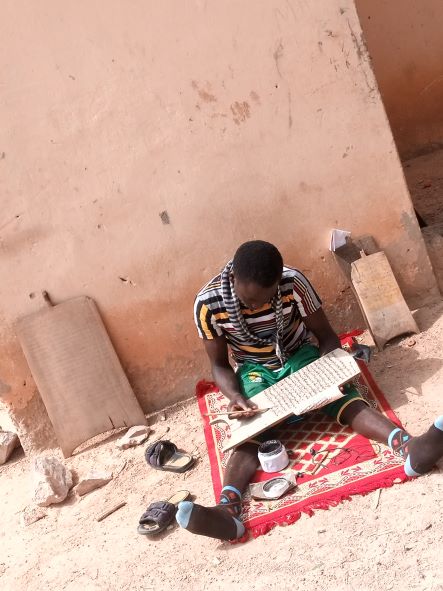
Student of Mallam Idris Islamiyya in Kano State

A teen, Allkasim, who does not know his age, hopes for a lifestyle change but doesn’t know when it will come.

“One sad event was when we lost three of our colleagues due to the food they ate. This was the food someone gave them when they went begging, and when they returned, they started vomiting blood. They later died because Mallam did not take them to the hospital. They were buried, and since he is a Mallam, no one questioned him, and the families of these boys were never contacted,” he added.

Child sexual abuse is an activity that a child does not fully understand and cannot give informed consent to. The child is unprepared and cannot yield consent or violate society’s laws or social norms.  The abuse occurs between an adult and a child, between a child and an older adolescent or relations; it can happen between trusted, known or unknown or relations.  The abuse may occur serially or once, and in most cases, the abuse remained undisclosed because of fear. When it is disclosed,  it  happened  as  a  process,  not  as  an  event (Lipppert et al.,  2009; Priebe, 2009; International Rescue Committee,  2012;  Cashmore  and  Shackel,  2013; Townsend  and  Rheingold,  2013;  WHO,  2015;  Greijer, 2016 )

When The ICIR contacted mallam Idris, he refused to respond to questions but commented on his local language.

“Duka yaran na, kowa lafiya sa da ba su da lafiya ko ba na kula da su, da gomneti ta ne me ni, shi ne abu da zan iya giya maka” which means “All the children under him are doing very well that if they are not doing well, the government would have come after me, that is all I can tell you,” Idris said.

Danlami Rimin Gado, secretary of the Almajiri Evacuation committee in Kano under the Ministry of Local government and the deputy director of school monitoring and evaluation department of local government, ministry of local government, Kano state explained the government’s plan to fetch out the bad Islamic teachers in the system.

“We have received several alerts of Almajiri children being used as slaves and often or regularly molested by some of their teachers this is not Islamic and will not have a place here, thank you for bringing this to the notice of the authority, we will conduct a proper investigation and make sure all these evil teachers are punished, and these children are given a good life,” Danlami said.

While parents may believe they are fulfilling their obligation to provide religious and moral education to their children and provide the learning free of charge, Almajiri children are often forced by their teachers (Mallams) to carry out undignified work and beg on the streets to fund their education.
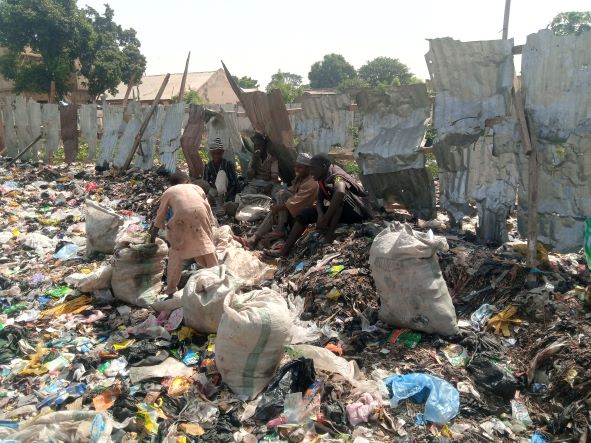
Almajiri

Disadvantaged and often lacking in decent upbringing, Almajiri children are compensations for overstretched family resources while hiding under the guise of sending them to an Islamic school to be with a teacher.

Regrettably, the Almajiri culture has since outlived its purpose and has become a breeding ground for child begging and, in extreme cases, potential materials for recruitment into terrorist groups. The pupils who were meant to be trained to become Islamic scholars now struggle to cater for themselves.


Kaduna Secret Almajiri School            

Despite the ban of Almajiri schools across Kaduna State under the present administration, Mallam Suleiman Gambo still runs a secret Islamic school attended by Muhammad Balarabe and many other young boys.

Balarebe, who could not tell exactly when he left Zamfara state for Kaduna, is one of the students of Mallam Gambo who run the secret Islamiyya at Rigasa.

Balarebe was sighted around Dadin Kowa plaza in Rigasa, begging with four other young boys between 10 and 12.
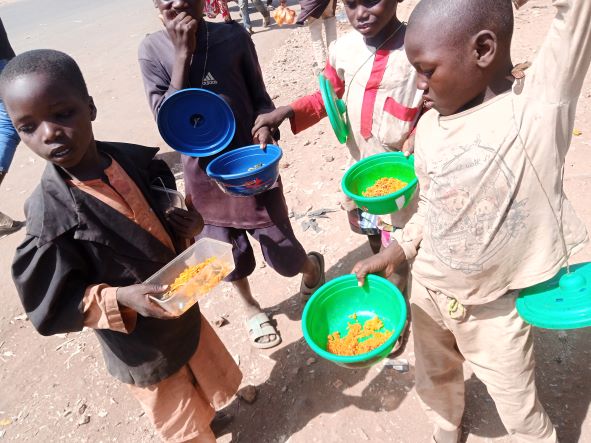
Studet of Mallam Gambo ISlamic School in KAduna State
Studet of Mallam Gambo ISlamic School in Kaduna State

Balarebe, whose hands were filled with injuries, narrates to The ICIR how Mallam Gambo maltreats them and subjects them to torture when they do not meet his target or bring substantial remittances.

“We used to walk from Rigasa to Kawo, a distance of about six kilometres. Going to these communities between Rigasa and Kawo helps us achieve our daily target of at least N500. So some of us go to Kawo Park, and we help people to carry their load, and they pay us.”

Balarebe said Mallam Gambo had warned them sternly not to disclose his name or the school’s location.

Findings by The ICIR showed that the school operated by Mallam Gambo is located in Kunchi line, in Rigasa. When the reporter asked one of the random young boys sitting at the school entrance about Mallam Gambo, the kids quickly gave a chorus response denying knowledge of the school.

Binta Ibrahim works for the state government as the Director, Public School Reform under the education ministry. When contacted, she lamented the state’s resistance to the Almajiri reform plan by a section of the citizenry, adding that she is not aware of any secret Almajiri schools.

“The Almajiri practice is still cherished by the Muslim community. According to current realities, the system has been subjected to abuse and needs to be reformed. We plan to develop a training and retraining framework for all Almajiri teachers in the state. This is expected to develop the appropriate scale to be used in placing and integrating the teachers into the formal education system,” Binta added.

“You know there will always be rebels to policies among any groups, and the issues of religion require sensitivity. We will make sure all Islamic teachers comply using all measures to stop the modern slavery, molestation, and abuse children are subjected to all in the name of Islamic education,” She added.


Like Jigawa, like Kano

Kazaure Local Government Area (LGA) in Jigawa state is increasingly becoming a hub for Almajiri children due to the problems of banditry in Katsina and Boko Haram in some parts of the Niger Republic. Children who fled troubled locations have made Kazaure home.

Kazaure LGA borders Kano, Katsina, and the Niger Republic; this geographical proximity, ease of access, and transportation have become one of the primary reasons for the influx of Almajiri children into Kazaure to sort for safety.
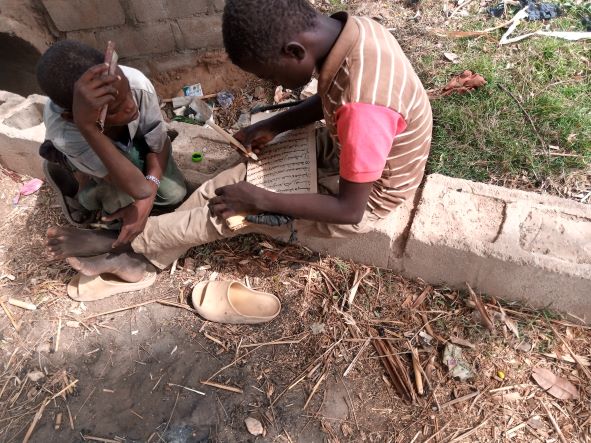
Saminu Danlami Almajiri Students Under Mallam Kasim

In search of safety and a good life, Saminu Danlami, originally from Dandume LGA, in Katsina State, has been on the street of Kazaure in Jigawa State for over two years under the guidance of Mallam Kasim, an Islamic teacher.

Danlami works every morning as a labourer on the farms owned by Mallam Kasim or his associates. After that, he goes begging in the evening. He narrated his ordeal since he left home three years ago.

“Suffering is already part of other students in Mallam Kasim Islamiyya and me. If we must eat, we must work hard on the farm and also hope for a good day from begging. I can’t remember having a good bath with soap because I can’t afford one,” he said.

“We took ourselves there to be under Mallam Salisu. This is because we needed somewhere to shelter. We have the liberty to run, but we always ask ourselves to run to where? Wherever we go, it will still be the same life. Some of the boys left for Kano before the big Sallah this year, and we have not heard from them since they left.  I hope they are doing better there; for us here, and it’s a life we have to endure until hope comes.”

The bitter life experience of Danlami and other Almajiri students under Mallam Kasim Islamiyya is just a consequence of conflict which has pushed them into a life of suffering.
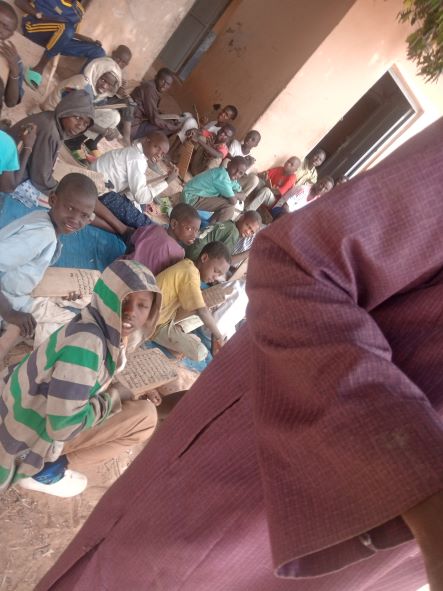
Mallam Salisu and his Almajiri Student in Kazaure

“This will be so disheartening to say, but most of us at Mallam Salisu School have been sexually assaulted, and more will still be abused since we all stay with him. A lot of them won’t be able to talk because they are scared, and even me talking to you, I hope he won’t know I am the one who told you all of this,” Danlamwon’tented.

Disturbed by how most of the boys were running from Mallam Salisu prefer won’t to Kano, Jaffar Alkasim, a 21-year-old Almajiri student under Mallam Salisu, narrate to The ICIR during it the second visit how some of these boys who Mallam Salisu has sexually abused were already practising the same thing within themselves.

“One of the boys Muhammed who left some months ago told me Mallam used to ask them to suck his penis mostly at night when they return from looking for food, while sometimes he used to ask them to call some small girls for him who hawk around the vicinity into his room, he gives them serious warning that scares them from telling anyone, some of  these boys already practising it within themselves as they use to suck themselves to experience what Mallam Salisu use to feel, he told me this when I caught them, and as their senior, I threatened to punish them and also report to Mallam Salisu, that was how some of them ran away after Muhammed shared this with me.”

Jaffar, using the local language, said, “ba na so ya san ni ne na giya maka wanan, kuma kar ka sa suna na a labrin ka, zan kai ka wurin sa yansu,” which mean, Mallam Salisu must not find out I told you all of this and my name should not be mentioned to him,” he advised.

Approaching Mallam Salisu, an innocent-looking man sitting on his mat with his legs wrapped over each other with so many Islamic slates lying on the wall close to where he sat.
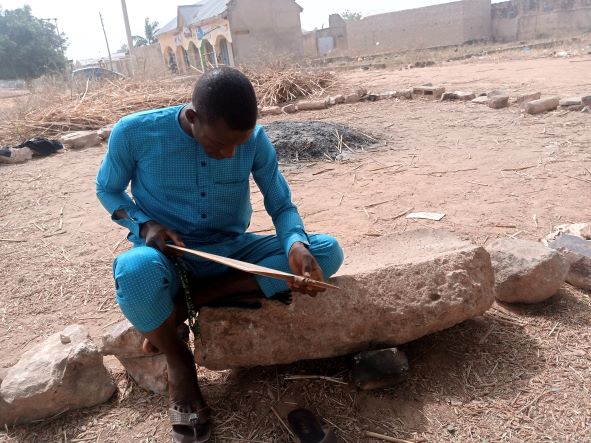
Jafar Alkasim a 21 year old Almajiri student under Mallam Kasim i Kazaure
Jafar Alkasim a 21-year-old Almajiri student under Mallam Kasim I Kazaure

Like Mallam Idris, Mallam Salisu also refused to respond to questions despite all strategies applied to make him talk.

“This is an Islamic school, and we are guided by Islamic teachings in all we do. If you have come to question our Islamic teachings and practice, I will advise you to leave now; I don’t have anything else to say to you,” he said.

Unlike Kano and Kaduna state, the Jigawa state government has not enacted laws to regulate, control and combat the wrong practice of the Almajiri system in Jigawa state, so some of these Mallam’s just like Mallam Salisu, still enjoy the evil practice they tag as an Islamic practice.

Special Adviser to the Jigawa state governor on Religious Affairs, Mallam Mujitafa Sale Kwalam, when contacted, explained to The ICIR how some of this Mallam hides under the teaching of Islam to mislead vulnerable children.

“The wrong practice of the Almajiri system is one which most government across the north is currently battling with, no we have read on the papers how a lot of these children are being abused while others are used as slaves this is not the teaching of Allah,”

“There will always be people with bad intentions in every society, and the best thing to always do when notified just as you have done, is to deploy take immediate action, people like that must not be allowed to call themselves teachers not to talk of Islamic teachers, our religion is sacred and does not condone the evil practice, we will visit this place I assure you,” Kwalam said.


What does the law say?

The National Human Rights Commission notes that the primary purpose of government is the security and welfare of its citizens in line with Section 14(2) (b) of the Constitution of the Federal Republic of Nigeria 1999.

Conscious of its mandate to monitor, promote, protect and enforce human rights of everyone in Nigeria in line with the national, regional, and international human rights instruments to which Nigeria is a party, the Commission has always spoken against the inhuman conditions children are subjected to under any guise.

Nigeria has ratified and is a party to the Convention on the Rights of the Child (CRC), African Charter on the Rights and Welfare of the Child (ACRWC) and the African Charter on Human and Peoples’ Rights which has been domesticated as Child’s Rights Act (CRA) 2003.

The CRA is a comprehensive human rights instrument that seeks to protect the rights of children in Nigeria and to put in place policies and programs for the development and survival of every child in Nigeria.

The provisions of the CRA are crucial to securing the human rights of Almajiri children. Implementing these rights should be at the heart of any intervention targeting the social and economic welfare of the Almajiri children. Section 4 of CRA specifically emphasized that every child shall have a right to survival, development, and education. Section 9 provides for freedom of child movement subject to parental control, not harmful to the child.

Other sections provide for rights to private and family life, freedom of movement, freedom from discrimination, the dignity of the child, health and health services, free, compulsory and universal primary education, amongst others.

The vulnerable nature of children has become a burden in the face of an ideological war, more so when they are poorly catered for and lack access to essential services. The proliferation of street children across Nigeria is one that deserves serious policy action.

For instance, in 2010, a total of 157 Tsangaya/Almajiri schools were built across the country by the administration of ex-president Goodluck Jonathan. The effort was part of the National Framework for the Development and Integration of Almajiri Education into Universal Basic Education. The project did not receive local support primarily because of its mixture of secular and Islamic values.

Ineffective Almajiri Reforms

Policy measures to modernize and reform the Almajiri system have been rebuffed. In 2001, UNICEF underscored the need for individual northern states to eliminate the Almajiri phenomenon. Different educational reforms have been carried out by successive state and federal governments but it has been met with stiff opposition by the Ulamas and several influential northerners because of its blend of secular and Islamic curricula. Ulamas are a group of religious leaders with vast knowledge in Islamic doctrine and law. Also, most parents see the hardships associated with the Almajirai as necessary for Islamic learning.

Similarly, efforts by the current Kano state administration to reform the Almajiri system has been opposed by the Council of Ulama. Between late 2019 and early 2020, the Kano State government banned street begging, employed an additional 7,500 teachers, and offered free and compulsory education for all Almajirai across the state.

In June 2019, the National Security Adviser, Babagana Monguno, said the Almajiri system was a breeding ground for insecurity. Yet, the Almajiri population is growing rapidly in northern Nigeria.

Puzzlingly, Nigeria seems confused mainly on addressing the problem despite the 2003 Children’s Rights Act. A 2017 survey in Kano State estimated 3 million out-of-school children in the State. According to estimates of the United Nations, Nigeria is home to about 8.7 million to 10.5 million out of school children.

Ulamas Speaks

Dr. Abubakar Kawu Hassan, one of the 2020 National Almajirci conveners organized in Kaduna state, has disclosed the current position of clerics and Ulamas on the issue. While kicking against the move by the state government to abolish the Almajiri education system, Hassan said practitioners had shown readiness for a good reform to integrate both formal education and the Almajiri system.

“There are proper ways to achieving such a goal. Issues of religion are sensitive to people as this is what they inherit. So, abolishing what the people believe in requires patience,” he said.

Sheikh Sulaiman Bello, a cleric, told The ICIR in an interview that, “This is not a good omen as most of these children have nothing doing apart from obtaining Islamic education. Abolishing most of these Isllamiyyas will also tell on the system, but establishing a system that will incorporate them into a formal education setting will help the system come out of so many evils already befalling the system,” Suleiman said.

“There has been so much horrible news about some Islamic teachers called (Mallams) and how they used to take advantage of these boys, abuse, molest and also use them as slaves. This is totally un-Islamic, it is evil and demonic. Anyone caught in such practice must be punished according to the law.”

Child rights activists, experts reveals possible treats

Many Nigerians have called for the abolition of the Almajiri system, saying it has become a breeding ground for insurgents and religious extremists.

Mr. Fred Amakolo, is the media officer of civil society organizations (CSOs) and activists under the aegis of Human Rights Agenda Network (HRAN). He explained the possible threats the society is exposed to with the abuse and maltreatment of Almajiri children and the wrong practice of the Almajiri school system in some parts of northern Nigeria.

“Seeing a child been abused should bother anyone with a conscience. Some of these children are innocent. They want to learn Islamic teachings and find food to survive. Let us put things in the right context, most Almajiri children are products of a failed system. Assume all things are rightly done, their parent provides food, and even pay their school fees. Do you think these children will roam the street begging? They won’t,” Amakolo said.

“The government can abolish the almajiri system, but until the real problem is addressed, we will still be moving in a circle without a solution. When you ask most of these kids begging on the street, I am confident to tell you, they all want a good life, they all admire and desire to be like me and you, wearing nice clothes and looking all fresh, but their situations and financial incapacitation condition them,” he added.


Court voids APC’s participation in Anambra poll

An Abuja Federal High Court has voided the participation of the All Progressives Congress (APC) in the gubernatorial poll conducted in Anambra State last month.

In its ruling on Monday, Justice Inyang Ekwo said the party’s primary that produced Uba, the APC’s candidate, did not meet the requirements set by the nation’s electoral umpire, the Independent National Electoral Commission (INEC).

The court ruled that the primary failed to comply with the party’s constitution and guidelines.

According to the court, the plaintiff, George Moghalu, proved that the APC failed to conduct a valid primary to which Uba laid a claim.

Justice Ekwo ordered INEC to remove Uba, a former senator, from its record as the APC candidate for the poll.

The judge also ordered the APC to refund the plaintiff the money he used to obtain interest and nomination forms for the election.

The APGA won the election with 112,229 votes, almost tripling the votes garnered by the APC. The APC had 43,285 votes, and the PDP, which came second in the election, got 53,807 votes.

While the PDP and the Young Progressives Party (YPP) won one local government apiece out of the 21 local government areas in the state during the poll, the APC won none.

APGA has been in power in the state since 2007.

President Muhammadu Buhari congratulated Soludo and APGA shortly after INEC declared Soludo, a former governor of the Central Bank, winner.

But Uba rejected the election result and vowed to head for the court to protest alleged irregularities in the poll.

Monday’s court ruling further compounds the crises faced by Uba.

In June this year, about 20 staff of Heritage Bank protested in his house because of his alleged failure to pay the money he owed the bank. Officials of the bank reportedly said the debt was at least N10 billion.

The ruling may also further sink the APC into a deeper crisis, following a leadership crisis that has engulfed the ruling party in recent months.

Monday’s judgement followed a similar ruling in Zamfara, where the Supreme Court sacked all elected candidates of the APC in Zamfara State, including the governor-elect in 2019.

The ruling brought the current governor of the state, Bello Matawalle, into office and most of the state’s House of Assembly members.

They belonged to the opposition PDP, though they have joined the governor to defect to the APC.

However, the Deputy Governor Muhammad Gusau refused to defect from the PDP.

Data journalism contest accepting entries

THE Sigma Awards, sponsored by the Google News Initiative, is now accepting entries for the third edition of Sigma Awards in Data Journalism.

The award aims to empower, elevate, and enlighten the global community on data journalism.

This year’s competition will highlight the best data journalism done about the pandemic as well as other topics such as politics, sports, and the environment.

Data journalists from around the world can apply for this competition.

The organiser says works must have been published in 2021. Entries in languages other than English should offer as much translation as possible.

A $5,000 cash prize will be split amongst winners. Winners and citations will also get a certificate and speaking opportunities in the events.

The organiser says, “We’ve gathered international experts in our pre-jury and jury. Together, they represent the best minds in the data journalism industry.”

The deadline for the submission of entries is January 7, 2022. Interested applicants can fill the form here.

Yuletide: NRC increases Lagos-Ibadan train service trips

0

IN A bid to accommodate the upsurge in passenger traffic during the Yuletide period, the Nigerian Railway Corporation (NRC) has increased the number of daily trips on the Lagos-Ibadan train service.

Lagos District Manager of the NRC Jerry Oche, in a statement, said the increase, effective from December 20, would last for three weeks.

“The trains would operate from 8 a.m. from Dec 20 to 4p.m on January 9 to further decongest road traffic.”


READ ALSO:

NGO trains health extension workers in FCT to curb neonatal deaths

Following the Train: N19.2 Billion wasted as Port-Harcourt – Enugu Train Service lie in ruins

Jonathan Commissions Enugu – Port Harcourt Train Service


He also urged passengers to board the trains with a maximum of 12kg luggage.

Lagos-Ibadan

The Lagos-Ibadan train service is one of the two railway projects financed by the Chinese loan.

A sum of $1.3 billion was expended on the project, which commenced full operations in June, 2021.

Minister of Transportation Rotimi Amaechi had earlier said the Abuja-Kaduna train service generated at least N300 million every month.

He added that the Federal Government planned to add 16 more trains to the Lagos-Ibadan rail line to increase revenue generation.

“Currently, we are running Lagos-Ibadan from the money we are making from Abuja-Kaduna rail service,” he had said.

Thirty-eight confirmed dead in Kaduna attacks

0

KADUNA State government has confirmed that 38 people were killed during terror attacks in some parts of Giwa Local Government Area (LGA).

This was disclosed in a statement by the Commissioner for Internal Security and Home Affairs Samuel Aruwan, on Sunday.

The terrorists had invaded Kauran Fawa, Marke and Riheya villages in the LGA on Saturday.

“Following the report of attacks by bandits across villages in Idasu, Giwa LGA, contained in an earlier update, security agencies have confirmed to the Kaduna State Government that 38 people were killed across the locations attacked.

“Twenty-nine of the victims have been identified, with nine remaining unidentified as of the time of this update,” Aruwan said.

Some of the identified victims included: Rabi`u Wada, Salisu Boka, Nura Nuhu, Bashari Sabiu, Lawal Dahiru, Abbas Saidu, Inusa Kano, Lawal Nagargari, Malam Aminu, Lawal Maigyad, Mustapha, Lawal Aliyu, Sale Makeri, Sani Lawal, Auwal Umar and Jamilu Hassan.

The rest were Badamasi Mukhtar, Jibril, Lawal Tsawa, Sule Hamisu, Sadi Bala, Kabiru Gesha, Abubakar Sanusi, Saiph Alh Abdu, Haruna Musa, Lawal Hudu, Shuaibu Habibu, Yahaya Habibu and Abubakar Yusuf.

The commissioner had released an earlier report saying that more than 20 people had died during attacks on the villages in the state.

He also said houses, cars, among other properties, had been burnt down during the attacks and extended condolences on behalf of the governor to the families of the deceased.

“Houses, trucks, and cars were also burnt, along with agricultural produce on various farms.

“The governor also commiserated with the affected communities and directed the Kaduna State Emergency Management Agency to conduct an urgent assessment of the area towards providing relief. In the meantime, security agencies have sustained patrols in the general area,’’ he said.

The ICIR could not reach the Public Relations Officer (PRO) of the Kaduna State Police Command, Mohammed Jalige for more details on the attack at the time of filing this report.

NYSC remits over N1bn to federation account in two years

DIRECTOR-GENERAL of the National Youth Service Corps (NYSC) Shuaibu Ibrahim, a brigadier-general, says the scheme remitted over N1 billion into the federation account between 2020 and 2021. 

Ibrahim said the money was generated from different business initiatives established by the NYSC.

He disclosed this at the weekend when Nigeria’s Permanent Representative to the United Nations Tijjani Bande paid him a courtesy visit in Abuja.

“…in an unprecedented feat, the Scheme remitted over one billion Naira generated as revenue from its various ventures to the federal account between 2020 and 2021,” he said in a statement issued by the scheme’s Deputy Director Press and Public Relations Emeka Mgbemena.

Findings show that the NYSC Ventures were created in 2012 as training and mentoring platforms for corps members interested in entrepreneurship development. Initiatives and funds generated through the ventures are expected to contribute to the nation’s Gross Domestic Product (GDP).

The Ventures Department also produces corps members’ kits and other supplies to orientation camps nationwide. They include NYSC Garment Factories located in Minna, Niger State; and Mgbaku, Anambra State.

The NYSC Rice Mill in Ezillo; NYSC Bakery and Water Factory, Kubwa, Abuja; NYSC Feed Mill in lpaja, Lagos State;  NYSC Entertainment Company Limited, which comprises the NYSC Nationa! Band, NYSC National Troupe and the NYSC Movie, are all registered.

Also, there are also NYSC Farms in Kwali, FCT, and Saminaka, Kebbi State.

Meanwhile, in a bid to enhance credibility of the mobilisation process and safeguard the nation’s education system, the DG announced it held separate meetings with corps producing institutions based in some African countries, including relevant Nigerian regulatory and professional bodies.

Through public sensitisation, production and distribution of face masks, hand sanitisers and liquid soap, Ibrahim also identified some COVID-19 preventive intervention measures deployed by the corps members.

Other achievements listed by the DG were the completion of NYSC North-West and South-West zonal skill acquisition centres, the commencement of work on the centre for the North-Central; publication of nine books on the achievements of the scheme; the establishment of a museum; the process of establishing the NYSC Radio, and the construction of NYSC Printing Press in Kaduna State.

Earlier, Bande had applauded the scheme, describing it as a well-thought-out initiative for youth engagement in the nation.

He stressed that matters of youth development were central to the progress of any country, adding that Nigeria had, through the NYSC, demonstrated recognition of youths as critical assets.

The diplomat, who noted that the scheme had broadened the knowledge of youths about the country and instilled patriotic zeal in them, also expressed delight at its current focus on the empowerment of corps members for self-employment.

He commended Ibrahim for his achievements since taking office as chief executive of the scheme.

How Nigeria’s justice system frustrates cases of sexual violence against street children

In Nigeria, children without proper parental guidance have been victims of sexual abuse perpetrated by adults who take advantage of their vulnerability. But the journey to justice is usually long, tedious, and in most cases, perpetrators walk free.


HIS legs could not touch the ground from the chair he sat on, so he swung them absentmindedly, and in a barely audible voice, narrated his experience at the hands of his abuser.

Seven-year-old Usman (real name withheld) spends a lot of time with his friends on the streets of Fadukwe, Niger state.

Though he lived with his parents, many of his peers spend all day hawking or training under a football coach, Jibrin Musa. Occasionally, Usman stay around the streets with them.

One day in October 2021, 30-year-old Musa lured him home under the guise of wanting to send him on an errand.

Oblivious of his intentions, Usman followed Musa home, who tied him up, stuffed his mouth with a rag and raped him.

“When I got to his place, he told me he would send me somewhere and gave me N10. He took me to his room, tied my hands and covered my mouth. He brought out his penis and put it in my anus. I started crying,” he said.

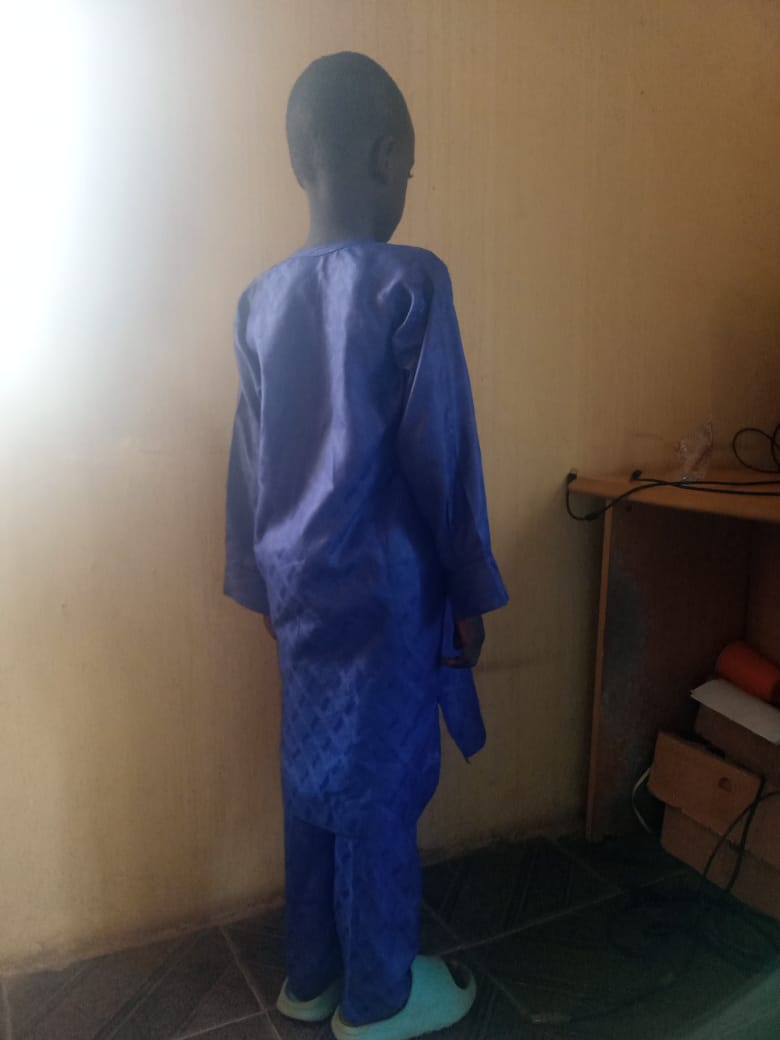
Seven-year-old survivor of child sexual abuse. Photo Credit: The ICIR.

Musa was arrested for abusing the seven-year-old, and though he denied violating the child, medical results show abrasion and laceration in Usman’s anus, which suggest forceful penetration.

According to the state’s child rights agency, a court prosecutor, Abdullahi Miyaki, has been assigned to the case, which is currently being heard at a Magistrate Court located at the High Court Complex, Minna.

The case was adjourned in December, and the hearing will resume by January 2022.

Long wait for justice

Child Sexual Abuse is prevalent in Nigeria, but children pushed into the streets for survival are the worst hit.

While poverty and illiteracy have significantly contributed to the number of street children in Nigeria, religion has also played a significant role through the practice of the Almajiri system.

Originally established to enhance quranic knowledge in children, the idea behind Almajiri schools is now being abused as parents abandon the welfare of their children to the teacher, known as ‘Mallam.’

The mallam, who relies on charity for his own survival, is unable to meet the needs of his students.

In most cases, he sends them out to beg for food, exposing them to various forms of violence, including sexual abuse.

In 2017, seven-year-old Nasir was allegedly raped by a 53-year-old fish seller identified as Mai Kifi in Maraban-Jos, Kaduna state.

He was raped severally until he could no longer control his anal muscles, which had begun to breed live maggots.

According to the National Coordinator of Arridah Relief Foundation Rabi Salisu Ibrahim, who reported the case to the police, the abuse had gone on long before it was detected.

“The child could not tell anybody. He became sick, and they did not take him to the hospital until he could not walk, before they took him to a chemist. We had to intervene to get the man arrested,” she said.


KEEP READING:
One too many: In Abuja, sexual and gender-based violence happens frequently but perpetrators often walk free

Sexual abuse thrives in Nigeria’s IDP camps with no recourse for victims

How Rivers State is responding to sexual violence

VIDEO: Survivors narrate harrowing experience of Domestic Abuse during COVID-19 lockdown

Delayed Justice: One year after, Ochanya’s mother remains traumatised by loss of daughter to sex predators


She told The ICIR that Mai Kifi was initially arraigned before a Magistrate Court in Kaduna and the case was to be transferred to a State High Court.

It, however, did not get to the High Court, and after some time, Mai Kifi was granted bail. He now goes about his fish business, a free man.

“He stayed in prison custody for about 9 months and they gave him bail. They said he was sick in prison. We have not gone to the high court up till today,” she said.

Almost five years later, the case is yet to be presented before a High Court due to delay in the advice from the Department of Public Prosecution of the State’s Ministry of Justice, and Nasir has now been relocated from Kaduna to Katsina, his home town.

She noted that such delays have led to many survivors abandoning court cases, as they often get worn out from the long wait for judgment.

“Ours is to keep motivating the parents to come to court and not drop the case because most of them get tired. At times we have to give them transport money just to make them come to court. But about sixty per cent of them drop the case along the line because of the time frame,” she said.

Abused and threatened 

While justice may be taking too long in Usman and Nasir’s case, many other survivors have it worse, as their abusers never even get arrested, much less appear before a court.

Some are threatened or bullied into silence by their abusers.

Two brothers, Abdul*, 10, and Yusuf*, 12, both residents of Tunga Abdulsalam, told their older sibling Mohammed Ibrahim that the same abuser had violated them.

Ibrahim had fully assumed responsibility for the boys and his five other brothers after the death of their parents.

Due to financial constraints, he could not enrol them all in school, so the two older boys helped him at his suya spot every day.

Business usually went on into the night, and the two brothers found themselves sleeping regularly at the Youth Centre located a short distance from the spot.

On one occasion, Ibrahim had stumbled on his 12-year-old brother engaging in sexual activities with another boy, Ahmed*,15.

Ibrahim learnt that two of his brothers had been introduced to the act by Ahmed’s brother Isa Badamasi, a man in his early thirties.

Ibrahim went to the Niger State Child’s Rights Agency with Yusuf and Ahmed, where he filed a complaint against Badamasi, who had travelled out of Minna at this time.

Upon his return from the agency, he was arrested by officials of Tudun Wada Police station.

Ibrahim said some people in the neighbourhood accused him of kidnapping Ahmed and reported him to the police. He was arrested till almost midnight when he was eventually released.

“Some people reported me at the police station. They locked me up from the morning when I went there till eleven in the night. They got there before me and when someone reports you to the police before you get there, you know you are the one in trouble,” Ibrahim said.

He said all his efforts to inform the police of the abuse yielded no results, and he had gotten a lawyer after his release in an attempt to take the matter further, but that placed him at the receiving end of threats and bullying by Badamasi’s allies.

“I already got a lawyer, but when things changed dimension, some youths gathered at my place. They threatened to scatter my house. One man called me and said ‘Because of Allah, leave these people. Treat your brothers, one day, God will show him’ ” he said.

Realising he was fighting a losing battle, Ibrahim handed over the case to Allah, who he now hopes would bring them justice. Badamasi still works in the same vicinity as Ibrahim, and they see each other every day.

“I knew that I would not get justice. That is why I just left it. Presently, he is where I am working; I see him every day. They did not investigate. I have prayed and left everything to Allah.

“Isa has people backing him. They don’t even know him. I brought him to Minna thirteen years ago. People told me he has been doing this for long. I don’t know. Nobody arrested him,” Ibrahim said.

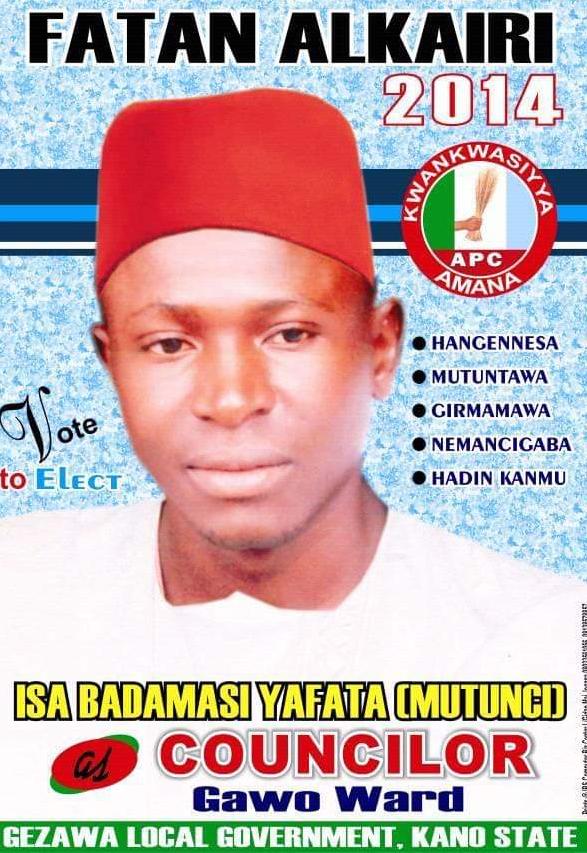
Findings by The ICIR show that Badamasi had contested under the All Progressives Congress (APC) for Councillorship in Gewaza Local Government Area, Kano, in 2014, though he lost.

Isa Badamasi's campaign poster, 2014.
Isa Badamasi’s campaign poster, 2014.

In an interview with The ICIR, Badamasi denied abusing either of the boys. He said the allegations were levelled against him because he had stopped working for Ibrahim and set up his suya spot.

“It is a lie. It is because I was doing business for him, but I want to open my own business and he doesn’t like it. He said he doesn’t want to see me in this place, because this is a business place close to him,” he said.

The ICIR contacted the Niger State Police Command on the issue, and the Public Relations Officer, Wasiu Abiodun, promised to look into the matter.

“Give me time to dig into all these. If they had arrested him for alleged kidnapping, I would need to find out if he had informed them of the act they had been perpetrating and what their actions were. If we need to reawaken the case again, we just have to do that,” he said.

However, at the time of filing this report, the issue is still unresolved at the Tudun Wada police station.

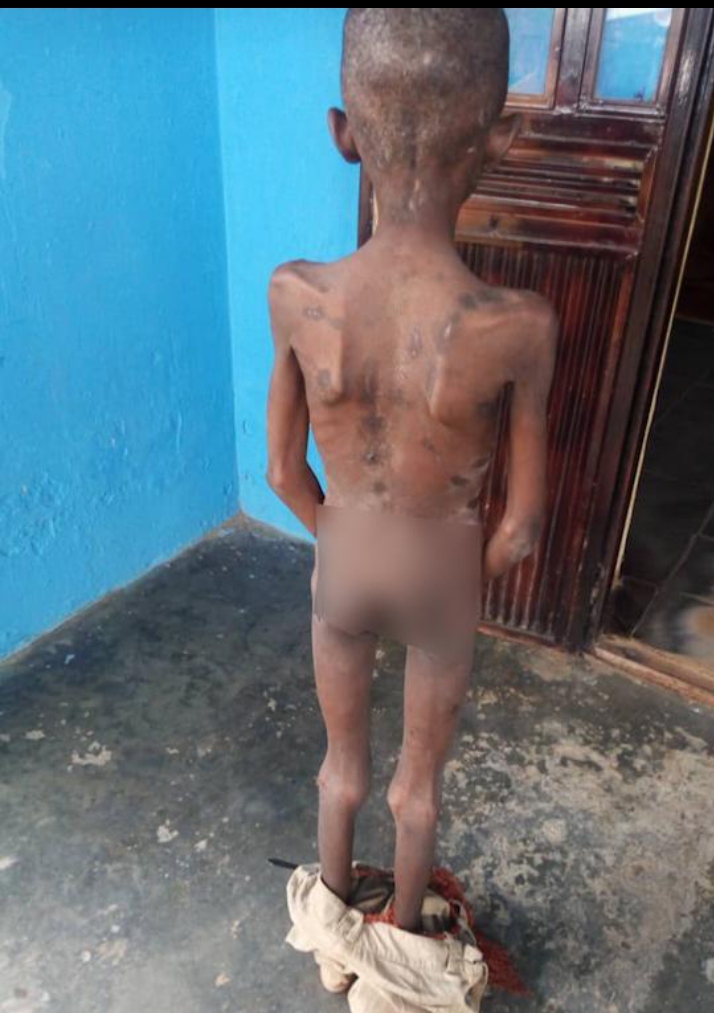
Still in Niger state, an eleven-year-old almajiri boy, Yahaya*, was found lying helpless on the streets in Dutsen Kura Gwari one morning in August 2021.

Almajiri boy, abused in Niger state.

Medical tests sponsored by the state’s Child’s Rights Agency revealed that he had been sexually abused, and he looked malnourished with scars covering most parts of his body.

Malnourished and abused Almajiri boy in Niger state.
Malnourished and abused Almajiri boy in Niger state

Currently under the agency’s care, Yahaya has been too traumatised to recall his Almajiri school or his abuser, who is still at large.

Six children, one abuser

While many boys experience sexual abuse in the North, their female counterparts have not been spared.

In Kpakungu, Niger state, 14-year-old Amina* sells ‘wara,’ a local delicacy consumed by many residents of Northern Nigeria.

She developed a ‘friendship’ with Tunde Akinwale, a 45-year-old man with two wives and five children.

Akinwale had nurtured the relationship with Amina till he successfully lured her to his house at Soje, where he had carnal knowledge of her. Amina did not understand that she was being abused. Every time they met, he presented her with a ‘gift’ of N200.

Forty-five-year-old Tunde Akinwale, who admitted to abusing underage girls.

In Nigeria, sexual intercourse between an adult and a person under 18 is prohibited by the Child’s Rights Act. It is immaterial that consent is given or the offender believed the child to be an adult.

Akinwale continued to prey on Amina and had her introduce five other girls to him, all between 12 and 14, who sold various things on the streets of Kpakungu.

As was his style, Akinwale ‘rewarded’ them with N200 or N300 naira each after every encounter.

Speaking with The ICIR, one of the girls, Habiba* who sells ‘fura,’ said Akinwale engaged them in threesomes occasionally.

“I did not know the man, it was Amina that showed me the man. He said I should come to his house. I went with Amina. He said we should lie down on the bed. We lay down. After, he gave us N200 each,” she said.

The ICIR made efforts to reach Akinwale, but his line remained switched off until press time.

Neighbours had reported the abuse to the Niger State Child Rights Agency, where he wrote a statement after which he was arrested.

In the statement, Akinwale admitted to abusing five of the children, but three months after his arrest, officials of the agency say he has not been arraigned before a court yet.

Children who were abused by Tunde Akinwale
Children who Tunde Akinwale abused.

Who is responsible for the Nigerian child?

The Ministry of Women Affairs, which oversees the development of Women in Nigeria, is saddled with the responsibility of child care.

Another agency authorised to handle child welfare cases in Nigeria is the National Agency for the Prohibition of Trafficking in Persons (NAPTIP).

The ICIR contacted both organisations to find out if there were communication channels available to street children in the event of sexual violence and the process of getting justice for them.

The Ministry of Women Affairs did not respond to requests for an interview from The ICIR on justice for sexually abused children in Nigeria.

But Assistant Director, Counselling and Rehabilitation Department of the NAPTIP Ogochukwu Adinde said the agency relied on their Investigation Department to rescue children who looked susceptible to violence.

“We have an investigation department that has a surveillance unit. They go out to the streets, especially endemic places. They look out for indicators that show children who are vulnerable to crime and pick them up. If they can’t identify their parents, they bring them to the office,” she said.

They also rely on ‘good samaritans’ to bring in vulnerable children or survivors of sexual violence, who are placed in a shelter run by the agency.

She noted that the NAPTIP had made efforts to create awareness through their Public Enlightenment Department, especially among children in schools.

Adinde also said the agency often contacted churches, mosques, markets and community heads to create more awareness.

While these are commendable efforts, they do not fill the gap between the organisation and street children. Most children have no access to formal education, and where to go after being abused remains a problem.

The position of the law

Nigeria has signed several legal instruments to protect children against sexual abuse, including the Violence Against Persons Prohibition (VAPP) Act and the Child’s Rights Act.

While the VAPP Act protects persons against sexual violence, the Child’s Rights Act of 2003 focuses on children.

Section 31(1) of the Child’s Rights Act prohibits sexual intercourse with a child, and an offender is liable upon conviction to imprisonment for life.

“Where a person is charged with an offence under this section, it is immaterial that, the offender believed the person to be of or above the age of eighteen years; or the sexual intercourse was with the consent of the child.” it states.

Beyond these laws, the Criminal and Penal Codes have existed in Nigeria for decades, prohibiting rape in Nigeria.

The 1999 Constitution of the Federal Republic of Nigeria guarantees certain fundamental rights to children. However, there is little distinction between children’s rights and those of adults, except in section 17(3), which protects children against exploitation.

But the VAPP and Child’s Rights Acts were established to focus on sexual offences and the rights of a child.

Legal Practitioner at Black Palms Group Redzie Jugo told The ICIR that the Acts provide more clarity on actions that constitute rape, absent in the pre-existing laws.

“The problem with some of the older laws is that there were certain acts that were not considered rape. As evil started to get ingenuous, some of these legislations needed to address these other things,” he said.

Despite the prevalence of child sexual abuse in Nigeria, many states are yet to domesticate these laws.

As of November 2021, only 28 and 18 states out of 36 have domesticated the Child’s Rights Act and the VAPP Act in Nigeria.

This lack of implementation makes a mockery of some of the enacted laws and treaties in the country.

Failure of the justice system

The United Nations International Children Emergency Fund (UNICEF) said 25 per cent of girls and one in ten boys in Nigeria are victims of sexual violence.

Only less than five per cent of children who report such violence ever receive any form of support. Despite the high rate of sexual violence in the country, convictions for rape cases in Nigeria is low.

There is no central database for the number of such convictions in Nigeria. However, The ICIR traced 65 rape convictions between 1973 and 2019 through news and law reports, though this list is not exhaustive.

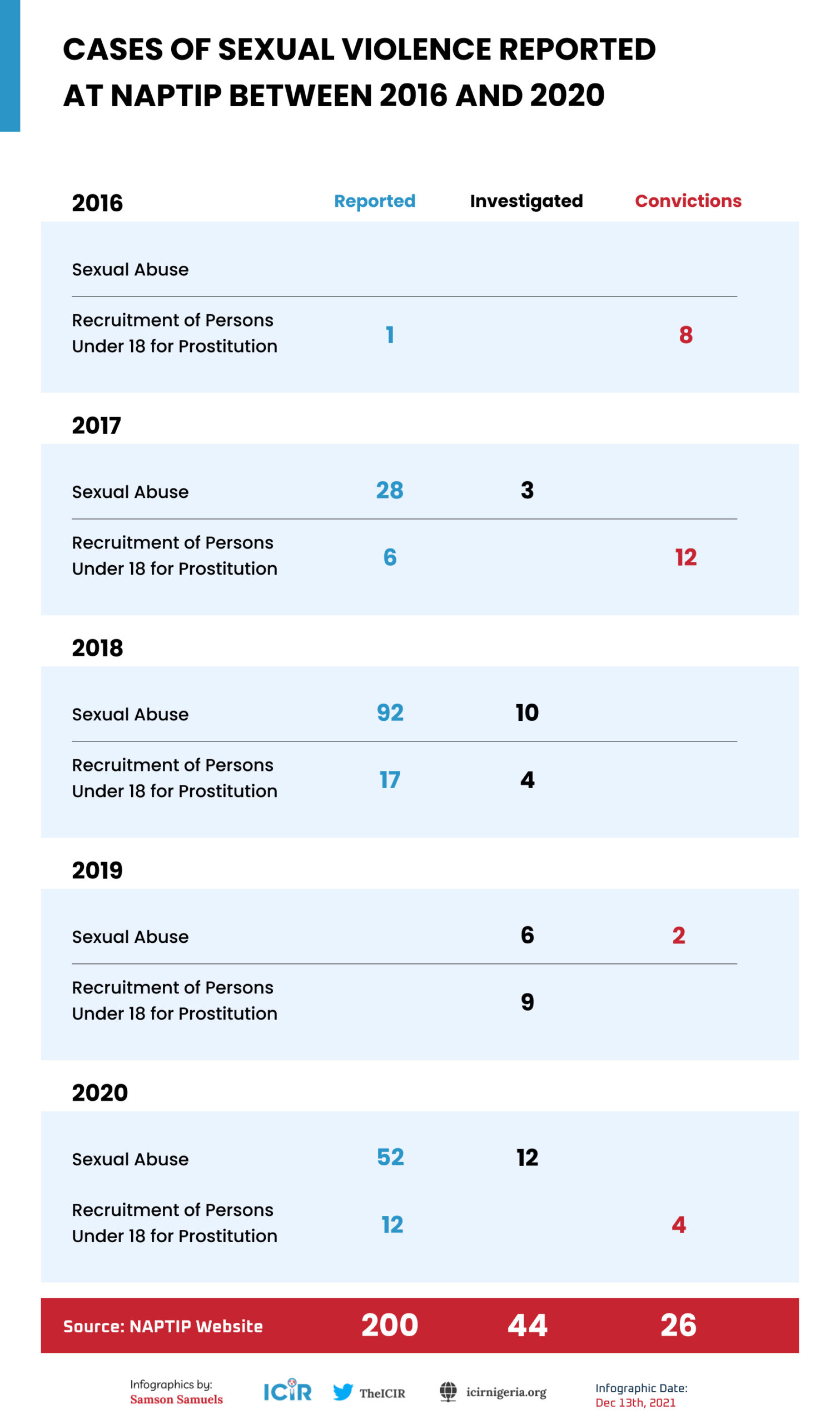
Data from the NAPTIP website also shows low conviction rates in cases of sexual violence.

Out of about 200 cases of sexual abuse and recruitment of persons under eighteen for prostitution reported between 2016 and 2020, only 44 have been fully investigated, and convictions have only been gotten in 26 cases of children recruited for prostitution.

Speaking on the failure of the Nigerian justice system, Co-founder, Young Ambassadors Against Drug Abuse Initiative (YAADAI) Zainab Khaleel said lack of implementation of established laws sets the country behind in the fight against child sexual abuse.

“One of the major challenges I have noticed in the course of this job is the fact that we create laws, but implementation has always been a problem in Nigeria. And if you do not implement policies and laws, then we’ll always continue to be backward,” Zainab said.

Agreeing with the implementation problem, Rabi Salisu Ibrahim also cited the lengthy duration of court proceedings as a factor hindering justice.

“I’m tired of telling stories of rape. I have never called the media to say we have gotten justice anywhere. In Kaduna State, we have good laws but no implementation.

“That process of waiting for case diary from the police and advice from the Ministry of Justice might take five, seven years and most of our cases die silently without seeing the high court. We don’t easily get judgment,” she said.

Founder, Wanda Adu Foundation, Wanda Ebe, told The ICIR that the lack of domestication of the laws against child sexual abuse in some states had been a significant barrier in the fight for justice.

“They’ll tell you that XYZ state has not domesticated the VAPP Act. Most times, justice looks impossible. Are they trying to say that before the VAPP Act sexual violence was allowed? Why do we have to wait before the Act is domesticated before we can do anything?” she asked.

Describing the search for justice as a tough fight, Ebe also identified the lack of synergy between some security agencies as a contributing factor.

“It’s as if there is a power tussle between the police and NAPTIP. It shouldn’t be like that. It has been very tough and challenging even for people who have money to pursue these cases, let alone street children.

“If you take any case to the police, NAPTIP automatically will not attend to that case. It is not supposed to be so. There is supposed to be partnership between these people,” she said.

But Adinde disagreed, saying there was a strong relationship between their team and other security agencies.

“We have very strong synergy with the police. There is no such rivalry, we have a great relationship with them,” she said.

She, however, noted that there were indeed specific challenges that limit the chances of justice, including lack of funds to expand zonal offices across all states in Nigeria and incessant court strikes.

“Conviction rates are also low because sometimes the courts go on strike and all cases go on standstill. There is nothing we can do,” she said.

Nigeria had declared a state of emergency on rape in 2020, but Director Amnesty International Osai Ojigho described it as an ‘empty declaration, saying the failure of security agencies to investigate rape cases has resulted in further injustice and a culture of silence.

Ojigho noted that though rape now operates at a crisis level in Nigeria, it is still being treated with levity.

“Women and girls continue to be failed by a system that makes it increasingly difficult for survivors to get justice while allowing perpetrators to get away with gross human rights violation,” she said.

FG’s unfulfilled promise

The Nigerian government had identified long trials as one reason victims of sexual violence never get justice.

On several occasions, the government promised to establish specialised courts to ensure speedy trials of rape cases, but very little has been done beyond promises.

The Minister of Justice and Attorney-General of the Federation Abubakar Malami spoke on the specialised courts during a press briefing in June 2020.

He also announced the government’s intention to conclude rape cases in record time through specialised courts at an international event organised by the United Nations in March 2021.

During his independence speech in October 2021, Nigerian President Muhammadu Buhari also reiterated this promise, but as the year comes to an end, there has not been enough action to match all the promises made in the past eighteen months.

Way forward

Speaking on possible solutions to the issue, Zainab Khaleel told The ICIR that there was a need to create safe spaces for street children.

She called for the education of street children on the Childs Rights Act and the establishment of emergency numbers in the event of abuse.

“They need to be educated first and foremost about their rights. There should be an emergency phone line that children can also reach. Even if a child is on the streets and uneducated, it doesn’t mean he doesn’t know how to use a phone.

“We need to create safe places. These are places where these children can be taken and rehabilitated, given psycho-social support, so that at least when they come out they are empowered. They need to be taken off the streets,” she said.

She also identified the need to have data on children who have faced sexual abuse in Nigeria to enable relevant authorities, address the issue adequately.

For President Twin and I foundation Aisha Umoru, relevant security agencies had to be trained and enlightened on how best to handle cases of sexual violence, especially against children.

“I keep saying the police needs to be enlightened. I can’t take a child to you and say she’s abused and then you ask her ‘did you not enjoy it?’ ” she said.

Umoru also noted that shelters for homeless children were scarce within the country and decried the state of existing shelters. She called for the construction of child-friendly shelters and likened those available to prison cells.

“Some of them sleep on the floor. Women Affairs has one, I think they say it’s a women shelter. NAPTIP has one also. But there is no particular shelter for an abused child,” she said.

She noted that the absence of shelters for abused children made matters worse because many survivors remain on the streets, vulnerable to recurrent abuse.

“If we had places to put these children, they don’t have to go back. But we don’t,” she said

Director-General, Niger State’s Child Rights Agency Mariam Kolo suggested that parents be educated on reproduction, especially where there is a lack of resources to raise many children.

She also said parents whose children are in almajiri schools should provide basic needs to remove the element of begging from the almajirinci.

“By intense sensitisation, you need to be aware of the number of children you produce; you cannot throw them out to any Islamic school without adequate protection and adequate food.

“When the parents are aware they cannot do that, the issue of marrying too many wives and too many children will be drastically reduced. Because the community now will play its role by not accepting them into any almajiri school without those measures in place,” she said.

*Real names were withheld to protect the identity of survivors

Support for this story was provided by the Media and Gender Project of Premium Times Centre for Investigative Journalism #CREATESAFESPACES.

Police arrest 11 kidnappers in Taraba, recover rifles, ammunition

THE Nigeria Police, on Sunday, arrested 11 members of a kidnap syndicate in Taraba State.

The suspected kidnappers, according to the Force Public Relations Officer Frank Mba, were allegedly involved in the killing of a deceased Police sergeant in Taraba and the kidnapping of an undisclosed officer of the Nigerian Customs Service (NCS) and relative of the Emir of Jalingo.

The deceased officer was late Sergeant Ogidi Habu, according to a statement issued by Mba.

The alleged criminals were identified as Luka Adam, Shuaibu Nuhu, Moses Amos, Peters Mashi, Ahmadu Mallam, Adamu Mohammed, and Dahiru Mallam Dalha.

Others were Gambo Isah, Sanusi Ahmadu, Mallam Mohammed Mauludu, Ibrahim Idi, all indigenes of the state.

The accused were arrested by the Police Intelligence Response Team, alongside the state Police Command.

The statement, which attributed the several criminal activities in the state to the arrested individuals, revealed that at least seven AK47 rifles and some ammunition were seized from the alleged criminals.

At least two of the listed accused persons –Gambo Isah and Sanusi Ahmadu – were on the wanted list of the Police.

They allegedly masterminded the killing of the Police sergeant and left a Police inspector with gunshot injuries in their recent operation, after a recent abduction of some victims in Jalingo.

Taraba State has witnessed several cases of kidnapping, killing, and other forms of insecurity in recent months.

In February, 48 hours after state labour chairman was kidnapped, gunmen struck in Jalingo to kidnap another.

Police investigations revealed the accused often trailed business owners and government functionaries, including motorists with flashy and exotic cars, to their houses and thereafter kidnapped them.

According to the statement, the accused always demanded huge sums of money as ransom from relatives and friends of their victims before their release.

“The Police team equally recovered seven (7) AK47 rifles, two (2) Beretta pistols, 121 rounds of live ammunition of different calibre, four (4) magazines, masks, illicit drugs and other incriminating items during raids of various hideouts of the suspects in the State.

“The arrest of the suspects follows the deployment of operatives of the Intelligence Response Team by the Inspector General of Police, IGP Usman Alkali Baba, psc(+), NPM, fdc to Taraba State to complement the efforts of the Taraba State Police Command in promptly containing the disturbing trend of kidnapping, armed robbery, and other violent crimes in the State,” the statement read.

Some victims of abductions were also rescued during the Police operation, the statement said.

Uncertainty over electoral bill as 30-day period for Buhari’s assent ends

THE 30-day period for President Muhammadu Buhari to sign the Electoral Act Amendment Bill into law expired on December 19 with uncertainty surrounding the fate of the proposed legislation.

The presidency did not respond when contacted by The ICIR over the development on December 19.

Calls to the Senior Special Assistant to the President on Media and Publicity Garba Shehu were not answered and a text message sent to him was not replied as of the time of filing this report.


READ ALSO:

Nigerian govt deliberately delaying Electoral Bill to manipulate 2023 election – Wike

Lai Mohammed applauds Buhari’s commitment to ending insecurity

Obasanjo, Abdulsalami, Sultan, others ask Buhari to implement constitutional reforms before 2023


The ICIR in the SMS sent to Shehu asked whether Buhari had taken a decision on the bill.

The Electoral Act Amendment Bill was forwarded to the president by the National Assembly on November 19. With the bill yet to be signed into law within the stipulated 30-day period – which expired on December 19 – it is expected that the president will write the National Assembly to explain his reasons for withholding assent, although there are also suggestions that he may decide to sign the legislation after the stipulated time.

The National Assembly can decide to override the presidential veto and pass the amendment bill into law with two-thirds majority votes in the Senate and the House of Representatives.

However, the National Assembly is set to go on recess for the Yuletide on December 21 and would not resume until the third week of January 2022, a development which has heightened the uncertainty over the fate of the amendment bill.

The National Assembly would have gone on recess on December 16 if not for delay in the passage of the 2022 budget.

But it is highly unlikely that the National Assembly would decide to override the president by moving to pass the bill with two-thirds majority, even though the lawmakers are believed to be pushing for the introduction of the contentious provision for compulsory adoption of direct primaries by political parties.

Members of the National Assembly believe that direct primaries would whittle down the enormous influence wielded by governors in the selection of political party candidates for elections through the indirect primary model.

On the other hand, the governors, determined to maintain their influence, are opposing the passage of the electoral bill and are lobbying the president to reject the provision for compulsory adoption of direct primaries.

Senate spokesman Ajibola Basiru has ruled out a face-off between the National Assembly and Buhari over the amendment bill.

Speaking on Arise Television on December 14, Basiru said the National Assembly would not go to war with Buhari over the Electoral Act Amendment Bill.

“When the president takes the decision (on the Electoral Act Amendment Bill) whatever the generality of the National Assembly thinks, we all will know. I think it is too early to seek to put us on a war path with the president.”

Basiru at the same time added that the National Assembly would take a decision in the best interest of the country, irrespective of the president’s attitude concerning the amendment bill.

Following the transmission of the amendment bill by the National Assembly, Buhari had consulted ‘relevant stakeholders’ for advice on the proposed legislation.

The stakeholders included: the Chairman of the Independent National Electoral Commission (INEC) Mahmood Yakubu and Attorney General of the Federation and Minister of Justice Abubakar Malami, a Senior Advocate of Nigeria (SAN).

INEC chairman Yakubu urged the president to assent to the bill.

Malami, in his advise to the president, reportedly highlighted problems that would arise with the inclusion of a provision for compulsory adoption of direct primaries in the Electoral Act Amendment Bill.

The AGF reportedly told the president that compelling all the political parties to conduct direct primaries could cause confusion.

Buhari is expected to return from Turkey – where he just celebrated his 79th birthday while on an official visit – on December 19.

The Nigeria Civil Society Situation Room, a coalition of over 70 civil society organisations (CSOs) working in support of credible and transparent elections in the country, has urged him to assent to the bill immediately he arrives Aso Rock.

The Situation Room, in a statement jointly signed by its convener Ene Obi and co-conveners Asma’u Joda and James Ugochukwu, in the same vein, asked the National Assembly to override Buhari, should he decline to assent to the amendment bill.

The coalition said, “We urge the president to sign the bill into law without delay and it will still be within his prerogative to bring fresh amendments after signing the bill, like he did with the Petroleum Industry Bill which he was highly commended for.

“It is not in doubt that President Buhari has till Sunday to assent to the bill. We urge the National Assembly, in the interest of Nigerians, to veto the President should he refuse to assent to the bill. The National Assembly has the power and they should use it this time around.”

The CSOs in the coalition include Policy and Legal Advocacy Centre (PLAC), CLEEN Foundation, Action Aid Nigeria, Centre for Women and Adolescent Empowerment, Centre for Democracy and Development (CDD), Centre for Citizens with Disabilities (CCD), African Centre for Entrepreneurship and Information Development (ACEIDEV), Rule of Law and Accountability Advocacy Centre (RULAAC) and Justice Development and Peace Commission (JPDC).

The coalition condemned the action of some governors who were asking the president to decline assent to the amendment bill, which it described as one of the most significant pieces of legislation made by the Ninth Assembly.

* Has Buhari declined assent for fifth time?

Should Buhari eventually fail to sign the bill, it would be the fifth time he would decline assent to the amendment of the Electoral Act.

On four occasions in 2018, the Eighth National Assembly led by then Senate President Bukola Saraki had passed and transmitted electoral act amendment bills to Buhari for assent and, on each occasion, he refused to sign.

On the first occasion in February 2018, Buhari rejected the amendment bill because of provisions that reordered the sequence of elections.

A second amendment bill passed by both chambers of the National Assembly and transmitted to Buhari in June 2018 was not considered at all.

For the third time, in July 2018, Buhari again refused to sign another version of the amendment bill passed and transmitted to him by the National Assembly citing concerns over increased cost of conducting elections, among other issues.

In December 2018, Buhari, for the fourth time, declined assent to the amendment bill, after the National Assembly had addressed all the reasons he gave for refusing to sign on the previous occasions.

In a letter dated December 6, 2018, and addressed to Senate President Saraki and Speaker of the House of Representatives Yakubu Dogara, Buhari said he would not sign the electoral bill into law at a time the country was preparing for the 2019 elections as, according to him, doing so would cause confusion and lead to uncertainty in the polity.

He promised to sign the bill after the 2019 elections.

Their pains, frustration in the hands of Lagos Okada riders (PART 2)

0

Lagos is Nigeria’s commercial centre. With a population of over 14 million persons, the state has been dogged with the challenges of Okada-related crimes. At different times, the Lagos state government had threatened to ban the use of Okada in the state due to insecurity associated with the operation of motorcycle taxis in the state. This is part of two of ‘”ow Okada riders cause disability, promote crime in Lagos”. Olanrewaju OYEDEJI reports.


1. Pedro

Pedro Lives in Ikola, Lagos state. He was involved in an accident with a hit and run dispatch rider at Victoria Island also in Lagos. He is currently bed-ridden and cannot afford hospital bills.


2. Mr Samuel, Afeez and Olatunde

Mr Samuel‘s three-bedroom flat was robbed by men on a motorcycle in Lagos. They came at night, carted away his money, six phones and wife’s jewellery.

The okada riders told Samuel that they have been surveying the place for a while. He however did not suspect much because he could not distinguish criminals on motorcycles from those who are not criminals. The situation has made him more scared of Lagos.


READ ALSO:

How Okada riders cause disability, promote crime in Lagos (PART 1)

Money for the boys: How ‘agberos’ pocket billions of Lagos transport revenue

Lagos micro businesses in the grip of ‘area boys’

Profiting from illegality: Lagos govt watches as local councils, touts exploit proscribed cyclists

Inside Lagos local government councils where officials divert taxes to personal bank accounts


Afeez lives in Ijaiye area of Lagos state and is one of the union leaders in Ijaiye. He lost a close friend to a hit and run Okada rider.

Olatunde narrated how a young lady’s bag and the phone was snatched right in his presence via a motorcycle. According to him, he tried to call attention to the motorcycle rider but he was fast gone. He said the lady was shell-shocked and could not say anything for minutes


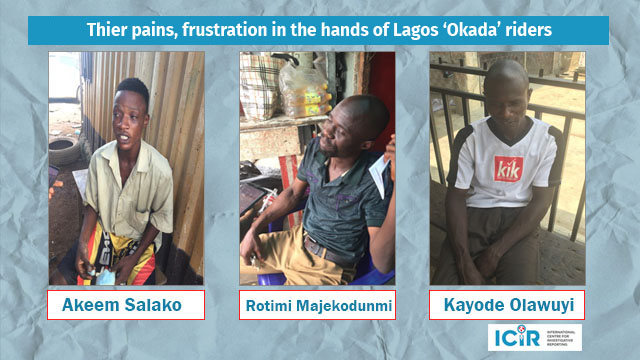
3. Akeem Salako, Rotimi Majekodunmi, Kayode Olawuyi

Akeem’s friend lost his leg during a motorcycle accident in Lagos.

Rotimi Majekodunmi told this reporter that more than once, he had witnessed scenes where people are left crying and stranded after their valuables were snatched in Agege area of Lagos. He noted that it has become very rampant that people sometimes fear plying the area anytime from 7 pm. He urged the state government to help safeguard people and their properties against criminal elements who operate through motorcycles in the state.

Kayode Olawuyi has worked in Lagos for over twenty-five years. He recounted several incidents of bag snatching, phone snatching that sometimes leaves victims stranded. He said they have tried endlessly to fight this menace but the crimes never stopped.


4. Chinedu, Dennis

Chinedu was working in a car wash close to his house as of September 2021. However he wanted something that could fetch him more funds, so he started Okada riding business. Two days after starting the ‘Okada’ business in Lagos, he was hit by a vehicle. His condition has continued to degenerate as is unable to use his legs till date.

“I saw that a road was free and wanted to take it but got knocked down.” He has been debilitated since then. Close friends described the incident as devastating, and have been praying for him to regain his legs.

Dennis –  A close person to Dennis lost one of her legs after hit and run motorcycles hit her and dispossessed her of her bag. Dennis himself had a close shave with Okada accident recently, he told The ICIR.


5. Tony, Akin, Comfort Olagunju

Severally, Tony has reported crimes by Okada riders, including those he sees from his place of operation but he says nothing has changed. He told his reporter that his friends have been victims of Okada crimes and every time he voices out. As someone who operates close to the expressway, he says criminal activities go on unchecked.

He narrated an incident of how road transport union leaders made attempt to ease off motorcycle riders from the area but the next day, the motorbike riders were back. According to him, even policemen or taskforce cannot help the situation.

Akin has been a witness of many incidents of robbery through armed robbery in Lagos. He narrates the psychological fear it creates always even in him.

Comfort Olagunju sat on a chair, unable to stand when she saw this reporter. She was hit by a motorcycle rider in the Iyana-Ipaja area of Lagos but she was lucky to escape more fatalities as she was rushed to get medical care.


6. Olatunde Azeez, Akoh Beatrice

Olatunde said that he lost a friend to activities of motorcycle riders in the state. He however opined that despite the criminality, there is a need to ensure that alternatives are provided before phasing off motorcycles. He believes that hunger and unemployment should be a priority as a way to ease the state of crimes.

Azeez told this reporter that phasing off motorcycle riders in the state will be a welcome development due to crime. He however noted that they should still be allowed to operate inside the streets of Lagos.

Akoh Beatrice told this reporter that going out at night is always scary because of thefts perpetrated by motorcycle riders in her area.


7. Bola Ogunniyi, Chidi, Elvis

Bola Ogunniyi said that his area has been terrorized by Armed Robbers who leverage motorcycles. He however called on the government to find alternatives so as not to increase criminality in the state.

Chidi revealed that in his area, a time limit is placed to entrant of motorcycles due to an increase in criminality leveraging on motorcycles.

Elvis noted that while many persons.


8. Mr Kolapo, Madam Bilikisu, Abdulfatah Adesina

Mr Kolapo said that the menace of Motorcycle riders has become very rampant in the state and even his area is not spared.  He believes that the lack of regulation and coordination on motorcyclists in the state enhances criminality. He also wants employment to be created for those who ride motorcycles in the state, so the criminality will not be on the increase.

Bilikisu told this reporter that she has family members using motorcycles to survive. Although, admitting to the crime perpetrated.

Abdulfatah Adesina, a mechanic in Lagos state, told this reporter that the menace of Motorcycle riders has become very worrisome, however, infiltration and poor regulation enhances criminality. He recounted incidences including how his close family lost valuables to the hands of motorcycle riders.


9. Adebayo, Tayo, Alabi

Adebayo owns a gas filling business in Lagos. Closing late has become a challenge because of crimes committed by motorcycle riders. He however believes that strengthening the state security system would have helped to ease the crime perpetrated by motorcycle riders.

Tayo recounted how the phone of a young lady was snatched right in front of him and the thieves zoomed off on their motorcycle. And Alabi shared a similar experience, worried that Okada riders contribute to the high crime rate in Lagos.


10. Ahmed, Ikechukwu and Daniel

Ahmed has not been a victim of Okada crime but some of his customers have fallen victims in the past.

Ikechukwu told this reporter that although the crime in Lagos is high and Okada business promises crime, he said if he sees an opportunity to ride an Okada, he will venture into the business. He told this reporter that he and his family do not have enough to eat.

Daniel, in his workplace, has seen many incidences of bag snatching and others committed by motorcycle riders but believe an alternate to motorcycle should be provided before banning even as he advocated for regulating Okada business in Lagos.


11. Tochukwu, Suleiman and Tajudeen

For Tochukwu, there is a need to curb Armed Robbery in Lagos especially those perpetrated by motorcyclists. He stated that those robbers have made the roads scary; however, before removing them from the roads, an alternative should be created.

Suleiman noted that Okada has been of help to him in Lagos. He noted that sometimes when they close late in Lagos, he uses the means of transportation for faster access. Suleiman pleaded that while some elements have used motorcycles for fraud, there is a need to ensure alternative jobs, so as not to embolden fraud and criminality.

Tajudeen said in his many years of staying in Lagos, he has seen countless cases of armed robbery, and there wants the government to strengthen laws on Okada operations. He lamented the loss of jobs and the high rate of unemployment that promote criminality in Lagos.  This condition makes many armed robbers disguised as motorcycle riders in the state.


12. Kehinde, Ajoke and Collins

Kehinde has witnessed many crimes but he says the absence of a proper security system emboldens criminals who operate through motorcycles.

Ajoke

Collins told The ICIR that Okada has become a menace in Lagos but the absence of alternative remains why many persons patronise them. He noted that many persons have been made to cry due to the activities of Okada riders but even as they are a thorn in the flesh of Lagosians, there is a need to also consider their survival before taking them off the streets.


13. Pastor, Opeyemi, Olayemi

Pastor Caleb urged the state to find ways of compensating those who will lose their jobs if Okada is phased out, he noted that many persons who engage in Okada riding are graduates struggling for survival.

Opeyemi works in a furniture shop in Lagos, he told this reporter that the Okada menace did not start ‘today’ in Lagos. He believes that there is a need for employment opportunities to be created as a way to ease the state of criminals.


Other Lagos residents weigh-in on Okada crime

Other Lagosians also told The ICIR that while the menaces of Okada crimes have become very worrisome in the state, there is a need to ensure adequate tracking of those who operate Okada as taxi in the state. They want Lagos to ban the Okada riding, but not without providing alternatives both for the commuters and the operators.


This report is produced in partnership with the Centre for Democracy and Development (CDD)