THE Federal Capital Territory, Abuja, reported its first flood incident in June 2023, following a heavy downpour that exacerbated into a flood submerging several houses in an estate.
The impact of the flood, which had become a regular incident, submerged 166 houses and displaced several residents from their homes. The ICIR captured it here and here.
Last year, flooding displaced 1.4 million people across various parts of the country from their homes and killed over 500 people. The federal government attributed the incident to unusual rainfall as a result of climate change and the excess water released from the opening of the Lagdo dam in Cameroon that flowed into the Nigerian River and its tributaries.
In Abuja, the Federal Capital Territory Emergency Management Agency said that the flood affected about 24,713 inhabitants in three of the six area councils of the FCT. This development forced the government to demolish houses on waterways as part of an effort to mitigate the flood.
However, experts told The ICIR that the government may need to develop a sustainable drainage system to channel water within communities, especially rural areas.
The ICIR captured the ordeal of residents who were impacted by the flood in 2022.
Mapping out flood zone areas
At the beginning of this year, Abuja was listed as part of the state at risk of heavy flooding in 2023. Weather25 forecasted that FCT would have 74 days of rain in 2023 with the highest rainfall impact from May and September.
However, the recent incident in the Tradmore estate showed that the emergency response of relevant authorities to flooding has been poor, Taiwo Ogunwumi, a flood risk consultant, told The ICIR.
Source: Google Earth (An image showing the locations in FCT prone to flooding)/ Kehinde Ogunyale
“Yes, the authorities in charge of flood risk identification and predictions are doing their best. However, there is more to be done. An example is the provision of highly detailed flood risk maps indicating the major natural and anthropogenic features (quantification and providing information on the economic cost loss that may arise from the future flood) that might be affected by floods,” Ogunwumi said.
Meanwhile, The ICIR analysed several media reports of flood occurrence in Abuja in the last four years and learnt that 20 communities within the six local councils have reported at least one incident of flooding.
Source: Aqueduct (An image sowing the water channels that runs into FCT)/ Kehinde Ogunyale
These communities include Lugbe, Lokogoma, Garki, Wuse, Damagaza, Gwagwa, Nyanya, Galadimawa, Gaduwa, Mpape, Kubwa, Dutse Makaranta, Giri, Yangoji and Kwaita.
Some other areas are located in Karmo, Apo, Apo-Dutse, Abbattoir, Angwan-Dodo, and some communities around Kuje local council.
Findings showed that the Abuja Municipal Area Council has the highest number of communities that have been impacted by floods. This, however, may not be unconnected to several water settlements (lake, river and creeks) found within the council.
(The map [zoomable] above shows water settlement across the FCT)
As a result of these settlements, communities around these riverbanks are eventually impacted when the water level rises due to heavy rainfall. For instance, a report captured how one person died in the Galadimawa axis of Abuja after heavy rainfall increased the water settlement in the area.
Climate expert Daniel Oladoja also told The ICIR that in the last century, human activities have disrupted the natural order of things climatically, which resulted in the excess precipitation that brought about flooding.
He said, “Excess rainfall places a strain on natural ecological systems and, in the absence of structural buffers, could lead to destructive flooding. Plainly speaking, excess rainfall could significantly swell the volume of water in the river systems and when those reach their carrying capacity, they will spill over on residential and agricultural lands.”
Mitigating the flood
Speaking at The ICIR Twitter Space the NEMA Assistant Chief Information Officer, Abdulkadir Ibrahim, said the agency has begun to sensitise people on flood mitigations and set up emergency structures across all state levels.
He said, “Presently, NEMA has already released climate disaster-related preparedness and migration strategy, which it is trying to downstream to the local government level.
“The major challenge we have in this is that most of the state emergency management agencies are not as functional as they should be. According to the Act which set up the National Emergency Management Agency, we have to work with the state and local disaster management agencies, which of course is virtually not available in most of the local governments.”
Ogunwumi, while projecting more flooding this year, said there is a need to improve the details of the early warning report, that is, the quantity of the possible impacts of the flood e.g. population, farmland, and market stall that can be affected by this flood.
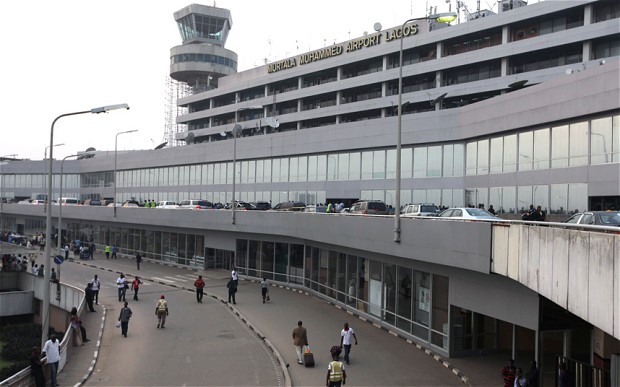
OFFICIALS of the Nigeria Air Force (NAF) have arrested a man for attempting to steal underground cables at the Murtala Muhammed International Airport (MMIA) Lagos.
Director, Public Affairs & Consumer Protection of the Federal Airports Authority of Nigeria (FAAN) Abdullahi Yakubu-Funtua disclosed this in a statement on Friday, July 21.
According to the statement, three men were spotted digging out the airport underground cables by guards on duty at the Nigeria Airforce HQ NADC gate.
The men fled upon sighting the guards, however, one of them, was shot and apprehended by the officials.
The injured suspect, identified as Usman Musa , 28, was taken to General Hospital Oyingbo where he is recieving treatment for his injuries.
“Usman Musa will be properly interrogated after he has stabilised.
“The Authority believes that this incident could be a relevant clue to unraveling the theft of the Runway Lighting at the Murtala Muhammed International Airport, Ikeja,” Yakubu-Funtua noted.
On July 12, FAAN confirmed that runway lights at the MMIA were stolen from the airport.
Some Heads of Departments were suspended following the theft based on the directives of the Permanent Secretary, Ministry of Aviation, Emmanuel Meribole.
The second runway of the MMIA, Lagos operated without airfield lighting for about 16 years until November 2022.
The runway was shut for three months before it was re-opened in November 2022 for flight services, after the successful installation of the CAT III Airfield ground lighting system.
This is not the first robbery attempt recorded at the Lagos airport.
In December 2021, Arik Air complained to the Nigerian Civil Aviation Authority (NCAA) about an attempted robbery of its taxiing aircraft by unknown men that encroached on the runway.
Yakubu-Funtua said that investigations had commenced into the theft, and described allegations that FAAN officials were involved in the incident as speculations.
“Once the investigations are concluded, we will let the public know,” he said.
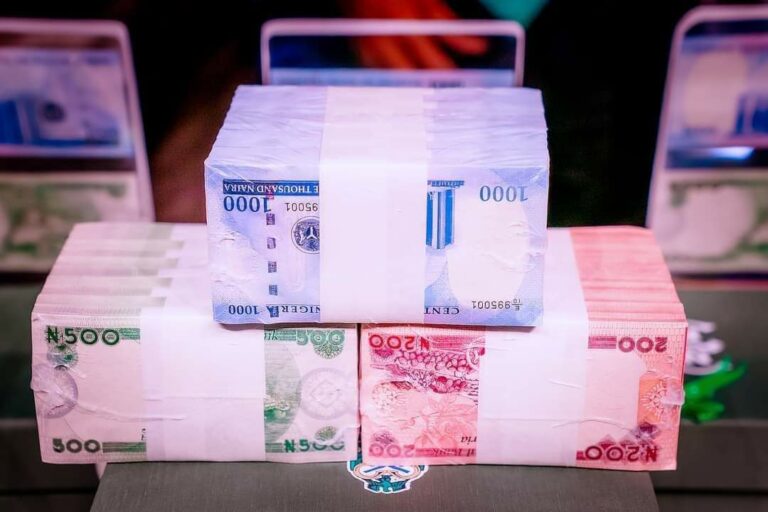
THE Federation Account Allocation Committee (FAAC) on Thursday, June 20 shared a total sum of N907.054 billion among the Federal government, states and local government areas in June.
The sum represented a 15.4 per cent appreciation from the sum of N786.161 billion shared in May 2023.
A report by The ICIR had projected a higher rise in federation allocation from gains expected from the removal of fuel subsidy and unification of the foreign exchange rates.
A statement by FAAC’s spokesman, Bawa Mokwa, said a FAAC meeting today that announced the sharing was chaired by the Accountant General of the Federation, Oluwatoyin Madein.
Mokwa disclosed that the N907.054 billion total distributable revenue comprised distributable statutory revenue of N301.501 billion, distributable value added tax (VAT) revenue of N273.225 billion, electronic money transfer levy (EMTL) of N11.436 billion, and exchange difference revenue of N320.892 billion.
FAAC noted that in June 2023, the total deductions for the cost of the collection were N73.235 billion, while total deductions for transfers and refunds were N979.078 billion.
It added that the balance in the excess crude account (ECA) was $473,754.57
The statement explained that the Federal government received N345.564 billion, state governments received N295.948 billion, and local government councils received N218 billion.
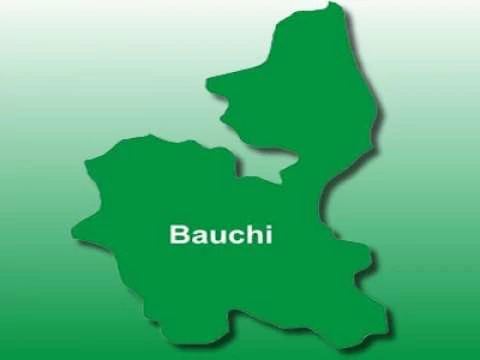
BAUCHI State Government, through the Local Government Service Commission, has dismissed six traditional rulers over offences bordering on misappropriation of funds, partisan politics and deforestation.
This development came barely three months after governor Bala Mohammed was reelected for a second term.
A statement dated Thursday, July 20, signed by the Acting Permanent Secretary Nasiru Ibrahim, disclosed that the affected monarchs are from Bauchi and Katagum emirate councils.
Parts of the statement read, “The Local Government Service Commission has approved the dismissal of six traditional rulers in Bauchi and Katagum emirates.
“This followed their involvement in partisan politics, misconduct, illegal forest reserve encroachment and felling of trees, misappropriation of public funds and insubordination which is contrary to the Public Service Rules.
“Those affected include Alhaji Aminu Muhammad Malami, District Head of Udubo; Alhaji Bashir Kabir Umar, District Head of Azare; Umar Omar, Village Head of Gadiya; and Umar Bani, Village Head of Tarmasawa, all in Katagum Emirate Council.
“While those dismissed from Bauchi Emirate Council are Bello Suleman, Village head of Beni and Alhaji Yusuf Aliyu Badara, Village Head of Badara.”
The affected traditional rulers were directed to hand over to their secretaries and the emirate councils, who are to appoint overseeing officers pending the appointment of substantive officials by the Commission.
The governor had, in November 2022, warned traditional rulers in the state against involvement in partisan politics, noting that his administration would not tolerate such behavior.
“By urging traditional rulers to mobilise the citizens to support the government’s policies and programmes, we do not mean that they should engage in partisan politics. Traditional rulers are not involved in partisan politics under any circumstances.
“The involvement of traditional rulers in partisan politics under any guise is not only an aberration but a desecration of our traditional institutions, and that would not be taken lightly by anybody,” Mohammed said.
The governor, in the same vein, noted that he had been receiving reports that some traditional rulers in the state were involved in shoddy practises with the grazing and forest reserves, as well as cattle routes in the state and warned that he would not spare anyone found wanting.
“Let me warn that any traditional ruler or official of the state or local governments found to be involved in such malpractices will not be spared,” he said, adding that “existing laws of the Land Use Act are to be strictly adhered to, to ensure a harmonious relationship between farmers and herders”.
THE Deutsche Welle (DW) Akademie is seeking podcasting coaches and trainers for West Africa and Namibia, with the focus on climate change.
Planning, arranging, and delivering podcast training (online) with media organisations and media makers from West Africa are among the responsibilities of the trainers.
The Initiative intends to assist media organisations and media producers in developing, producing, and disseminating crisis podcasts by assisting them in doing so.
August 4, 2023, is the application deadline. Interested applicants can apply here
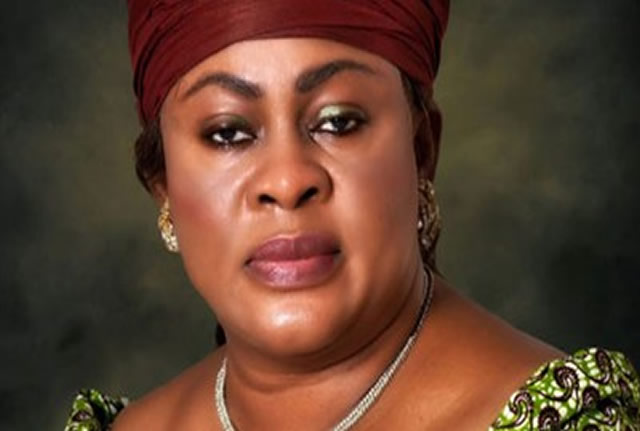
THREE years after the charge was filed, the Economic and Financial Crimes Commission (EFCC) has arraigned a former Aviation Minister, Stella Oduah, her ex-aide, Gloria Odita and seven others over alleged N5 billion naira fraud.
They were arraigned before an Abuja Federal High Court presided by Inyang Ekwo on Friday, July 21, for money laundering, conspiracy, and maintaining anonymous bank accounts.
The 25-count charge was read to them by an official of the court. Each defendant entered a not-guilty plea.
Other defendants include Chukwuma Irene Chinyere, Nwosu Emmanuel Nnamdi, Global Offshore and Marine Ltd, Tip Top Global Resources Ltd, Crystal Television Ltd, China Civil Engineering Construction Corporation (CCECC) Nigeria Ltd and Sobora International Ltd.
The EFCC alleged that Oduah misused government funds worth an estimated N5 billion while serving as a minister.
The charge marked FHC/ABJ/CR/316/2020 was first filed in 2020.
The court mandated that the prosecution of Oduah and others accused of laundering nearly N5 billion be handled by the office of the Attorney General of the Federation (AGF).
Ekwo gave the order after Oduah and the other defendants were arraigned before him by the EFCC.
The judge claimed that the controversy surrounding the case’s prosecution played a role in his decision to assign the case to the AGF.
To ensure thorough prosecution of the accused, he instructed the EFCC to transmit the case file to the AGF’s office.
The case was postponed until October 17 for trial.
Between 2021 and 2023, the case was repeatedly set for arraignment, but it was postponed for several reasons.
In February 2014, former President Goodluck Jonathan sacked Oduah as minister of aviation, alongside three other members of his cabinet.
Oduah’s sack did not come as a surprise as her approval for the purchase of two bullet-proof cars for N255 mi caused public outrage in the country, with many Nigerians calling for her removal and prosecution.
The House of Representatives approved the recommendation by its aviation committee asking for her removal following the controversial purchase of two armoured vehicles at an inflated N255 million.
Oduah had maintained she did nothing wrong as funding for the cars, made available by First Bank, was arranged to comply with her spending limit and relevant laws.
She said the purchase was not done in her name.
The minister was also accused of forging her certificates.
Investigations by an online newspaper, Premium Times, broke the scandal.
THE Nigerian Electricity Regulatory Commission (NERC) has advised any community intending to fix issues about transformers, cable poles or any other electricity distribution equipment to reach an agreement with the electricity distribution company (DisCo) operating its respective franchise area.
It has become a common occurrence for DisCos and communities to engage in altercations over repairing faulty transformers and erecting electric poles, among other issues.
Owing to the fact that DisCos spend eternity to respond to consumers’ complaints on faulty equipment, many communities take it upon themselves to fix whatever the fault is, and then expect the respective DisCo to effect reimbursement.
At some point, the Federal Competition and Consumer Protection Commission (FCCPC) stressed the point that DisCos, and not consumers, were responsible for buying, replacing, or repairing transformers and other electrical equipment used in power distribution.
Speaking during an enlightenment and protection workshop for staff of the FCCPC and the National Orientation Agency (NOA) on July 19, NERC’s Principal Manager of Market Competition and Rates, Chigozie Valerie Azikiwe, stated that electricity consumers of a community become investors in the DisCo operating the franchise of their area when they use their own funds to buy or repair equipment.
Azikiwe said such consumers deserve to be paid back through energy units of the same value they spent.
She advised that consumers in such a community intending to engage in such a project should have an agreement on reimbursement with the respective DisCo from the beginning of the project.
“In terms of repayment, there is a process. One mistake a lot of people make is to purchase transformers or poles without discussing with their DisCo. The right process is to talk to the DisCo before purchasing the transformer.”
“The repayment is not cash. What is obtainable now is energy credit, but you must follow the process of engaging the network owner from day one,” she said.
Also, NERC’s Assistant Manager on Consumer Affairs, Chukwunonso Okwuosa, while calling on participants at the workshop to be champions in informing consumers to follow the right process, noted that consumers did not know the regulations that protect their rights.
He corroborated Azikiwe’s position that it is a form of investment for electricity consumers in DisCos when they install or repair their transformers or any other electricity distribution equipment themselves, as the DisCos were expected to repair such equipment in the first place.
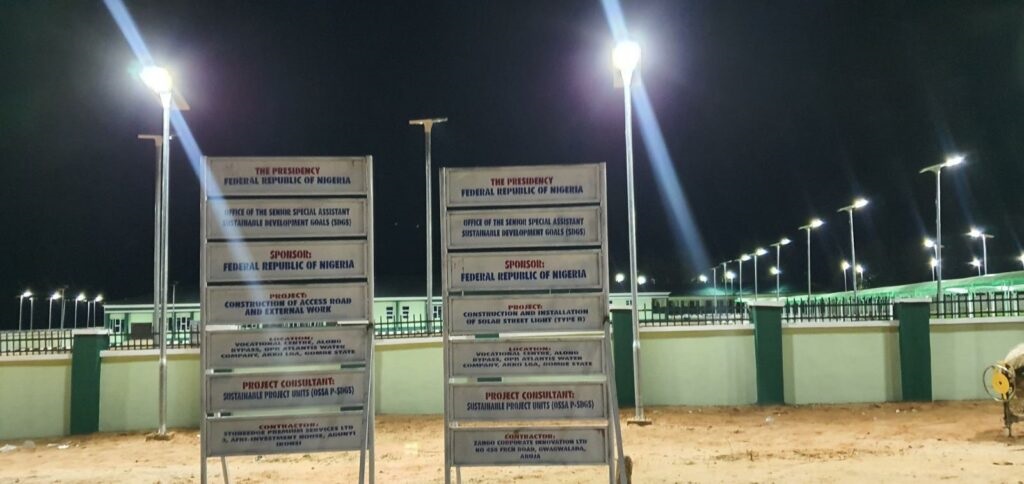
Both teachers and pupils in Gombe State, continue to endure difficulties as promised classroom and toilet construction projects remain unfinished, despite the allocation of funds to Cocoon Nigeria Limited by the Office of the Senior Special Assistant to the President on Sustainable Development Goals (OSSAP-SDGs). As a result, schools are still lacking sufficient classrooms, forcing students to learn on bare floors in overcrowded classes. Additionally, WikkiTimes’ 2022 investigation uncovered another scandal involving the same OSSAP-SDGs office, where four out of five contractors received over N1 billion for solar streetlight installation in Adamawa State. Allegedly, the projects were never executed, and the contractors were linked to the same individuals.
In May 2021, the Office of the Senior Special Assistant to the President on Sustainable Development Goals (OSSAP-SDGs), headed by Adejoke Orelope, paid N36,071,552.18 for the construction of one block of six classrooms with VIP toilets at Hammadu-Kafi Primary School, along Biu Byepass in Akko Local Government Area of Gombe State.
Cocoon Nigeria Limited got the contract and received the payment, which is part of the 2021 projects of OSSAP-SDGs in the area, according to data from govspend.ng, an open contracting platform.
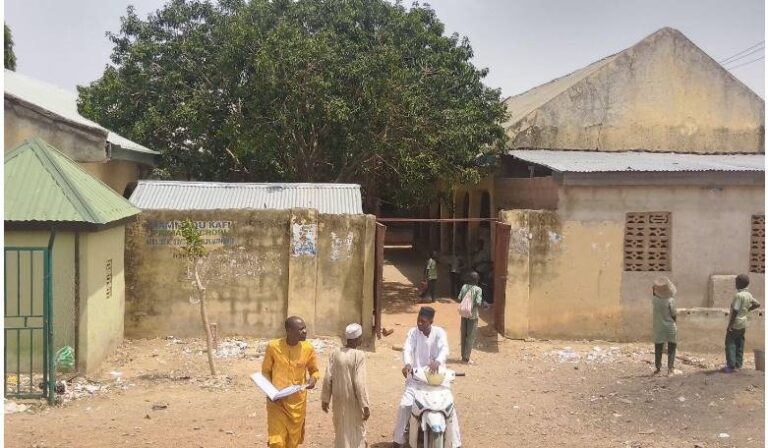
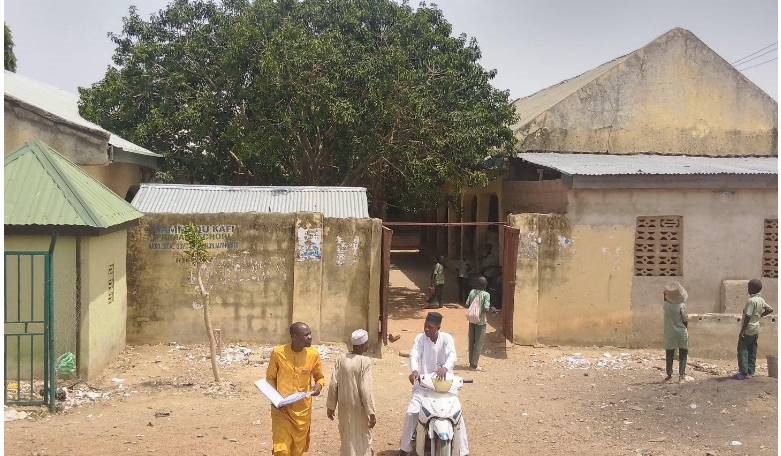
A view of Hammadu-Kafi Primary School, Biu Byepass, Akko, Gombe State. (Credit: WikkiTimes)
Similarly, in another separate release, the OSSAP-SDGs paid N36,093,998.75 to Musbal Integrated Services Limited for the construction of one block of six classrooms with VIP toilets at Kindiyo Primary School in Balanga Local Government Area.
An investigation by WikkiTimesrevealed that the classrooms and VIP toilets project at Hammadu-Kafi Primary School was not executed, leaving pupils to continue to receive lessons on bare floors in dilapidated classes. Due to classroom shortages, the school runs two shifts – morning and afternoon.
Pupils in primaries 1, 2, 5 and 6 take the morning session, while primaries 3 and 4 pupils have the afternoon session.
When this reporter visited the school on May 16, 2023, only seven classrooms were available for pupils. The last classroom constructed for the school was in 2013.
Data obtained from the office of the head teacher of the school shows that Hammadu-Kafi Primary School has a population of 2,000 pupils and 22 teachers, meaning that the pupil-teacher ratio, PTR, is about 91: 1, more than double the UNESCO maximum ratio of 40:1 and the 35:1 recommended by the Nigerian Education policy.
With its population, the school requires between 40 and 50 classrooms going by an acceptable pupil-to-classroom ratio of between 30 pupils to 50 pupils in a classroom. In the US, for example, the national average of student to classroom ratio is 24. In the United Kingdom and Wales, legislation stipulates not more than 30 pupils in a classroom for kids between five and seven
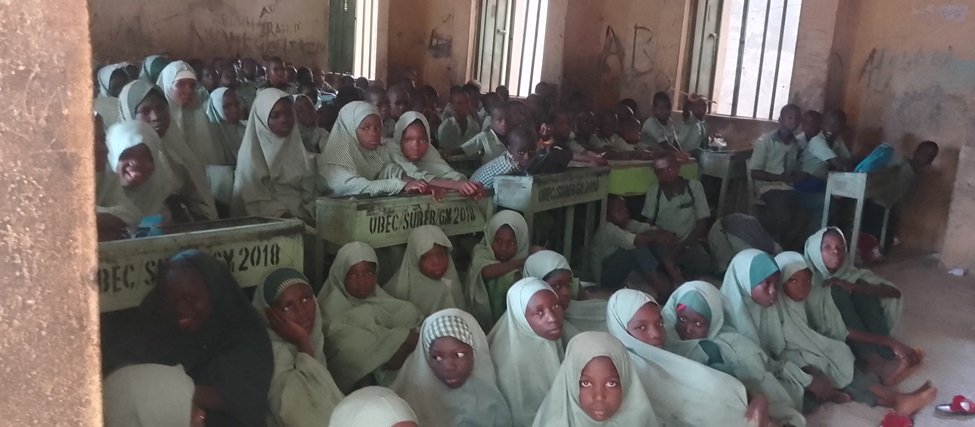
Each class at the school houses at least 160 pupils against the recommended 50 pupils class. A few desks were littered with available classes. Between three to four pupils sit on a desk designed for two. More than half of the pupils in every class sit on dusty floors.
Pupils receiving lessons on the floor (credit: WikkiTimes)
Khalid Adam, an 11-year-old Primary 5 pupil, said, “Most of us do not have seats. We sit on the floor because there are not enough seats in the school.”
He explained that only the lucky ones among them secure seats.
“Everybody strives to reserve their desks in the class throughout the session. If you are unlucky, you have to manage by sitting on the bare floor,” he added.
WikkiTimes gathered that seats are allocated to the pupils at the beginning of each academic session. It is done on the basis of first come, first serve.
Like their pupils, teachers at the school do not have the luxury of having an office. The teachers use the shade provided by the only tree planted at the centre of the narrow pavilion of the school premises.
A view of teachers segregated into gender-based clusters welcomes a visitor to the school premises.
Only the headteacher and his assistant share an office. The office is a double-room structure embedded in one of the blocks of classrooms in the school. The headteacher occupies the second room while his assistant uses the first room.
The office also serves as a store for the school. Brooms, books, hoes and chalks are stacked in a corner just next to the table of the assistant headteacher.
The headteacher, Sani Ahmed said he uses his own money to buy chairs and chalk for the school.
“Since the establishment of this school in 2007, we have not received chairs from the government. I have to use my salary to buy chairs and seats for the school,” he said.
Hopes Dashed
Barely three months after OSSAP-SDGs disbursed N36,071,552.18 to Cocoon Nigeria Limited, the contractor handling the construction of one block of six classrooms with toilets project at Hammadi-Kafi primary school along Biu Byepass in Akko local government area of Gombe State, a team of surveyors from the Sustainable Development Goals (SDGs) Gombe office surveyed and demarcated an area for the construction of a block of six classrooms and toilets in the school.
A public search on the company at CAC and NG-Check reveals that the company, whose address is given as 10 Sarkin Crescent, Kaduna, has three directors; namely, Moukarim Wajdi, Suly B Mohammed and Amal Bouri, all who appear to be foreigners.
WikkiTimes gathered details of the contract, which is under lot A1, including the construction and furnishing of one block of six classrooms at the cost of N36,071,552.18.
On 28 September 2021, a team of surveyors from the Sustainable Development Goals (SDGs) Gombe office surveyed and demarcated an area for the construction of a block of six classrooms and toilets in the school.
This was a great sigh of relief for the school. Excitement and happiness filled the staff and pupils but unknown to them, the project will not be delivered anytime soon. Two years after, neither the surveyors nor officials from the SDGs office returned to the site. No construction work ever took off in the school, to the disappointment of the people.
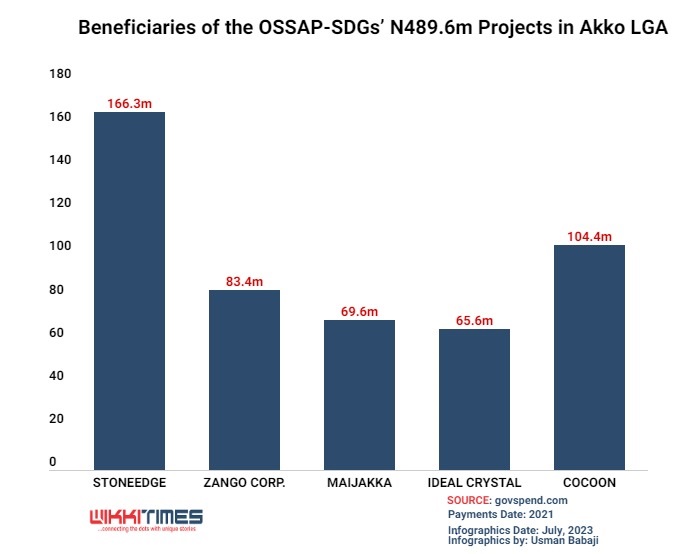
An infographic showing 2021 beneficiaries of OSSAP-SDGs projects in Akko LGA
A source in the school who does not want to be named told WikkiTimes that “a team of experts from SDGs visited, inspected, surveyed and promised to modernise the school. They surveyed the location with a great deal of energy as though work on the site commences the next day. But up to this moment, they never return.”
He added: “Nobody explained to us why or when work will commence as promised. We were left to our fate.”
One Toilet for 2,000 Pupils
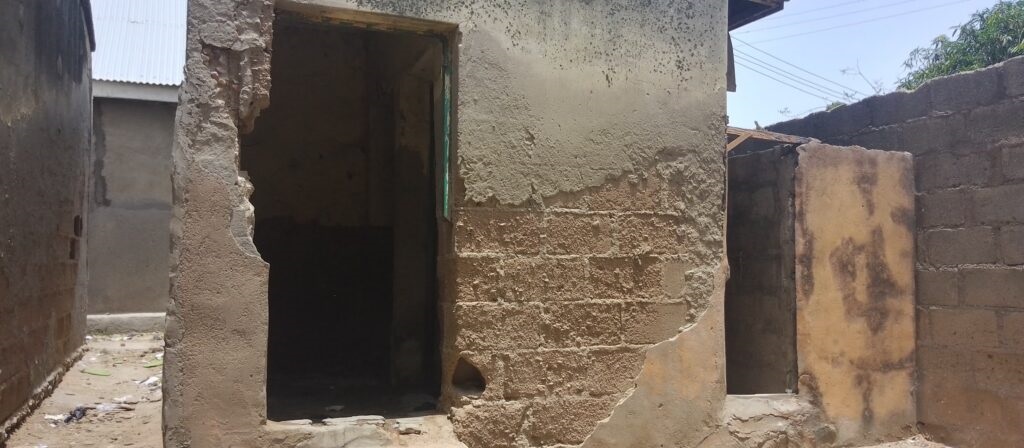
The over 2,000 Hammadu-Kafi Primary School pupils converge on a pit-latrine toilet daily to urinate or defecate. At breakfast, a long queue of pupils widened at the door of the toilet facility, waiting to take their turns, while others are forced to use the back of their classes. According to UNICEF data, only 10 per cent of Nigerian schools have access to requisite sanitation facilities, including toilets.
The only toilet facility at Hammadu-Kafi Primary school (credit:WikkiTimes)
Similarly, teachers in the school use one latrine pit toilet separated only by a wall from that of their pupils.
“I don’t feel comfortable using the school toilet as a woman because other male colleagues use it as well. We were forced to be visiting close by houses to respond to our call of nature,” Aisha Sambo, a female teacher at the school, said.
The toilets are stinky and messy because of the high number of pupils and staff that rely on them, coupled with water scarcity in the school. The only borehole constructed at the school gate has stopped working.
Every day, the school spends at least N300 buying water from vendors. A group of pupils trek about a kilometre to fetch water to help keep the toilets clean. Despite these attempts, the school environment is always unfriendly for the nose.
The headteacher, Ahmed, said keeping the two latrines in the school clean remains a difficult task due to the non-availability of water sources within the premises.
Cocoon Nigeria Limited failed to give an explanation about why the project was not executed. One Jonah Ali, a representative of the company, declined to respond to WikkiTimes‘ enquiry about the project. Instead, he vowed to introduce this reporter to the Managing Director, Moukarim Wajdi, the next day to respond.
“The MD is not available. I am on my way to the town now. I will give him your contact to call you tomorrow,” he said but has not kept to his words as at press time.
Kindyo: Project Diverted
In June 2021, OSSAP-SDGs awarded a contract for the construction of one block of six classrooms with VIP toilets to Musbal Integrated Services Limited at N36,093,998.75.
Musbal Integrated Services Limited has five persons listed as directors, including its current Managing Director, Adamu Bala who is also a native of Kaltungo Local Government Area, Gombe State. The four other directors of the firm include Aisha Abdullahi, Mustapha Aliyu, Jamil Garba and Mariya Shinkafi.
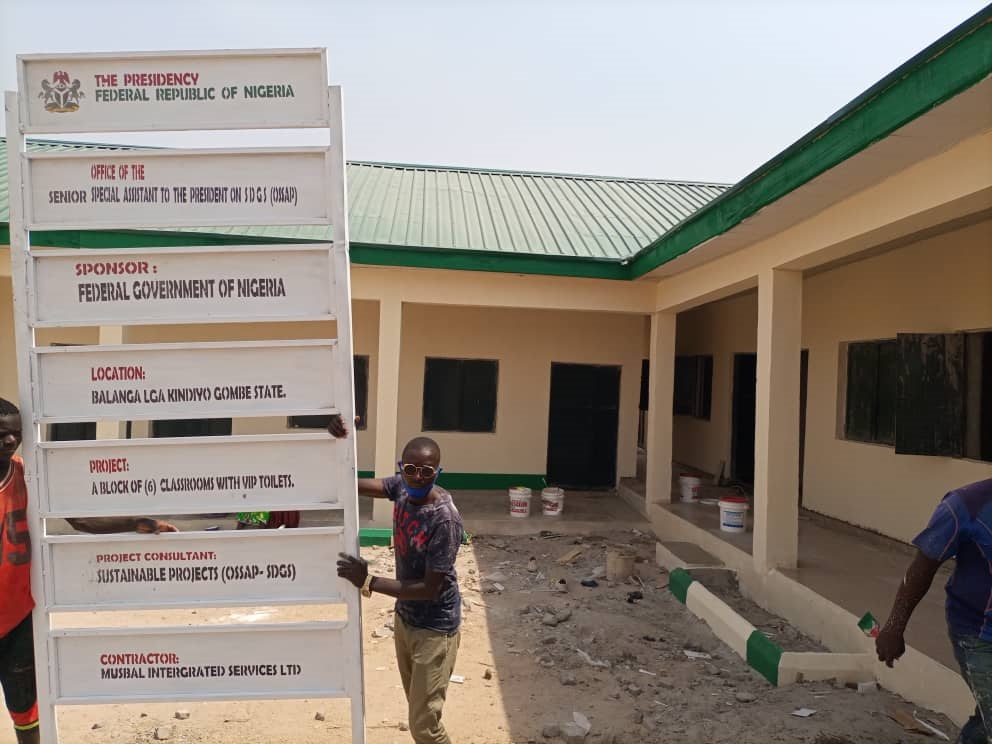
The project was to be executed at Kindiyo Primary School, a community in Balanga local government area of Gombe State, as per payment details for the project available on Govspend.
A view of a block of six classrooms constructed at Kulo, Kindiyo Ward, Balanga. (credit: OSSAP-SDGs)
However, when this reporter visited the Kindyo community on 17 May 2023, it was apparent that the OSSAP-SDGs diverted the project to a different community, Kolu, which is not the original beneficiary of the project.
WikkiTimes’ findings reveal that the diversion of the project worsened the dire need for additional classrooms at Kindiyo Primary School. Similarly, it also denied the school an opportunity of having a toilet for the first time since its establishment in 1978.
Records from the office of the headteacher of the school indicate that while this year alone, it admitted 200 pupils, the school only have six classrooms manned by five teachers, including the head teacher.
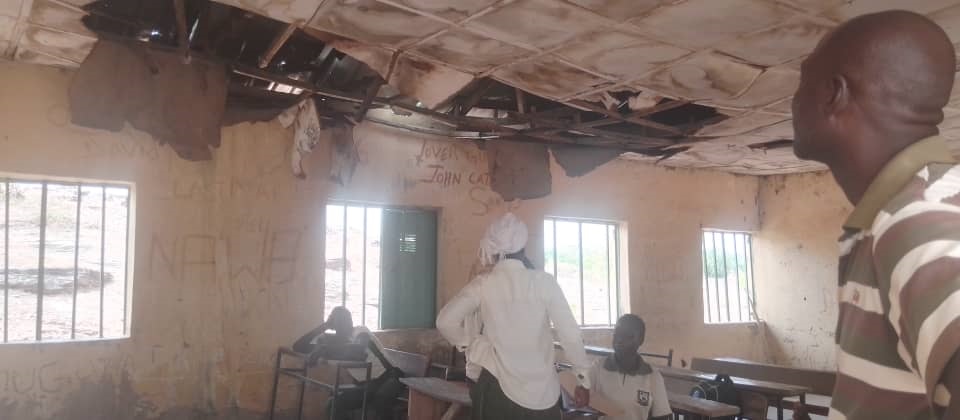
Four out of the six classes do not have desks. The classrooms also have no windows or doors, and their ceilings have been torn apart.
Amos Hussaini, Assistant Headteacher, said the lack of a toilet facility in the school exposes pupils to scorpion bites due to the hilly nature of its surroundings.
A collapsed classroom block in Kindiyo Primary School (credit: WikkiTimes)
“Women teachers have to use toilets in houses close to the school thereby losing man hours that would have been channeled to teaching in the process. “As you can see, the walls of classes have been turned into toilets by the pupils. This has contaminated the air around the school. Sometimes, one struggles to breathe because of the bad smell of excrement and urine,” he said while pointing to a pile of pupils’ faeces behind one of the blocks of classrooms.
Work Done
The project, the construction of one block of six classrooms in kindiyo, but diverted to the Nomadic school Kolu was executed and put to use.
The contractor, Musbal Integrated Services Limited, furnished and wired all the classes.
Similarly, both Musbal Integrated Services Limited and OSSAP-SDGs separately confirmed that the project was executed.
Musa Ibrahim, a parent, told WikkiTimes that their children were eager to go to school shortly after the classrooms were put to use.
“At that time, we don’t have to chase our children to school. They simply go to school by themselves without much ado,” he said, noting the impact of the project.
The newly constructed classes provide additional classes for the school. The number of classes rose from just two to seven with an office and a store.
Moses Usman, a teacher at the school, said the additional classes meant that all pupils in the school have a classroom to receive lessons against learning under the tree as it previously used to be.
However, he noted that they are unable to keep the constructed toilets clean because of a lack of water.
“We don’t have sources of water here in the school. We have sent some pupils to fetch water every day,” he said.
He added that sometime this year, thieves broke into the newly constructed classes and went away with fans, wires, bulbs and ceilings.
“After we noticed this incident, we removed all the remaining ceilings and wires to avoid losing everything to the thieves,” Usman said with his voice echoing dismay.
Fake Pictures Claiming Project Execution
When contacted, the media aide to Senior Special Assistant to the President on SDGs, Desmond Utomwen claimed that the Hammadu-Kafi Primary School project was fully executed and he said he was ready to share evidence to prove his claim.
One of the misleading pictures OSSAP-SDGs shared
After about 24hrs, he shared 12 photos. He claimed that seven of the photos were for the one block of six classrooms Cocoon Nigeria Limited constructed along Biu Byepss Akko Local Government Area.
It was evident that the pictures were meant to mislead. First, the pictures Utomwen claimed to be classrooms Coocon constructed along Biu Byepass were fake. In reality, the photographs are of a skills acquisition centre project along the same axis.
Similarly, data from govspend.ng shows that the skills acquisition project is different from the one block of six classrooms with the VIP toilet contract, even though both projects were billed to be executed in Akko LGA. “I have given you information as far as that project is concerned. All I know is that the project was fully executed and payment made,” he insisted after this reporter demanded him to further substantiate his claims.
An infographic showing 2021 beneficiaries of OSSAP-SDGs projects in Balanga LGA
When WikkiTimes pressed further to obtain the list of projects for 2020, 2021 and 2022, the media aide to the Senior Special Assistant to President on SDGs dodged, arguing that the questions ‘were abstract.’
He added, “Those questions you asked were abstract, I must tell you, and I cannot respond to abstract questions. Nobody will have time to give details about the budget for projects in 2020, 2021 and 2022.”
Adamu Bala, Managing Director of Musbal Integrated Services Limited, the firm handling project at Kindiyo insisted that the project was executed but failed to give reasons for the diversion of the project from the original community.
In a WhatsApp voice call while in the Holy Land performing this year’s Hajj, the Managing Director dodged questions bordering on why the project was transferred to Nomadic Kolu despite a dire need for additional classrooms in the original community where the project was cited.
“You are one person that I will never forgive for unnecessarily disturbing my Hajj ibadat for no reason. You cannot collaborate with my traitors to spoil my name and think you can go free,” he declared in an emphatic voice.
THE Federal Competition & Consumer Protection Commission of Nigeria (FCCPC) has delisted two digital money lenders (DMLs) for violating customer privacy.
The Commission said the violating DMLs have resorted to using Android Package Kits (APK) file formats, providing links to consumers to visit unregistered websites using their Android devices/phones.
“In the course of that interaction, consumers’ private information that is otherwise protected and prohibited from access or download by DMLs or their apps is accessed and downloaded,” the FCCPC said.
The regulatory agency added that it has placed digital money lenders that have refused or failed to register under the guidelines on its watchlist for strict surveillance and necessary action.
The FCCPC said it will soon release a list of illegal (unregistered) digital loan apps operating in Nigeria.
The Commission said in a bid to protect consumers and maintain a regulated financial ecosystem in conjunction with the Joint Regulatory and Enforcement Task Force (JRETF), it took decisive actions against two of the companies for their alleged involvement in fraudulent practices.
According to a statement by the Commission’s boss, Babatunde Irukera, on Thursday, July 20, the two companies are Sycamore Integrated Solutions Limited and Orange Loan and Purple Credit Limited.
According to the FCCPC, during the Commission’s ongoing investigation and tracking of these illegal DMLs, it was discovered that some registered DMLs had engaged in duplicity.
While appearing on the approved list and Playstore, these registered lenders also used APKs to attract borrowers to illegal and unregulated lending practices, FCCP claimed.
“The companies or apps so far identified, and for which there is supporting evidence of this malfeasance, are Sycamore Integrated Solutions Limited and Orange Loan and Purple Credit Limited.
“They are the owners of “Getloan” and “Camelloan” respectively, and occupy Nos. 1 and 65 on the Approved List of the Commission, which is available on the Commission’s website.
“Accordingly, the Commission has now permanently delisted Sycamore Integrated Solutions Limited and Orange Loan and Purple Credit Limited, along with their respective apps – “Getloan” and “Camelloan”.
“In addition, the Commission has entered an Order to Google Playstore and other payment and financial service providers, permanently prohibiting the provision of any services associated with digital lending to Sycamore Integrated Solutions Limited and Orange Loan and Purple Credit Limited,” the Commission stated.
The FCCPC clarified that the revocation and penalties taken against these offenders were final and would set a standard for handling any other violators found in the future.
In light of these recent developments, the Commission reiterated its advice to consumers to exercise caution when selecting digital money lenders.
It recommended that consumers patronise only DMLs on the Commission’s approved list, as these lenders have undergone regulatory scrutiny, ensuring the safety and privacy of consumers’ information.
The Commission and the JRETF pledged to continue tracking illegal operators employing APKs and other means to interact with consumers.
The FCCPC ask the public to provide reasonable evidence and report any violations through the designated email address, lenderstasforce@fccpc.gov.ng.
The Commission specifically recommended that consumers only patronise digital lenders on its approved list to avoid falling victim to illegal and prohibited lending and recovery practices.
A total of 180 loan applications have been registered (completely or partially) and given the go-ahead by the FCCPC to operate in Nigeria.
In April, the Federal Government, in conjunction with Google, prohibited loan apps from accessing contacts and images of their customers.
In a chat with The ICIR on Monday, April 10, the spokesperson of the Federal Competition and Consumer Protection Commission (FCCPC), Ondaje Ijagwu, said the Federal Government is putting measures in place to enforce the latest policy by Google.
He said the action was consistent with the Nigerian authorities’ move to curtail the invasion of customers’ privacy by loan app firms.
Debt recovery agents of loan apps in Nigeria have continued to shame defaulting borrowers against the nation’s cyber laws while the loan app companies charge borrowers high-interest rates.
In August 2021, The ICIRexplained how Nigerian fintech companies shame, threaten customers for late payment of loans.
Also, in March 2022, The ICIRhighlightedhow loan apps debt recovery agents operate.
The digital loan apps mislead borrowers by posting lower interest rates on the Google Play Store, but borrowers saw their loan tenor increase as the loan apps raised interest rates by more than 50 per cent.
The interest rates can be as high as 75 per cent to 395 per cent per year.
Despite the efforts of the regulating authorities, the Illegal loan apps have ignored Nigeria’s cyber laws and continue to shame their customers.
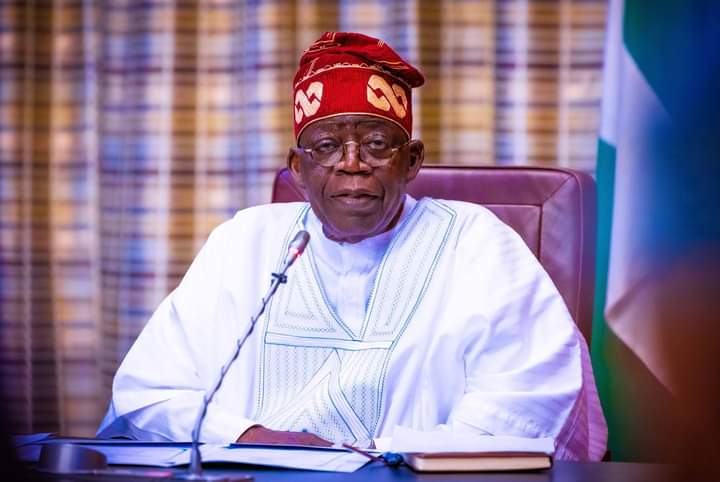
President Bola Ahmed clocked 50 days in office on Wednesday, July 19, with the populace getting apprehensive as his administration’s economic policies induced unprecedented inflation rates and inflicted agonies.
Tinubu had, immediately after replacing his predecessor, Muhammadu Buhari, eliminated the fuel subsidy regime, a decision that instantly triggered a 200 per cent increase in the pump price of petrol, a strategic commodity that influences pricing and cost in other sectors of the economy.
The Tinubu administration jacked the fuel price from a range of N187 to N255 per litre obtainable in Lagos and Abuja, respectively, to a new price of N488 per litre in Lagos to N560 in Abuja. The prices were higher in some other states across the country.
Infographic describing sharp rise in petrol price following subsidy removal by Tinubu administration
On Tuesday, July 18, the administration effected another round of fuel price increases. A litre of petrol now sells for N570-N620 in Lagos and up to N700 in Abuja. The price is higher in some states across the country.
Another key policy pronouncement of the administration is the foreign exchange rates unification, by which forces of demand and supply determine the rates, with direct consequences, especially on prices of imported goods.
Policy impact
The astronomical spike in transportation costs is a crippling result of the fuel subsidy removal. Fares have gone well over 100 per cent on many routes across the country, with multiplier effects on passenger commuting, goods movement, and prices of foodstuffs.
File Photo: A market in Nigeria
This has further worsened, for most Nigerians, the poverty level and quality of living generally. More commuters have taken to the roads trekking long distances as they cannot afford the new high fares.
The unification of forex rates hits the national economy through debts, with the profile rising to N81trillion following the floating of the naira and the resultant devaluation by the Central Bank of Nigeria (CBN).
The devaluation saw the local currency, which was exchanged at N430 to the dollar at the official window before Tinubu assumed office and as at the end of the first quarter when the Debt Management Office (DMO) last published the national debt profile, shoot over N750 at the close of trading at the import and export window on Tuesday, July 18.
A June 6 report by The Guardian newspaper highlighted trouble in the health sector as drugs and cost of care generally increased by 150 per cent, arising from the inflationary impact of floating the naira.
The Guardian report revealed that drugs were fast getting out of stock or unaffordable. The Federal government disclosed its plans to reduce the importation of drugs in the country from 60 per cent to 40 per cent to promote the local manufacturing of drugs. For now, 70 per cent of medicines consumed in the country is imported.
Fears over proposed electricity tariff hike
Despite assurances in June by the Nigeria Electricity Regulatory Commission (NERC) and electricity distribution companies (DisCos) that electricity tariffs would not be raised, there are indications that the tariff will go up latest August as the Tinubu administration pushes to completely hands-off power sector subsidy, as it did petrol.
The president of Nigeria Consumer Protection Network and coordinator, Power Sector Perspectives, Kunle Olubiyo, believed the tariff would soon be increased.
Olubiyo told The ICIR, “Tariff adjustments happen every six months. However, most of us just concluded that the six months period was supposed to end on June 30, 2023, and that with effect from July 1, there might be an upward review.
“However, that is not sacrosanct; there is nothing in the books that says it has to be July 1. But, of course, in this month of July, somewhere along the line before this month ends, you may load credit and notice some adjustment.”
Food prices going out of reach
The sharp increase in fuel prices on May 29, when Tinubu assumed office, has greatly affected prices of foodstuffs. Distributors and dealers of food items complain of high transportation costs following an increase in petrol price.
Checks in most markets in Abuja revealed that the price of a mudu of garri has risen from N300 to N600 between May and June. A six-piece bunch of plantain that sold for between N600 and N800 two months ago is now selling for N1,400.
Consumers are worried prices of foodstuffs are likely to go higher following the fresh increase in fuel price on Tuesday.
The worry is heightened by the possibility of prices going through the roof, with the Nigerian National Petroleum Company Limited (NNPCL) maintaining that market forces would determine the fuel pump price. Nigerians do not see market forces as favouring the local economy now.
Price of garri gradually going out of reach.
What economic analysts are saying
To many key economic watchers, the government’s direct announcement and strict implementation of its key policies without unveiling mitigation strategies is not pro-poor, as the poor have been left to absorb the shocks.
“Let us not be carried away by the positive reactions in the capital markets by these policies. Above all, we should remember that the economy is meant to serve the Nigerian people.
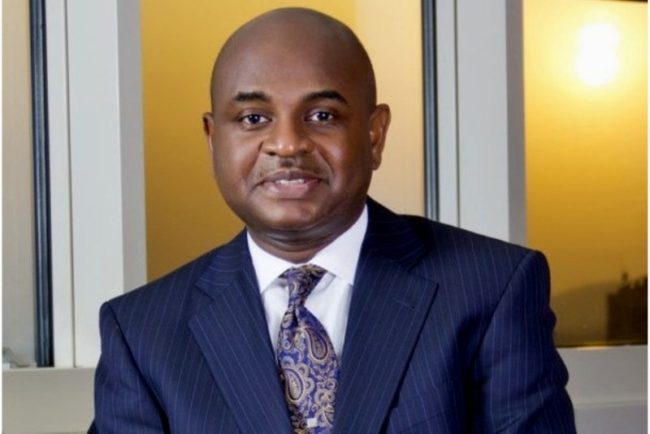
“The reality is that Nigerians are suffering greatly because the cost of living has risen beyond their means,” a former Deputy Governor of the Central Bank of Nigeria (CBN), Kingsley Muoghalu, said.
Muoghalu: The poor are left to absorb shocks of the government’s policies
Muoghalu noted that the Federal government should have moved faster on the matter of a new minimum wage and should have had a way of subsidising transportation.
“All these should have been addressed with the same determination that we have seen in the government’s reforms,” he said.
The Lead Director of Centre for Social Justice (CSJ), Eze Onyekpere, saw the steps taken so far by the Federal government as signalling no hope for poor Nigerians.
Onyekpere believes the renewed hope mantra of Tinubu’s administration offers no hope to the poor.
“Implementing policies has been a problem for this new government. Announcing these policies when it had not been thought through is not giving any hope. The poor are now bearing the brunt,” Onyekpere said.
He added that continued devaluation of the naira would further affect the prices of goods in an upward swing.
Onyekpere is foreseeing the likelihood of prices of petroleum products continuing to rise with the imposition of a 7.5 per cent value-added tax (VAT) on their importation.
He advised the government to think out measures that would sustain forex inflow to match demand, or there would be a run on the naira, which he feared could see it exchanged for N1,000 against the dollar.
Despite the agonies the Tinubu administration’s reforms seem to be inflicting on the people, analysts like Tilewa Adebajo of CFG Advisory are urging the President to ensure policy consistency.
Adebajo said keeping at it would put investors on alert on “how serious Nigeria is,” which he viewed as having the potential to attract more private capital into the Nigerian economy.
“Consistency in policy reforms is key. We need to show long-term commitment to our policies such that both local and international investors can take us more seriously,” he said.
According to Adebajo, Tinubu must use the meeting at the United Nations General Assembly in September to market Nigeria’s policies and show commitment on transparency and accountability.
“The President is to go to the United Nations General Assembly in September, and he is to deliver a major speech with respect to the policy direction of Nigeria.
“We need a budget that is clear and transparent, devoid of ways and means, so that by the first quarter of next year, when the International Monetary Fund comes up with its Article 4 report on Nigeria, we can see credit rating agencies begin to upgrade Nigeria and pull us out of junk status,” he said.

![[Flood series] Mapping out areas in Abuja prone to flooding](https://www.icirnigeria.org/wp-content/uploads/2022/10/Flooded-Ala-Obaje-Community-Igalamela-LGA-Kogi-State.-Photo-The-ICIR..jpg "[Flood series] Mapping out areas in Abuja prone to flooding")