Home Blog Page 1772

June 12: Hold Buhari, APC responsible for attacks on protesters, PDP tells Nigerians

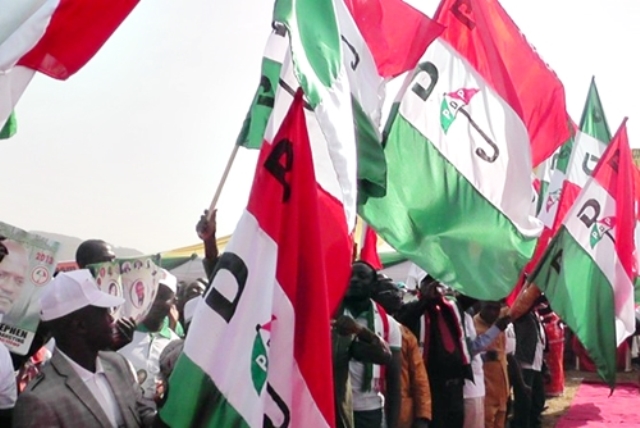
THE People’s Democratic Party (PDP) has urged Nigerians to hold President Muhammadu Buhari and the All Progressives Congress (APC) responsible for the clampdown on protesters who staged protests to mark Nigeria’s Democracy Day on June 12.

Tear gas canisters were fired at some Nigerians who converged in different parts of the country to protest against misrule by the Buhari-led government.

The PDP, in a statement issued on Saturday by the National Publicity Secretary Kola Ologbondiyan, described the attacks as sacrilegious.

The party also said that Buhari displayed his disdain for free speech and other democratic tenets when he addressed Nigerians on Saturday morning.

It also knocked the president for failing to caution the security agencies against clamping down on protesters.

“It is awkward that the APC and President Buhari, who were allowed their freedom when they protested in 2014, would turn around to subject Nigerians to actions of inhumanity including the use of firearms against the people, as being witnessed today,” PDP said in the statement.

The party disclosed that it was cataloguing all the infringements which the APC and President Buhari “are rudely imposing on people in the country” for the attention of the international community.

The ICIR had reported earlier on Saturday how security agents attacked protesters at Ojota in Lagos State.

Several media reports indicated that the government mobilised police and other security agents to clamp down on protesters in various parts of Nigeria.

The ICIR also, on Saturday, reported how a pro-Buhari protester said people in his group members were paid between N1,000 and N2,000 each to join demonstrations against the June 12 protest.

The pro-Buhari protester, Abdul Yusuf, made the revelation in a video sent to Premium Time.

Meanwhile, Nigeria faces unprecedented insecurity in which four of its six regions are confronted with secessionists, bandits, kidnappers and terrorists.

While the North-East and North-West battle terrorism, banditry and kidnapping, respectively, the South-East and South-West are threatened by secessionists.

Buhari had directed the security agents to go after trouble makers in the country and bring them to justice.


READ ALSO:


Also, in October 2020, the president vowed that he would never allow protests that would culminate into arson, destruction of property, looting and wanton killings that characterised the #EndSARS protests across the nation.

The immediate past Inspector-General of Police Muhammed Adamu also gave a similar threat.

Nigerians staged the #EndSARS protests to compel the Federal Government to disband the Special Anti-Robbery Squad (SARS) – a notorious arm of the nation’s police.

Apart from pro-secession protests in the South-West led by Sunday Adeyemo, popularly known as Sunday Igboho, no major protests have taken place in the country since the #EndSARS conundrum.


Twitter did not change ‘like’ and ’retweet’ button colour in solidarity with June 12 protest

ON Saturday, June 12, 2021, many Nigerians across multiple locations took to the streets in protest against the Federal Government’s inability to tackle insecurity and economic woes in the nation.

As a result, the hashtag #June12thProtest trended on the social media.

June 12 is marked as Democracy Day in Nigeria.

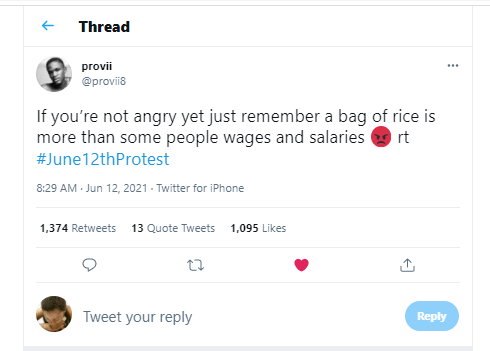
Among those using the hashtags were some individuals who alleged that Twitter, or its CEO Jack Dorsey,  had changed the like and retweet button to green or the Nigerian flag in solidarity with the protest.

A search conducted by the FactCheckHub on Twitter using the phrase ‘Like button changed’ showed results [archived here] of multiple tweets making the claims.

The Claim

Twitter or its CEO Jack Dorsey changed the like and retweet button in solidarity with June 12 protest.

The Findings

Checks by the FactCheckHub showed that the claim was false.

A Twitter user with the username @ChibuzorUkwu tweeted that the retweet button was changed from blue to green.

“Twitter has changed the retweet button colour from blue to green in solidarity with Nigerians on #June12thProtest’ Let’s light the candles of hope and unity that they thought was put out during #EndSARS. Jack is blessed,” his tweet read.

The Twitter retweet icon colour prior to June 12 was green and it is still green.

Findings revealed  a noticeable change was made to the retweet option colour  in 2016 and it has since been returned to its default green colour.

A Twitter user with the username @urPapaDeyCraze tweeted that the like button changed.

“The like button of any tweet carrying #June12thProtest just changed!!! jack is behind us! RT aggressively,” his tweet read.

The user attached screengrabs of a tweet showing that the like button had been replaced by the Nigerian flag. One of the attached images had no flag to represent it before retweeting while the other had a flag to represent after retweeting.

Screenshots attached to the tweet.

The FactcheckHub traced the original Tweet and found that the claim is false. The tweet had showed the default red heart when liked.

The tweet shows red heart when liked and not a flag.

Furthermore, the FactCheckhub fact-checkers liked multiple tweets with the hashtag #KeepItOn and #June12thProtest but it did not change into a flag.

The Factcheckhub observed that the same person or a group of persons was behind this misinformation.

For instance the screenshot of tweets with flags as like icon in circulation had Provii [@provii8],  @urpapapadeycraze, and David of FCT [@Dhavidote] as the alleged accounts.

A red flag that the images were manipulated was that the tweets had the same posting time of 8:29am, June 12. They also had the same number of likes, quote tweets and content.

This led to further scrutiny and the Factcheckhub observed that these accounts were interacting with one another.

For instance @UrPapaDeyCraze tweeted that the like icon changed to flag using a screenshot of Provii’s tweet. Provii came under the tweet to to ask for followers.

The fourth comment on UrPapaDeyCraze tweet showed Provii’s confirmation comment, “Wow it’s True guys.”

Dhavidote tweeted manipulated screenshot of his tweet and that of @UrPapadeyCraze.

This pattern was noticed on the two other accounts too.

The people behind the misinformation were using it to get traction and engagement.

The Verdict

The claim that Twitter retweet and like icon changed in support of the June 12 protest in Nigeria was FALSE. Malicious actors were deliberately misinforming the public for their personal gain.

The dilemma over grazing laws

0

By Eric Teniola

PRESIDENT Muhammadu Buhari has often referred to the gazette which published the grazing laws in Nigeria. In his television interview to mark his 6th anniversary in power, he made reference to the so-called gazette.  The president was echoing what his Chief of Staff Professor Ibrahim Gambari said on April 1, 2018, when he was the chancellor of the Kwara State University in Ilorin.

On that day Professor Gambari referred to existing laws on grazing and that the major problem facing us now is the non-implementation of the grazing laws as contained in the gazette. My understanding is that both the president and his chief of staff were equating the laws of Northern Nigeria on grazing as if they were laws passed by the central government. The grazing laws which the two men referred to were passed into a decree by the then Premier of Northern Nigeria Sir Ahmadu Bello (12 June 1910-15 January 1966), the Sardauna of Sokoto. The laws were not operative in the West, Mid-West and Eastern regions.

According to Dr. Ismaila Iro, Grazing reserves in Nigeria started during the pre-colonial era. Although formally introduced by the British, grazing reserves were demarcated by the Fulani who conquered and ruled Northern Nigeria. The attempt by the British in 1940 to separate the grazing land from the farm land, however, faltered because the Europeans imposed land use controls divorced from economic and demographic dynamics in the pastoral system. Formal grazing reserves in Nigeria started accidentally in the 1950s when Hamisu Kano, working with pastoralists on livestock vaccination, foresaw the shortages of grazing land in Northern Nigeria. Supported by the government, he initiated the grazing reserve scheme from the abandoned government resettlement schemes (Fulani Settlement Scheme). The resettlement schemes collapsed because the government had neither the financial nor the managerial ability to continue with the financially burdensome scheme, and the best alternative use of the land, the government thought, was to convert it into grazing reserves that were less financially committed.

Grazing reserve hatched in 1954 after a study of the Fulani production system contained in the ‘Fulani Amenities Proposal.’ The proposal suggested the creation of grazing reserves, the improvement of Fulani welfare, and the transformation of the herd management system. By 1964, the government had gazetted about 6.4 million hectares of the forest reserve, ninety-eight per cent in the savanna. Sokoto Province had 21 per cent of the land, followed by Kabba, Bauchi, Zaria, Ilorin, and Katsina, with 11-15 per cent each. The Wase, Zamfara, and Udubo reserves followed in succession.

In 1965, the Northern Nigerian Government incorporated the Fulani Amenities Proposal into the Grazing Reserve Law. Before the enactment of the Grazing Reserve Law of the Northern Nigeria, the pastoral Fulani relied on the goodwill of the farmers, who conferred upon themselves the lordliness of occupied and unoccupied land. Because interpersonal and kinship affiliations governed the dispensation of land, the Fulani worried about being evicted from the land when their relationship with the hosts would become strained. The planners, however, applied a top-down approach that excluded the Fulani from formulating and implementing this well-intentioned programme.

Accordingly, the Fulani gave less than the expected cooperation in the scheme. Professor Gambari coming from Kwara state had in mind, the Kwara State grazing laws that were in existence years ago. In an article by Professor Ade Olomola, he said the grazing laws in Kwara State were in operation only in Kwara. According to him, the main focus of the settlement policy was the development of grazing reserves in the state. The objectives of the policy were (i) to provide feed and water for pastoralists on a year round basis, (ii) to eliminate nomadism, improve cattle production and raise the living standard of pastoralists, (iii) to ensure efficient use and protection of environmental resources and (iv) to prevent or minimize incessant clashes between herders and farmers which often result in bloodshed and loss of life. The procedures involved in the implementation of the policy included: land acquisition, demarcation, surveying, gazetting of grazing reserve, development of grazing reserve and settlement of pastoralists. The following were the grazing reserves at various stages of acquisition in Kwara State: Nweri, Kinikini, Gidan Magajia, Moli, Wuru, Okuta , Olodan, Igbaja, Alapa, Babanla, Chita, Lata, Oro, Sharagi, Shao, Kaiama and Omi-Eran (LSC)

The Gidan Magajia is one of the two grazing reserves that have been gazetted in the state. It is the largest in the state and the focus of attention. Two implementation committees were set up for the purpose of development and management of the reserve as well as settlement of pastoralists. They were the policy committee at the state level and grazing reserve management committee at the local government level. The former is charged with the responsibility of formulating and defining development policy and ensuring that the management committee is provided with the means to achieve management objectives. The latter was to advise and assist on matters affecting the settlers on a day-to-day basis as well as identifying settlers for the reserve. \

The Order setting up the reserve stipulated that it should be maintained through proper grazing management and improvement activities such as water development, fodder conservation plan, range reseeding and fertilization, control of undesirable weeds and fire tracing. Other development activities included: construction of earth dams, boreholes and wells to provide watering facilities, construction of roads, office and residential quarters, establishment of livestock services centre and pasture development. Moreover, efforts were to be made to ensure that the highest possible level of productivity was achieved without endangering the reserve. To this end the government stipulated that soil and water conservation and other erosion control methods should be used to prevent degradation, desertification and overgrazing, and to maintain the carrying capacity of the reserve. Both the federal and Kwara State governments were supposed to play active parts in the development of the grazing reserve. The Federal Government was to be involved in the provision of infrastructure such as dams, roads and means of transport for range guards through the agency of the National Livestock Projects Division (NLPD). The Kwara State government had the responsibility to acquire the land following stipulated legal procedures and provide staff for the management of the reserve. As at 1992, five government officials consisting of a project officer, a veterinary assistant, two range guards and a security guard were operating in the reserve.

In short, the central government did not enact any grazing law. The best the central government has done was the promulgation of National Commission for Nomadic Education, Decree 25, 1989 and National Commission for Mass Literacy, Adult and Non-formal Education, Decree 17, 1990. These two decrees were promulgated by General Ibrahim Babangida. The minister of education at that time was Professor Babatunde Aliu Fafunwa (23 September 1923 – 11 October 2010). All the military governors at that time were ordered by General Babangida to launch it in their states.

I remember at that time there were public outcries about the decree that they favoured the Fulani people. I think it was the best thing at that time that the central government ever did for the Fulani people. The Commission devised a series of innovative approaches and strategies. The broad goals of Nomadic Education Programme were: To integrate nomads into national life through relevant, qualitative and basic functional education and to raise both the productive and income levels of nomads, as well as boost the national economy through improved knowledge, skills and practices of nomads. The NCNE’s mandate included, among other things, the following functions: formulate policy and issue guidelines in all matters relating to nomadic education in Nigeria; provide funds for: the research and personnel development for the improvement of nomadic education in Nigeria, the development of programmes on nomadic education and the provision of equipment and other instructional materials, construction of classrooms and other facilities relating to nomadic education.

Other mandates included: establishment, management and maintenance of primary schools in the settlements and grazing reserves carved out for nomadic people, to determine the standards of skills to be attained in nomadic schools, to arrange for effective monitoring and evaluation of activities of agencies concerned with nomadic education; to liaise and co-operate with other relevant ministries and agencies; to receive block grants and funds from the Federal Government or any agency authorised on that behalf and allocate same to nomadic school based on any formula approved by the Federal Executive Council; to act as an agency for chanelling all external aids to nomadic schools in Nigeria; to ensure effective inspection of nomadic education activities in Nigeria through the sections in the Federal and State Ministries of Education performing duties relating to nomadic education; to collate, analyse and publish information relating to nomadic education in Nigeria; and to undertake any other action desirable for the promotion of nomadic education. The objectives of the nomadic education programme are to: expose the nomadic child to the elementary forms of modern education; enable the nomadic child take part in the development of his immediate environment, in particular, and the country in general; make the nomadic child self-reliant to improve his living conditions, thus eliminating the hardships and constraints in his/her life; help him/her modernize his/her techniques of herdsmanship on animal management, fishing or farming as the case may be; assist the nomadic child develop rapidly and fully both physically and intellectually, to cope with the demands of the contemporary world; and develop the initiative of the nomadic child and stimulate in him/her scientific and analytical modes of thinking.

On November 22 last year, the Executive Secretary for Nomadic Education Professor Bashir Usman said out of the estimated population of 9.4million nomads in Nigeria, 3.3 million were children of school age. The participation of the nomads in the existing formal and non-formal education programmes is abysmally low, with a literacy rate ranging between 0.2 per cent and 2.9 per cent.

Teniola, a former Director at the Presidency, wrote from Lagos.

We were paid between N1000 and N2000 to counter June 12 protest – Pro-Buhari protester

A pro-Buhari protester has revealed that individuals in his group were paid between N1000 and N2000 to join demonstrations against the June 12 protest, which is going on in Abuja and several other cities across the country.

Abdul Yusuf, who was part of the pro-Buhari counter protest, stated this in a video published by Premium Times,

Speaking in Pidgin English, Yusuf said he was invited to Unity Fountain, the venue of the protest in Abuja, by one Mohammed Garuba.

“I dey for my area when they called me to come and protest. They promised to pay us N2000, some N1500 and N1000,” he said.

He added that he would not have put on the ‘#I STAND WITH BUHARI’ branded shirt he was wearing if he had not been promised money.

Hiring protesters to counter an ongoing protest has become a standard practice by government officials and politicians in Nigeria.

During the #EndSARS protests, thugs were seen being ferried to protest venues in Abuja to unleash mayhem and violence on peaceful protesters demanding an end to police brutality.

June 12 protest

The June 12 protest was organised to awaken the Muhammadu Buhari administration to myriads of problem that Nigeria is currently facing.

The organisers of the protest are demanding accountability and better governance from the president.

They are asking Buhari to resign from office if he cannot tackle insecurity and provide good governance in the country.

FG to enforce Oronsanye’s report, claims wage bill increased three-fold in six years


THE Federal Government has informed Nigerians of plans to dust up Steve Oronsanye’s report on the rationalisation of the federal civil service.

Oronsanye, a former head of the civil service of the federation, was directed by the former administration of Goodluck Jonathan to merge agencies with similar roles into one in order to prune down the cost of governance.

The previous government failed to implement the report despite raising similar concerns on spiralling cost of governance at the time.

The rationalisation report, the government said, sought to look at the various ministries, department and agencies of the government with similar responsibilities with a view to pruning down the cost of governance.

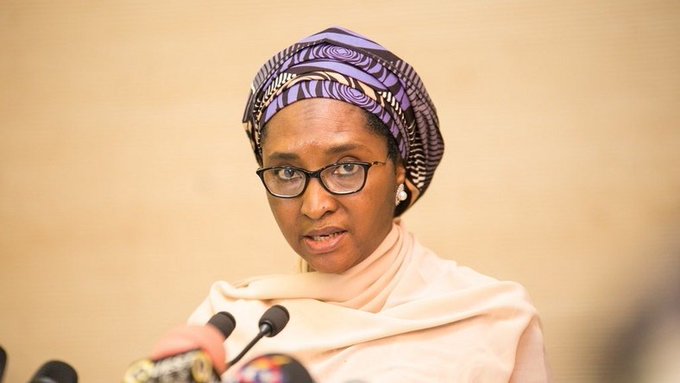
Nigeria’s Finance Minister Zainab Ahmed  confirmed this plan of the Federal Government and expressed concern that the government’s wage bill had increased three-fold since 2015, despite the government placing a ban on employment in the federal civil service.

The minister, however, noted that there had been  replacement of retired federal civil servants, which could have affected the huge wage bill, admitting however that some people gained employment through a process that was not completely approved.

She explained that even with the cap on employment, there was an open window for the replacement of retired directors in federal government agencies.

”The government now found out that what agencies are doing is that if a director retires, based on director salaries, they employ six people to take up the director’s salary,” adding  that, “Many of these agencies do not follow approved processes.”

“It is a problem that the president has decided to address by setting up a Presidential Committee on Salaries that I co-chair with the Minister of Labour and Employment-Chris Ngige. In that committee, we are reviewing Oronsanye’s  report, we are reviewing all the various salaries’ scales in tune with what the Salaries and Wages Commission has.”

The essence is to cut down and streamline the cost of governance, she noted.

She further stressed that delays in the process of payment of most newly intakes into the federal civil service was a result of following unapproved procedures by some government agencies.

“For instance, when they get slight approval from the head of the service to employ 12 people, you discover that in their payroll, they have up to 500 people employed. Before you get registered into the IPPS that captures people for payment, there are several levels of approvals that organisations need to show, including the vacancy while also confirming whether the budget for payments of new intakes is there.”

It is also on record that many states cannot match up with the new minimum wage, prompting some to owe workers, amid post-COVID-19 harsh economic realities and loss of jobs.

“I expect states now to be able to take the matter of minimum wage up with the Constitutional Review Committee. In my opinion, each state should pay according to their own strength,”Minister Zainab emphasised.

According to the CBN, the Federal Government’s personnel cost rose by 18.5 per cent to N1.85 trillion as the minimum wage was increased from N7,500 to N18,000 in 2011, thus accounting for 51 per cent of the Federal government’s retained revenue.

By 2016, personnel spending had gulped about 59 per cent of the Federal Government’s N3.2 trillion revenue.

Police deny reports that 60 persons were killed in Zamfara attack, say ‘only over 30’ died

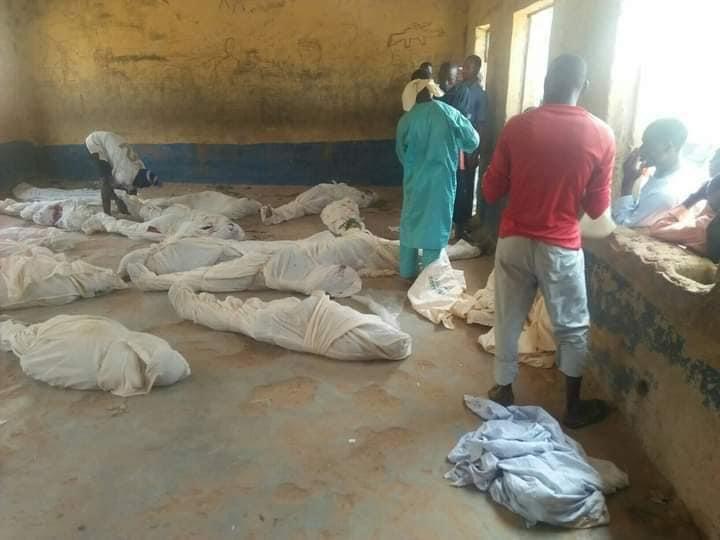
THE Zamfara State Police Command has denied reports that more than 60 people were killed when gunmen suspected to be terrorists attacked Kadawa village in Zurmi Local Area of the state.

Spokesperson of the Zamfara State Police Command Mohammed Shehu, who confirmed the attack in a telephone conversation with The ICIR, said the reported figures were incorrect.

According to Shehu, only ‘over 30’ villagers were killed when terrorists invaded the town.

The attack, which took place on Thursday, was among the latest in a series of deadly attacks and mass kidnappings in Nigeria in recent months.

BBC Hausa Service had earlier reported how gunmen suspected to be terrorists invaded the community around 6:00 pm on Thursday and killed 54 people.

According to an eyewitness spoken to by the BBC, the terrorists rustled cows and looted many shops in the village.


READ ALSO: 

People of North-West are one, yet killing each other – Buhari

Criminals take advantage of my adherence to democratic principles to perpetrate evil ― Buhari

Data puncture Buhari’s claim of lifting 10.5 million Nigerians out of poverty


The eyewitness added that the gunmen also attacked neighbouring villages of Maganya and Jinkirawa after the incident.

He said: “They killed 54 people, all of who are males. Right now, there are no people to perform funeral service for the deceased because the village has been deserted. We are presently conveying the corpses of the deceased to the palace of Emir of Zurmi where the funeral will be held.”

NAN had also reported from some eyewitnesses in the village that the gunmen invaded the village on Thursday afternoon, speaking in foreign languages and shooting at anyone trying to escape the attack.

One of the villagers, who gave his name as Lawali, said 67 bodies were recovered within the village while 26 others were picked up at different locations on the outskirts of the village.

It was also reported that several others were wounded.

NAN also reported that Zamfara State Governor Bello Matawalle, on Friday, called on the people of the state to rise and defend their communities against attacks.

Zamfara, in recent years, has recorded series of attacks by gunmen suspected to be bandits and terrorists, which had resulted in the death of several people.

The state was described as the epicentre of banditry in Northern Nigeria by the former Executive Secretary of the National Health Insurance Scheme Usman Yusuf, in a live webinar organised by The ICIR.

However, the attacks have been condemned by Nigerian President Mohammadu Buhari, who described them as ‘insane’ and warned that the Federal Government had the capacity to crush those promoting insecurity in Nigeria.

In an interview with Arise TV on Thursday, Buhari noted that the situation was giving him concerns. He further observed that the people of the North-West were suffering a lot of casualties as a result of the attacks.

A journalist Yusuf Anka, who has been reporting on happenings in Zamfara State, in a series of tweets shared on his Twitter handle, said that more than 150 people had been killed in the last seven days in the state.

Data puncture Buhari’s claim of lifting 10.5 million Nigerians out of poverty


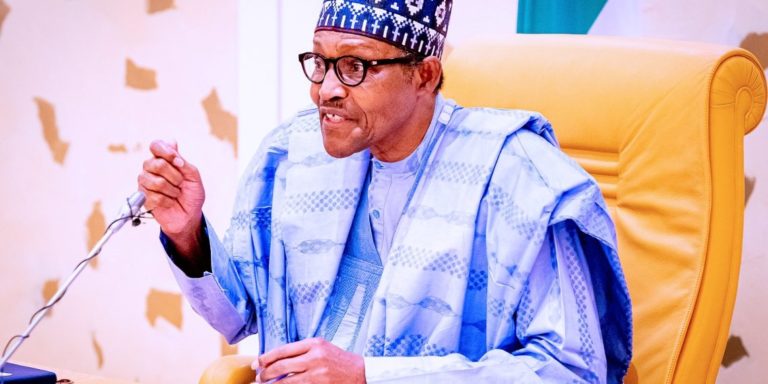
Nigeria’s President Muhammdu Buhari, on Saturday, claimed that his administration lifted  10.5 million Nigerians out of poverty in the last two years, arguing that various interventionist programmes by his administration had put the economy on the path of sustainable economic growth.

Buhari, who made this claim during his June 12 Democracy day address, said interventions made by the Central Bank of Nigeria (CBN), targeted at agricultural, services, infrastructure, power and health care sectors of the economy had seen appreciable growth in the economy.

According to Buhari, “In the last two years, we have lifted 10.5 million people out of poverty -farmers, small-scale traders, artisans, market women and the like.

“I am very convinced that this 100 million target can be met and this informed the development of a National Poverty Reduction Programme Pwith growth strategy. The specific detail of this accelerated strategy will be unveiled shortly, ”Buhari stated.

However, available data have shown that many Nigerians still live in extreme poverty in the last two years( 2018 or 2019 to 2020 or 2021), despite interventionist efforts by the government.

About 87 million Nigerians lived in extreme poverty in 2017, said World Poverty Clock.

According to the World Poverty Clock, the number rose in 2019. Nigeria had a total population of 205.32 million in 2019, with 105.097 million living in extreme poverty, representing 51 per cent of the population. This means the number of extremely poor people rose from 87 million to 105 million in two years.

An individual is classified as living in extreme poverty if the person earns below $1.90 per day.

The National Bureau of Statistics (NBS) said in a 2020 report, covering September 2018 to October 2019, that 40 per cent of people in the country lived below poverty line of N137,430 ($381.75) a year, representing 82.9 million people.

The NBS did not say that the number of poor Nigerians fell in 2020. It rather said that 67 per cent of household incomes fell by August 2020, as against 2019. This meant more people thrown into poverty.

A 2021 report by Alexander Irwin, Jonathan Lain and Tara Vishwanath, published on World Bank blog, noted that more Nigerians had been pushed into poverty by COVID-19 – even with all the interventions by government.

Contrary to Buhari’s claim on economic growth path, growth in the last five years has been less than two percent – less than 2 6 per cent of population growth- meaning more poverty for Africa’s most populous nation.

Recession has occured in the last two years with the economy exiting in the last quarter of 2020. However, growth was just 0.11 per cent in the fourth quarter of 2020 and 0.5 per cent in the first quarter of 2021. The situation means that more people are not out of poverty due to lack of growth in the economy.

An economist and former director-general of the Abuja Chamber of Commerce and Industry (ACCI)  Chijioke Ekechukwu told The ICIR that the president might have lifted a number of people out of poverty, but probably not up to 10.5 million people.

He said the Anchor Borrowers Programme impacted many rice growers, millers and traders.

However,  data do not justify Buhari’s claim.

From 2018 to 2020, unemployment has risen from 18.8 per cent to 27.1 per cent and then to 33 per cent, according to the NBS. More joblessness means more people in the extreme poverty circle.

The exchange rate has risen from N307/$ in 2019 to N410/$ in 2021.Weakening local currency makes products expensive and reduces incomes. It consequently increases the number of poor people. The exchange rate has weakened 34 per cent in two years, demonstrating that more Nigerians have jumped into extreme poverty.

Nigeria may be the largest economy of the African content, but the average Nigerian is more miserable than many in other countries. The misery index is calculated by adding a country’s inflation and unemployment rates, among others. Nigeria’s inflation rate is over 18 per cent and the country’s joblessness is rising, fuelling misery among the population.

Analysts warn that a holistic approach to tackling poverty should have a national policy appeal and feed into the national budget, the government’s planning and other policies of the government.

“If we don’t have a national policy programme upon which the government feeds into its national budget and other programmes, we may not get it right. The programmes would be knee-Jerk,which do not take us to where we want in terms of growing the economy. For instance, what is the national policy programme on agriculture, poverty reduction, unemployment, and others? This programme should ordinarily feed into the national budget to drive economic growth.”An associate consultant at the British Department of International Development (DFID) and a development analyst Celestine Okeke told The ICIR.

#June12Protest: Police fire teargas at peaceful protesters in Ojota, Lagos

THE Nigerian police, on Saturday morning, fired teargas to disperse protesters who converged peacefully for the June 12 protest in the Ojota area of Lagos State.

A policeman was seen shouting “you are criminals” and pointing his gun towards the protesters in a livestreamed video seen by The ICIR on the Facebook page of Premium Times.

In response to the action of the police, the  protesters chorused, “We are not criminals; we are only fighting for our rights, we are only demanding a better Nigeria.”

“We are organised. We have banners. We are not here for war,” some of the protesters added.

However, moments later, some of the protesters, including journalists who were at the scene to cover the protest, were seen scampering and running for safety.

“You can see them. We are asking for our rights and they are shooting at us,” one of the protesters could be heard saying as the smoke from the teargas canisters covered the screen.

“Later, they will tell us that it is photoshopped,” another protester added.

The organisers of the protest are demanding accountability and better governance from the Muhammadu Buhari-led administration.

The protesters are asking Buhari to resign from office if he cannot tackle insecurity and provide good governance in the country.

Criminals take advantage of my adherence to democratic principles to perpetrate evil ― Buhari


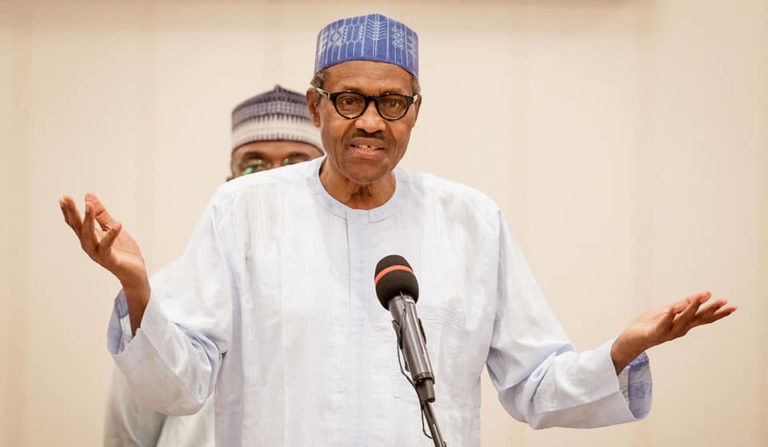
PRESIDENT Muhamamdu Buhari has said that criminals are taking advantage of his adherence to democratic norms to perpetrate evil in the country.

Buhari stated this in his Democracy Day speech on Saturday, noting that some criminals were taking undue advantage of the difficult situation in the country.

He noted that criminals took advantage of his administration’s concentration on the Boko Haram insurgency in the North-East to wreak havoc on other parts of the country.

“When you elected me as your president in 2015, you did so knowing that I will put an end to the growing insecurity, especially the insurgency in the North-East, but the unintended consequences of our scattering them in the North East pushed them further in-country which is what we are now facing and dealing with.”

The president however said that his administration was addressing the security challenges and would soon bring some of the culprits to justice.

“We are, at the same time addressing the twin underlying drivers of insecurity namely poverty and youth unemployment,” he noted.

Buhari, who disclosed that he was worried over the state of insecurity in the country, condoled with the families of victims of various forms of violent crime in the country.

“I also share the pains of families and direct victims of ransom-seeking, kidnapped victims who went through unimaginable trauma in the course of their forced imprisonment.

“Once again, I want to render my sincere and heart-felt condolences to the families and friends of our gallant service men and women who lost their lives in the line of duty and as a sacrifice to keep Nigeria safe,” the president said.


Buhari says fighting corruption is difficult under democracy


FACED with widespread criticisms over concerns that his administration’s anti-corruption campaign is not effective, Nigerian President Muhammadu Buhari has explained that it is not easy to fight corruption under a democratic government.

Buhari made the observation in an interview with the Nigerian Television Authority (NTA) on June 11.

Responding to a question concerning his administration’s faltering campaign against corruption, Buhari observed that during his time as a military head of state, he was able to arrest and jail public officials that were suspected of corruption.

He noted that it was not possible to do the same thing in a democracy.

Seemingly giving an excuse for his inability to live up to expectations on his promise to fight corruption, Buhari said, “I would like to repeat what I used to say. When I was younger in the uniform, when I came, I arrested the President, Vice President, ministers, governors and commissioners and put them under detention and told them that they were guilty until they could prove themselves innocent.

“Now, this is opposite the democratic system as people would like to believe.”

Campaigning ahead of the 2015 presidential election, Buhari had vowed that “anyone who steals Nigeria’s money will end up in Kirikiri Maximum Prisons” and the fight against corruption was among the major agenda of his administration when he assumed office as president on May 29, 2015.

However, about six years after, his anti-corruption efforts have not recorded much success – rather it appears that the level of corruption has increased.

In Transparency International’s 2020 Corruption Perception Index (TI-CPI), released in January, Nigeria slumped to 149 (out of 180), scoring 25 points out of 100.

It was Nigeria’s worst ranking since 2015, placing the country as West Africa’s most corrupt nation after Guinea-Bissau.

In 2019, Nigeria was ranked 146th, with a total score of 26 (out of 100). In 2018 and 2017, the country maintained a CPI score of 27, ranking 144 and 148 respectively.

Nigeria had ranked 136 out of 176 with a score of 27 in 2014 one year before Buhari was elected.

Although the Nigerian government had faulted the Nigeria’s low rating in the 2020 Transparency International Corruption Perception Index claiming that it did not truly reflect the efforts being made to fight against corruption, the latest ranking indicated that corruption had continued to thrive in Nigeria despite the pledge by Buhari and his party, the All Progressives Congress (APC), to fight corruption.

Buhari, in the interview with the NTA, also suggested that some elected political office holders at the state and federal levels are corrupt.

He said, “Nigerians, I think, are very forgetful. I am very pleased that the majority of Nigerians think that this administration, under the circumstance, are (sic) doing their (sic) best but people who misappropriated funds are elected members either at state or federal level.

“You can accuse them or try to prove that when they were elected members of the House of Representatives and they are given ministries and so on, they had only one house and maybe a wife but now they have several houses maybe in Abuja, maybe in Lagos.

“So, rarely, if you try to work out their legitimacy limit, viz-a-viz their expenditure, they will be exposed.”

Although Buhari made a case for the establishment of a special court to prosecute corruption cases, which he said would boost his administration’s anti-graft war, the country’s main anti-corruption agencies, the Economic and Financial Crimes Commission (EFCC), and the Independent Corrupt Practices and Related Offences Commission (ICPC) have been losing corruption cases in court.

Many high profile corruption cases, such as the N1.6 billion fraud allegation involving an ex-presidential aide, Warimapo-Owei Dudafa, were dismissed by courts on the grounds of insufficient evidence.

In an earlier report, The ICIR had noted that, after about five years in office, the Buhari government was yet to deliver on the anti-corruption fight.

The report observed that it was still business as usual, with public officials and politicians continuing to misappropriate public funds with little or no consequence.

Many cases of corruption that have taken place under the Buhari administration are well documented in the media and civil society and international organisations have also reported about unbridled corruption under Buhari’s watch.

The current state of affairs in the country led to Nigeria’s poor ranking on Transparency International’s Corruption Perception Index.