Home Blog Page 501

Usmanu Danfodiyo University bows, lifts ban on press club 16 days after suspension

0

THE management of Usmanu Danfodiyo University, Sokoto, has lifted the suspension it placed on one of the campus press clubs, Pen Press UDUS, after 16 days.

The decision was confirmed in a post by the Pen Press Udus on its Facebook page on Thursday, August 29, following widespread condemnation of the suspension by Nigerians.

Pen Press was suspended after publishing a report highlighting issues related to the poor drainage system in Zamfara Hostel, one of the university’s female hostels.

The report also detailed the hardships faced by students due to the defective drainage, including health risks and discomfort, citing accounts from different students residing in the hostel.

The hostel is believed to be one of the largest female halls of residence in the university, housing over 500 students.

The hostel, said to be jointly constructed by Zamfara State and the university management and inaugurated in 2016, has reportedly been plagued by poor drainage, particularly affecting the students living in Block A.

In a letter dated August 14 and signed by the administrative secretary of the Student Affairs Division, Mahmud Muhammad Isah, the school management directed that Pen Press cease all activities, including publication and interviews, until further notice.

The school management, in the suspension letter addressed to the editor-in-chief of Pen Press, cited concerns over “factual inaccuracies or misleading information” and “potential harm to the university’s reputation.”

However, in a post on its Facebook page on Thursday, Pen Press stated that the management had lifted the suspension.

“We are thrilled to inform you that the management of Usmanu Danfodiyo University Sokoto (UDUS) through the Student Affairs Division has lifted (the) suspension on Pen Press publication and other activities.

“Recall that we informed you in a post on August 21st that our activities have been suspended. From now on, you will be seeing our publications as the matter has been resolved with the management,” the statement read in part.

While no official statement has been released in this regard, the dean of Students’ Affairs, Umaru Aliyu, a professor, in a phone call conversation with The ICIR, confirmed that the suspension had been lifted.  “It’s true,” Aliyu said.

What the suspension means to Pen Press?

However, speaking with The ICIR, the editor-in-chief of Pen Press Udus, Abdulrasheed Akere, expressed concern over the possibility of continued censorship by the university management, despite lifting the suspension.

When asked if the press club would continue with its critical reporting, he said, “Not really because some of the management’s statements during the meeting were that we are practising journalism as if we have grown beyond the school or independent media organisation out there.”

According to him, this wasn’t the first time their report would be met with hostility and criticism from the management, adding that the club abandoned reporting about the situation of the school clinic over its past experiences with the management.

The ICIR reports that over the years, there have been efforts to suppress media and the civic space in Nigeria. The 2024 data by Reporters Without Borders (RSF) placed Nigeria as one of West Africa’s most dangerous and difficult countries for journalists.

By this, Nigeria ranks 112th out of 180 countries where journalists are regularly monitored, attacked and arbitrarily arrested. In 2020, The ICIR reported that 160 journalists were attacked in two years, as the country was ranked 115th out of 180 countries on the Global Press Freedom Index.

Also, The ICIR reported that 63 journalists and three media houses experienced various attacks in 2022.

According to The ICIR findings, at least 39 Nigerian journalists were harassed across the country by state and non-state actors in 2023.  

Alleged terrorism financing: NLC president, Ajaero, leaves police headquarters

0

THE PRESIDENT of the Nigeria Labour Congress (NLC), Joe Ajaero, has departed the headquarters of the Intelligence Response Team (IRT), a department under the Nigeria Police Force, in Abuja.

Ajaero who arrived at the IRT some minutes past 10am left at 11.15am after writing his statement.

He declined speaking with journalists at the IRT headquarters but scheduled a press briefing at the NLC headquarters.

The ICIR reported that the police summoned Ajaero to appear at the Force Headquarters in Abuja on August 20.

In an invitation letter signed by Adamu Muazu, an assistant commissioner of police (ACP) on behalf of the deputy commissioner of police, IRT, the police requested Ajaero’s presence for questioning.

The police further warned that an arrest warrant would be issued if he failed to make himself available.

Responding, the NLC convened an emergency national executive council (NEC) meeting, resolving to request a time extension from the police to consult with its legal team.

Subsequently, a formal letter from Femi Falana’s chambers was submitted to the police.

Falana, a senior advocate, in the letter addressed to the inspector general of police (IGP), Kayode Egbetokun, through the deputy commissioner of police (DCP) Mohammed Ahmed Sanusi, explained that Ajaero had fixed a meeting for August 20, before the police invitation was sent to him on Monday, August 19.

He promised  Ajaero would be available at the police headquarters on August 29.

Falana also requested the police to provide him with details of the allegations of criminal conspiracy, terrorism financing, treasonable felony, subversion and cybercrime levelled against the NLC president.

Ajaero, however, honoured the invitation today.

He was accompanied by Falana, Deji Adeyanju, Marshal Abubakar, and some senior officials of the NLC.

Meanwhile, the NLC had vowed it would embark on an indefinite strike from today, August 29, if the police detain Ajaero.

The NLC leadership had mobilised its members, especially the central working committee (CWC) to storm the police headquarters, in Abuja, where Ajaero would be meeting the police.

In a circular on Wednesday, August 28, the NLC general secretary, Emmanuel Ugboaja, called on the union’s affiliates and state councils to participate in a peaceful procession and prayer session in solidarity with Ajaero.

The circular emphasised the importance of unity in overcoming challenges and upholding the values of justice, fairness, and democracy in Nigeria.

It partly reads, “Members should gather at their respective state secretariat of congress. From there, they will embark on a peaceful procession to their state police headquarters and hold a prayer session until the president’s interaction with the police is concluded.”

Akwa Ibom CP, Ayilara, dies in Lagos hospital

0

THE Akwa Ibom State Commissioner of Police (CP), Waheed Ayilara, has died in a Lagos hospital. 

Ayilara, who served as a former deputy commissioner of police (DCP) in charge of the State Criminal Investigation Department (SCID), Yaba, Lagos, was said to have attended his boss’s son’s wedding and a senior colleague’s retirement and birthday ceremony in Lagos before his passing.

The news of his death sent shockwaves through the police community, especially his colleagues who saw him hours before he died.

Sources at the events he attended revealed he was in great spirits and showed no signs of illness.

It was gathered that the CP sought medical attention at the hospital on August 28, shortly after attending the party.

Colleagues remembered Ayilara as a compassionate and devoted officer, whose absence will be profoundly felt.

“He was an exceptional leader and mentor to many,stated a unit head at State CID, Yaba.

The ICIR reported in April that a deputy commissioner of police (DCP), Gbolahan Olugbemi, was found dead in his home in Ogbomosho, Oyo State.

Olugbemi worked at the Lagos State Police Command and went to celebrate the Easter holidays in the town.

The police chief, who was celebrated for his role during the #EndSARS protest, died in a mysterious circumstance.

His death threw his family and the Police Force into mourning.


Again, manufacturers seek CBN clearance of $2.4bn FX forwards, say businesses affected

0

MANUFACTURERS for the umpteenth time are urging the Central Bank of Nigeria’s (CBN) fulfillment of N2.4 billion foreign exchange (FX) forward obligations to its members.

A foreign exchange forward is an agreement between two parties – in this case Central Bank – to buy or sell currency at a specified price on a predefined expiry date.

The manufacturers said the inability of the apex bank to clear this outstanding $2.4 billion obligation is negatively impacting the economy’s productive sector.

The director-general of MAN, Segun Kadir-Ajayi, who spoke exclusively to The ICIR said manufacturers are faced with high-integrity payments as a result of the inability of the CBN to fulfill its part of the commitments while putting the estimated impact loss to businesses at N1.8 trillion.

DG of Manufacturers Association of Nigeria, Segun Kadir-Ajayi.

According to him, this has exacerbated the economic woes of manufacturers, many of whom are facing bankruptcy due to the added financial strain.

“Manufacturers are enduring forwards of high-interest payments from both the local and international banks, for this delayed payment despite fulfilling their side of the bargain, “he said.

He added that the development is negatively affecting the operations of manufacturers, with its overbearing rise in production costs for consumers.

He further urged the apex bank to fulfill their side of the obligations as the development is eroding the trust private businesses have in the apex bank.

Ajayi-Kadir also stressed that the clearance will help insulate the manufacturing sector from volatile exchange rate negative impacts.

Meanwhile, the ICIR reached out to the CBN’s official spokesperson, Sidi Hakama, but did not get any response.

Commenting on the negative impact of the unstable exchange rate on businesses, the MAN helmsman said, “It’s not helping to reduce the cost of goods as it’s affecting the cost of goods.

He, however, said that the Nigerian Customs Service (NCS) is seeking to engage the manufacturers on a stable exchange rate for manufacturers as part of their trade facilitation responsibility.

In a related development, a research economist, Gospel Obele said the federal government’s inability to incentivise businesses and provide loan facilities at a single-digit interest rate is a major cause of the rising price of goods.

According to the economist, businesses are transferring prices to the consumers which are fuelling high consumer goods costs.

“Nigerians pay more to consume at higher costs, amid rising manufacturing and production costs. This is not a good development as it weakens the purchasing power of goods.”


READ ALSO:


He urges caution, stressing that gross domestic product GDP growth appreciation to 3.19 per cent in the second quarter, which accelerated from 2.98 per cent in the previous three-month period is not impacting enough on the productive sector of the economy.

He suggested that the GDP growth must be refocused by the government to deal with access to the market, finance, and enabling business environment.

“GDP can be used to stir productivity, unlock financing and services sector, where the average man can afford the basic things of life and elevate the quality of their life,” he further said.

Minister directs NNPCL to sell PMS above N1000 to curb smuggling 

0

THE MINISTER of State for Petroleum Resources, Heineken Lokpobiri has said that the Nigerian National Petroleum Company Limited(NNPCL) must sell petrol above the landing cost – currently at N1,117 per litre – to curb the smuggling of the products to neighbouring countries.

Lokpobiri who disclosed this on Wednesday, August 28, at the 2024 Energy and Labour Summit in Abuja, added that security agencies are complicit in smuggling activities.

He said unless the NNPC Ltd imports and sells petrol above the landing cost, smugglers would continue to move petroleum products to neighboring countries.

The ICIR reported that the group chief executive officer of the NNPCL, Mele Kyari had last month met the Comptroller General of Nigeria Customs Service (NCS), Bashir Adewale Adeniyi on the rapid impact of the NCS’ “Operation Whirlwind” in reducing the smuggling of Premium Motor Spirit (also known as petrol) across Nigeria’s border communities.

During the meeting, Kyari said PMS evacuation to border states had decreased from 32 million litres per day to about 25 million litres within just two months.

The federal government had in May last year removed the subsidy on petrol, which raised the price from about N197 to about N650 per litre.

While PMS is sold at an average of N701.99 in Nigeria, it is sold at an average of N1,672.05 in the Republic of Benin and N2,061.55 in Cameroon.

In other countries around the region, the price of PMS ranges from N1,427.68 in Liberia to N2,128.20 in Mali, averaging N1,787.57, according to the fuel price data obtained from trading economics statistics.

This development had heightened PMS smuggling out of Nigeria.

Lokpobiri’s submission at the event favours NNPC’s sale of imported fuel at a price above the landing cost to abridge the potential profit gap and disincentivise smuggling of the product to neighbouring countries for high profit-making by those involved in the shady business.

The minister said, “If NNPC imports PMS and sells to marketers at perhaps N600 or below, there’s no way that smuggling can stop.

“When smugglers are taking the products outside the country, even if you put all the policemen on the road, they are Nigerians; you and I know the answer (response).”

Lokpobiri said that fuel smuggling from Nigeria to neighboring countries was an issue that could not be entirely eradicated.

He took the opportunity of the summit to explain that the NNPC Limited lacks the funds necessary to rebuild the nation’s aging pipelines, which contribute to economic sabotage through pipeline vandalism and crude oil theft.

Minister of State for Petroleum Resources (Oil), Heineken Lokpobiri,

He said, “The old, corroded pipelines, some of which date back to the 1960s and 1970s, are easily vandalised thus facilitating the illegal transport of fuel.

“The reason why pipeline vandalism is very easy to do is because the pipelines have all expired; they are completely corroded. So, anybody can just go and tap it, and the thing is busted.”

The minister stated that even with increased crude oil production, “the challenge lies in transporting it to terminals due to the deteriorated state of the pipelines.”

Lokpobiri called for a public-private partnership to address the infrastructure issues, saying, “That is why we have to go for the global model – PPP. We have to get the private sector to come in.”

He said there was a need for Nigeria to play a strategic role in ensuring energy security across West Africa, stressing that “Nigeria plays a very critical role in the energy security in Africa.”

Lokpobiri expressed concerns about the supply of crude oil to local refineries, including the Dangote Refinery, noting that without increased production, meeting domestic and export obligations would be challenging.

He added, “Our ambition is to ramp up production. It is only when we ramp up production that the midstream and the downstream can also be successful.

“Supporting local refining is the way to go. We can look for investors to explore and bring out this crude so that we will be able to meet both our domestic obligations and also export some to be able to raise more dollars and meet our obligations.”

He underscored the importance of ramping up production to support local refining and ensure healthy competition among refineries.

Oil, gas suppliers decry multiple taxation impacts on interstate businesses

0

THE National Oil and Gas Suppliers Association of Nigeria (NOGASA) on Wednesday decried the impact of multiple taxation of their business on major highways across the country.

Speaking with newsmen on Wednesday, August 28, in Abuja, the National President of NOGASA, Benneth Korie, said multiple taxation along interstate highways is a huge threat to oil and gas movement across different states of the federation.

He called on the federal government to take steps to address the menace.

”Multiple taxation remains a critical concern, and excessive and double taxation by various government levels must be addressed to create a fairer business environment,” he stated.

He spoke on the challenges towards ensuring adequate access to and availability of refined petroleum products, addressing the menace of smuggling, enhancing the country’s agricultural sector, improving the transportation network, and tackling the incidence of multiple taxation.

Underscoring the need to foster a competitive environment to ensure the healthy circulation of petroleum products, the NOGASA President commended the Chairman of Dangote Group, Aliko Dangote, for his contributions to the industry through the establishment of Nigeria’s largest refinery, which he believes would boost supply, competition, and the overall growth of the economy.

He said the investment by Dangote promises substantial benefits, including enhanced supply, increased competition, and a bolstering of the country’s national economy and foreign exchange earnings.

While calling for a balanced distribution of petroleum products, he urged Dangote Refinery to ensure that its refined products are available to a broader range of stakeholders, including NNPC Trading, NNPC Retail, and all major marketers.

“This inclusivity will facilitate sustainable and widespread distribution across the country, ”Furthermore, the Federal Government should expedite the commencement of the Port Harcourt refinery slated for September. This will help alleviate current shortages and ensure that products are distributed among the same stakeholders.”

The NOGASA President emphasised that the association’s concerns extended beyond taxation, touching on other pressing issues such as the availability of refined petroleum products, agricultural development, transportation infrastructure, and the fight against smuggling.

On smuggling, Korie called for a redesign of distribution channels and enhanced security measures at border points to curb the illegal exportation of petroleum products out of the country.

“Strengthening our security agencies, especially at border points, with necessary equipment and support is crucial. Additionally, providing logistics and drones for surveillance will help combat smuggling and product theft effectively,” he asserted.

On economic stability, Korie urged the government to give priority attention to the development of agriculture as a means of addressing inflation and promoting food security in the country.

He suggested that farming be made more attractive through subsidies for agricultural inputs and equipment.

“Reliance on unsustainable palliatives is not the solution. Instead, increasing budget allocations for agriculture and encouraging cluster farming will significantly boost food production,” he noted.

Korie also underscored the importance of improving Nigeria’s transportation network, particularly the expansion and revamping of railways for bulk cargo. He emphasized that prompt payments to contractors and prioritization of emergency road repairs are essential for effective logistics.

He expressed optimism that with the production of Automated Gas Oil from Dangote’s refinery and crude oil transactions in Naira, prices would reduce, benefiting the entire supply chain.

“With Dangote’s refinery production and crude oil transactions in Naira, we expect a reduction in automated gas oil (AGO) prices. NNPC should leverage its shares in Dangote’s refinery to drive down these costs, which will, in turn, lower transportation expenses and reduce market prices,” he explained.

He also acknowledged the efforts by the Nigerian Midstream and Downstream Petroleum Regulatory Authority in regulating the industry.

“I would like to acknowledge the efforts of the NMDPRA in regulating the industry. We urge them to ensure that products are available to marketers at fair prices to prevent profiteering,” he said.

He also stated that “Government should also facilitate the availability of Condensed Natural Gas kits and conversion centers; Marketers are ready to offer their stations for these purposes, which will reduce reliance on PMS and AGO.”

The ICIR has earlier reported that the NOGASA had earlier raised a concern with unstable exchange rate which created problems for oil and gas businesses, while urging the government to prune down energy prices impact on rising inflation.

NCC declares September 14 as final deadline for NIN-SIM linkage

0

THE Nigerian Communications Communication (NCC) has declared September 14 as the final deadline for telephone users in the country to complete the compulsory linkage of their national identity numbers (NINs) to their subscriber identification module (SIM).

In a statement by the commission’s director of public affairs, Reuben Mouka, on Wednesday, August 28, the NCC urged users who have not completed their NIN-SIM linkage to ensure it is updated before the deadline.

“The NCC directed all mobile network operators (MNOs) to complete the mandatory verification and linkage of SIMs to NINs by September 14, 2024. Effective September 15, 2024, the Commission expects that no SIM operating in Nigeria will be without a valid NIN.

“We urge all members of the public who have not yet completed their NIN-SIM linkage, or who have faced issues due to verification mismatches, to visit their service providers promptly to update their details before the deadline. Alternatively, the approved self-service portals are available for this purpose,” the statement read in parts.

The organisation noted that since the commencement of the policy by the federal government in 2020, over 153 million SIMs have been successfully linked to NINs, reflecting a compliance rate of 96 per cent, an increase from 69.7 per cent in January 2024.

It called for the cooperation of all Nigerians to achieve 100 per cent compliance as the process approaches its final phase, adding that the process was essential for the security of the country’s digital economy.

“By verifying all mobile users, this policy strengthens confidence in digital transactions, reduces the risk of fraud and cybercrime, and supports greater participation in e-commerce, digital banking, and mobile money services. This, in turn, promotes financial inclusion and drives economic growth.

“Through collaboration with the Office of the National Security Adviser (ONSA) and the National Identity Management Control (NIMC), the NCC has uncovered alarming cases where individuals possessed an unusually high number of SIM cards – some exceeding 100,000,” the statement added.

In 2020, the Federal Government mandated that telecommunications subscribers link their SIMs with their NINs.

Similarly in 2022, The ICIR reported how the Federal Government directed telecommunications operators to immediately bar outgoing calls from SIM cards not yet linked with the NIN.

The ICIR reported in late July that many telecom subscribers/consumers were unable to access their phone lines, particularly MTN, because of their inability to link their NINs with their SIMs.

However, the NCC directed all mobile operators to immediately reactivate all lines they disconnected.

FCT Police parade Naval officer over alleged killing of ex-Naval chief’s son in Abuja

0

THE Federal Capital Territory (FCT) Police Command has paraded a Nigerian Navy officer, AbdulRasheed Muhammad, who was arrested over the alleged murder of the son of former Chief of Naval Staff, Ishaya. I. Ibrahim, a vice admiral.

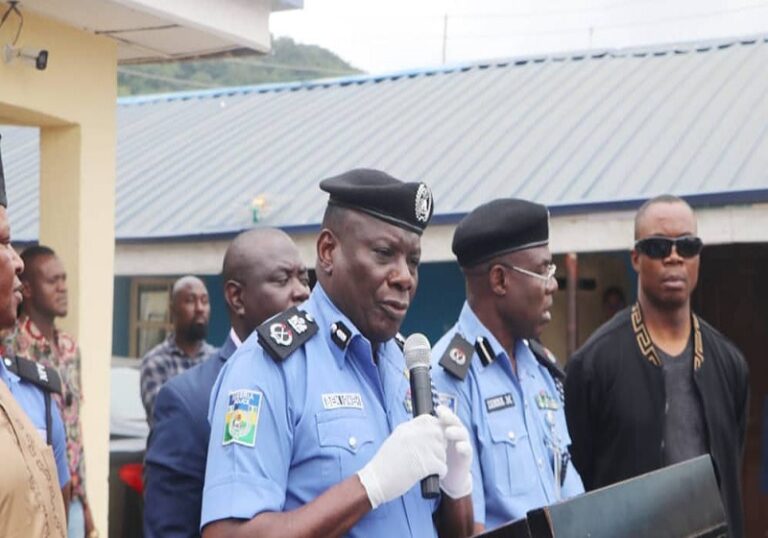
While parading Muhammad on Wednesday, August 27 in Abuja, the FCT commissioner of police (CP), Bennett Igweh, said the suspect killed Aminu Ibrahim and stole his car two weeks ago.

Igweh confirmed that the car had been recovered.

According to the police chief, Aminu was robbed and killed in the Maitama area of Abuja, and his Prado SUV vehicle was taken away by his attackers.

“I want to inform you that AbdulRasheed Muhammad, a serving Nigerian Navy personnel, committed the murder. He has confessed to the crime, and we have recovered the Prado Jeep.”

While speaking to journalists at the FCT police headquarters, Muhammad revealed that he served as a seaman in the Navy and was assigned to the former Chief of Naval Staff’s residence.

“I work at the house. He wanted to go out at night, around 11:30. He said he needed security.

“So, I followed him with my gun. Along the way, he stopped to check his ATM, as if he was going to buy something.

“I thought maybe I was going to escort him to a market or somewhere. Then, when I came out through the other door, I shot him, took the car, and left. I’m a guard and a seaman in the Navy. He did not do anything to me; I killed him to steal his car,” the suspect confessed.

The police also paraded 94 suspects associated with the Islamic Movement of Nigeria (IMN), also known as Shi’ites, who were taken into custody in connection with the fatal incident resulting in the death of two police officers on Sunday, August 25.

Some recovered weapons on display
Some weapons recovered by the police

In addition, the police paraded twin brothers – Obike David and Obike Stanley – who the police said specialised in ATM card theft.

“They execute their plans by claiming to assist unsuspecting persons who seem new to the operation of ATMs. While at it, they swap their ATM cards and proceed to withdraw money from the accounts of their victims.

According to the police, during interrogation, they confessed to the crime and will be charged in court after investigations.


Interpol arrests over 300 West African cybercrime gang, Black Axe

0

INTERNATIONAL Criminal Police Organisation (Interpol) has confirmed the arrest of over 300 people linked to one of West Africa’s most feared criminal networks – Black Axe.

In the mission tagged “Operation Jackal III”, Interpol said the highly-coordinated cybercrime gang was behind several crimes including some of the global financial fraud facilitated by cyberspace.

Interpol described the operation as a “major blow” to the Nigerian criminal network and warned that the technological expertise and global reach of the Black Axe made it a menace to the world.

In a report by the BBC, a senior Interpol official, Tomonobu Kaya, said the “Black Axe are very organised and very structured,” and are known for money laundering, using cryptocurrency.

Originally from Nigeria, Black Axe is known for its involvement in trafficking, prostitution, and cyber-enabled financial fraud.

Operation Jackal III led to the seizure of $3 million of illegal assets and more than 700 bank accounts being frozen, the report said.

In 2022, Interpol revealed that the “Black Axe and similar groups were responsible for the majority of the world’s cyber-enabled financial fraud as well as many other serious crimes”.

Experts have argued that West African nations to take proactive steps to address the underlying causes of these criminal behaviours.

The West Africa Regional Coordinator for the Institute for Security Studies, Oluwole Ojewale, noted that it is “the general failure of governance” that fuels recruitment into organisations like Black Axe and other criminal groups.

Nigerian woman gives birth to 11 babies after allegedly carrying pregnancy for 3 years

0

A FIFTY-four-years-old Nigerian woman, Alake Latoyosi, has given birth to 11 babies in Cotonou, Benin Republic.

The births took place in two batches, with the first set of six arriving on 7 August, while the second came seven days later, on 14 August.

The babies included eight boys and three girls, but two of the girls passed away during delivery.

According to the husband, Yahaya Nafiu, in a report by Premium Times, the pregnancy lasted over three years before the delivery.

Nafiu, 56, who is the Missioner of the Ilorin Descendants Progressive Union (IEDPU) in Port Novo, Ajasse, and Cotonou in the neighbouring West African country, said the hospital was unable to determine his wife’s pregnancy position, which prevented the doctors from performing a Caesarian section. 

Nafiu added that he already had several children before the babies arrived, and his wife also had children from a previous marriage.

The birth has now led the husband to seek financing support to cater for his babies and the mother.

Noting that the remaining nine are hale and hearty, Nafiu said he struggled to meet the huge financial cost of caring for them and their mother.

“A few days after the delivery of the first set of children, my wife said she felt strange movements in her stomach. After a scan was carried out at the hospital, the doctor revealed that she was carrying another set of children, which led them to contact the initial birth attendant, and the next set of five babies was delivered”, Nafiu was quoted as saying.

This is coming about a month after Nigerians contributed over N4.2 million to the family of one Sodiq Olayode, whose wife, Abiodun, recently gave birth to a set of quadruplets. 


READ ALSO:


A colleague of Olayode, identified as James, tweeting as #jamysax on X, shared the news on Wednesday, July 24.

James’ post on X would later attract significant attention from netizens, with many commenting on the difficulties of raising young children, following increasing hardship in Nigeria.

They eventually crowdfunded for the family.