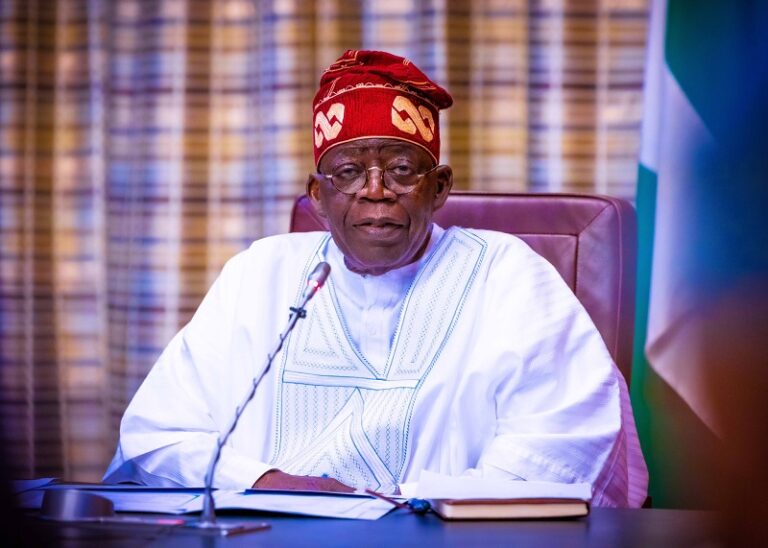
PRESIDENT Bola Ahmed Tinubu has been elected the new Chairman of the Economic Community of West African States (ECOWAS).
Tinubu was elected on Sunday, July 9 at the organisation’s 63rd Ordinary Session of the Authority of Heads of State and Government of the Economic Community in Bissau, the capital of the Republic of Guinea-Bissau.
With this, the president now leads the authority of heads of state and government of ECOWAS.
He will be responsible for leading implementation of the decisions of the ECOWAS heads of state and government, promoting peace, stability, and economic growth within the West African region.
He will also represent the region at international forums and engage with other regional bodies to promote regional integration and cooperation.
President Tinubu has also received handover documents from the outgoing chairman, Guinea-Bissau’s President, Umaro Embaló.
Speaking on the development, Tinubu said, “We will take democracy seriously, Democracy is very tough, but it is the form of government.”
The ECOWAS chairmanship is a position held by one of the heads of state or government of the member countries.
The chairman is chosen on a rotating basis for a one-year tenure.
Tinubu’s immediate predecessor, Muhammadu Buhari, occupied the position from 2018 to 2019.
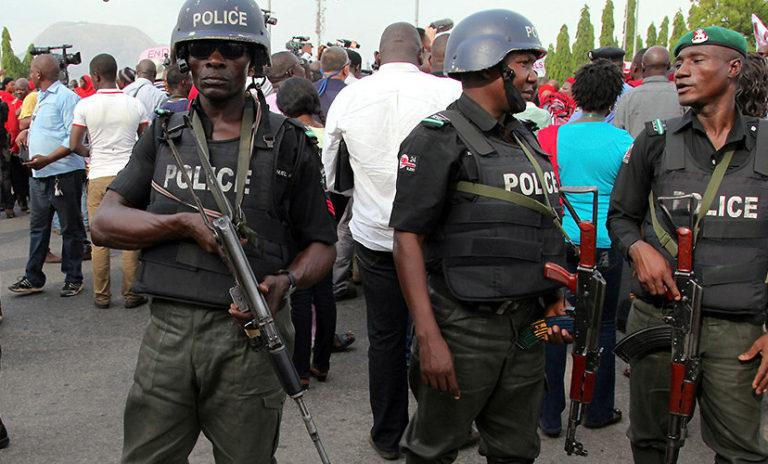
THE Yaba magistrate court in Lagos State has ordered that a police inspector, Kabiru Odeyemi, be remanded at the Ikoyi correctional centre for the alleged murder of a generator repairer, Idris Jagun, in the Oregun area of the state.
Odeyemi has also been dismissed from the force.
The pro-democracy group that brought the incident to the attention of the state police, the Take-It-Back Movement, confirmed the development on Saturday, July 8.
UPDATE: killer cop, Alhaji Kabiru Odeyemi who murdered 24 year old Idris Bakare at the Oregun area of Ikeja Lagos has been remanded at the Ikoyi prison following an order of the Yaba Magistrate Court. Case has been adjourned to 11th of August, 2023 for hearing. https://t.co/QKoSa1mZ4I
— Take it back Movement (@TIBmovement) July 8, 2023
Odeyemi had allegedly shot Jagun while attempting to disperse a group of people fighting on the road on a Sunday night. The technician was hit by a bullet allegedly shot into the crowd and consequently died at a clinic in the state.
The Lagos State police command spokesperson, Benjamin Hundeyin, confirming the officer’s dismissal, said, “The recommendation for the dismissal of Inspector Kabiru Odeyemi was approved today. This paves the way for his arraignment, which will take place on Friday, July 7, 2023.
“The Commissioner of Police, Idowu Owohunwa, assures Lagosians of his unwavering determination to police the state within the dictates of the rule of law, civility and respect for human life.”
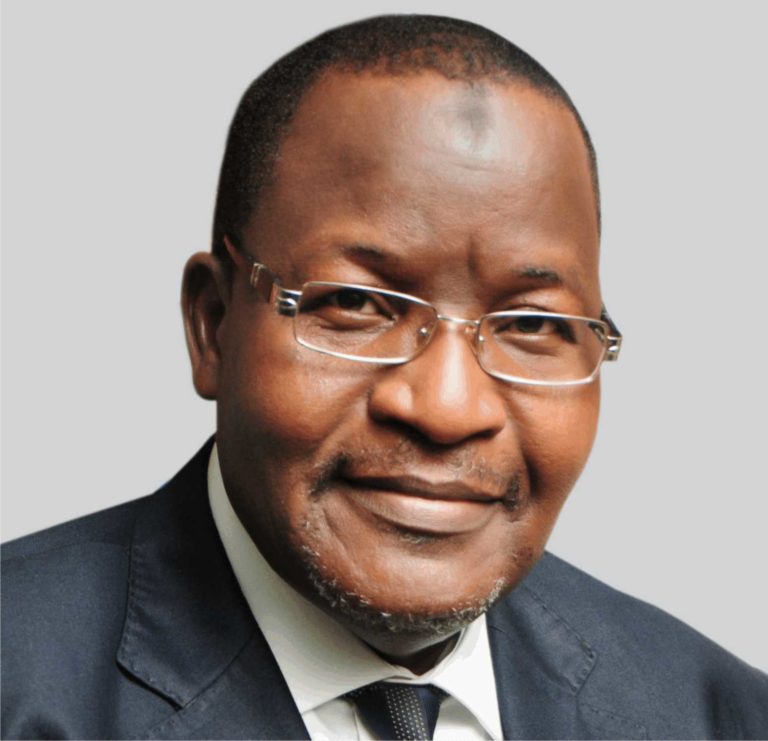
THE Executive Vice-Chairman (EVC) of the Nigerian Communications Commission (NCC), Umar Garba Danbatta, has announced that the investment profile in the nation’s telecommunications sector has reached $75.6 billion as of 2021.
The figure comprised foreign direct (FDI) and local investments.
Danbatta disclosed this at an interactive session with stakeholders in the communications media ecosystem in Lagos on July 5, where he provided his scorecard covering the period he became the chief telecoms regulator in August 2015 till this year.
According to him, the investment profile in the sector in 2018 stood at $68 billion. The figure increased to $70.5 billion in 2019, and $72 billion in 2020. By the end of 2021, the figure had risen to $75,560,563,417.79 ($75.6 billion).
The latest figure is the current official investment profile computed in the industry, up from the initial $70 billion investment in the last few years.
The ICIR reports that investments in the telecommunications sector in Nigeria is computed from two sources: the Central Bank of Nigeria (CBN), and the financial data the Commission obtains from service providers.
While the CBN collects and calculates an element of the telecoms sector to include FDI, portfolio and others, the Commission collects investment figures from telecom licensees described as domestic investment arising from capital expenditure (CAPEX), which form part of the total investment in the industry.
Danbatta said that through effective regulatory environment put in place by the Commission, the telecom sector had recorded tremendous growth from an initial investment profile of $500 million as at 2001, when the sector was fully liberalised.
He added that the telecom sector had continued to be a major contributor to Nigeria’s economy through an impressive sectoral contribution to the nation’s gross domestic product (GDP), up from about 8.5 per cent in the third quarter of 2015, contributing N10.126 trillion to the nation’s GDP in 2022 alone.
Citing data from the National Bureau of Statistics (NBS), Danbatta said the telecoms sector contributed N10.126 trillion as an aggregate quarterly contribution to the GDP in 2022.
“In the first quarter, the sector contributed 12.94 per cent equivalent to N2.246 trillion, while the second quarter witnessed an all-time high GDP contribution by the telecoms sector to the nation’s economy, standing at 15 per cent and valued at N2.593 trillion. The sector’s contribution to the GDP in the third quarter was 12.85 per cent, and in the fourth quarter, it grew to 13.55 per cent, which are valued at N2.436 trillion and N2.851 trillion, respectively.
“The growth trajectory continued this year as telecommunications and the information services sector in Nigeria delivered a handsome N2.508 trillion in terms of financial value contribution to the nation’s GDP, representing 14.13 per cent in the first quarter 2023,” he said.
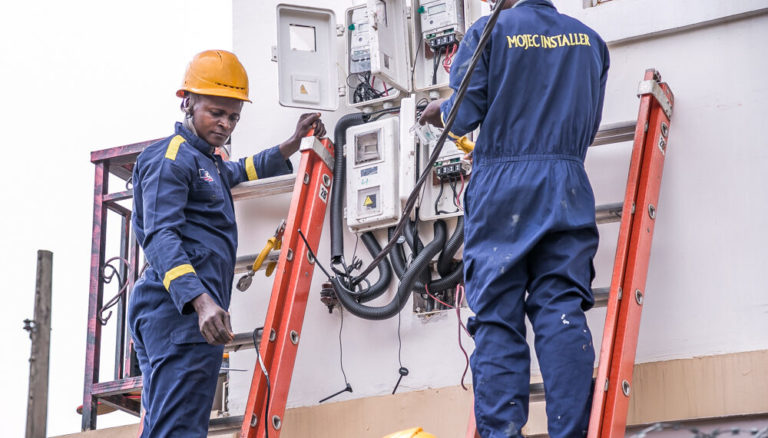
LOCAL electricity meter manufacturing and assembling firms could face economic distress in the days ahead as the Federal government has opened a bid for a $155 million World Bank loan to import meters.
The Association of Meter Manufacturers and Assemblers of Nigeria (AMMON), worried the move could cripple the $500 million investment in the industry, has petitioned the Bureau of Public Procurement (BPP).
AMMON, in a petition signed by its acting president, Ademola Agoro, and the secretary, Durosola Omogbenigun, urged the Bureau and the government to save the local meter manufacturing business from total collapse, as well as save jobs.
In the petition, obtained by The ICIR, AMMON stated, “The tender which closes on July 11, 2023, if left to continue, would amount to a constructive breach of the award of contract(s) for the supply of four million meters under the Phase One of the programme already awarded to some of our members since November 2022 by the Transmission Company of Nigeria (TCN), a bid process that the BPP approved.
“You may note that the TCN recently advertised a World Bank funded bid process for the supply of 1.2 million smart meters to DisCos in Nigeria. That your office be aware that this particular bid process is being opened to foreign companies (manufacturers, suppliers and exporters) of fully built electricity meters with planned Custom duty waiver granted to them to import meters into Nigeria.
“These importers, who are primarily foreigners, have not made a verifiable investment in the backward integration programme of the Federal Government, nor have they made any investment in local manufacturing and assembling of meters in Nigeria, which has always been the standard requirements for Meter Assets Providers (MAP) in Nigeria to show proof of investments in the backward integration and must have meter assembling/manufacturing plants and factories in Nigeria.”
While lauding the “good” intentions of the TCN and the Nigerian Electricity Regulatory Commission (NERC) to achieve mass metering for Nigerians and bridge the gap in the sector towards solving the nation’s electricity problems, AMMON stated that such intentions should consider the country’s economic state, which it reminded does not support the importation of fully-manufactured products.
Illustrative picture of Nigeria’s current metering status
AMMON expressed worry that the proposed bid process would lead to a disastrous outcome for local meter manufacturing/assembling companies it stated had invested over $500 million in the industry.
It compared the industry, which it estimated as employing over 10,000 Nigerians in direct employment and more than 30,000 Nigerians in indirect labour, with competitive wages, to the communications sector.
The group urged the Federal government to direct the immediate suspension of the TCN bid process pending proper consultation with stakeholders in the power sector, especially meter manufacturers, to address members’ concerns.
It also enjoined the Bureau For Public Procurement (BPP) to direct the TCN, NERC and Central Bank of Nigeria (CBN) to honour the contract for the supply of four million meters awarded to local meter manufacturers in Phase 1 of the Mass Metering Programme.
According to a NERC report, the huge metering gap for end-use customers is still a key challenge in the industry. It is estimated that of the 12,542,581 registered energy customers as at March 2022, only 4,740,114 (37.79 per cent) had been metered.
Reacting to the development, a power sector governance expert, Chuks Nwani, told The ICIR that the government should close the metering gap with a multifaceted approach.
Nwani suggested that since the metering gap keeps widening by the day, indigenous manufacturers and meter importers should synergise to close the gap.
“No one group can close the metering gap. Metering is a major issue that affects the liquidity of the power sector. All hands must be on deck. Local manufacturers may not have the capacity to close the gap, so why shut out importation if Nigerians can access meter and not be exploited by estimated billing?” he asked.
A former NERC commissioner in charge of engineering performance and monitoring, Frank Okafor, also told The ICIR that with the Electricity Act, states can get more involved in metering to be able to close the gap.
“This is a great opportunity for the states. Lagos and others are already showing capacity in various areas since the Electricity Act was signed. Other states can also look at opportunities in closing the metering gap,” Okafor said.
THE Police Service Commission (PSC) has ordered the dismissal of three senior police officers over misconduct and abuse of office.
This was disclosed in a statement issued on Sunday, July 9, by the commission’s spokesperson, Ikechukwu Ani.
The commission also demoted nine officers, including a commissioner of police.
According to the statement, the sanctions were given during the PSC’s 21st plenary meeting presided over by Clara Bata Ogunbiyi, a retired justice of the Supreme Court.
The PSC also ordered that 18 police officers be “severe reprimanded.”
However, the commission did not disclose the names of the dismissed or sanctioned officers, neither did it categorically state their offences.
The PSC ordered the compulsory retirement of an Assistant Commissioner and a direct refund of all entitlements wrongly paid to him.
However, it approved the posthumous promotion of a late Inspector, Ifeanyi Oroke, to Assistant Superintendent for acts of gallantry, and the reinstatement of a certain Inspector Augustina Oko.
The commission had earlier approved the appeal for adjustment on the promotion date of Iheanyi Kingsley to the rank of Assistant Commissioner, and reinstatement of Chief Superintendent Anaele Samuel Onuoha, in compliance with a court judgment.
The 21st plenary meeting of the commission will reconvene on Tuesday, July 11, 2023.
GUNMEN have kidnapped the Ekiti State chairman of the All Progressives Congress (APC), Paul Omotosho, on Saturday, July, 2023.
Omotosho was said to have been attacked in the evening along the Agbado-Imesi-Ekiti road in the Gbonyin local government area of the state.
The state’s publicity secretary of the party, Segun Dipe, confirming the incident to journalists, said, “The chairman was driving in a Venza car along the road when the bandits shot at one of the tyres of his car.
“He was taken into a Toyota Hilux van and driven off. He was alone in the car when the incident happened, according to the information we have.
“It happened in the evening; we got the information at about 6pm. The security agencies, police and Amotekun have been alerted and they are all working on it,” he said.
The Ekiti state police command was yet to issue an official statement confirming the kidnap.
The ICIR reached out to the police spokesperson in the state, Sunday Abutu, on Sunday morning through calls and messages, but he had not responded to enquiries till the time of filing this report.
FOLLOWING the marking of houses and subsequent demolition executed by the new Kano State Government, headed by Governor Abba Kabir Yusuf, and the controversies the policy has generated, The ICIR deployed its reporters, Marcus Fatunmole FATUNMOLE and Olayinka FATUNBI, to the state on June 28 for a thorough investigation into the crisis. Here is their account after meeting relevant stakeholders in the state.
Key issues in reportThe Kano State Government justifies the demolition of buildings with the claim that it is recovering public lands illegally sold by its predecessor.
The argument is flawed with unexplained exemptions of some of the buildings by the government. Victims said the spared properties belong to the government’s relations or loyalists.
Apart from the exemptions, the current chairman of the state Public Complaints and Anti-Corruption Commission, Muhyi Magaji, was part of the last administration and a beneficiary of the land sold by the former government led by Abdullahi Ganduje. The ICIR has a copy of documents of the land he bought and sold to a resident who is now a victim of the demolition.
This ICIR reports that some affected property owners said they purchased their lands before Ganduje’s tenure.According to estimates from a surveying firm in the state, assets being lost to the demolitions run in into several billions of naira, in a state with an estimated $12 billion economy and 90 per cent of all residents falling below the poverty line.
Most officials who served in the last administration refused to speak on the crisis; sources said the officials had fled the state.
The new government says no regret for its action, blames buyers and Ganduje administration for the demolition.
Compensation is likely only for a few victims.
Residents, including APC legal adviser, victims say demolition is a political vendetta.
We warned Ganduje – ASUP, other education stakeholders.
A drive around many parts of Kano city brings three things into sight: the debris from several properties that the government pulled down within days after it assumed office; the buildings whose roofs, doors and windows have been dismantled, and the heaps of garbage littering many parts of the northern Nigerian business hub, especially the Sabongari area. This report focuses on the first two.
A house at the back of the School of Management Studies in Salanta marked for demolition by the Kano State Government. Photo credit: The ICIR
At noon on Friday, June 30, a day after the just-concluded Eid-el-Kabir festivity, Saminu Shehu Muhammad arrived at the gate of his multimillion-naira home marked by the state government for demolition.
He alighted from his car, nodded repeatedly and stared at the house. He moved towards the building’s electric fence and scanned through the copies of a court judgement posted on its perimeter walls. He then inched a few meters away from his large gate, gazing at scavengers breaking into the rubbles of block works and ruins of concrete floors of his neighbour’s properties from a distance.
The location behind the School of Management Studies in the Salanta area, said to be owned by the Kano State Polytechnic.
The new government had pulled down dozens of posh houses like Muhammad’s and malls on the premises because they were allegedly built on the school land.
Muhammad’s house is the most exquisite among the few remaining.
But for a Federal High Court exparte order, his property would have turned to rubble.
He claimed the state-owned courts denied him the order before he headed to the Federal High Court.
His fate now depends on the government’s willingness to obey the order, pending when the court will determine the motion on notice.
Scavengers break into rubble, looking for iron rods at one of the sites where the Kano State Government destroyed several properties. Photo credit: The ICIR
Peeking through his house, Muhammad told The ICIR he followed all legal processes before acquiring the land, adding that all victims of the exercise in the area had their documents issued by the past government.
“The new government didn’t give us any notice; they just came to our houses and asked us to quit. We urged them to investigate the matter before the demolition started.
“The new governor alleged that seventy per cent of the houses in Salanta belonged to Ganduje and his wife. God knows that Ganduje doesn’t know me, and nobody in his cabinet or his family knows me. I am just a businessman. I do my business at Kwari market.”
Another victim, Ayuba Sani, owns a storey building under construction in the area. He said he had spent over one hundred million naira on the property.
He bought the land two years ago. “It was not the government that sold the land to me. I bought it from someone who received the allocation from the past administration.”
He said the government notified him of the demolition on June 14.
He went to complain at the Kano State Urban Planning and Development Authority (KANUPDA), the agency executing the demolition.
“On June 16 at night, two days after we went to the KANUPDA office, we saw bulldozers approaching our structures. Without delay, they started demolishing our houses,” he said.
Sani Mustapha Kurmawa is another victim of the exercise. He was almost in tears while narrating his ordeals to The ICIR. The 50-year-old claimed he would lose over N300 million if the government pulled down his properties.
He took our reporters to one of his properties, a big event centre along the BUK Road, split in two by a thick wall. He has dismantled the centre, leaving only the walls waiting to be torn down by bulldozers.
Another deluxe home awaiting demolition at the back of the School of Management Studies in Salanta. Photo credit: The ICIR
Describing the government action as a ‘mistake’, Kurmawa said the area where he had his properties had been a stream.
“After I bought it, I filled the stream with sand and debris so the people in the area would be safe. After filling the stream, I donated part of the land to a nearby school to build classes and used the remaining space.
“Despite my kindness, the KNUPDA marked my place for demolition, and it didn’t mark the portion I donated to the school.”
He said the government targeted him because he was a member of the opposition party – the All Progressives Congress (APC).
“From Kofar Famfo down to Kabuga, many buildings were allocated during former Governor Rabiu Musa Kwankwaso’s administration, and they did not mark them. But they marked our own just because the immediate past administration allocated it, which shows it’s politically motivated” he explains.
The Kano ancient wall, known locally as ‘Badala’, is erected along the Kofar Famfo – BUK Road.
Many residents interviewed by The ICIR said the government was partial in marking homes in the area.
Kurmawa, Sani and Muhammad are among the scores of demolition victims.
While the new government argued that its predecessor sold the land to cronies, families, and APC loyalists, thereby altering the city’s master plan, the former government and victims described the action as a political vendetta.
Some of the buildings destroyed by the government in the city. Photo credit: The ICIR
Background to the crisis
There are three major players in the crisis: the state’s former Governor Rabiu Musa Kwankwaso, who founded the New Nigeria Peoples Party (NNPP), which produced the incumbent government; Governor Yusuf; and the former Governor Ganduje.
Kwankwanso had protested public land sales before his party won the last governorship election and had vowed to pull down every structure erected on the lands sold if his party won the election.
He said the lands sold were on religious places, cemeteries, schools, hospitals and other sites. Kwankwaso’s opposition to land sales by Ganduje further incensed the hostility between the two leaders.
The ICIR reports that Ganduje was Kwankwanso’s former deputy. Both leaders enjoyed a smooth relationship till the former succeeded the latter on May 29, 2015.
But as of June, the enmity had grown so profoundly that Ganduje threatened to slap his former principal at the State House in Abuja because he (Kwankwaso) backed the demolition.
Another set of buildings marked for flattening by the government in the state capital. Photo credit: The ICIR
Massive buildings turned into rubbles
Several buildings, including residences, hotels, shops, malls, and monuments, have been levelled by Governor Yusuf since June 3, when the exercise began. The governor took over power from Ganduje, whose party lost at the governorship election on May 29.
Some of the buildings brought down are the three-star Daula Hotel consisting of at least 50 rooms, four executive rooms, a restaurant and other facilities; and a three-storey building at the Race Course in the Nasarawa GRA, which had 90 shops.
The Eid Prayer Ground witnessed the most extensive demolition. Many residents interviewed said there were scores of storey buildings on the land.
“We had several-storey buildings here before they came and destroyed everything. We had more than 50 of them,” said Abdullahi Musa, a resident of the area.
“All the houses were like these two and three storey-buildings surrounding the area, but they are all gone,” he added, pointing at nearby cluttered buildings.
The ICIR could not count the houses at the Hajj Camp, another location where several buildings were flattened, but some reports said there were 130 houses on the land. They were mainly shops and malls. When our crew got to the premises on June 29, only rubbles were left of all invested on the land.
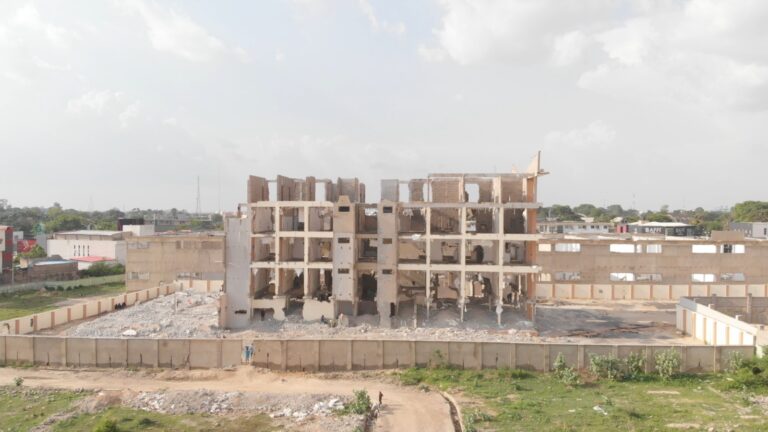
Aerial view of some of the rubbles of properties demolished by the Kano State Government at the Eid Prayer Ground. Photo credit: The ICIR
The government did not spare dozens of shops built in front of the Government Girls Secondary School, Dukuwuya, along Federal College of Education in the city.
Similarly, hundreds of shops within a swathe of storey buildings await demolition along France Road within the Sabongari area.
Doors and windows have been removed from most of the structures.
The ICIR gathered that some buildings at the location were built before Ganduje took over power in 2015.
There are similar scores of buildings along the BUK Road, including fuel stations and large plazas.
These were in addition to the Government House Roundabout monument flattened by the government because its “location was wrong”, and it was “a huge structure that blocked not only the scenery but the vision of the persons coming from all sides”, according to the new Commissioner for Information, Baba Halilu Dantiye.
Aerial view of fuel stations and several other buildings along the BUK Road marked for demolition by Governor Yusuf’s government. Photo credit: The ICIR
The ICIR reports that while the government said 95 per cent of people in the city were happy with the demolition, most residents interviewed condemned the action and accused the government of launching a vendetta against its predecessor.
Residents averred that it was wrong for Ganduje to sell public land, especially prayer grounds, schools, hospitals and city wall corridors. They also accused the government of exempting buildings of its loyalists among those marked along the BUK Road and other locations.
Besides, they argued that some of the land beneficiaries, who were APC members, had decamped to the NNPP and were shielded. The head of the anti-corruption agency, Muhyi Magaji, is prominent among those allegedly covered.
The crew obtained the land documents bought and sold by Magaji. One of the reporters contacted him through the phone. He didn’t pick up several calls put to his line. He did not also respond to text message sent to him.
Estimated cost of some of the buildings
A section of other structures marked for demolition by the Kano State Government along the BUK Road for allegedly being on the old Kano Wall, locally known as Badala. Photo credit: The ICIR
The ICIR contacted a surveyor at the Murijawando and Co Estate Surveyors and Valuers in the state.
The surveyor provided this organisation with the values of three buildings within two locations where the government demolished properties.
One of the buildings is a six-bedroom duplex at the Hajj Camp.
The land measuring 450 square meters cost N18,000,000, and the cost of the building work was N59,317,335 million. The building’s total cost was N77,317,335.
The second building, a 13-bedroom duplex along Salanta Quarter, was behind the School of Management Studies. The cost of the land, measuring 1,800 square metres, was N144,000,000. The building cost was N401,819,680, and the total money spent on the structure was N545,819,680.
The third property, a nine-bedroom duplex along Salanta Quarter behind the School of Management Studies, was bought for N85,680,000. It measured 1,071 metres square. The building cost was N218,158,610, and the total cost was N303,838,610.
Because the demolished and marked buildings are in the hundreds, the properties’ worth is in billions of naira, given the values by the surveyor on three buildings.
This estimate (billions of naira) is much less than the government’s value for the Eid Ground alone.
A massive hall pulled down by the Kano State Government at the back of the School of Management Studies in the Salanta. Photo credit: The ICIR
More victims speak against demolition
Alike Onyekachi, Nelson Chime, Anthony Chinedu and Chigozie Emmanuel are among the occupants of shops within several storey buildings on France Road, near the Kano Pillars Stadium. They pay between N300,000 and N400,000 annually as rent. Some had just paid the rent before the government marked their shops. They have emptied their shops, hoping the government bulldozers would emerge anytime to bring down the buildings. They have occupied the buildings for at least three years.
Like most buildings on affected lands in the city, many structures on France Road already have their roofs, windows, and doors pulled out, with some allegedly removed and carted away by criminals, as reported in other locations.
At the Eid Ground are scores of victims who have invested so much in properties destroyed by the government on the premises. They said they had spent about 20 million each on their buildings.
They are mainly small-scale business people who thought they would no longer pay rent on shops for the rest of their lives. But their investments are all gone.
The traders still hang around nearby shops, and some continue to use the shops they rented adjacent to the Prayer Ground.
The ICIR spoke with the market deputy leader, Masaud Ibrahim, Ibrahim Danfulani, Mustapha Yusuf, Abbas Yawu, Rakiya Mai Kanwake, Hafsat Umar, Sahura Garba, Sharib Musa, Yahaya Sani, and Anwalu Ali. They all condemned the exercise.
Sani Mustapha Kurmawa, one of the victims, says he will lose N300 million if the Kano Government destroys his properties. Photo credit: The ICIR
Some traders happy with demolition
Rakiya Mai Danwake, Mustapha Yusuf, Jafar Sarki Dabo and Hafsat Umar are happy with the exercise. They were among the traders in the city but did not have a shop or any building among those demolished.
They said the former administration and developers of plots sold at the Prayer Ground and Hajj Camp chased them away from where they had traded in the open for several years.
According to them, the new government did the right thing to have pulled down the buildings on the lands.
“The past administration was always chasing and harassing us. Sometimes, they even seize our wares. I swear to God; I am happy with what the new government did. I support the demolition. It does not affect my business,” said Umar.
Saminu Shehu Muhammad, one of the homeowners at the back of the School of Management Studies in Salanta area. Photo credit: The ICIR
Former government officials allegedly go into hiding
The ICIR contacted the Secretary of the former government, Usman Alhaji Usman. Attorney-General and Commissioner for Justice, Lawan Musa Abdullahi, Commissioner for Information, Muhammad Garba, and the Permanent Secretary of the State Bureau for Land Management, Zainab Ibrahim-Braji. None of them agreed to speak with our crew about the demolition exercise.
The ICIR called several times and sent the officials text and Whatsapp messages. They did not pick up the calls or respond to the messages.
Sources in the state said many officials who served in the past administration had fled because of the issues surrounding the demolition and other ongoing investigations into the activities of the past government.
On July 3, the state anti-corruption agency arrested Ganduje’s Commissioner for Works, Idris Wada Saleh, over one billion naira fraud allegation. The agency went further to invite the former governor for questioning on July 5 over a video where he was seen pocketing wads of dollars, supposedly a bribe from a contractor.
The Daula Hotel destroyed by the Kano State Government. Photo credit: The ICIR
Governor, Information Commissioner, MD KNUPDA insist land revocation policy stands
On Saturday, July 1, The ICIR crew was with Governor Yusuf at the Government House, where he hosted the Emir of Rano, Kabiru Muhammad Inuwa.
The governor reiterated his government’s decision to reclaim all public lands sold by Ganduje.
“In our campaign promises, we assured our commitment to restoring the glory of Kano state through reclaiming all encroached public lands where private individuals or groups erected illegal structures.”
“These places are meant for public utilisation. It is therefore disheartening to witness the incessant destruction and conversion of public places that are used to render social services by unpatriotic citizens. We shall bring an end to land grabbing and indiscriminate erection of illegal structures in the state,” he told the Emir.
A day before, he had told the Emir of Kano, Aminu Ado Bayero, that he hadno regret destroying the properties.
The Commissioner for Information, Baba Halilu Dantiye, aligned with the governor.
Kano State Commissioner for Information, Baba Halilu Dantiye, shares his thoughts with The ICIR on the demolition exercise by the state government. Photo credit: The ICIR
In an exclusive interview with The ICIR, he denied allegations of political vendetta by Governor Yusuf’s government. He claimed that ninety-five per cent of Kano people were happy with the demolitions.
However, he said the government was law-abiding and would study the orders already issued against the exercise by the court.
“Now that the Attorney-General is in place, he has been sworn in. I’m sure he will make suggestions and advise accordingly. “This is a government that obeys rules. The former government didn’t obey the rules. They didn’t obey court orders. I assure you that this government will obey court orders. We will take action according to the rule of law,” he stated.
He said the government was setting up a commission of enquiry where victims would table their complaints and possibly get compensation.
Besides, he noted that the demolition had no consequence on investment in the state.
Aerial view of buildings already marked for demolition at the back of the School of Management Studies in Salanta area. Photo credit: The ICIR
The ICIR reports that many victims interviewed argued that the exercise would negatively affect investment in the state.
Among them is Kurmawa (mentioned earlier), who said banks no longer accept land documents because of the fear succeeding government could revoke such land.
A lawyer in the state, Abubakar Laro Yusuf, also shared the same view as Kurmawa.
Speaking exclusively with The ICIR in his office, the Managing Director of the Kano Urban Planning and Development Authority (KNUPDA), Ibrahim Yakubu Adamu, disagreed with the argument that the government carried out the demolition too hastily. He said the government made its position clear months before its inauguration.
He dismissed claims that the exercise was a political vendetta against Ganduje’s government.
Managing Director of the Kano Urban Planning and Development Authority (KNUPDA), Ibrahim Yakubu Adamu, says adherence to the city’s master plan is a must for his agency. Photo credit: The ICIR
“People that are shouting are just about five per cent. Ninety-five per cent are happy about what the governor is doing. The five per cent, it is either they are the beneficiaries or the ones that have perpetrated the act. Very soon, you will hear that there is a judicial enquiry, and all the issues will be sorted out.”
“For example, the Institute for Tourism and Hospitality is a university. He (Ganduje) sold it out to his cronies or himself. This Daula Hotel was already a university under Kano State University. About 2,000 students were schooling there. They relocated them where they didn’t have the facility to accommodate them. What do you expect the government to do?”
He said the government had to reclaim the lands for the state’s growing population.
He also said the past administration sold many court lands and judges’ residences.
While promising that the government would respect court orders, he blamed Ganduje’s government and the land buyers for the crisis.
I warned Ganduje against selling public lands
Ibrahim Usman Aikawa, a doctorate holder and engineer, is the former Academic Staff Union of Polytechnic (ASUP) Chairman. He is currently the coordinator of the Coalition of Stakeholders on Education in the state. He works with the Kano State Polytechnic as a chief lecturer.
He said he joined others to warn Ganduje’s government against selling public lands through appeals and protests.
“We organised protests against selling our land. The government did not heed our advice. They went ahead and did what they did. People in the state should remember that we cautioned the government not to do this. They did; people came in and started buying.”
Dr. Ibrahim Usman Aikawa, former Academic Staff Union of Polytechnic (ASUP) Chairman, says he warned Ganduje’s government against selling public land. Photo credit: The ICIR
He said the blueprint of the new administration was to recover all public lands allocated to people.
“It took them about three years campaigning that whosoever buys this land do it at his own risk. For example, I can’t see anywhere in Nigeria that somebody will go into a praying ground and sell the land to the public. Look at how important religion is,” he said.
Aikawa alleged that some officials of the past government invested the money they siphoned in the buildings.
“There is nowhere they want to hide their money. They will now sink the money in this business (of building houses). Go to the buildings, check all the areas, and you will find out that you only see some offices being occupied by tenants.”
He defended the head of the anti-corruption agency, saying it was the court that reinstated him and not the new government.
Ganduje had sacked Muhyi Magaji before a court reinstated him on May 31.
Speaking on the implications of the demolitions on the state economy, the lecturer said no serious investor would invest in Eid Ground, hospital or school lands.
APC Lawyer react
Barrister Abdul Adamu is the APC lawyer in the state. He’s the only person in Ganduje’s camp willing to speak with this organisation on the crisis.
Kano APC Legal Adviser, Abdul Adamu, condemns the demolition of properties by the Kano State government. Photo credit: The ICIR
He said the demolition was political vendetta and condemnable. “Condemnable in the sense that there is no way a rational being or a rational government can just come and start demolishing structures because it was the first administration that allocated the land. They said most of the lands were sold, and up till today, there is nowhere they justified the allegation that the government sold.”
“Most people whose buildings were pulled down came up with their certificate, showing that it was allocated to certain individuals. Then, those particular individuals sold the property to them after the government had allocated it.”
He said sections one and five of the Land Use Act empower the governor to allocate land to people.
He frowned at the government labelling the structures as illegal. “The nagging question is, who pronounced those structures illegal?” he queried.
“The governor cannot on his own just wake up and say these structures are illegal,” he added.
He said the Eid Ground is so big that 80 per cent of it had no people when Muslim faithful came to pray there during the last Eid-el-Kabir celebration.
“During the reign of Governor Musa Kwankwaso, he allocated lands on the ancient Kano Wall (Badala) to certain cronies and individuals. The lands that he allocated to his people are still there without being demolished. That is why some people see it as vendetta. Why is it that the lands allocated by former Governor Kwankwaso during his tenure were not marked for demolition? Why is it that only the ones allocated by Governor Ganduje were marked for demolition?.”
Lawyer reacts to crisis
Yusuf, a legal practitioner based in the state (mentioned earlier), said he wasn’t concerned about whether the demolitions were borne out of political vendetta but said the implications were that the policy would affect the public investment in properties, particularly properties owned by the government.
Kano-based lawyer, Abubakar Laro Yusuf. Photo credit: The ICIR
“If one government could allocate lands to people, give them consent to assign the property. And then, after that government has gone, another government comes and says, ‘Look, all those things, we do not agree with them’ and will move into the property and start demolishing, nobody, in my view, no good investor will invest his money in property owned by the government. So, it will affect the value of property allocated by the government.”
He said the exercise could cause a security threat to the state.
He urged the victims not to take laws into their hands but to pursue legal remedies.
The lawyer said it was surprising that some of the state’s courts declined to grant exparte applications for interim injunctions to restrain demolition of properties pending the determination of the motion on notice to enable all parties to be heard before the court would grant interlocutory injunctions.
He said “However, one cannot rightly say or conclude that the government has pocketed courts. But the fact remains that in cases where there is urgency, one will expect the High Court to act promptly and forestall damages that may occur to those properties if they are demolished, and at the end of the day, the owners of those properties are found to be entitled to the properties and the act of demolition was not lawful. That is the situation we found ourselves in that High Court did not act promptly to grant those exparte orders.”
Some of the buildings on France Road Sabongari marked for demolition. Photo credit: The ICIR
Litigation may delay resumption of demolition
The ICIR reports that since the Eid-el-Kabir holiday, the demolition has stopped.
A prominent lawyer in the state, who pleaded anonymity, said there were almost 300 litigations arising from the exercise before various courts in the state.
AS President Bola Tinubu moves to amend Nigeria’s tax laws and fiscal policy to improve government revenue, analysts want the reforms to adequately address the welfare of the average Nigerian to engender trust.
The analysts, who spoke with The ICIR, said Nigeria’s tax administration had faced many issues arising from multiple taxation, poor administration, tax touting, non-payment of tax refunds, and other complex natures of the tax laws.
Revenues from tax are used to run the cost of governance and build social infrastructures that help to improve the quality of living.
Tinubu had on Thursday, July 6, signed four Executive Orders on tax relief and, the following day, set up a presidential committee on Fiscal Policy and Tax Reforms.
According to a financial analyst, David Adonri, a tax policy should balance all the contending objectives for optimum tax effect on the citizens and businesses.
Adonri explained to The ICIR that taxation as a core fiscal policy does not constitute the only primary source of government revenue, but is also applied as income redistribution to incentivise investment in critical sectors of the economy.
He said the tax administration in Nigeria had been in “disarray” and needed to be reformed and harmonised, and several taxes discouraging investment reversed.
“It is, therefore, a welcome development for President Tinubu to reform tax policy and administration to increase clarity and prevent multiple taxations,” Adonri said.
He added that it was necessary to bring the informal sector into the tax bracket to discourage population explosion, and any tax relief for households should only cover the husband, wife, and two children.
A former president of council, Chartered Institute of Bankers of Nigeria (CIBN), Segun Ajibola, raised issues on tax payers’ misgivings about the application of the taxes they had been paying.
“If I pay tax, what is in it for me?” Ajibola asked.
According to him, if the new administration could practically demonstrate to Nigerians how tax revenues are applied to help their welfare, it would become much easier to widen the tax net.
“So, a lot needs to be done, but the demonstration of effective utilisation of revenue will improve the state of welfare of the masses, encourage businesses and attract new investment into the economy, and that will ultimately encourage more people and businesses to come into the tax net,” the CIBN ex-president said on Friday, July 7 on the Arise Television programme, The Morning Show.
He added that the masses should be able to see the “marginal productivity” of every naira collected.
The head of financial institutions ratings at Agusto and Co, Ayokunle Olubunmi, pointing out that the country had one of the world’s lowest tax collection rates-to-gross domestic product (GDP), told The ICIR that many citizens did not want to pay taxes because of concerns about what the government does with the revenues collected from taxes.
“But we have found ourselves in a dire situation now because of crude oil theft, infrastructure decay, and the likes, as oil revenue is falling.
“The truth is that with all the intent to move into renewables, the oil revenue will fall further. That is why you could see that the government is trying to look into ways to collect more tax revenue,” Olubunmi said.
This could be why the government has been very aggressive on the tax issue in the last two to three weeks, he asserted.
He believed one of the reasons the government set up the committee on tax reforms could be because of the criticisms that trailed its proposed levy on the annual renewal of car ownership.
Olubunmi said, “One of the beauties of paying taxes is that there should be a correlation between the amount of taxes people pay and the accountability in government. So, the more taxes we pay, the more we will be concerned over what the government does with our money.”
He suggested that the government should develop a tax system that must not necessarily overburden people that have low incomes.
A Federal High Court in Kano has restrained the Kano Public Complaint and Anti-Corruption Commission and other security operatives from harassing, arresting, inviting, or detaining the former governor of Kano State, Abdullahi Ganduje.
The court also restrained them from arresting Ganduje’s family members or any appointee who served in his administration.
The presiding judge, Justice A. M. Liman, gave the directive on Friday, July 7.
The directive will remain effective pending the hearing and determination of the substantive originating motion.
Ganduje had approached the court asking for a perpetual restraining order to declare his invitation in connection to a video illegal.
The former governor is being investigated for video clips allegedly showing him receiving dollars from a contractor during his first tenure in office.
In 2018, Ganduje was allegedly captured in a secret video made public by a journalist, Jafaar Jagaar, where he was seen allegedly receiving bundles of dollar notes from a contractor and stuffing them inside his flowing dress ‘babanriga’ dress.
The EFCC had invited Ganduje, along with the chairman of the State Universal Basic Education Board (SUBEB), Danlami Hayyo, and the Accountant-General of Kano State, Shehu Mu’azu, for interrogation.
Liman directed that the order would remain in operation until the hearing of the motion for the enforcement of Ganduje’s fundamental human rights scheduled for July 14, 2023.
The other respondents named in the suit are the Nigeria Police, Inspector-General of Police, Commissioner of Police Kano State, State Security Services, Nigeria Security and Civil Defence Corps, Attorney-General of the Federation, Attorney-General of Kano State, and Kano State Public Complaint and Anti-Corruption Commission.
THE Independent Corrupt Practices and Other Related Offences Commission (ICPC) says it does not have files implicating the President, Bola Tinubu, in its possession.
The commission disclosed this in a statement its spokesperson, Azuka Ogugua, issued on Saturday, July 8,
Reports that the Department of State Services (DSS) carted away files implicating President Tinubu from the ICPC have been making the rounds.
But the commission has asked Nigerians to dismiss such reports as “unfounded.”
It declared there were no files incriminating President Tinubu and some of his close aides in any of its offices across the country.
“The attention of the Independent Corrupt Practices and Other Related Offences Commission has been drawn to a spurious news report by an online media, titled ‘Secret Police, DSS Carts Away Files Implicating President Buhari, Close Aides from ICPC, CCB’.
“The Commission hereby refutes the report and states unequivocally that there were no files implicating President Tinubu or close aides at its headquarters or offices across the states. Therefore, the alleged carting away of such imaginary files is unfounded and should be disregarded by the public,” the statement read.
The ICPC warned against the distribution of false information and urged the media to remain ethical in its practices.
“While the Commission does not dispute the role of the media to inform the public, it is deeply disturbed by irresponsible practice and non-adherence to the tenets of the journalism profession by some media outlets.”