Home Blog Page 1144

[INVESTIGATION] How Many Teachers Does It Take To Run A School? The Answer May Surprise You

By Chigozie Victor

A school in rural Nasarawa struggles with only two full-time teachers. And on the day HumAngle visited, it turned out one of those teachers had been called away by the education board for a meeting…
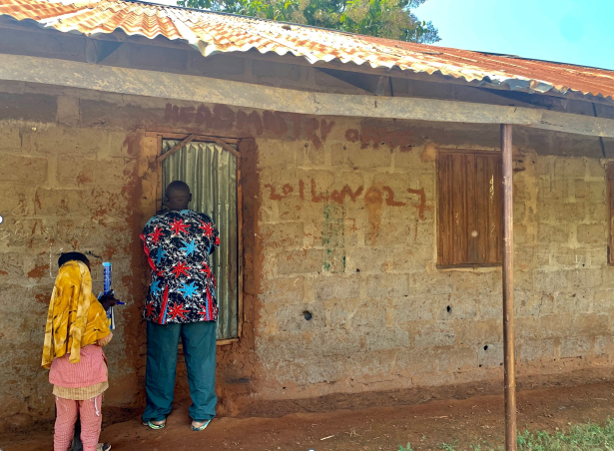
In this photo, the head teacher of LGEA primary school in Umaisha unlocks the door to a classroom as two pupils hold on to a few teaching materials. Photo: Chigozie Victor/HumAngle.

One thing so unavoidably distinct about the head teacher’s office, is the plastic furniture stacked against the room’s walls.

The pattern of the arrangement is such that the furniture is placed around the edges so that there is at least some space for the headteacher to use.

On a second look, you would notice that there are no books or teaching materials anywhere in the room. The place looks nothing like a head teacher’s office. It looks more like a storeroom for chairs.

Abdullahi Ahmed’s office is in the old block of classrooms a few feet across from the new one they had just moved into. Ideally, that is where he should conduct his duties outside the classroom, but in practice, he is hardly in his office at all, there aren’t enough teachers to oversee the students when he is not within sight of them. So he must be in sight of them as much as he can.

 Running a school with one teacher is an impossible situation.
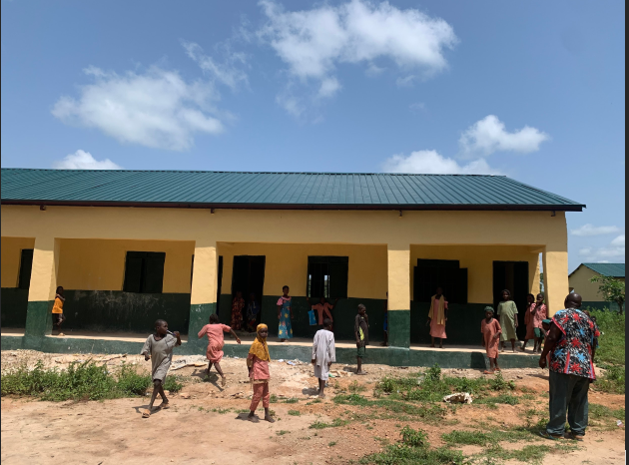
Pupils run out of their classrooms due to the absence of teachers; the headteacher can be seen, telling them to retreat. Photo: Chigozie Victor/HumAngle.

Ahmed is the head teacher of a Local Government Education Authority (LGEA) primary school in Sogene community, located in Umaisha town in  Nasarawa state, North-central Nigeria.

Students appear to be fond of Ahmed, but he has many problems to contend with. The most paramount, he repeatedly tells this reporter, is the school’s need for more teachers.

“There are only two teachers in this school; myself and one other teacher,” he says, his forehead gathering in a frown.

On a regular school day, he finds himself rushing in and out of classrooms, struggling to teach as many classes as he can before and after recess, leaving him spent at the end of the day.

While Abdullahi speaks with this reporter, he has a difficult time concentrating. Occasionally, a peeking student by the office door would disappear for a minute, only to return with their peer a while later, their excited voices floating above Ahmed’s as he struggled to speak above the noise.

Even after a lanky boy rings the bell to signal the end of recess, the students show no intention of returning to their respective classes. Some play outside in clusters, some who are in their classes interact noisily, while those who are fascinated by the presence of a stranger hang around the door and window of the office, disappearing when they are asked to leave, only to come back moments later in their numbers.

“They think you are here to vaccinate them,” the head teacher says as he takes his seat again; he had just gotten up for the second time to send the students away to their classes.

Ahmed resigns himself to the commotion as there is no teacher available to teach the students anyway.

“My colleague is not here. He was called to the LGEA office to attend to something,” he explains.

“Only the PTA teacher is around, and he is teaching a class.”

PTA teachers     
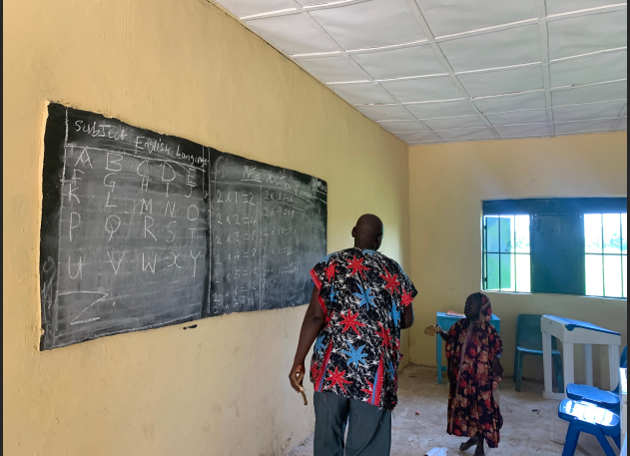
Abdullahi Ahmed teaches a pupil to recite the multiplication table. Photo: Chigozie Victor/HumAngle.

To make up for the shortage of teachers in his school, the head teacher has employed an extra hand to help with the job. This teacher who is not employed by the Nasarawa State government is called a PTA teacher.

Hussaini, the PTA teacher, has to take three classes (classes 1, 2, and 4) on four or five subjects daily. He complains that the workload is quite heavy for him.

“The students are too much for me,” he says, slightly leaning in, so that this reporter can hear him above the noise that has drowned out his class.

When he is not rushing in and out of classes like the headteacher, Hussaini struggles to grade assignments and classwork.

“They give me about ₦‎ 5000 at the end of the month,” Hussaini says, explaining that the money barely gets him anywhere as he has four children to provide for.

“He is also a farmer and a fisherman,” the head teacher interjects when this reporter asks Hussaini how he gets by on his meagre salary.

“He catches fish very early in the morning, and by 8 a.m., he is already here in time for school, then goes back again by 1 (after school hours) and finishes up,” the headteacher says as Hussaini nods in affirmation.

“We call him PTA teacher because it is the school that takes responsibility for his salary, not the PTA itself,” he clarified.

“At times, we collect ₦‎ 10 each from students every week, so if it is ₦‎2500 that we are able to gather at the end of the month, we can say please take this one and go and buy soap to wash your hands,” he says, a metaphorical explanation of the inadequacy of the salary given to Hussaini.

“Most of the schools in areas like ours do the same,” he added.

In another LGEA primary school in Gindin Kade, located in Awe LGA of the state, the head teacher of the school revealed that he had recently employed a PTA teacher to make up for the lack of teachers in his school.

Scarcity of teachers abounds in Nasarawa LEA schools

“It was just this term that we started employing PTA teachers, and it was because of how things were going. You know you have to help yourself so that God can help you,” Ishaka Dano, headteacher of Gindin Kade LEA primary school says in a placid tone.

Unlike the LEA primary school in Sogene, the one at Gindin Kade has three teachers, excluding Dano himself. Each of these teachers has committed to contribute ₦‎2000 from their individual salaries towards the payment of the PTA teacher that they have employed.

Employing and paying extra teachers out of their own salary (which they complain is miserly) might seem like a huge sacrifice to make for their students but Dano and one of his teachers who spoke with this reporter say that they are doing so for two reasons.

“The stress is too much. How can you teach class 1, and then still go to class 2? We are not robots,” he said, explaining stress as one of the reasons.

“But the most important thing is that the three of us are all from this community and the pupils in the school are our children, so we are just doing this to help our children,” he said.

Grades combined

Sogene LEA primary school. Pupils pose for a picture having run out of their classes to play outside. Photo: Chigozie Victor/HumAngle.

Teachers remain insufficient. To fill this gaping hole, the schools combine students from different grades in one classroom.

While this may seem alarming as curriculums differ according to grades, the headteachers of both schools say that the combination is merely done to curtail the noise that emanates from classes that are without teachers at different times of the day.

“That is why we combine them to manage them so that after we teach one class, then we will say you people should occupy the front row seats so that we will teach the other class. If we don’t do it like that, they will all be noisy. Some might even run away [outside the school premises],” the headteacher of Awe LEA school says.

“Make do”
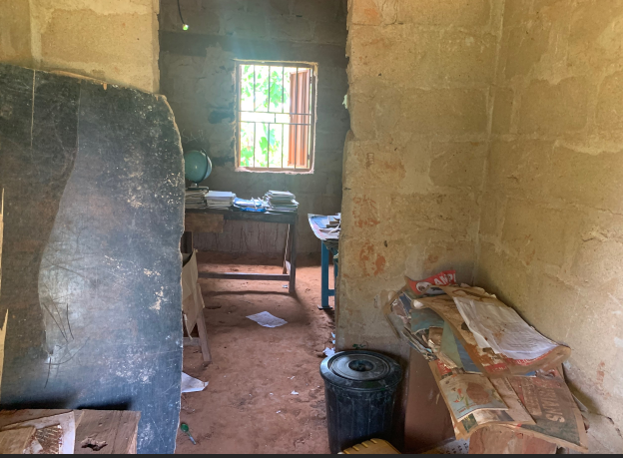
This photo shows Ahmed Abdullahi’s office, a few feets from the new block of buildings erected by Nasarwa SUBEB. Abdullahi says he does not mind working in the unconducive state of the office but is more pressed for more teachers. Photo: Chigozie Victor/HumAngle.

“You will be teaching and a child will come complaining to you that he has been beaten by another. That is because there is no teacher in that class,” he says in a pained voice.

While this technique which has been adopted by both schools may seem innovative, Ahmed Abdullahi, the headteacher of the Sogene LEA thinks that there are only so many teachers that can combine different grades and successfully carry out their duties.

“The educational rule only allows for a maximum of 30 or 40 students to be tutored by one teacher but you [teachers] are combining one hundred plus in a class.

“If you give them classwork before you mark it, you have consumed the whole day,” Abdullahi said, going on to make a case for the importance of creating different streams for a particular class if their population is above the teacher-to-student ratio.         

Ahmed Abdullahi noted that his school is lacking in a number of facilities and amenities but his primary focus was on the deployment of more teachers to his school.

For instance, when this reporter pointed out the absence of toilet facilities in the school, he insisted that the lack of teachers was a more pressing concern.

“We don’t have enough teachers, how can we say we need more offices? The main problem now is teachers,” he says, instead, moving to another classroom.
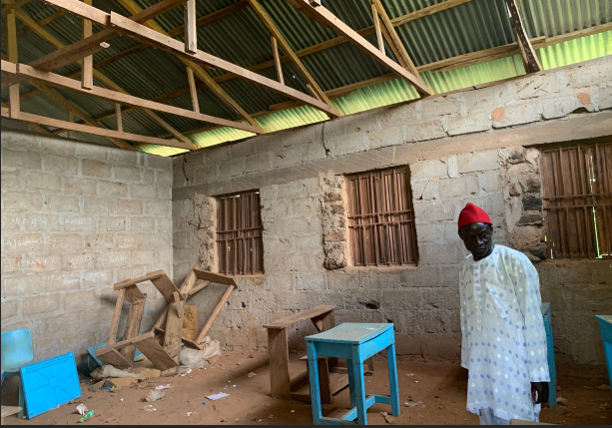
PTA chairman at Sogene LEA primary schools shows the reporter the poor state of old classrooms in the school. Photo: Chigozie Victor/HumAngle.

The PTA chairman who joins him later comments on the decaying structure of the old office and classrooms as well as the lack of running water in the school. Even though Sogene LEA primary school had recently gotten a new block of 3 classrooms courtesy of the Nasarawa State Universal Basic Education Board (SUBEB), they still lack a conducive environment for all students as there is still a shortage of classrooms.

“From next week, class one and class 2 will be taking these classrooms,” he said, showing off the board that he has painted with black charcoal in preparation.

At the moment, all that he wishes for are additional teachers. He says this as many times as possible.

“We wrote and wrote and wrote before they built these new classes for us. Before, we had only two,” he says.

“They have brought classrooms and seats, so now, the issue of teachers is our main problem.”

The headteacher at the Awe LEA school says a similar thing.

“I will say we are lucky they came and built this school for us,” he says, narrating how he would tell members of the community to assist him in complaining to SUBEB.

Like Ahmed Abdullahi of the Sogene LEA school, this head teacher at Awe is equally more distressed about the lack of teaching hands than he is about other abnormalities in his school.

For instance, the new building, which he says is barely two weeks old, is already mouldy.
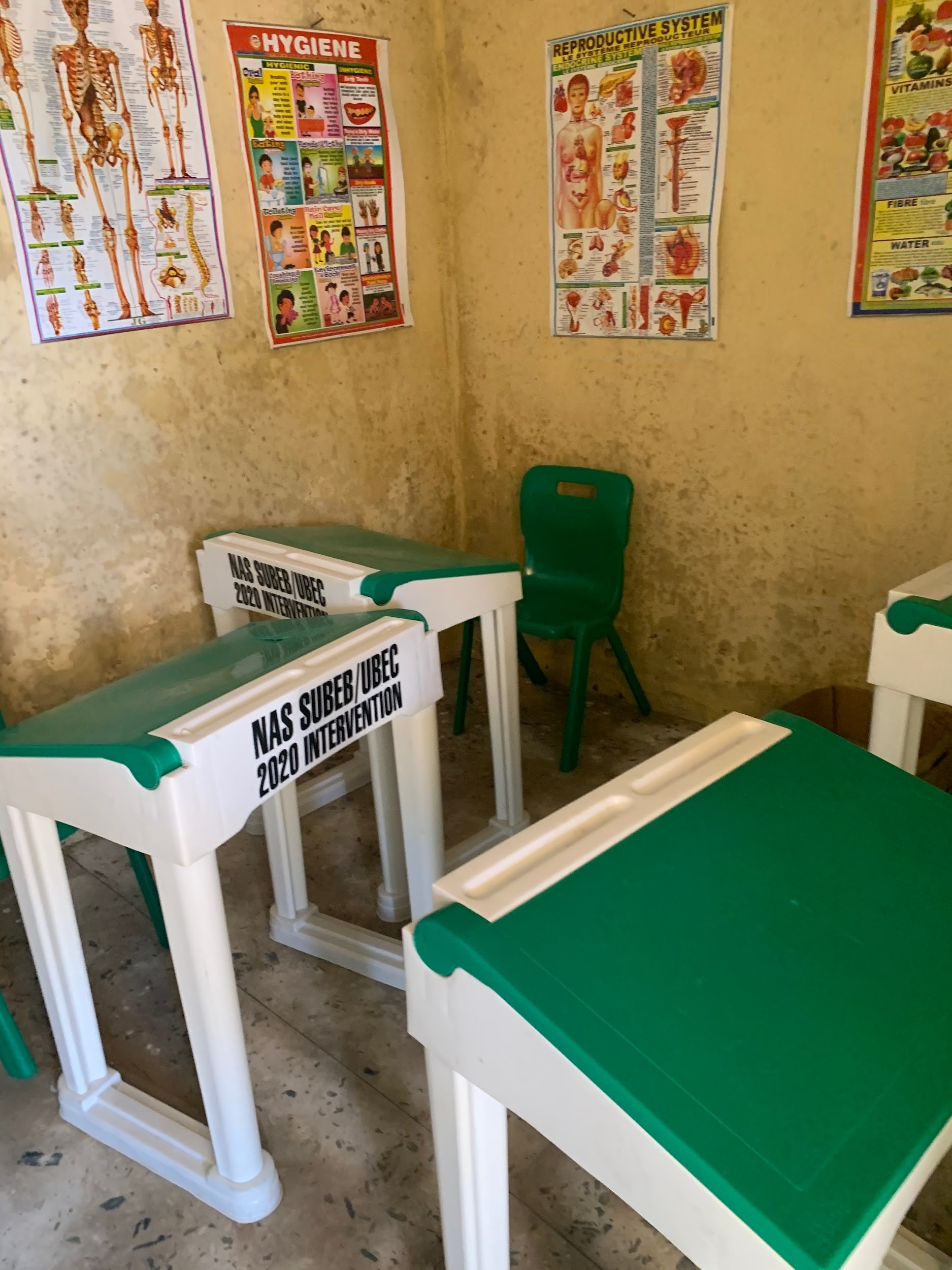
Mouldy wall of one of the new classrooms in Gindin Kade LEA primary school. Photo:

While the two other classes appear to be okay, the head teacher’s office and the class attached to it do not resemble new structures as their walls are riddled with moulds whose distasteful odour hits the nostrils upon entrance, and its walls, made untidy by the greyish decaying colour left on the yellow colour of the walls.

Much like the other headteacher’s resignation with the state of his office, the headteacher at Awe does not seem fazed by the obvious low quality of work which the builders have done, he talks instead (alongside one of his teachers) about the inadequacy of teachers.

“Quality assurance department was informed about this issue, and their response was that these days, there is no appointment for employment,” the teacher says.

But while the head teacher at Sogene emphasised solely on the teaching gap in his school, the one at Awe, perhaps because he has more teachers, raises an issue with the teaching aid that the school is provided with.

“We have a serious problem with the teaching aid.”


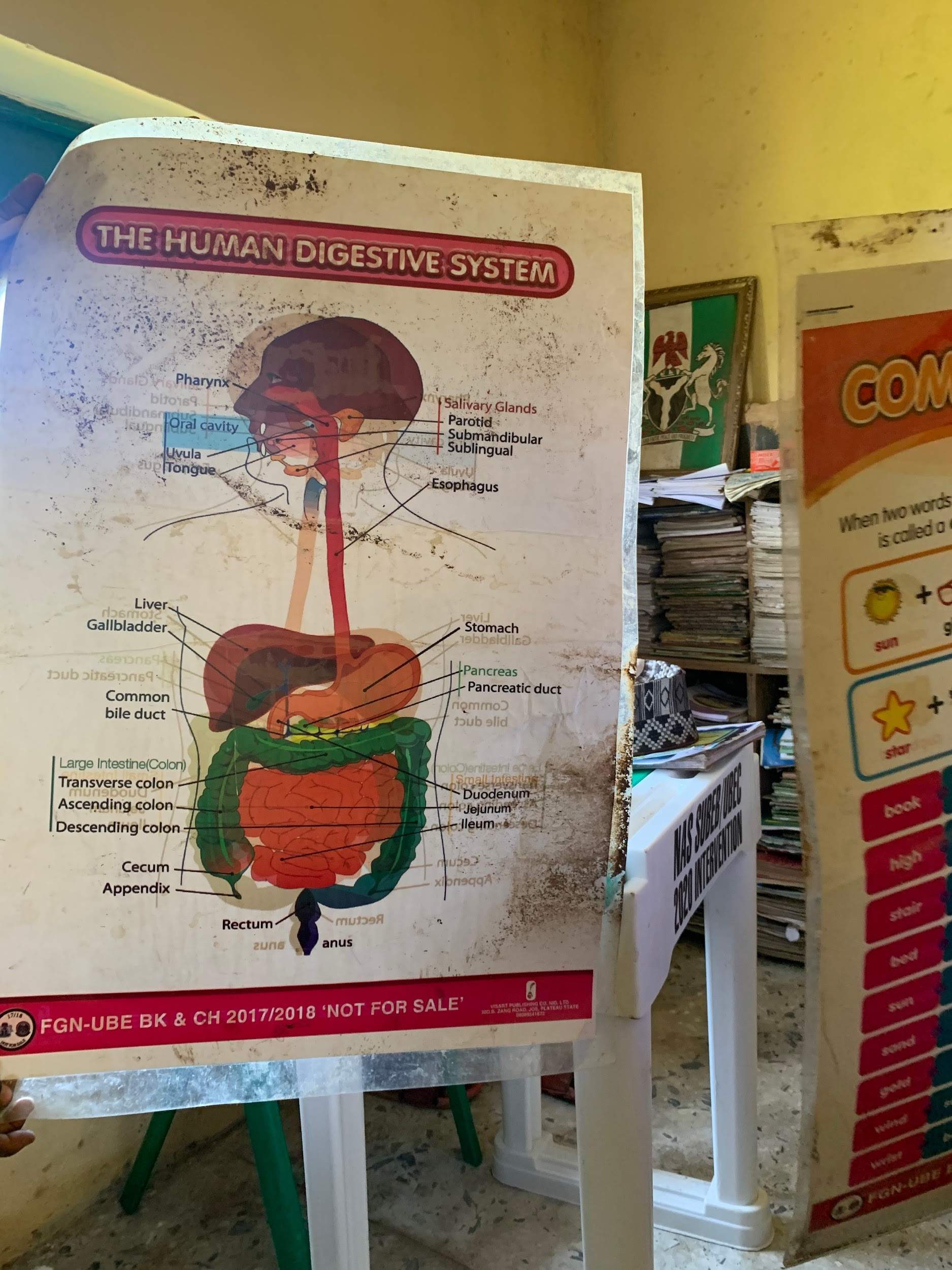
The headteacher of Gindin Kade LEA primary school holds up a teaching aid supplied to them by the state education board. Photo: Chigozie Vicor/HumAngle.

“Now let’s be clear here, this one is something for secondary school,” he says, holding up a poster.

“This one too. Look at it; it is the human digestive system and they are saying that we should teach it in primary school,” he adds.

The head teacher, upset about the teaching aids, goes around the classroom adjoining his, to point out the irregularities in the aids they are being supplied.

The teacher accompanying him tells this reporter that they were recently supplied with Igbo textbooks even though the students do not have the Igbo language as a subject of study or anywhere in their curriculum.

“You will not get mathematics or social studies textbooks, but they will bring Igbo textbooks for you,” he said, suggesting that the abnormality probably happens because the required textbooks have long been distributed to other areas while “the less privileged communities get the leftovers.”

Teacher-to-student ratio

While the headteachers of Sogene and Awe LEA primary schools may be filling the teaching void as best as they can, the students are still not getting the required quality of education.

The LEA school at Sogene has a total number of 162 students, while the school at Awe has 150 students currently enrolled, with only two, and three teachers, respectively.

Although there is no “consensus” on a standard student-to-teacher ratio (usually derived by dividing the total number of students enrolled in a school by the number of teachers available to them), “there is wide agreement that younger children need more time and interaction with teachers for a quality education.”

And so going by this notion, one may not be able to say that the appalling lack of teachers in both Awe and Sogene LEA primary schools is short of a general standard, but it is, however, clear that pupils of both schools would not be able to get “quality education” from their schools because even though the class sizes (usually derived by dividing the number of students enrolled in a school with the number of classes in the school) are not as outrageous as the one obtained in  a primary school in Kano with 499 students in one class, the students would still not be able to get proper education from their teachers as they (teachers) are forced to combine classes hence preventing them from focusing “more on the needs of individual students and reducing the amount of class time needed to deal with disruptions,” an advantage only enjoyed by small classes, of which the aforementioned school are.

Other things which are instrumental to quality education such as “teacher satisfaction,” which is inclusive of working conditions, salary, staff-to-student ratios, infrastructures and facilities are also lacking in the two schools which were visited.

Zero Recruitment

Unfortunately, the poor number of teachers noted in Sogene LEA Primary school and Gindin Kade LEA primary school are not peculiar to both schools, it is in fact, a statewide issue currently plaguing a lot of public primary schools in Nasarawa State.

The situation is so dire that recently, the Nasarawa State House of Assembly decried the “falling standard of primary education,” and called on the government of the State to declare a state of emergency on primary education.

According to the house, 3,665 primary school teachers have either died or retired between 2011 and 2021 but have not been replaced.

“We need to fill the gap by recruiting competent hands in the interest of our children and the state at large,” Daniel Ogazi, the house chairman on education had complained to the management of SUBEB when it appeared before the committee for its 2022 budget performance, in August.

Mohammed Dan’Azumi who is the chairman of the Nasarawa State Universal Basic Education Board (SUBEB) was contacted through phone, text, and WhatsApp to give comments on the board’s action towards resolving the issue plaguing primary education in the state, but he did not make himself available for an interview.

This report is part of a collaborative investigative series by HumAngle, the International Centre for Investigative Reporting (ICIR), NPO Reports and TheCable, facilitated by the Wole Soyinka Centre for Investigative Journalism (WSCIJ) under its Collaborative Media Engagement for Development, Inclusivity and Accountability (CMEDIA) project, with support from the John D. and Catherine T. MacArthur Foundation.

6 moments in African football in 2022 that will be talked about for years to come

1

By Chuka Onwumechili, Howard University

2022 was a significant year for African football. It was a benchmark for the women’s game and a year that may mark the first real move into African football as a business rather than football as development. It ended with some thrilling matches at the men’s World Cup in Qatar, proving the real progress made by teams from African countries.

The first full year of a return to the sport after the COVID pandemic, 2022 has shown that the African game is able to grow and claim its own space in world football beyond the headlines generated by star African players like Mo Salah and Sadio Mané playing for high profile European clubs.

Each of the six key events I’ve noted here presented a watershed moment. We may not all agree on the order, but can be sure they will be talked about for years to come.

Afcon wins new respect

Many top African footballers play for clubs in Europe. Late in 2021, the European Club Association threatened to prevent key players from representing their countries at the Africa Cup of Nations (Afcon) tournament in 2022. They cited COVID-19 problems and conflict with the scheduling of league football in Europe. The Conversation Africa projected that the English Premier League alone stood to lose up to 37 players to Afcon.

But the African countries stood their ground and insisted on the release of the players. Importantly, several key figures in football, including European club manager Patrick Vieira, demanded that Afcon be respected. In the end, the European clubs bowed and released their players to participate in Africa’s most glamorous football tournament.

Afcon went on to achieve record numbers in fan engagement, with over 1 billion video views worldwide and unprecedented social media attention.

Women’s football scores big

Club tournament the African Women’s Champions League is barely two years old and there was no prize money on offer in 2021. But, in a stunning announcement, the Confederation of African Football (Caf) offered a purse for 2022. Winners now receive US$400,000 and the runner-up and third-placed teams US$250,000 and US$200,000. These are noteworthy figures, even compared to the prize for a club winning the Women’s Champions League in Europe. There, the published prize for 2022 was US$230,000 or £200,000. ASFAR from Morocco triumphed over Mamelodi Sundowns from South Africa.

The prize money demonstrates a genuine move by Caf to improve women’s football on the continent and it will surely trigger more participation by women in the sport across various African countries. With such interest, media will follow to further raise the game’s profile.

Africa makes its mark at the World Cup

Before the 2022 men’s football World Cup, Africa had previously presented three teams at the quarter final stage – in 1990 (Cameroon), 2002 (Senegal) and 2010 (Ghana). Morocco joined that list in 2022 and then went a step further, making history by becoming the first African team to reach a World Cup semi-final. However, Morocco reaching this zenith was not the only story for Africa at the 2022 World Cup.

This World Cup marked the only finals in which Africa had won eight games in regulation time. The previous highest total was four – in 2002 and 2010. This clearly marks major progress, more than a 75% win increase.

A football team poses in the middle of a field with a bank of cameras taping and photographing them.
The Moroccan team celebrates victory in the quarter-final of the World Cup.
Alex Grimm/Getty Images

Video assistant referees introduced

Although video assistant referees are now a common part of global football, referees watching the game on video screens was new at Afcon in 2022. The system was used for the first time in the final stage and proved crucial in helping match officials make decisions.

Several games were decided by video analysis following video replays. It was critical in deciding a knockout stage game between Nigeria and Tunisia, for example. A video replay led to the disqualification of a Nigerian player as his team chased an equalising goal. Although the system has been challenged at other tournaments, it was considered a success at Afcon.

New powers in the women’s game

Nigeria had dominated African women’s football for so long that for years there was no contest at the continental championship level. However, the hard work of countries like Morocco, South Africa and Ivory Coast has gradually started to pay off.

At this year’s Women’s Africa Cup of Nations (Wafcon), Ivory Coast failed to qualify, beaten by Nigeria despite its credible performance at the 2019 Women’s World Cup. However, Nigeria found that its dominance at Wafcon had come to an end. Nigeria was eliminated by hosts Morocco at the semi-final stage and then beaten by Zambia in a tough third place game. Morocco, playing eye catching football throughout the tournament, lost to South Africa in the final. South Africa had earlier dealt Nigeria a blow at the group stage.

These performances and results demonstrate the spreading of top level talent and teams across the continent.

A brand new league

The biggest development of the year, however, has to be Caf’s announcement of a new league for African premier clubs, starting in 2023. The lucrative new Africa Super League involves the continent’s best clubs, some countries providing as many as three teams and others none.

This competition is made for TV, designed to generate revenue from deep-pocket sponsors through broadcast rights. The tournament will replace the African Champions League as the continent’s premier club competition and will be dominated by the big North African clubs from Egypt, Algeria, Morocco and Tunisia. With top West African players migrating to Europe and Asia in recent years, the North Africans have dominated.

In the long term this should help develop stronger, better funded African clubs, better able to keep some top talents at home. If Caf is able to pull this off, it will be a significant watershed in African football.

Caf’s new leadership, elected in 2021, came in with an ambitious ten-point plan to revitalise African football. It hasn’t been easy, given the state of finances that it inherited, including the loss of a major sponsorship. Yet, its activities in 2022 have demonstrated the potential to dramatically open new vistas.The Conversation

Chuka Onwumechili, Professor of Communications, Howard University

This article is republished from The Conversation under a Creative Commons license. Read the original article.

2023: Politicians, secessionist groups behind attacks on INEC facilities – IGP

0

INSPECTOR General of Police (IGP) Usman Baba has declared that politicians and secessionist groups are responsible for attacks on Independent National Electoral Commission (INEC) facilities across the country.

Baba made the claim on Friday, December 16, in Abuja, at the commencement of an investigative hearing held by the Ad-hoc Committee of the House of Representatives set up to investigate attacks on INEC offices and facilities.

Represented by the Deputy Inspector General of Police (DIG), Operations, Dandaura Mustapha, the IGP attributed the attacks to the clandestine activities of some politicians and secessionist groups in the South-East and South-West.

“When INEC finally lifted on campaigns, the campaigns commenced and what we realized initially was inter and intra party dispute. We realized that members of political parties were destroying billboards, posters and campaign offices in some states. We quickly alerted the Commissioner of Police in charge of the Commands and gave them a clear directive that it is the right of every political party to go to all nooks and crannies of society and campaign.

“What we discovered is what we all know in this country, it is a well known fact that in the South-East geopolitical zone we have issues of secessionists, the IPOB and ESN. These groups are bent on stopping elections from taking place in the South-East.

“In the South-West, we equally have the pro-Yoruba secessionists that are equally bent on succeeding and not allowing the election to take place in their areas hence the attack on INEC in Osun and Ogun of recent. Those ones are there too, sponsored by politicians and other stakeholders.

“There is also an issue of failed and desperate politicians who are bent on stopping INEC from conducting this election. The failed politicians are those who could not come back through any political parties and as far as they are concerned let everything scatter. They are using that opportunity to sponsor illiterate followers of the party and hoodlums to make sure that this general election does not hold and should not be successful.”

The IGP revealed that all the security agencies held a meeting on December 13, where operational officers discussed measures to be taken to safeguard INEC facilities.

Also speaking at the hearing, INEC Chairman Mahmood Yakubu noted that the attacks on the Commission’s facilities have affected preparations for the election.

“The attacks have far-reaching implications on preparations for the general election. First, the facilities that are destroyed, especially offices will take time to rebuild. They are not like items of procurement that you can procure off the shelf. So an alternative arrangement has to be made. So in some states in addition to these malicious attacks other matters that have arisen as a result of fire and flooding, we will have to make alternative arrangements by renting in some places we can find facilities to rent.

“In some of the remote areas we may not find facilities to rent, so we have to look for alternatives to the damaged facilities.”

The Speaker of the House of Representatives, Femi Gbajabiamila, while declaring the hearing open, said the House was disturbed by the attacks ahead of the 2023 general elections.

He called on all stakeholders to ensure that the menace is put in check.

“It is on this basis that the House of Representatives not only unequivocally condemned these nefarious attacks but also resolved to set up an Ad-hoc Committee to investigate the remote and immediate causes of the incessant attacks on INEC facilities.

“We are indeed hopeful that at the end of this investigation the committee would be able to come up with far-reaching recommendations that will not only bring an end to these unfortunate attacks on our democracy but also ensure that the perpetrators of the nefarious acts will be made to face the full wrath of the law,” he said.

The ICIR reported that the Imo State Police Command blamed suspected members of the Indigenous People of Biafra (IPOB) for the recent attack on the headquarters of the Independent National Electoral Commission (INEC) in the state.

Unidentified gunmen had on December 12, razed the INEC office in Owerri, Imo State capital.

Three of the gunmen and a policeman died in the attack.

But IPOB had denied responsibility for the attacks on INEC facilities in the South-East.

The group also said it has no plans to disrupt the 2023 general elections in the South-East.

FG declares Dec 26, 27, Jan 2 as public holidays

0

THE Federal Government has declared December 26, 27, 2022 and January 2, 2023, as public holidays to mark Christmas, Boxing Day and New Year celebrations.

This was disclosed in a statement by the Ministry of Interior signed by the Permanent Secretary, Shuaib Belgore, on Friday, December 16.

According to the statement, Minister of Interior Rauf Aregbesola urged Christians to be security conscious while praying for the eradication of insecurity in the country.


Read Also:

“We must imbibe the life of Jesus Christ in His practice and teachings on Humility, Service, Compassion, Patience, Peace and Righteousness, that His birth signifies. This will be the best way to portray Christ and celebrate his birth.

“Peace and security are two critical conditions for economic development and prosperity. We urge Christians and Nigerians to make the best use of this festive period to pray for the total eradication of insecurity bedeviling our dear nation.

“We strongly charge Nigerians not to be lulled into insensitive crisis by criminally minded elements that want to create anarchy in the country,” the minister said.

Aregbesola urged residents to report suspicious activities to security agencies through the N-Alert application available on mobile phones and assured that security measures were in place to protect lives and properties.

Ogun will soon become oil producing state – Governor

0

OGUN State governor Dapo Abiodun has said the state will soon become an ‘oil producing state’.

The governor spoke at the commissioning of Molusi College Road on Friday, December 16, in Ijebu Igbo, Ogun State.


READ ALSO:

Disregard petition against my second term bid, Abiodun tells APC chairman

INVESTIGATION: Multi-billion World Bank power project grounded in Enugu, Cross River, Ogun States (Part 1)

INVESTIGATION: Multi-billion World Bank power project grounded in Enugu, Cross River and Ogun states (Part 2)

#EndSARS: Suspected leaked DSS document calls for intensified security in Ogun State


“By the special grace of God this state will become oil producing. From the Keji Island, we have Olokola and we are working assiduously to become oil-producing. We must because we are the industrial capital of this nation,” he said

The governor added that his administration will ensure the development of the state by constructing pliable road networks which would link all rural and urban communities together to foster economic development.

He also stated that his government will see to the establishment of a seaport to facilitate and increase trade and investment in the state.

“Again in this state, we will also have a seaport. The seaport fit into our modern time transportation masterplan. We have done our road network connecting us and we must complete the ongoing roads with our seaport. Before I leave, before my eight years, ships will sail through Ogun State,” he said.

African leaders urged to make more investments in health systems

0

AFRICAN leaders have been urged to commit more resources to their nation’s health systems to improve citizens’ well-being.

The appeal was the highlight of the just-concluded second edition of the International Conference on Public Health in Africa (CPHIA 2022) in Kigali, Rwanda, according to a statement from the meeting mailed to The ICIR by Ouma Onyango.

The conference had the theme, ‘Preparedness for Future Pandemics and Post-pandemic Recovery: Africa at a crossroads’.

Participants called for solidarity among African nations and global partners to advance local manufacturing of health commodities, strengthen emergency preparedness and response, and expand universal health coverage.

They also sought improved collaboration with the African Centre for Disease Control (Africa CDC) to implement the New Public Health Order, a roadmap for sustainable health outcomes and improved health security championed by the African CDC.

“Drawing on lessons from Africa’s past experiences in outbreak response, the New Public Health Order is guided by principles of local ownership, leadership, equity, innovation and self-reliance. Throughout the three days of the conference, stakeholders echoed the call for a new approach that empowers African countries to be prepared for the health challenges of the future,” read a part of the statement.

The conference was held between December 13 and 15 and had over 2,500 participants from 90 countries across the continent and beyond.

The participants include heads of state and ministers of health, leading scientists and researchers, representatives from the private sector, civil society, and global health and development organisations.

The meeting also honoured Africans who have made remarkable impacts in the health sector in the region, including Nigeria’s Stella Adadevor, who sacrificed her life to prevent Ebola from spreading in Nigeria in 2014.

Some of the other awardees are Rose Leke, a professor of immunology and parasitology, who received the Achievement in Global Health Leadership Award.

Leke, a Fellow of the Cameroon Academy of Sciences, the African Academy of Science and The World Academy of Science, got the award for her contributions to academia, including her time as Head of Department at the Faculty of Medicine and Biomedical Sciences at the University of Yaounde and Director of the Biotechnology Centre. 

She has also chaired the African Region Regional Certification Commission since its inception in 1999 and made the decision to certify the WHO African Region free of wild polio in 2020. 

Memoranda of understanding (MoU) were also signed at the meeting, including the CDC and Medicines for Malaria Venture (MMV) MoU to enhance supply security and facilitate equitable access to quality approved antimalarials, thereby maximising the use and health impact of existing products on the continent. 

The collaboration aims to support African Union member states in accelerating and scaling-up African manufacturing, building on existing capacities and developing new ones to support the manufacturing of quality-assured malaria APIs and FPPs. 

Sessions at the meeting focused on Africa’s most pressing health challenges and topical issues, including re-emerging and high-burden infectious diseases, non-communicable diseases, mental health, the role of women leaders in public health, technology and digital health innovations, the power of engaging civil society, community actors, and the private sector to advance shared health goals. 

Speaking on behalf of the government of Rwanda, which hosted the event, the State Minister of Health, Dr Yvan Butera, said Rwanda was glad to collaborate with the Africa CDC to implement the New Public Health Order in its various aspects, including strengthening institutions for public health, building public health workforce, expanding local manufacturing, increasing domestic investment in health, and promoting strategic partnerships, which he said resonated very well with the theme of the conference.

Some of the participants are Rt. Hon. Édouard Ngirente, Prime Minister, Republic of Rwanda; Yvan Butera, State Minister of Health, Republic of Rwanda; Tedros Adhanom Ghebreyesus, Director-General, World Health Organization (WHO); Chikwe Ihekweazu, Assistant Director General, World Health Organization (WHO) for Surveillance and Health Emergency Intelligence; Winnie Byanyima.

They also include the Executive Director, UNAIDS; Awa Marie Coll Seck, Minister of State to the President of the Republic of Senegal and Ahmed Ogwell Ouma, Acting Director of Africa CDC.

The next edition of the meeting will be hosted by Zambia.

Buhari not fighting corruption according to global standards – CSO

0

THE Executive Director, Corruption Observatory and Public Awareness Initiative, Richard Ivie, has said that President Muhammadu Buhari is not fighting corruption according to global standards.

Ivie made the assertion while speaking on Channels Television on Friday, December 16.

According to him, the Buhari administration has failed to protect whistleblowers.


READ ALSO:

Corruption: Whistleblowers are victimised in Nigeria’s public sector – Coalition

Court jails Senator 42 years for corruption

NIS sacks eight personnel over alleged corruption, redeploys 100

Anti-corruption academy offers ‘power of the pen’ corruption reporting training


“The problem is the language from the top, the tone from the top. I’m very sorry I don’t think the President is really serious about fighting corruption and they say he is the African champion of anti-corruption. I don’t know what measure was used to make that appointment or award.

“There is no whistleblower protection law. The first thing to do if you want to fight corruption is to protect those who want to speak out. Not based on what has happened or suspicion alone. The present policy is not right,” he stressed.

Ivie emphasized the need for Nigeria to adopt a transparent and standardized integrity system to check corruption among public office holders and politicians.

He also faulted the efforts of the Economic and Financial Crimes Commission (EFCC) in the campaign against corruption.

“The speech of Mr Bawa (EFCC chairman) indicted the corruption campaign of this administration. That a lot of recoveries and arrests are being made show that the system is dirty,” he said.

Ivie also spoke of the need for Nigeria to adopt a standardized whistleblower protection policy and integrity system.

“We are talking about international standards that strengthen systems and make it very impossible for corruption to thrive. Everything you do will go through the process and you think about the risk you will meet. Even for you to steal one million naira the system will throw it up, people will know and you will be exposed publicly.

“The ICPC and EFCC are overwhelmed and others need to be strengthened to ease the activities of the agencies.”

However, Ivie faulted the provision of incentives for whistleblowers. According to him, the government should instead provide protection for whistleblowers.

“Whistleblowing is based on three principles – protection, confidentiality, and trust. The issues of incentivizing whistle blowing is optional. Why should a giant of Africa initiate a policy based on incentive? What an average whistleblower wants is to be protected, trust the institution he is disclosing the issue to. The protection shouldn’t just be about you but all the people around the whistleblower.”

Twitter bans high-profile journalists for doxxing

0

TWITTER Chief Executive Officer (CEO) Elon Musk has banned some high profile journalists from the microblogging site for doxxing (sharing his live location) during a space.

Musk barred the following journalists from Twitter: Ryan Mac from New York Times, Donnie O’Sullivan from CNN, Drew Harwell from Washington Post, Matt Binder from Mashable, Micah Lee from The Intercept, and Steven from Voice of America.

Prior to this, 20-year-old Jack Sweeney was suspended from the platform for tracking the Live location of the Tesla boss through @Elonjet.

Barely 24 hours after suspending @ElonJet from Twitter, Musk has gone after top journalists, for violating privacy policy by sharing @ElonJet links.

The Chief Twit posted, “Criticizing me all day long is totally fine but doxxing my real-time location and endangering my family is not.”

“They posted my exact real-time location basically assassination coordinates in direct violation of Twitter’s terms of service,” he added.

During a Twitter Space, Musk tried to explain his decision but within a short time, he left the session due to some offensive questions.


READ ALSO:


report by India Today said the Space was shutdown and all the guests tuned in were evicted.

Subsequently, minutes later, Twitter temporarily halted Spaces feature, and stated that it would be back after a bug fix.

Currently, there is an ongoing poll on Twitter, asking users to vote on when the suspended accounts who shared Musk’s real-time location would be released.

In an earlier post Musk stated,“Any account doxxing real-time location info of anyone will be suspended, as it is a physical safety violation. This includes posting links to sites with real-time location info. Posting locations someone traveled to on a slightly delayed basis isn’t a safety problem, so is ok”.

The Pulitzer Center Rainforest Journalism Fund offers Dom Phillips reporting grant

THE Pulitzer Center Rainforest Journalism Fund is inviting applications for its Dom Phillips Reporting Grant themed “How to Save the Amazon?”.

The Fund is seeking reporting ideas focused on solutions for the future of the Amazon.

Proposals can be centered on the Brazilian Amazon, but projects about the Amazon in Colombia, Peru, Ecuador, Bolivia or Venezuela are also welcomed, just as stories addressing border areas, or projects held collaboratively between Amazon countries.


Read Also:

Independent and staff journalists, freelancers, journalists collectives, writers, photographers, audio and radio producers and TV and film producers anywhere in the world can apply for this grant.

Selected proposals will receive the necessary funds to carry out the project, in accordance with the detailed budget submitted upon application.

The organiser says the grant is named after Dom Philips, the British journalist killed along with Brazilian Indigenous Expert Bruno Pereira during a trip to the Amazon region on June 5, 2022. How to Save the Amazon was the title of the book Phillips wanted to finish writing.

The deadline for the submission of applications is January 18, 2023. Interested applicants can apply here.

Global Landscapes Forum seeks social media ambassadors

THE Global Landscapes Forum (GLF) is accepting applications for the GLF Social Media Ambassadors Volunteer Program.

The program seeks social media ambassadors who will shape the global conversation about sustainable landscapes, network with top organisations around the world, and gain early access to GLF campaigns and events.

Selected social media ambassadors will help boost the GLF’s campaigns and events through their social media channels; co-create insightful content in collaboration with the GLF Social Media team; provide live coverage of GLF events; and attend virtual coordination meetings.


Read Also:

Social media-savvy sustainability enthusiasts, 18 to 35, from around the world can apply.

Basic knowledge of English is required.

The deadline for the submission of the application is December 31, 2022. Interested applicants can apply here.