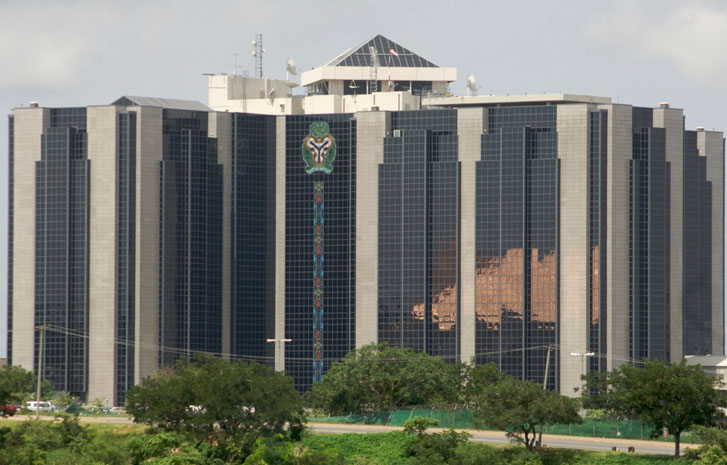
THE Central Bank of Nigeria (CBN) has calmed the nerves of point-of-sale (PoS) machine operators with the assurance they will not be endangered by the new cash withdrawal policy it initiated.
The apex bank, saying it would be offering the operators, about 1.4 million of them, some measure of concession, reiterated that the overall aim of the policy was to ensure a strong legal tender, amid concerns of the dwindling value of the naira.
The CBN had, on December 6, issued a directive to commercial banks and financial institutions limiting daily automated teller machine (ATM) withdrawal to N20,000, while limiting over-the-counter withdrawals for individuals and corporate organisations to N100,000 and N500,000, respectively.
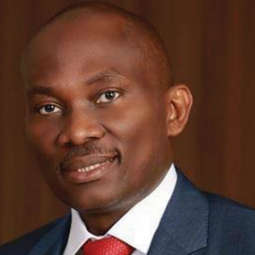
“I cannot say that we are going to be rigid; we want to ensure that we make life conducive for our people. It is not to say that we will reverse or change timing of the policy. Whether it is about tweeking the amount higher to accommodate key operators, we will do so because we are humans,” the CBN governor, Godwin Emefiele, said in an interview with newsmen.
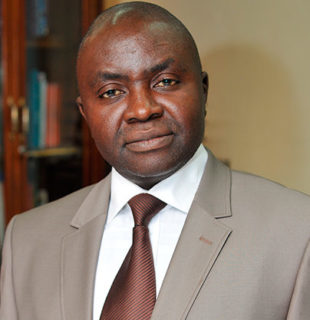
Explaining further measures to assist the PoS operators on the new policy, the director of Banking Supervision and Services at the CBN, Mustapha Haruna, explained that the apex bank had provided allowances for PoS agents for withdrawals above limits.
“PoS operators are not in any way endangered; that is why we made provisions for how much a typical agent needs in a day. People need to see this as a policy intended to contribute to growth and development. When Nigerians understand the benefits of this policy, it will definitely shift mindsets,” Haruna said.
Prior to the clarifications, the president, Association of Mobile Agents Association of Nigeria (AMAAN), Victor Ololo, had expressed worry about the policy’s negative effects on the businesses of AMAAN’s members.
Ololo: fears AMAAN members will lose jobs, businesses
Ololo was concerned that many AMAAN members could lose their jobs, and suffer from the consequent economic distress.
He said, “An average agent attends to a minimum of 20 customers a day, which is about N400,000 minimum in transactions. What we are appealing is that the CBN should give some recognition to agents through its principals, where we can have access cards, to serve Nigeria’s unbanked.”
Some lawmakers had also expressed their reservation that many of their constituents who run cash-driven businesses could be dislocated economically.
Some of them sought a readjustment of the policy, stressing that Nigeria is still a largely cash-driven informal economy.
Bulkachiwa: ‘The cash withdrawal policy will cahse problems for us’
“I have 100 labourers working daily on my large farm in Bauchi, and they have to be paid by 5pm daily with cash. This policy will cause problems for us,” Senator Adamu Bulkachiwa, representing Bauchi North, said.
Also, Abubakar Njida, a herdsman and village head of Wafa Bango community in Yola North where there is a limited number of PoS operators and ATMs, argued that the policy would disrupt his business.
“As a trader, I withdraw N500,000 to buy rams and cows. N20,000 withdrawal per day will disrupt my business. It won’t help my business at all,” Njida said.
The senator representing Abia North senatorial district, Orji Uzoh Kalu, said that many members of his constituency are business people and would be negatively affected by the policy.
Kalu: urges CBN to increase withdrawal limit for individuals to N500,000
Kalu said, “They should make maximum withdrawal limits for individuals to be N500,000 because Nigeria is still largely a cash-driven economy.”
The Federal House of Representatives minority leader, Ndudi Elumelu, lauding the policy, believed it would help curb banditry by checkmating kidnappers, especially, who often request huge sums of cash for ransom payments.
Elumelu: lauds policy, believes it will check banditry
“If we want to stop banditry, then we must embrace this policy and make it impossible for them (bandits) to have cash,” Elumelu said.
An economic analyst, Muda Yusuf, did not consider the policy as sitting well with small-scale businesses.
Yusuf: ‘The policy will impact negatively on the informal sector of the economy’
“It will negatively impact on the informal sector of the economy. The informal sector is a significant part of the economy, accounting for over 80 per cent of trade and commerce in the Nigerian economy and substantial components of jobs in the economy,” Yusuf, chief executive officer of the Centre for Promotion of Private Enterprise and former Director-General of the Lagos Chamber of Commerce, told The ICIR.
Sensitive court materials and documents, including files, were confirmed burnt.
“Hoodlums have razed part of the Owerri Magistrate’s Court located at Owerri-Orlu Road. It happened today ( Sunday). This is very unfortunate,” an eyewitness told Punch.
Spokesperson of the Imo State Police Command, Micheal Abattam, also confirmed the incident, adding that the fire had been put out.
He disclosed that an investigation had since commenced and that the Command would go after the culprits.
The state government announced the development in a statement signed by the Commissioner for Internal Security and Humanitarian Services, Emmanuel Bagna Umar.
“We receive with great joy reports on the rescue mission undertaken by NAF in rescuing seven kidnapped Chinese nationals. His Excellency, Governor Abubakar Sani Bello, commended the courage and effort of the Commander and men of 271 NAF Detachment for the excellent operation.
“He specifically applauded the inspirational leadership style and acumen of the Chief of Air Staff, Air Marshal Oladayo Amao, under whose command the NAF has continued to record tremendous successes in its operations nationwide, including the successful rescue of these Chinese nationals in Kampanin Doka and Gwaska areas of Birnin Gwari LGA, Kaduna State,” the statement said.
The state government further reiterated its commitment to collaborate with all security forces in the state in ensuring that citizens are safe and secure.
“Governor Bello felicitates with the victims, their families, friends and associates for their safe rescue and wishes them well,” the statement added.
THE Peoples Democratic Party (PDP) is yet to reconcile with its five aggrieved governors, otherwise known as the G-5 Governors or Integrity Group, headed by the Rivers State Governor Nyesom Wike.
The PDP controls 14 of Nigeria’s 36 states. The APC has 21 in its fold, while the All Progressives Grand Alliance (APGA) is in charge of one.
PDP’s crisis continues as the presidential election is 70 days from now.
The party’s presidential candidate, Atiku Abubakar, has continued his campaign, hoping to win the G-5 governors to his fold or proceed to the poll without them.
None of the G-5 Governors has shown up in all the states where Atiku has had his campaign since September 28, when he flagged off his campaign.
Atiku, 76, and a former vice president, has contested the presidency five times since 1993 and lost.
He is among the four leading candidates vying for the seat as President Muhammadu Buhari’s two-term ends on May 29, 2023.
The presidential election will be held on February 25, 2023.
The PDP candidate is vying for the country’s most exalted seat against Bola Tinubu of the ruling All Progressives Congress (APC), Peter Obi of the Labour Party (LP), Rabiu Kwankwaso of the New Nigeria’s Peoples Party (NNPP) and other candidates.
Tinubu, Obi, Tinubu and Kwankwaso are currently the four leading candidates. Tinubu and Obi are from the South, while Atiku and Kwankwanso hail from the North.
Atiku’s emergence as the party’s flagbearer angers Wike’s group because the incumbent President Buhari hails from the North like Atiku. Both of them are from the Fulani tribe.
Many Nigerians hoped Atiku would settle for Wike as his running mate after winning the party’s primary; he opted for the Delta State Governor Ifeanyi Okowa.
After many appeals by the party stalwarts, Wike agreed to work with Atiku, but with the condition that the party’s chairman, Iyorchia Ayu, who is also from the North, resigns for a Southern party stalwart to lead the party.
While the APC is hopeful that the Integrity Group will back its presidential candidate in the coming election if the crisis remains unresolved, Obi’s LP is not also losing sleep over winning the group to its camp.
Many analysts have described the G-5 Governors as significant to whoever wins the presidential election because of their influence and large followership.
The ICIR reports that all appeals to Wike by the Atiku’s group have failed, as the River governor uses virtually every public event to attack the Adamawa-born politician.
The G-5 governors, backed by many PDPs chieftains in the South, including former governors, are insisting on either a power shift to the South or Ayu’s resignation to reflect a federal character in power-sharing within the PDP.
The PDP had ruled Nigeria between May 29, 1999, to May 29, 2015, when it lost the presidency from the then incumbent Goodluck Jonathan, who was seeking re-election to Muhammadu Buhari, a retired Army General, who led Nigeria through a putsch between December 31, 1983, to August 27, 1985.
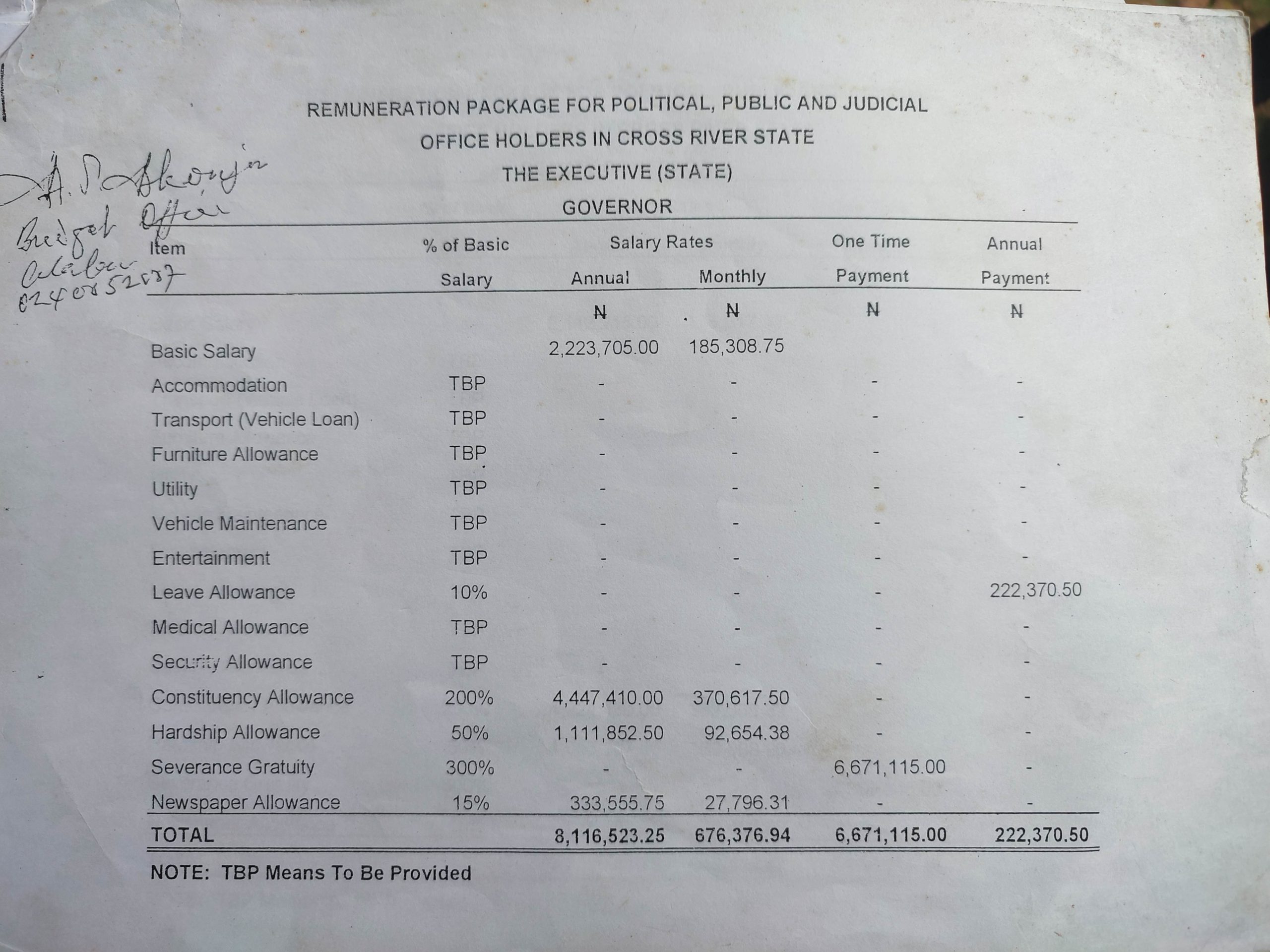
UPON the successful completion of his two terms of eight years as governor, Ben Ayade of Cross River State will receive 300 per cent of his annual basic salary as severance gratuity.
This is apart from other allowances like hardship, constituency allowance, newspaper, furniture, medical, security, entertainment and vehicle maintenance among others.
Meanwhile, five thousand retired civil servants in Cross River State have not been given their pension entitlements from the state government – a violation of section 210 of the 1999 constitution which concerns the protection of pension rights.
In February 2017, senior special assistant to President Muhammadu Buhari on prosecutions, Okoi Obono-Obla accused the Cross River State government of misappropriating N19 billion that it received as a bailout fund to pay outstanding salaries, pensions, and gratuities.
Remuneration packages for governor Ayade
It goes back to 2015 when President Muhammadi Buhari had approved the sum of N338bn for 27 states as part of efforts to end the lingering problem of unpaid workers’ salaries, which had escalated into a crisis. Cross River State was given N7.8 billion in July 2016 and another N11.5 billion as bailout funds.
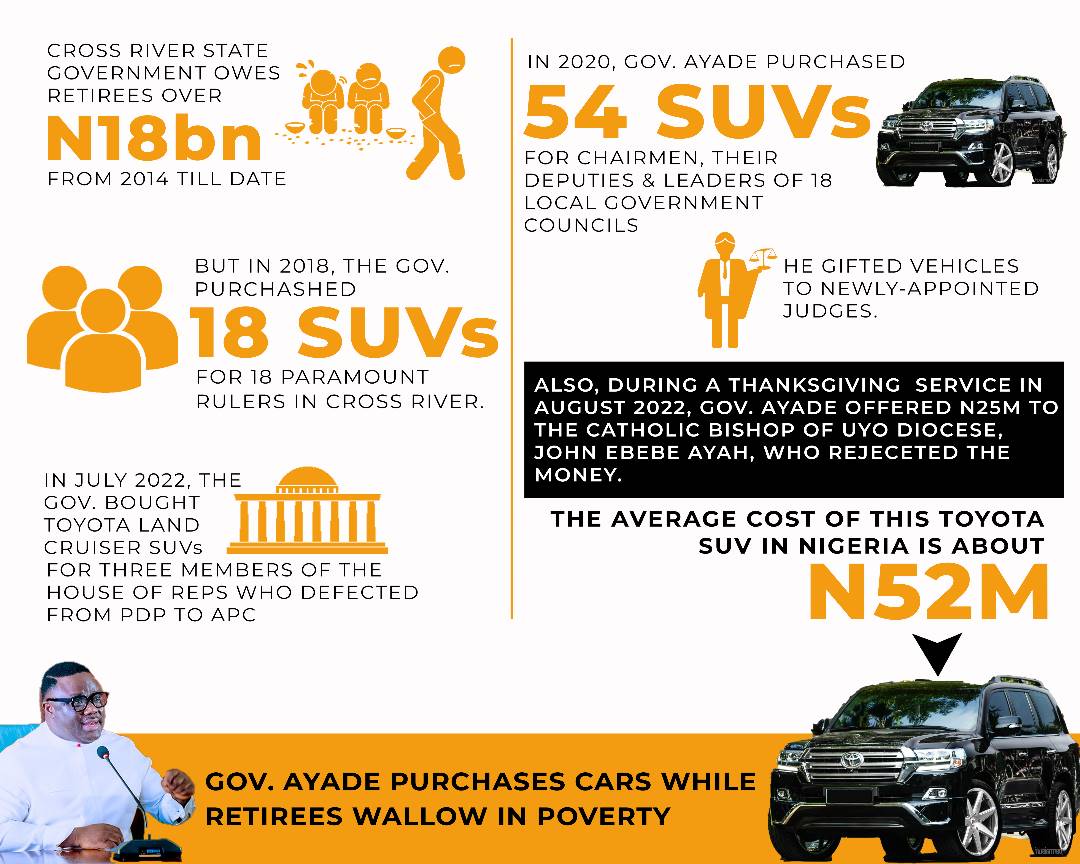
Gov Ayade purchases cars, while retirees wallow in poverty,First tranche of bailout released to states
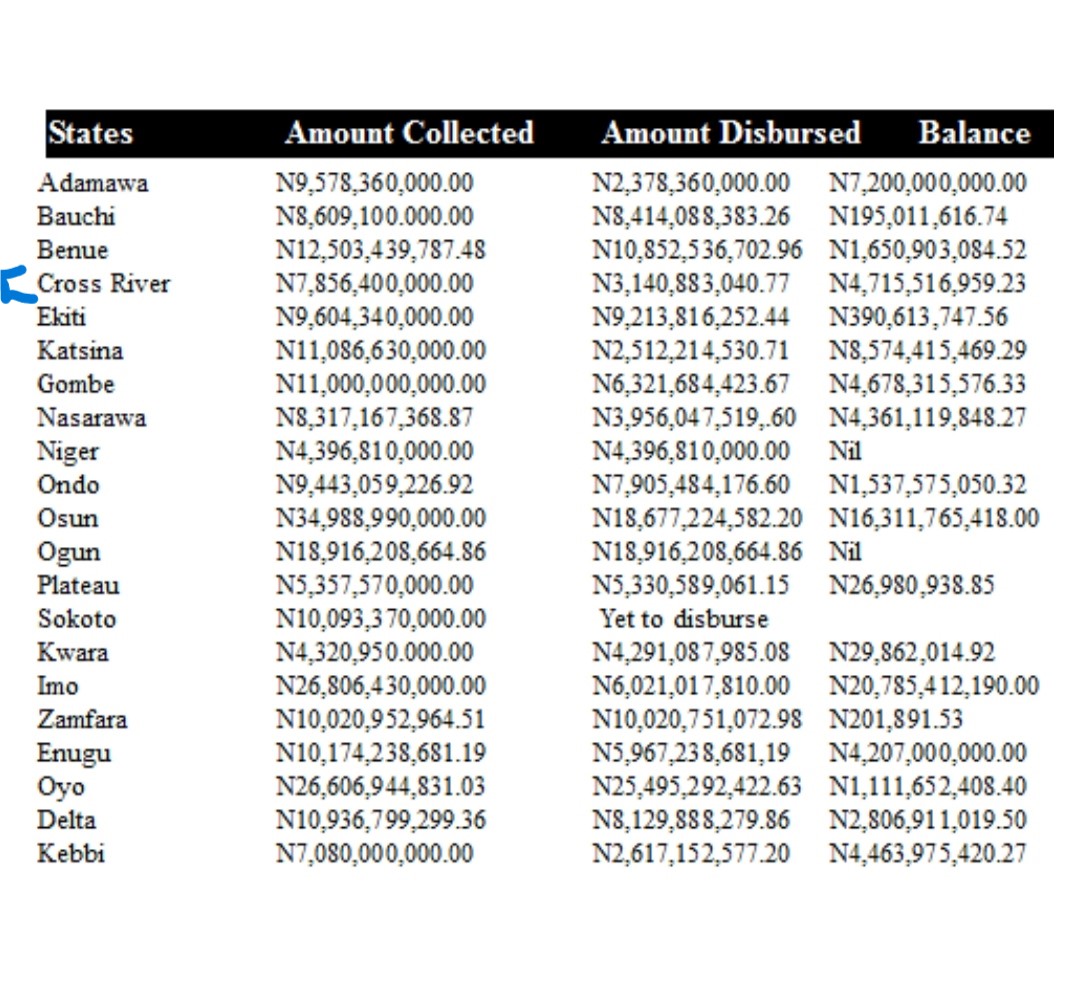
But a report on the monitoring of state bail-out funds released in 2016 by the Independent Corrupt Practices and Other Related Offences Commission, ICPC, and the Nigeria Labour Congress showed that the Cross River State misappropriated federal funds.
The report showed that out of the N7,856,400,000.00 it received, it had only disbursed N3,140,883,040.77 with a balance of N4,715,516,959,23, claiming not to have outstanding salaries for workers as of November 19, 2015.
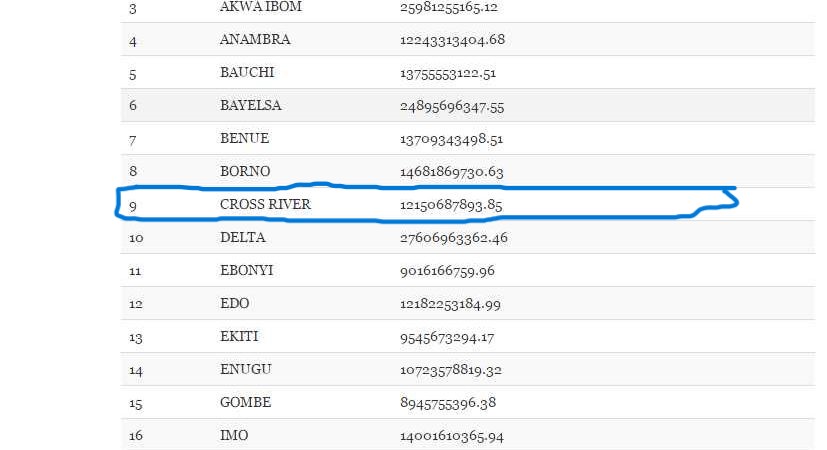
Cross River State also received N19.25 billion, including 12.15 billion as the first tranche and N6.75 billion as the second tranche as Paris Club refund, a settlement of long-standing claims by state governments relating to over-deductions from their federation account allocation committee (FAAC) allocation to service the debts. Altogether, the state received over N38.2 billion as bailout and Paris Club refunds.
First tranche of Paris-Club Refund
However, there is yet no explanation as to what the funds were used for. The Senate Committee on States and Local Government Administration and the Organised Labour have asked the government to explain how it expended the fund. The Cross River State chapter of the All-Progressives Congress (APC) had vowed to probe Ayade over the fund. That was before he moved into the party.
Copy of letter demanding an audience with APC chairman
In 2017, the Economic and Financial Crimes Commission (EFCC) embarked on an investigation into how the Cross River State government applied the Paris Club loan refunds paid to it by the federal government. The commission has been contacted for comment.
In a swift reaction to the allegations by Obono-Obla in 2017, the chief press secretary to the Ayade, Christian Ita said that the bailout funds were still intact. “Not a kobo of the funds which are lodged in the state government account with the UBA has been touched, “he said. “The governor has directed that the funds be used to pay severance allowances to past political office holders and clear outstanding gratuity to retirees”.
Struggling to get by
James Essien struggles to pay his apartment rent of N400,000 a year. Sometimes, he borrows more money than he earns from his pension to be able to pay rent and other dues. Whenever the money comes, he uses everything to pay for debt and starts borrowing again.
“We are helpless and hopeless, some of us have been forced to withdraw our children from school because they cannot pay their fees, “said Essien. “Some have terminal sicknesses, and they cannot take care of themselves”.
In 1979, when he started work in the civil service, Essien hoped that he would build a house for his family in the village and own a flourishing business upon retirement. In October 2014, 35 years later, he retired from the ministry of women’s affairs as the director of administration. As a director, he explained he was entitled to a gratuity of N6 million naira, which was supposed to come immediately after he retired.
But eight years after he left active service, Essien is yet to receive his gratuity. At 63, he only depends on his monthly pension of N135,000, which he says does not come regularly. Sometimes, he waits for two months before he gets one. His 32-year-old daughter was discharged this October after his children contributed N250,000 and paid her hospital bill. He could not afford the bills. She was losing blood.
“I look like a failure among some of my friends because I have nothing to show for the years I spent working for the state, “he said. “I looked forward to a better life after work”.
Essien hails from Ekori in Yakurr LG. He shares a two-bedroom apartment in a tree-lined estate in Calabar with one of his daughters and his wife.
To keep his family running, every month, Essien spends 75,000 on food, N6000 on light and N2000 on water. He also spends N4000 for his TV cable subscription service and N12,000 on fuel. Sometimes, he spends more, all from his irregular pension of N135,000.
The Sub Treasury of the office of the Accountant General of the state, which handles the verification and documentation for payment of pension and gratuity, Sunday Daniel, said that they usually receive complaints from retirees who are not paid even after they have been cleared.
“Most of them are old and sick, yet they come here in their thousands every year for screening and nothing changes,” he said. “A former Chief judge in the state once called to complain that he was yet to receive his pension since September”.
Between August 2016 and February 2017, the Association of Cross River State Local Government Pensioners claimed that 28 of their members died from circumstances related to financial challenges arising from the non-payment of their pension entitlements.
In Ekori, where James hails from, at least three retirees have died without receiving their entitlements. He said that retirees die because they cannot care for themselves. Out of 50 retired permanent secretaries, as of 11th August 2015, at least 12 have reportedly died without receiving their outstanding benefits.
Last year, an investigation revealed that after the state government had declared people ‘dead’ and stopped disbursing pensions, retirees were told to prove that they were still alive. A worker at the office of the state auditor-general said the office is now trying to resolve the issue of dead pensioners which was published by the accountant-general because some of them have come back to prove that they were not dead.
Several protests, little results
On the morning of November 3 2020, about 50 retirees blocked the Murtala Mohammed Highway in the Calabar metropolis in protest over the non-payment of their wages.
The workers sat in the middle of the road, with their documents in their hands and some of them carrying placards that read: “Governor Ayade pay our pension and gratuities”, “pensioners are dying due to non-payment of pension and gratuities” and “Ayade harmonise pension”.
One year after, the workers protested again after their demands were unmet. This time, they blocked the entrance to the Calabar Government House as they protested the non-payment of their benefits by the state government.
Old and weak protest years of unpaid pension
Four years ago, they protested after six of their colleagues died because they could not afford money to pay hospital bills. Essien said that he was part of the protest at the government house that resulted in the payment of gratuities up till 2014. But since then, the government has looked away.
“We are waiting to see if the government will hear our cry,” he said. “Else, we will protest, this time with big banners at the airport so that everyone can see what we are passing through as retirees in the state,”.
In his reaction to the 2020 protest, Special Adviser Media and Publicity to Governor Ben Ayade, Christian Ita, said that no verified pensioner in the state or local government service was owed a pension. The state commissioner for local government Affairs, Stella Odey was also quoted as saying that every genuine pensioner would be paid once they undergo screening and are captured in the payroll.
This September, some of the retirees came together and set up a committee known as concerned pensioners of Cross River State to adequately represent the interest of the thousands of pensioners in the state.
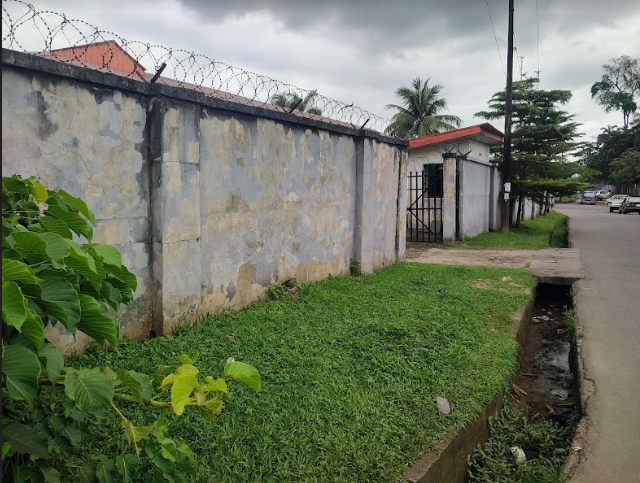
Sub treasury office where thousands of state pensioners gather for documentation
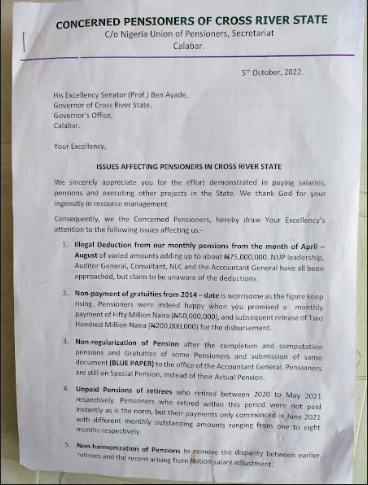
On October 5, 2022, the committee wrote a letter to the governor detailing some of the issues affecting pensioners in the state, including illegal deduction from the irregular monthly pensions they receive, non-payment of gratuities from 2014-date, non-regularisation and harmonisation of pension and unpaid pension of workers who retired between 2020 and May 2021.
Copy of letter written to governor Ayade on issues affecting pensioners
The governor’s office acknowledged six days after, on October 11, but has failed to deliver a response to date. They also wrote a letter on October 6, seeking an appointment with the state party chairman of the All-Progressives Congress, APC Alphonsus Ebe. But he is yet to grant their request. APC is Ayade’s party.
Ayade’s monthly N50 million sinking fund is not enough
In November 2021, Ayade established what he described as a sinking fund to enable him to set aside a minimum of 30 to 50 million nairas monthly from the budget to be used in addressing the issue of gratuity for retired civil servants in the state. It was to take effect in January 2022.
This was followed by the signing of a memorandum of understanding between the government, organised labour and the Cross River State Traditional Rulers’ Council.
Five months later, the head of service in the state, Timothy Ogbang Akwaji inaugurated a nine-man committee made up of the government and labour to oversee the disbursement of N200 million said to have been released by the state governor for payment.
However, while Akwaji claims that the state government has been consistent with the payment, several pensioners who spoke to said that they were yet to receive any payment.
In an October letter, the pensioner’s committee alleged that the disbursement of N50 million allocated monthly to offset gratuity is ‘shrouded in secrecy even as those in charge are partial in their selection of people to receive payment.
The committee said that rather than pick members from retirees- if there was a need because the accountant general already had the details of everyone- to properly represent the interest of everybody, the government chose civil servants who are not transparent in the disbursement.
Millions for jeeps
One of the pensioners who prefers not to be mentioned said that the non-payment of gratuity and inconsistent pension payment is not because of lack of funds but because governor Ayade has demonstrated a lack of priority for retirees in his use of public funds.
In 2018, for instance, there were reports of how the governor bought jeeps that cost millions of naira for each of the eighteen paramount rulers in Cross River State. “The same traditional rulers had cars which were given to them by the government and are still in good condition, “he claimed.
This July, the governor bought Toyota land Cruiser Prado Sports Utility Vehicles (SUVs) for three members of the house of representatives who defected from the People’s Democratic Party, PDP to the All Progressives Congress (APC).
Also, in 2020, there were reports of how he gave out 54 SUVs to chairmen, their deputies and leaders of 18 local government councils. The SUVs consist of 18 Ford Edges for chairmen, 18 Ford Escapes for Deputies and 18 Ford EcoSport (Council Leaders).
He also gifted vehicles to newly-appointed judges in the state as a way of “appreciating the judges for standing with the truth” and promising to make improvements on their welfare.
During a thanksgiving in August this year, the Catholic Bishop of Uyo Diocese, John Ebebe Ayah, rejected Ayade’s N25 million donation and asked him to use it and pay the salaries of workers in the state.
“But each time he sees the wage bill, he expects it to reduce and forgets that others are retiring and entering into the list,” the pensioner said. “He is gifting cars when pensioners in his state can hardly afford to eat”.
A weak union
Retired secondary school teacher Peter Ude expected the Nigerian Union of Pensioners to speak up for people like him – he’s a registered member of the local chapter.
But, he says, the union has failed.
It has not held a meeting in the last five years, although Rule 13 of the constitution and code of conduct of the NUP asserts that all state and local branches should hold general meetings at least twice a year to hear the grievances of members.
In 1996 Ude moved from teaching to work on the board of internal revenue, and in 2021, he retired from the ministry of land as a planning and research statistics staff.
Ude alleged that the union was aware of certain percentages amounting to over N75 million deducted from the monthly pensions between April and August, adding that it only exists to collect the 1 per cent check-off dues, which every pensioner pays and is deducted automatically every month.
“After the government stopped remitting to the union, they went ahead to deduct another 1 per cent from pensions, “he said. “We have spoken to them about the deductions, but they claim to be unaware of it, same with the auditor general and the accountant general.
He hoped that after retiring, his four children would get jobs and cater for him. In addition to that, he planned to use his gratuity to start up a business and earn additional income.
But the reality is far different.
His children are back at home, with no jobs. He does not have anything to fall back on. No gratuity. His pension of N125,000 which should come in every month does not come.
“We all depend on the pension for survival, “he said.
Six months before he retired, Ude said that the state government trained them on various entrepreneurship skills as an exit policy but never provided grants to support the skills earned.
More cause for alarm
A report released by the National Pension Commission, PenCom and titled ‘status of implementation of the Contributory Pension Scheme’ (CPS) shows that as of June 2021, the Cross River state government was yet to commence funding of retiree’s accounts through the contributory pension scheme, thereby failing to domesticate the 2014 Pension Reform Act.
The CPS was intended to, among other things, provide a soft landing for retirees while also relieving the states of the burden of having to pay pensions to retired civil servants from the treasury.
The report, however revealed that while the state had only drafted a bill on the scheme, it was yet to, among other things, enact a law on the CPS to guide its implementation, establish a pension Bureau, register employees with the Pension fund administrator and commence remittance of pension contributions for the employees.
Of the 25 states that keyed into the CPS, only five, including Lagos, FCT, Osun, Kaduna, and Delta states, have been outstanding in the monthly remittance of both the employees’ and employers’ portions of the contributions.
This means that as more employees retire, they are being pushed into old-age poverty while workers still in active service gear up to retire into poverty. A former head of Corporate Communications, PenCom, Peter Aghaghowa said that the autonomy that states enjoy over their pension schemes remains a challenge bedevilling its smooth operation.
“Unfortunately, it is the workers that will bear the consequences of the default in remitting pension contributions because whatever benefit they are going to get at retirement is dependent on what is in the retirement savings account, “he was quoted as saying.
Fighting outrageous pension laws
Since the return to democracy in 1999, Nigerian governors, who spend a maximum of eight years in office, have taken millions of taxpayers’ naira monthly in form of pensions.
In the twilight of his tenure in 2014, Governor Godswill Akpabio of Akwa Ibom State initiated a controversial bill law that will enable him and other former governors to pocket N200 million in annual pension. The bill was passed, despite the criticism that greeted it.
However, some state governments have been making efforts to cut pensions. Last year, the Lagos state house of assembly approved a 50 per cent reduction of pension paid to former governors after Babajide Sanwo-Olu, the governor, submitted a bill to abolish the Public Office Holder (Payment of Pension Law 2007), including the removal of the law which provides houses in Abuja and Lagos for former governors who were also entitled to six new cars every three years.
Last year, a bill seeking to amend the law on pensions for former governors and their deputies and grant guaranteed life pensions for former governor and their deputies, including their spouses generated controversy in Enugu State.
After protests and public outcry, the state House of Assembly suspended the amendment of the executive bill, which had scaled the first reading and billed for the second reading.
We are committed to paying gratuities – government
When contacted for comments, Cross River State head of service, Akwaji, said that the state government has been working to clear outstanding payments, which are in the region of N18 billion.
He confirmed that the state government sets aside N50 million naira monthly, and everybody can’t be paid simultaneously. He was responding to allegations that some retirees were being side-lined.
He explained that sometimes, there are delays in the pension payment because the inflows don’t match up with the commitment. On the issue of non-remittance to the contributory pension scheme, he said that the state government was still fine-tuning the aspect of the pension reform act, which made the pension administrators king over the contributors.
“We must domesticate it and in doing that, we want to make the contributors king because there is no point why you do your contributions and when you retire, they say you cannot access your money till you are a certain age, “he said. “We want to be sure it will benefit our workers”.
State chairman of NUP, Comrade Emmanuel Adie said that the union was working to tackle the issues affecting pensioners in the state, adding that it is also being discussed at the national level.
A push for reform
Head of Transparency International (Nigeria), Auwal Musa Rafsanjani, said that corruption remains the major reason why state governors deprive retired civil servants of their legitimate entitlements. He said that Cross River and other states have failed to provide audited reports of how they expended the bailout funds because there is no mechanism for effectively monitoring and evaluating the use of the funds, so he’s been pushing for an investigative hearing.
TI is processing pensioners’ complaints, but according to Rafsanjani, the key to real reform in the system is more transparency and accountability for the management of funds.
“Unfortunately, we have lawmakers who are unwilling to push for the reforms, “he said. “At the state level, assembly members have become political puppets in the hands of governors,” he said.
Meanwhile, back in Calabar, Essien has no idea when he will get the pension that he deserves.
THE Convener of Northern Elders Forum (NEF), Ango Abdullahi, has said the discovery of oil in some northern states will not address the high rate of poverty in the region.
According to Abdullahi, the discovery will not make any difference because Nigeria’s oil sector only serve the interest of the rich and powerful while the poor suffer the brunts of corruption.
Abdullahi made the assertion in an interview with the Nigerian Tribune.
“Only very few people benefit from oil exploration and oil business. I am sure you have read recently that up to 700,000 barrels of crude oil are stolen every day. Is the oil stolen by the poor Nigerians? No, it is stolen by the elected and educated people in the country. So, oil has been a source of poverty in Nigeria,” he said.
Abdullahi added that the oil sector “has killed the initiative to create something more permanent and more useful”.
He stressed that what will save Nigeria, particular Northern Nigeria, is to go back to agriculture.
“Oil has been responsible for killing agriculture in Nigeria and agriculture is the employer of 70 per cent of Nigerians”, he said.
President Muhammadu Buhari, in November, flagged off the first crude oil drilling project in northern Nigeria, on the boundary of Bauchi and Gombe states.
The commercial quantity discovery was the first in the region after several crude oil explorations in the Upper Benue Trough.
During the flag-off in Bauchi, Buhari said the successful discovery of the Kolmani Oil and Gas field by the Nigerian National Petroleum Corporation (NNPC) and partners will attract foreign investment, generate employment and increase government revenue.
OPERATIVES of the National Drug Law Enforcement Agency (NDLEA) have intercepted more than one million pills of Tramadol and other opioids in Indomie noodles packs at the Murtala Muhammed International Airport (MMIA) Ikeja, Lagos, as well as in Gombe State.
The NDLEA, according to a statement by its Director of Media and Advocacy Femi Babafemi, seized over 600,000 pills of Tramadol 225mg from Karachi, Pakistan, in two shipments on Ethiopian Airlines flights.
In addition, 5,960 pills of Rohypnol concealed in 60 packs of indomie noodles going to Johannesburg, South Africa, were also seized at the SAHCO export shed of the airport on Wednesday, December 14.
A female freight agent, Olaleye Adeola, has been arrested in connection with the noodles consignment.
In a related development, a trader at Balogun market in Lagos Island, Akunne Chibuzor Tochukwu, was arrested on December 13, in collaboration with the Zone 2 Police Headquarters, Lagos, over his attempt to export a Tramadol consignment to Dubai, UAE.
Akunne Chibuzor Tochukwu Photo credit: NDLEA
“The consignment was seized at the Lagos Airport by NDLEA operatives on 25th November while a market labourer, Oke Abosede Ronke, whose services were requested to convey the drug for export had earlier been arrested,” the Agency said.
Meanwhile, NDLEA said its operatives in Lagos on December 11 intercepted a truck and a bus conveying 113 jumbo bags of Cannabis Sativa weighing 4,802.84kg around the VGC Estate area of Ajah while three suspects, Taofeek Yusuf, Ifeanyi Okorie and Israel Nwachukwu, were arrested in connection with the seizures.
In Gombe State, a total of 1,154,500 pills of Tramadol, Rohypnol and Exol being transported from Onitsha, Anambra State, by a truck driver, Umar Hassan, 28, was also seized on December 15.
AS the World Cup ends today, December 18, 2022, the world awaits a breathtaking final battle between the last winner France and the 2014 runner-up Argentina.
Both countries have won the World Cup twice, and today’s final will earn one of them a better record than the other.
France beat Morocco to reach the final, while Argentina defeated Croatia.
Argentina have won the World Cup twice, in 1978 and 1986
France, on the other hand, won the World Cup on home soil in 1998, and in Russia in 2018.
France, who won the last world cup (2018), will be aiming to retain the cup.
The French are trying to win the World Cup back to back after Brazil did so in 1962.
The Argentines will be trying to avoid a third defeat in the final. They lost to West Germany in the final of the 1990 World Cup in Italy, and again to Germany in the final match of the 2014 World Cup in Brazil.
The two key players to look out for amid other talented players from both countries are Kylian Mbappe of France and Lionel Messi of Argentina.
The Qatar 2022 World Cup final match will take place at the magnificent Lusail Stadium.
Apart from the revered trophy, there is a chance to win the mouth-watering $42 million grand prize.
The host country, Qatar, picked December 18 for the final of the 2022 World Cup to mark their annual National Day.
This will add glamour to the closing ceremonies before the final match.
The closing ceremony, coming after 29 days of intense football matches, is to feature fireworks and musical performances. Nigerian musician, David Adeleke, popularly known as Davido, is one of the artistes expected to perform at the event.
The President of FIFA, Gianni Infantino, has described the Qatar 2022 World cup as the best ever.
The $42 million cash prize for winning the Qatar 2022 World Cup trophy is higher than that of the 2018 World Cup, where the winner (France) got $38 million.
The runner-up of the 2022 World Cup will go home with $30 million, while Croatia, who defeated Morocco (The first African country to reach the Semi-Finals) on Saturday to claim third-place earned $27 million.
The teams that made it to the first group stage of the Qatar World Cup earned $9 million each.
In the same vein, the teams that made it through to the round of 16 earned $13 million each.
The 2022 World Cup tournament featured 32 teams from various countries across the world.
TWITTER has restored the accounts of suspended media practitioners after polls where majority voted in support of the motion.
The poll results which had to be repeated revealed that 59 per cent of 3.6 million Twitter users voted for the immediate restoration of suspended jounalists’ accounts.
In a post, Elon Musk said “the people have spoken. Accounts who doxxed my location will have their suspension lifted now”.
The people have spoken.
Accounts who doxxed my location will have their suspension lifted now. https://t.co/MFdXbEQFCe
The Chief Twit had alleged that some journalists had infringed on his privacy via doxxing. As a result, the journalists’ accounts were banned.
Twitter also reinstated the spaces feature which had been shut down just before banning the journalists who hosted a space Musk angrily stormed out of.
Although the journalists claimed to have only reported on the jet tracking account @elonjet, criticisms from media organizations, and other authorities have raised the concern that Twitter may be undermining press freedom.
Society for Advancing Business Editing and Writing (SABEW) in a official statement condemned Twitter’s actions.
The group said Twitter’s action “violates the spirit of the First Amendment and the principle that social media platforms will allow the unfiltered distribution of information that is already in the public square”
The United Nations Under Secretary for Global Communications Melissa Fleming tweeted that media freedom should not be toyed with, noting that a free press is the cornerstone of democracy.
Deeply disturbed by reports of journalists being arbitrarily suspended from Twitter.
Media freedom is not a toy. A free press is the cornerstone of democratic societies and a key tool in the fight against harmful disinformation.
European Union Commissioner for Values and Transparency Vera Jourova sanctioned Twitter with Europe’s new Digital Services Act which entails “the respect of media freedom and fundament rights”.
The German foreign office, French minister of industry and other prominent bodies also condemned Twitter’s actions.
The owner of the microblogging site, Musk, keeps making impulsive changes to Twitter’s moderation policies.
Tech Journalist Kara Swisher who has been covering Musk for more than two decades told the PBS news her concerns.
Swisher said regulating Twitter in America would be difficult because of the First Amendment but in Europe there are different rules that come to play.
She added that “it’s about the whims of the richest man in the world and what he feels like doing on any given day”.
Christmas and New Year are holidays with dietary excesses that many of us cannot control. This often leads to the “festive bulge”. As the holidays approach, could there be a recipe to contain this weight gain and pave the way to sustainable nutrition-based health at the same time?
There’s a lot of focus on what we eat and how much we eat – but what about when we eat?
Chrononutrition is the science of how timing affects our responses to nutrients. Scientific insights into when we eat suggest it may be worth exploring for better health.
While the idea of getting started on chrononutrition over Christmas can sound challenging, the guilty conscience that tends to follow feasting over the holidays may provide the needed motivation for the year ahead.
So for better health in the new year, why not try out time-restricted eating (TRE)? TRE is a type of intermittent fasting: a person eats all their meals and snacks within a particular time window, ranging from six to 12 hours each day. This implies 12 to 18 hours of fasting.
As researchers with a focus on circadian biology, we have identified the festive season as a suitable starting point for a lifestyle change to time-restricted eating.
What is chrononutrition?
The basic idea of chrononutrition is that the body’s response to the timing of meals can promote well-being and health via the circadian timing system. This timing system refers to the internal 24-hour mechanism that primes our bodies for the challenges and stimuli of the 24-hour day. This includes when nutrients are likely to be consumed, how they are used within the body at a given time and how the body responds to them at a given time.
A rodent experiment in the 1930s led to a focus on counting calories and calorie-restricted eating. This dietary restriction extended the lifespan of rats in this case. It was subsequently shown in a wide range of species. The promise is large: if you eat less, then weight loss, better health and a longer life may follow.
The rodent experiment was followed by research into diets that foster health and prevent disease. Interest in “meal-timing, circadian rhythms and lifespan” was sparked by Franz Halberg (known as the father of American chronobiology), among others, in the 1980s.
These studies around food and behaviour take evolutionary considerations into account. For instance, rodents gain fitness when fed in a time-restricted manner. In contrast, human behaviour tends to involve more erratic eating patterns during the hours when people are awake.
Lifestyle changes
So what practical advice can we give on the occasion of Christmas and New Year from the 2017 Nobel Prize-winning field of chronobiology? The field gained recognition for its discoveries into how internal clocks organise our physiology and enable us to live in harmony with the external rhythms of day and night.
Findings from this field point to a simple lifestyle change: limiting when you eat to eight to 10 hours a day could protect you from developing obesity, or even lessen the negative health impacts of existing obesity. And time-restricted eating can work even if practised for only five days per week.
Importantly, if you can reduce a long habitual eating window (for instance, 15 hours) to a time-restricted eating window of eight hours, you are likely to benefit more than someone who reduces a habitual eating window of 10 hours to eight hours. Reductions in eating-time windows have already been found to help some overweight humans lose weight, sleep better and feel more energised.
Granted, much of the evidence comes from animal studies – and humans are certainly not big mice. Nonetheless, there have been no reports of detriments to this practice in humans. However, there has been one report of possible disadvantages to offspring in a pregnant animal model of time-restricted eating.
To get started, consider having a late breakfast and an early dinner. Of course, if in doubt about the impact of time-restricted eating – or if you have medical or dietary restrictions, or are pregnant – talk to your doctors first for advice.
Beyond paying attention to calorie intake and food composition, “when we eat” is a relatively simple and potentially sustainable approach.