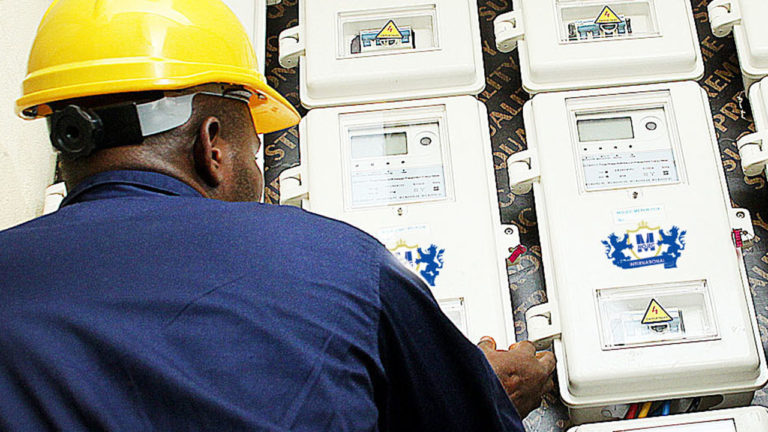
A Federal High Court in Kano has issued an order restraining the Nigerian Electricity Regulatory Commission (NERC) and the Kano Electricity Distribution Company (KEDCO) from implementing the new electricity tariff for Band A consumers.
The suit marked FHC/KN/CS/144/2024 was filed by Super Sack Company Limited and BBY Sacks Limited.
Others are Mama Sannu Industries Limited, Dala Foods Nigeria Limited, Tofa Textile Limited, and Manufacturers Association Of Nigeria Limited.
Ruling on an ex-parte motion by Abubakar Mahmoud, counsel to the plaintiffs, the presiding judge, Abdullahi Liman, stopped NERC and KEDCO from going ahead with the tariff hike pending the hearing and determination of the motion on notice filed before it.
The order also restrained the defendant from intimidating and threatening to disconnect the applicants’ electricity supply for non-acceptance of the new increased tariff.
In April, NERC approved an increase in electricity tariff for customers under the Band A classification.
With the new tariff, customers under the category, who are expected to receive 20 hours of electricity supply daily, would begin to pay N225 per kilowatt, starting from April 3 — up from N66.
Nigerians, including the House of Representatives and other stakeholders, have since criticised the sudden hike, asking NERC to suspend the implementation of the new tariff.
The ICIR reported that the Northern Elders Forum condemned the tariff, urging Nigerians to reject it.
“By implementing such exorbitant electricity tariffs, the government is effectively perpetuating a form of economic oppression that will only serve to widen the gap between the rich and the poor in Nigeria. It is imperative that this act of exploitation be firmly rejected and not be allowed to stand unchallenged,” the forum said.
DESPITE increasing the lending rate to 24.75 per cent, the Central Bank of Nigeria (CBN) has admitted regrets over the country’s declining economic activities.
The lending rate is currently at 24.75 per cent, which makes it difficult for small and medium enterprise businesses to borrow from commercial banks due largely to the ‘cost of funds’ (interest rates put on money borrowed from commercial banks).
The CBN deputy governor of Corporate Services, Bala Bello, disclosed this in a statement published on the bank’s website on Friday.
He noted that the country’s Composite Purchasing Managers’ Index declined sharply to 39.2 index points in February 2024 from 48.5 index points in the previous month.
According to Bello, economic activity has contracted for eight months due to exchange rate pressures, inflation, and security challenges.
“Economic activity has been contracting for eight consecutive months, mainly due to exchange rate pressures, rising input prices, security challenges, and other idiosyncratic headwinds. This calls for well-nuanced policy decisions targeted at price stability to forestall stifling economic activities and derailing output performance,” he said.
He noted that the apex bank was concerned over rising inflationary trends despite sustained hikes in the monetary policy rate, with forecasts of further price increases in the near term.
“Both food and core inflation rose in February 2024, underpinning an acceleration in headline inflation to 31.70 per cent in February 2024 from 29.90 per cent in the previous month.
“This continued rise in inflation was mainly due to high production costs, lingering security challenges, and exchange rate pressures,” he said.
He added that the country’s inflation soared to 33.22 per cent in March, which he noted was unacceptable and required coordinated efforts to curb it.
He explained further that inflation was unacceptably high and required decisive and coordinated efforts to curb it, given its adverse impact on citizens’ purchasing power, investment decisions and broad output performance.
“The Federal Government’s initiatives addressing food insecurity, such as releasing grains from the strategic reserves, distributing seeds and fertilizers, and supporting dry season farming, are important and commendable,” he added.
Recall that the MPC raised the country’s interest rate to 24.75 per cent in March.
Conversely, economy watchers say interest rate hikes are not enough to drive down inflation since commercial banks are not lending to businesses because of double-digit inflation at 33.22 per cent.
“Hiking of the interest rate is not the solution to declining economic activities. You could notice that banks are not lending much now to businesses, and most businesses are afraid to borrow from bank because of high interest rate. The government must look at the fiscal policy tool to support whatever monetary efforts are being employed by the CBN,” former Director-General of the Lagos Chamber of Commerce, Muda Yusuf told The ICIR.
A NIGERIAN, Okechukwu Valentine Osuji, 39, has been convicted of wire fraud and conspiracy by a federal jury in New Haven, Connecticut, United States (US).
He faces up to 60 years in prison.
The jury, on Wednesday, May 1 convicted Osuji for operating a business email compromise scheme in several countries, including the United States.
In a statement issued by the United States’ Department of Justice on Thursday, May 2, Osuji and his accomplices, John Wamuigah and Tolulope Bodunde defrauded their victims of over $6.3 million.
Osuji was convicted of conspiracy to commit wire fraud, wire fraud, and aggravated identity theft.
According to the Principal Deputy Assistant Attorney General, head of the Justice Department’s Criminal Division, Nicole M. Argentieri, Osuji led a network of scammers in Malaysia and his conviction shows how the department collaborates with international law enforcement to bring criminals to justice.
“Today’s conviction is another example of how the department’s collaboration with international law enforcement partners enables us to bring cybercriminals to justice in the United States.”
The US Attorney for the District of Connecticut, Vanessa Roberts Avery also released a statement noting that the conviction was made possible as a result of hard work and shared commitment between the US and Malaysia’s law enforcement officials, adding that the agency will continue to look out for cybercriminals, no matter where in the world they operate.
“While it is often difficult to identify and bring to justice cyber criminals operating overseas, today’s verdict demonstrates the expertise of the FBI and Stamford Police in uncovering this criminal network and the shared commitment of our counterparts in Malaysia to ensure that fraudsters are held accountable in a court of law,” she said.
Similarly, the Executive Assistant Director of the FBI’s Criminal, Cyber Response, and Services Branch, Timothy R. Langan Jr, also vowed that the department would work tirelessly to bring to justice anyone who engages in criminal activities against Americans.
“This conviction is the result of hard work and close collaboration between the FBI and our local and international partners. Together, we will work aggressively to bring to justice anyone who engages in fraud and theft against Americans, no matter where they are in the world.”
Osuji was arrested in Malaysia and extradited to the United States in 2022. He is slated to be sentenced on July 24 and faces a mandatory minimum of two years on the identity theft count and a maximum penalty of 60 years in prison on the wire fraud and conspiracy counts.
His alleged accomplice, John Wamuigah, remains in Malaysia and is pending extradition proceedings, while Tolulope Bodunde pleaded guilty on February 16.
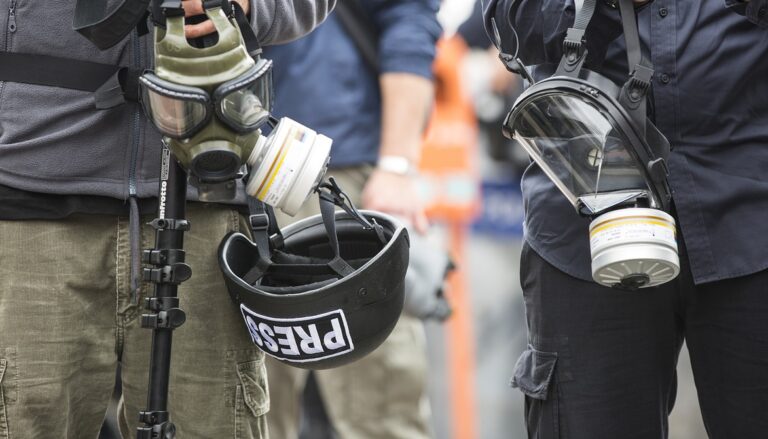
Section 22 of the 1999 Constitution of the Federal Republic of Nigeria (as amended) mandates the media to ensure the government’s accountability to the people through reporting. However, other laws passed by the Nigerian government fail to protect journalists carrying out this responsibility and are often deployed as tools to suppress the free press.
DURING the 29th Convocation Ceremony of Kwara State Polytechnic held in November 2023, the institution’s Rector, Abdul Jimoh Mohammed, made a passionate appeal to the government for funds.
Mohammed stated that the institution had funding problems and needed support for course accreditation and rehabilitation of old structures.
According to some reports, he also pleaded that the state government take over salary payments for six months while bragging about infrastructure already developed with the school’s Internally Generated Revenue (IGR).
Three months after this passionate appeal, a journalist with online media outlet The Informant 27, Abdulrahman Taye Damilola, reported that Mohammed had been less than truthful about his claims on inadequate funding, as the institution generated over N1 billion annual revenue surplus during the year.
The report also stated that Mohammed’s claims of infrastructural development were inaccurate as some of the projects were shoddy and incomplete.
Following the publication, some staff of the newsroom were arrested by the police. The writer and three of his colleagues, Adisa-Jaji Azeez, Salihu Ayatullahi, and Salihu Shola Taofeek, were arraigned before a magistrate in the state.
The charges brought against them at the time of the arraignment include cyberstalking and conspiracy under sections 24(1b) and 27 of the Cybercrimes Act. They were also charged with defamation under section 393 of Nigeria’s Penal Code.
Although the Act was established to prohibit cybercrime in Nigeria, some parts of the law have been weaponised against online journalists, regardless of the constitutional mandate to perform watchdog responsibilities.
Section 22 of the 1999 constitution of the Federal Republic of Nigeria as amended provides that “the press, radio, television and other agencies of the mass media shall at all times be free to uphold the fundamental objectives contained in this Chapter and uphold the responsibility and accountability of the Government to the people.”
However, until it was recently amended, Section 24 of the Cybercrimes Act, especially subsection 1b, which provides that “any person who knowingly or intentionally sends a message or other matter by means he knows to be false, for the purpose of causing annoyance, inconvenience, danger, obstruction, insult, injury, criminal intimidation, enmity, hatred, ill will or needless anxiety to another or causes such a message to be sent, commits an offence under this Act,” has been repeatedly used to obstruct the achievement of this goal.
The Economic Community of West African States (ECOWAS) Court of Justice also declared the section inconsistent with Article 9 of the African Charter on Human and People’s Rights.
Ayattullahi, who serves as The Informant247’s Editor, told The ICIR that the charges were later changed to criminal defamation and conspiracy, and described the ongoing process as draining, as it is taking a toll on both the author of the report and newsroom.
“When you know that even if you have facts they can lock you up at any time on the instruction of powerful people, definitely, even if you have evidence and you want to publish something in the future, you are going to think twice,” Ayatullahi said.
He also noted that delays by the prosecution was further frustrating the productivity of the newsroom and the progress of the case.
“On Monday, we were in court, and they told us that they could not get fuel to appear in court. The magistrate had to adjourn the case till the 15th of this month. Before this last sitting, they told us that they are yet to conclude the investigation, and once they finish the investigation, they are going to bring the evidence to court.
“When they were supposed to bring the evidence to court, they said they don’t have fuel,” he said.
More concerns despite amendment
In February 2024, Nigerian President Bola Tinubu signed an amendment to some sections of the bill, including section 24.
Section 24 (1b) now only punishes a person who sends a message that “he knows to be false, for the purpose of causing a breakdown of law and order, posing a threat to life, or causing such message to be sent.”
While Civil Society Organisations (CSOs) have commended this amendment, there are still concerns that the Act can be deployed to stifle freedom of expression.
A press release by six CSOs: Paradigm Initiative, Gatefield, ResearcherNG, FollowTaxes, North-East Humanitarian Hub and Anvarie Tech, urged the federal government to further amend the Act to reduce the chances of abusing citizens’ rights.
“We call on the Federal Government of Nigeria to take decisive action in further amending the Act to address these challenges and enact legislation and policy that are rights-respecting with particular interest in Sections 24, 38, 40, and others. We also call for safeguards against possible abuse by more explicitly requiring judicial oversight,” the statement co-signed by the organisations read.
The threat to press freedom and the civic space in Nigeria has been a matter of concern for several years, as journalists and other civic actors are targeted via several means, including laws like the Cybercrime Act, unlawful or prolonged detention and outright attacks by both state and non-state actors.
In 2023, The ICIRtraced 39 journalists who had been harassed during the year in the line of duty through media reports, though the list is not exhaustive.
Of the 39, four journalists were staff members of The ICIR.
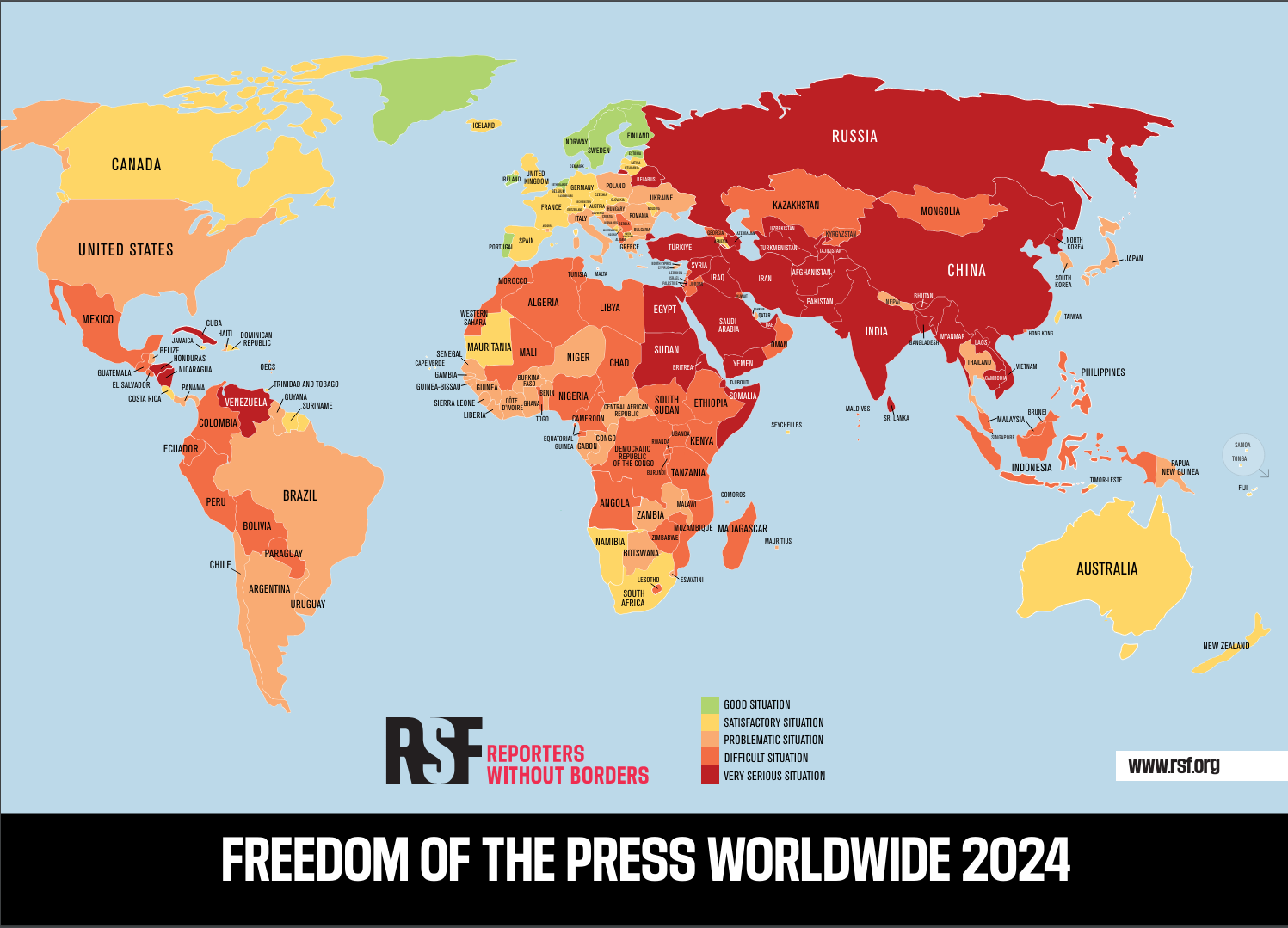
THE latest data on the 2024 World Press Freedom Index by Reporters Without Borders (RSF) has placed Nigeria as one of West Africa’s most dangerous and difficult countries for journalists.
By this, Nigeria ranks 112th out of 180 countries where journalists are regularly monitored, attacked and arbitrarily arrested. However, the 2024 figure is lower than the 123rd position the country had in 2023.
The ranking assed several indicators such as political, legislative, economic, social and security indices.
According to RSF, “The level of governmental interference in the news media in Nigeria is significant. It can involve pressure, harassment of journalists and media outlets, and even censorship. This interference is even stronger during electoral campaigns. Addressing political issues in a balanced way can also be difficult, depending on the media outlet’s owner. To a large extent, government officials have a say in the appointment and dismissal of media officials, whether in the public or private sector.”
On the legal framework, RSF said that Nigeria’s constitution protects freedom of expression and opinion, but many laws’ provisions make it possible to obstruct journalists’ work.
Some of these laws are the laws on cybercrime, anti-terrorism, state secrets, and the penal code.
2024 Press Freedom Index
For the economic and socio-cultural context, the ranking showed that while there are many media outlets in the country, poor remuneration makes journalists vulnerable to corruption.
It added that media outlets in the county have also been the targets of attacks based on religion, gender, or ethnicity.
On security, RSF said, “In recent years, most of West Africa’s violent attacks, arbitrary detentions, and shooting of journalists have taken place in Nigeria, especially during the country’s electoral periods. Nearly 20 journalists and media outlets were attacked during the general elections in February and March 2023.
“Crimes committed against journalists continue to go unpunished, even when the perpetrators are known or apprehended. There is almost no state mechanism for protection. The authorities keep journalists under close surveillance and do not hesitate to threaten them.”
However, according to the ranking, the top five safest countries for journalists are Norway, Denmark, Sweden, Netherlands and Finland. On the other hand, the countries unsafe for journalists are Eritrea, Syria, Afghanistan, North Korea and Iran.
In West Africa, countries like Benin socred 89, Togo ranked 113th, Ghana ranked 50th, Ivory Coast ranked 53rd, Niger ranked 80th, Burkina Faso ranked 86th and Liberia 60th.
Others include Mali: 114th, Guinea: 78th, Guinea Bussau: 92nd, Serria Leone: 64th and Senegal: 94th.
The ICIR reported several attacks on the media including its journalists while carrying out their responsibility.
SOME stakeholders have highlighted the importance of youth inclusion and adoption of technology as prerequisites to robust governance and accountability.
The stakeholders, including President Bola Tinubu’s Senior Special Assistant on Youth Initiative, Titi Gbadamasi, Founder and Africa Director of MacArthur Foundation, Kole Shetima, Global Director of Budgit, Oluseun Onigbinde, Executive Director of Yiaga Africa, Samson Itodo, spoke at the Promad’s Accelerating Youth Participation in Governance (AYPG) on Thursday, May 2, in Abuja.
The event featured a cohort of 18 young leaders from the six Area Councils of the Federal Capital Territory who received training on participation in governance.
The session’s highlight was a panel discussion on artificial intelligence, with insights shared by panellists and the African director of the MacArthur Foundation, Kole Shetimma, who delivered the keynote address.
The stakeholders charged youths with being intentional about politics and governance and urged them to embrace Artificial Intelligence to hold political leaders accountable.
Speaking on the role of youths in governance, the SSA to the President on Youths Initiative, Gbadamasi, noted that Nigerians, both at home and abroad, shared the same aspiration for a better Nigeria, adding that their active involvement in governance was a critical tool for progress.
Addressing concerns about youth representation in positions of power, Gbadamasi stressed the importance of intentionality and consistency in pursuing leadership roles.
She said that governance was not a passive endeavour but required proactive engagement and strategic participation from youth.
Gbadamasi also urged the youth to remain steadfast in their commitment to effecting positive change, emphasising the need for sustained involvement in the political process.
“So young people cannot take a back seat. They cannot be relaxed in their approach. We must show consistency. Most importantly, we cannot be here today and there tomorrow if we want a better Nigeria. We have to continually show up for a better Nigeria.”
When asked about President Tinubu’s commitment to mainstreaming youth representation, Gbadamasi explained that significant strides had been made in this regard, noting that the president’s cabinet had a convincing number of youths.
She also highlighted the administration’s efforts to prioritise youth-centric policies and initiatives across various sectors, including education and agriculture.
Responding to questions about achievements within Tinubu’s administration in its first year, particularly concerning youth-focused initiatives, she said, “we have very significant strides. For instance, we have the Student Loan that has now been signed into an act and that gives priority to education, young peoples’ education. So we no longer have issues with you cannot go to school because you don’t have funds. You can apply, and it’s devoid of any kind of who-knows-who process.”
Addressing the implications of AI in elections and governance, the Executive Director of Promad, Daisi Omokungbe, emphasised the inevitability of technology in shaping electoral processes and overall development.
“Essentially, whether we like it or not, AI and other technologies will shape our elections. It will shape our development and businesses…So for us not to be on the wrong side of technology and AI, that is why we put this event together.”
Less than 10 per cent of youths engaged their elected leaders in FCT
Drawing from recent research conducted by the organisation, Omokungbe highlighted the ‘alarming’ lack of engagement between young people and their elected representatives in the FCT.
According to him, less than 10 per cent of those interviewed never had the opportunity to engage their elected representatives.
“On the other side, their elected representatives have also not engaged them in town hall meetings or called for a consultative forum where they will be able to shape development issues,” he said.
The Promad boss, therefore, called for urgent need for proactive youth involvement in governance and democracy.
“We cannot be passive about governance and democracy and expect to have sustainable development. So we need all of us to be active about governance, about democracy, to attain certain development, “ he said
Panelist weigh in
Speaking on rethinking youths’ participation in governance with AI in Nigeria, the Executive Director of YIAGA, Itodo, recommended re-evaluating traditional approaches to civic engagement and leveraging technology to enhance democratic processes.
He further explained the multifaceted role of AI in mobilising voters and countering misinformation during elections.
“We can use AI to mobilise people to show up for an election, and to do so, one of the things AI tends to do is to detect fake news. You can use AI to counter misinformation…Another thing AI can do is examine and analyse images to detect and make informed decisions about the existence of images.
“The second thing AI can do is fast-tracking decision-making,” he added.
While acknowledging AI’s transformative potential, he sought a balanced approach to technology adoption and its use for societal benefit.
Also emphasising the importance of AI and its threat, Budgit Global Director, Onigbinde said AI emerged like other technology tools, with benefits and challenges.
THE Nigeria Police Force (NPF), on Thursday, May 2, announced the arrest of Ibrahim Abdullahi, one of the suspects involved in the violent attack on the Abuja-Kaduna passenger train in March 2022.
The Force Public Relations Officer (FPPRO), Olumuyiwa Adejobi, disclosed this during a press briefing in Kaduna State.
According to Adejobi, Abdullahi, known as “Mandi,” was also involved in the abduction of students from Greenfield University in 2021.
The Police spokesperson also revealed that 48 AK-47 rifles were found with the suspect during his arrest.
Adejobi said Abdullahi masterminded and participated in the kidnapping and murder of students of Greenfield University and most of the kidnappings along the Abuja-Kaduna highway.
He said the suspect was arrested based on credible information at the Abuja-Kaduna Road flyover by Rido Junction in Chikun Local Government Area.
He explained that the suspect confessed to being a leader of a kidnap syndicate terrorising the Kaduna-Abuja Expressway and ranked among notorious bandits like Dogo Gide and Bello Turji, who had terrorised the North.
He added that investigations were underway to determine his weapons’ sponsor(s) and supplier(s).
The ICIR reported in 2023 that another suspect linked to the Abuja-Kaduna train attack, Bello Yellow, was arrested by vigilantes in Abuja.
The suspect was reportedly arrested by vigilantes in the Zuba area of the Federal Capital Territory (FCT).
It was gathered that he was apprehended in the early hours of Sunday, January 22, when he alighted from a car around Dan-Kogi Motor Park.
A vigilante, who refused to disclose his name, said members of the Miyetti Allah sighted the suspect in the area.
Reports say N103,000 cash, three sticks of cigarettes, and a lighter were found in his possession.
The vigilante source stated that the Divisional Police Officer in Zuba came to the vigilante office with his men to pick up the suspect.
The ICIR reported that terrorists attacked an Abuja-Kaduna train in March 2022. Several passengers were abducted in the incident.
This organisation gathered that the terrorists used an improvised explosive device to derail the train.
According to a passenger on the train, who was identified as Anas Iro Dansuma, the explosives destroyed the train’s engines around Katari to Rijana.
Dansuma said the terrorists attacked the train and shot sporadically.
Pictures and videos from the attack seen by The ICIR show passengers who sustained injuries, while some parts of the train were destroyed.
Earlier in October 2021, terrorists attacked the Abuja-Kaduna train with explosives, forcing a suspension of operations on the rail line.
For years, Kaduna State has been the centre of violent attacks in Nigeria, with several incidents of kidnapping for ransom, attacks on villages and abductions.
In 2022, the Kaduna International Airport was attacked by terrorists and a staff of the Nigerian Airspace Management Agency (NAMA), Shehu Na’Allah, was killed.
Terrorists, numbering over 200, invaded the Kaduna International Airport located in Igabi Local Government, disrupting the operation and killing one security personnel of the Nigerian Airspace Management Agency.
The attack caused panic at the airport and reportedly grounded a Lagos-bound AZMAN aircraft scheduled to take off at 12:30 p.m.
THE Federal Ministry of Industry, Trade, and Investment has extended the deadline for companies interested in managing the $10 billion diaspora fund to apply.
The deadline has been moved from May 6 to May 13, 2024.
The minister, Doris Nkeiruka Uzoka-Anite, disclosed this in a circular on Thursday, May 2, in Abuja.
Uzoka-Anite stated that the extension was designed to allow stakeholders additional time to adequately prepare their applications following the guidelines established for the fund.
The minister urged prospective applicants to utilise the extra time to complete their submissions, ensuring they are thorough and competitive.
“The Federal Ministry of Industry, Trade, and Investment wishes to inform all interested parties that the deadline for the submission of expressions of interest (EOI) for the Nigeria diaspora fund has been extended.
“The new submission deadline is May 13, 2024. This extension is intended to accommodate stakeholders who require more time to prepare their applications by the guidelines provided for the $10 billion Nigeria diaspora fund,” the minister stated.
She noted that the EOI was open to fund managers interested in developing and establishing a multisectoral, multilateral private sector-led investment fund.
“We encourage prospective applicants to use this additional time to finalise their submissions that meet the outlined criteria, ensuring comprehensive and competitive proposals. For further inquiries or additional information, please contact the Federal Ministry of Industry, Trade, and Investment during office hours (8:00 AM to 5:00 PM),” she further said.
The minister had earlier invited eligible firms to indicate interest in providing services as Nigeria diaspora fund managers.
The minister made the announcement on her X account.
She disclosed that the fund managers would be responsible for developing and establishing a multi-sectoral, multilateral, private sector-led investment fund to form the $10 billion Nigeria diaspora fund.
Last year, Nigeria was estimated to have received more than $20 billion in diaspora remittances, according to the World Bank.
Informed analysts said the fund could serve as Nigeria’s support facility and hedge fund, supporting Nigeria’s naira appreciation amid the current foreign exchange fluctuation.
“The fund will support the strengthening of Nigeria’s foreign reserve and serve as a hedge for Nigeria’s fluctuating exchange rate,” a development economist, Celestine Okeke, told The ICIR.
ECONOMISTS have expressed divergent views on adopting a fixed Customs duty exchange rate following frequent changes in the rate, which they believe are creating volatility and hurting the Nigerian economy.
The Central Bank of Nigeria (CBN) has adjusted the Customs duty exchange rate about 38 times since the beginning of this year.
In its latest adjustment, The ICIR reported that the CBN raised the rate by 14 per cent to N1,327.35/$ on Monday, April 29.
The report noted that the frequent changes significantly burdened the business community and dashed importers’ hopes.
As of May 1, the rate had jumped to N1,373.65/$ from less than N1,200/$ a few days earlier.
The frequent changes have led to high volatility in cargo clearing costs, worsening inflationary pressures and aggravating investment risk, especially in the real sector of the economy.
In recent conversations, renowned economists Bismarck Rewane and Muda Yusuf differed on whether the apex bank could fix exchange on Customs duty.
Yusuf, the chief executive officer (CEO) of the Centre for the Promotion of Private Enterprise (CPPE), issued a statement on Wednesday, May 1, urging the apex bank to adopt a quarterly framework starting at the rate of N1,000/$ to minimise volatility in the Customs duty exchange rate.
He suggested that the adoption be carried out in line with the present administration’s commitment to bolstering investors’ confidence and driving economic growth.
“Such framework should adopt a quarterly Customs duty exchange rate after due consultation with the fiscal authorities. We propose a commencement rate of N1,000/$ Customs duty exchange rate.
“Consultation with the fiscal authorities is imperative because of the trade policy implications of such decisions. It is also consistent with the commitment of the present administration to effective coordination between fiscal and monetary authorities.”
Yusuf buttressed that it took a lot of work for investors to plan under these unstable circumstances as the situation has introduced unprecedented uncertainty and unpredictability to the international trade dynamics.
According to him, investment risk has become elevated, planning has become difficult, risk management has become challenging, and investors’ confidence is being weakened.
He added that it was a double whammy for investors to grapple with volatility in the foreign exchange market and contend concurrently with high unpredictability in the international trade ecosystem, stressing that it differed from Nigeria’s current growth aspirations.
However, in his view, Rewane, CEO of Financial Derivative Limited, said fixing the exchange rate on Customs duty would mean returning to fixing the unregulated exchange rate market when he spoke on Channels Television on Tuesday, May 2.
He said, “I have listened to the question on Customs duty whether you can fix it.
“You cannot fix an exchange rate for a Customs duty. What you can do is take the average for the entire month and say that this is the average.”
“The CBN could set an average for the month,” Rewane said, adding, “but to fix it is the beginning of going back to fix the unregulated exchange rate. The free market system and price mechanism allocate resources efficiently. So, let’s not decide ourselves.”