Home Blog Page 774

PRIMORG, others urge Osun gov’t to investigate N1.3bn corruption-ridden contracts

0

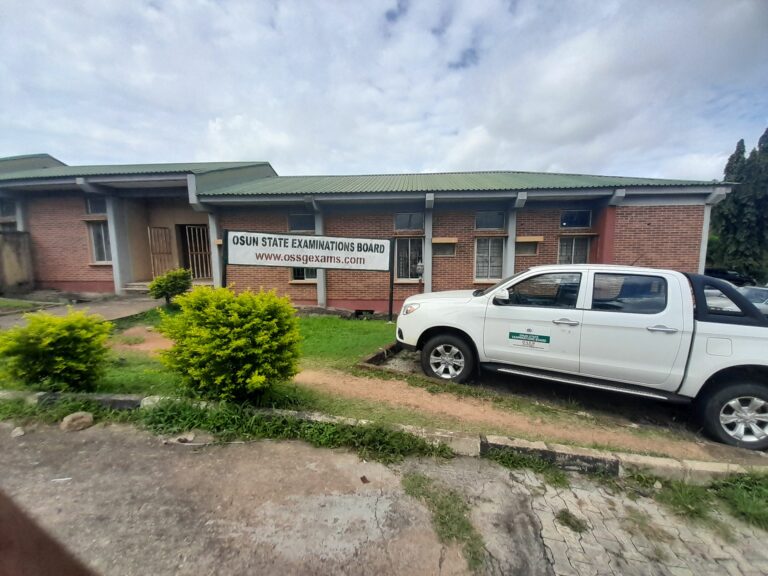
PRIMORG, a Nigerian nonprofit and media advocacy organisation promoting citizen engagement, participation, and inclusion in governance, has called on the Osun State Government to investigate the award of N1.3 billion in corruption contracts to nonexistent companies between 2019 and 2021 by the state.

The organisation made the call during its weekly anti-corruption radio programme, “Public Conscience,” in Abuja on Wednesday, October 5.

The ICIR-funded investigation, exposed how the state government flouted public procurement laws by awarding contracts to non-existing entities.


Read Also:

The report showed that nine projects were awarded to ghost firms from 2019 to 2021 – during the administration of the immediate past Governor Gboyega Oyetola. Oyetola is currently the Minister of Marine and Blue Economy in the government of President Bola Tinubu.

During the programme, the reporter, Taiwo Fatola, emphasized citizens’ critical role in public procurement processes and underscored the need to hold leaders accountable.

Fatola said, “I urge the government (Osun State) to do something about this report and ensure that procurement laws are strictly adhered to going forward to encourage transparency and accountability of procurement processes.

“Citizens need to be more conscious, interested, and ask questions in public procurement as that will help keep the government on their toes. When government officials know the citizens are asking questions, they will be pushed to do what is right. People should show more optimism and follow up on public procurement processes.”

The ICIR reports that former Governor Oyetola has not responded publicly to the report’s findings since it was made public. Furthermore, the Osun State Bureau of Public Procurement and the Governor’s Office have not taken any known actions in response to the investigation.

Mukhtar Modibbo, the Community Engagement Manager at Connected Development (CODE), condemned the violation of procurement law in Osun State, emphasizing that such violations often result from the widespread abuse and disregard for Freedom of Information (FOI) requests by government institutions in the state.

Modibbo called for a united effort to combat the flouting of procurement law in Nigeria and stressed that stringent punishment should deter others from engaging in procurement corruption.

Modibbo remarked, “We have a bigger framework, that is the Open Government Partnership. How effective do we look at procurements, issues of ownership, and service delivery within the framework of open government partnership?

“The punishments, to some extent, are not really there. Cases like that will stay in court for years. We have to strengthen a lot of systems for us to achieve those things. How strong is our judiciary? What is the time frame? What is the framework of that? Some will stay up to 3-5 years on a case. At the end of the day, the case will not even come with serious punishment.”



Sokoto, Benue, Ogun, Enugu lowest-performing states on fiscal transparency

A report by BudgIT, a civic non-governmental organisation, has shown that Sokoto, Benue, Ogun, and Enugu states were the lowest-performing states on fiscal transparency in the second quarter of 2023.

Fiscal transparency refers to the publication of information on how governments raise, spend, and manage public resources.

The organisation ranked the 36 states on nine parameters expected to be available on the states’ website.

These parameters are Medium-Term Expenditure Framework (MTEF), Proposed and Approved Budget, Citizens’ Budget, Budget Implementation Reports (BIR), Audit Report, Accountant General’s Report/Financial Statement, eProcurement Portal and the State website with Fiscal Repository.

In 2020, N43.41 billion ($120.6 million) was disbursed to 24 states under the performance-based grant component of the World Bank-Assisted States Fiscal Transparency, Accountability and Sustainability Programme-for-Results.

The SFTAS programme aimed to strengthen the participating states’ fiscal transparency, accountability, and sustainability. After two years, the Federal Government said that the Central Bank had disbursed N471.9 billion from the $1.5 billion it got for the programme.

According to BudgIT ranking, Sokoto state, which scored 33rd on the table in the first quarter of 2023, moved to be the least-performing state in the second quarter. The state had not published MTEF, BIR, proposed budget, or citizens budget, nor did it have a functional e-procurement portal. Also, the state had a comprehensive but not timely approved budget, while the website had no documents available.

For Benue State, the e-procurement portal was not fully comprehensive but accessible. There’s no available information on its MTEF, proposed budget, or citizens’ budget, nor does it have a functional website.

Also, Ogun State fell significantly from 13th in Q1 to 34th in Q2. The state’s MTEF document and citizens’ budget were no longer available. The BIR and the approved budget were not fully comprehensive. Also, Ogun had no published information on its proposed budget, while the state’s website, which is its fiscal data repository, was down as of the period under review. 

Similarly, Enugu State’s performance dropped from 14th to 33rd in the ranking as analysis showed that the state’s lack of accessibility to the MTEF, proposed budget and citizen’s budget was due to website unavailability. 

However, the states with the highest ranking are Jigawa, Ondo, Osun and Oyo in the second quarter under review. 

Meanwhile, in the first quarter of 2023, Kano, Borno and Benue scored the lowest in transparency and accountability. The ICIR review on both quarters showed that Benue State had maintained a poor performance in six months. In Q1, the state scored 28 points, while 35 points in Q2.

The Acting Head of Open Government and Institutional Partnership, BudgIT,  Iyanu Bolarinwa, told The ICIR that the report was published to know measures put in place by the states to ensure fiscal transparency and accountability following the conclusion of the SFTAS programme.

He said, “All of these indices we have pointed out in the table are to ensure that the information is available on time, and it gives us the opportunity always to put the state government on their toes and get them more transparent and accountable.”
The ICIR reported how 13 out of the 36 states in Nigeria implemented 80 per cent of their budgets for the 2022 fiscal year.

Cover image by Freepik

Tinubu’s government lacks economic direction, economists say

SOME economists have said President Bola Tinubu-led administration lacked a clear-cut economic policy direction, consequently increasing Nigerians’ suffering.

Nigerians are battling double-digit inflation at 24.08 per cent, a situation that has seen lending to the manufacturing sector becomes problematic and prices of food and other household commodities overshoot the rooftops.

The experts who spoke with The ICIR argued that the government must get a policy plan to improve the economy and relieve Nigerians from economic-induced pains.

Tinubu’s government came with a ‘no more subsidy’ (unpegged the international price of crude from the local price of premium motor spirit) pronouncement at his inauguration on May 29, 2023, but has rescinded the decision afterwards, which increased economic uncertainties.

Petrol prices, following his inauguration speech, increased by over 200 per cent, while delays in palliatives disbursement and overstretched negotiations with the Nigeria Labour Congress (NLC) heightened Nigerians’ avoidable pains.

For an economist, Kalu Aja, Tinubu’s government has lost the economic momentum it has with key pronouncements on exchange rate floating and removal of fuel subsidy, with the rescinding of pronouncements.

“The government has also been struggling with its exchange rate policy despite floating it initially, as naira continues to sustain a downward trend against the dollar, amid dwindling revenue resources from oil and increasing oil theft.

“There was an initial momentum when the government came in with pronouncements on the removal of subsidy on the exchange rate and petrol subsidy. There were lots of recommendations, and the market reacted positively to that,” Kalu told our correspondent in an interview in Abuja.

He further argued that the government’s delay in palliative distribution after petrol subsidy removal caused many problems, as he also pointed out further loopholes in Nigeria’s exchange rate policy.

“The government slowed down on the palliative, and now the petrol subsidy is back. The exchange rate float didn’t work optimally because the government didn’t do a full float,” he said.

He stressed that the government’s unstable stance on the reforms had affected its plans. “Currently, the government seem ruthless, with no clear-cut direction, a situation that does not give investors confidence and stability to the economy.”

Another development economist, Celestine Okeke, shared similar concerns and noted that the government had been shy about getting a policy direction, but enjoys making pronouncements.

“The government is yet to come up with any major economic policy direction. It is not healthy for the economy, and that is why we may not see any concrete development in the near future.

As a result of the policy somersaults, the World Bank, in its report, has described Nigeria’s currency as one of the worst performers in Africa.

According to the Bank, the naira weakened by nearly 40 per cent against the US dollar since it was devalued in June.

“So far this year, the Nigerian naira and the Angolan kwanza are among the worst-performing currencies in the region: these currencies have posted a year-to-date depreciation of nearly 40 per cent.

“The weakening of the naira was triggered by the Central Bank’s decision to remove trading restrictions on the official market. For the kwanza, it was the decision of the Central Bank to stop defending the currency as a result of low oil prices and greater debt payments.”

Some media outlets have also come hard on the government’s losing momentum on its policies.

For instance, the Financial Times of London editorial, on October 5, 2023, wants the government to “spell out his policies to the sceptical public.

According to the editorial,” The President should refrain from announcing plans, including the restoration of democracy in Niger- without any idea of how to implement them.

“Only four months into his presidency, what started out with a bang risks becoming a whimper. Tinubu needs to regain the momentum,” the editorial said.

FOR THE RECORD: Palliatives announced by Tinubu, others for Nigerians in 5 months

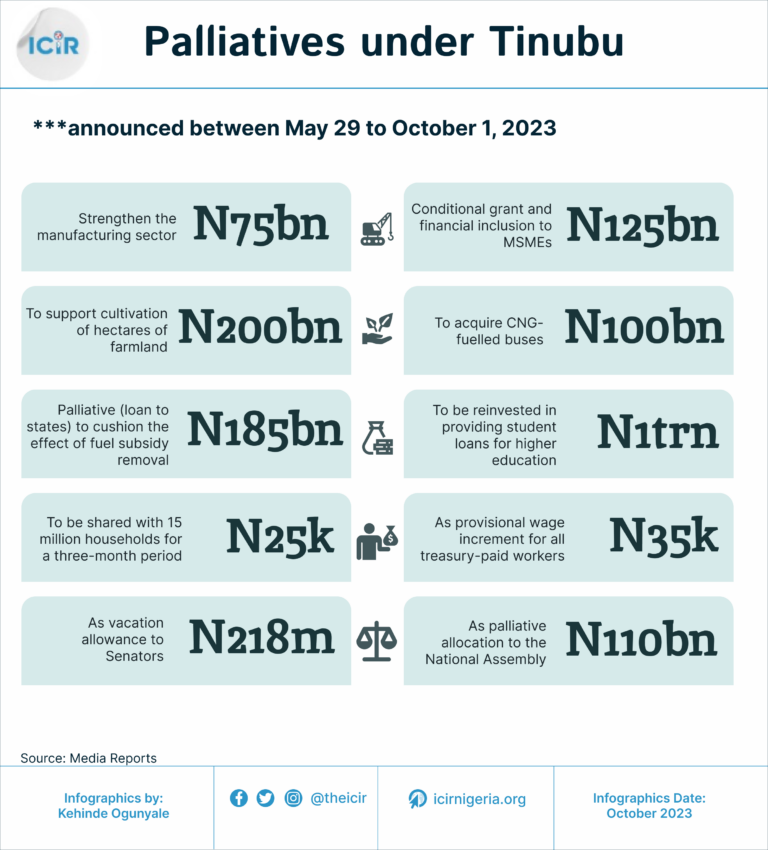
BETWEEN May 29 and October 1, 2023, President Bola Tinubu announced at least nine palliatives to cushion the effect of fuel subsidy removal.

The removal announced by him while delivering his inaugural address on May 29 has increased economic hardship for citizens, as seen in a sharp rise in transportation and cost of basic needs. It has also grown inflation to its highest rate in over a decade. 

The ICIR findings showed that the palliatives announced by the government are to support sectors like agriculture, transportation, households, workers, and lawmakers’ welfare.

Going by the distribution, sectors like manufacturing, agriculture, transportation and business will get N500 billion while workers and selected households receive N35,000 and N25,000, respectively, for a period. On the other hand, lawmakers’ allocation is N110.2 billion, while the 36 states get N185 billion palliative loan.

However, there are concerns that these palliatives might not have a significant impact following criticisms that trailed a similar policy by the previous administration.  

In July, The ICIR examined one of the Federal Government’s proposed interventions of N8,000 for 12 million households, which it later suspended after backlash from Nigerians.

The palliatives announced in five months

After the subsidy removal and unification of segmentation in the foreign market– two policies that impacted the Nigerian economy – Tinubu requested that the National Assembly approve N500 billion to be distributed to vulnerable households. Sharing N8,000 to households came with mixed reactions, forcing the government to suspend the decision.

By the end of July, Tinubu, in a nationwide broadcast, addressed the country on other palliative measures to cushion the hardship. This address came barely some days before a nationwide warning strike organised by the Nigerian Labour Congress (NLC), in reaction to the government policies pushing the cost of living upward.

Here are the palliatives announced by Tinubu since he assumed office:

  • N75 billion to strengthen the manufacturing sector and increase its capacity to expand and create good-paying jobs between July 2023 and March 2024. Seventy-five firms will receive one billion naira repayable short and long-term loan. On Wednesday, October 4, The ICIR reported the Manufacturing Association of Nigeria saying there was a delay in releasing the fund.
  • Empower micro, small and medium enterprises and the informal sector as growth drivers with N125 billion. That is N50 billion on Conditional Grant to one million nano businesses between June and March 2024, while N75 billion goes to MSMEs and start-ups.
  • N200 billion to support the cultivation of 500,000 hectares of farmland and all-year-round farming practice.
  • Invest N100 billion between June 2023 and March 2024 to acquire 3,000 units of 20-seater CNG-fuelled buses.
  • N1 trillion saved from fuel subsidies to be reinvested into the education sectors and loans.

On October 1, Nigeria’s 63rd Independence Day Celebration, Tinubu added that the government would provide an additional N25,000 to the “average worker’s” salary for six months. Meanwhile, after deliberation with the labour union leaders who had declared an indefinite strike, the President added an extra N10,000, making it N35,000 to be paid for six months.

Also, Tinubu approved N25,000 as a new social safety net policy that will cover about 15 million Nigerians.

Meanwhile, between May and October, the National Assembly approved N70 billion from the N819.5 billion 2022 supplementary budget to support their working conditions.
They also earmarked an extra N40 billion to acquire 465 Sports Utility Vehicles (SUVs), bulletproof cars for principal officials and members, totalling N110 billion. 

They also announced another N218 million as ‘vacation allowance’ to senators when embarked on a seven-week recess. The ICIR reported (here and here) how these funds would benefit Nigeria if they were invested in different sectors of the country. 

World Bank warns Nigeria against fueling inflation

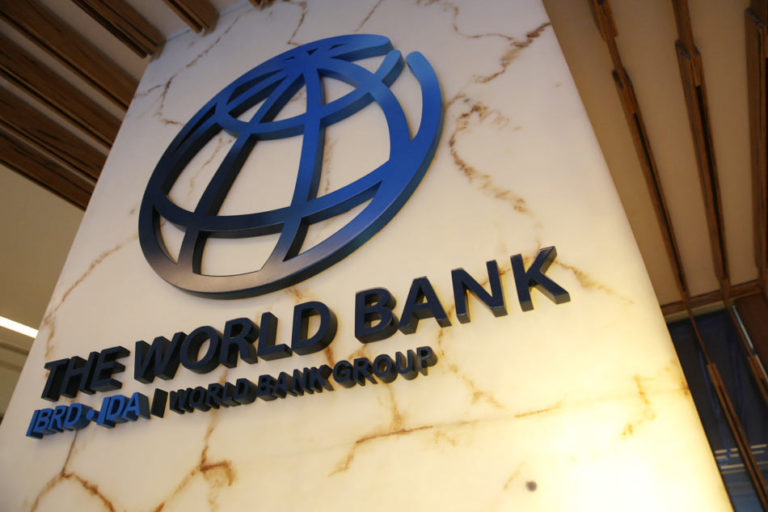
THE World Bank has urged Nigeria to take a coordinated approach to not further fuel inflation and other macroeconomic indicators.

It stated this in its latest report, ‘Africa’s Pulse: An analysis of issues shaping Africa’s economic future (October 2023 | Volume 28).’

“If monetary and fiscal actions are not adequately coordinated to bring down inflation, the risk of de-anchoring inflation expectations would fuel further inflation, accelerate interest rate increases, and exacerbate the deceleration of economic activity,” it said.


Read Also:

According to the Bank, rebuilding fiscal space was essential to curbing inflation and supporting economic activity in Nigeria and other African countries.

It stressed that inflation had remained above target for a prolonged period and showed no sign of peaking in Nigeria and other African countries.

“Inflationary pressures in the region are still dominated by high food and fuel price inflation and the weakening of domestic currencies,” particularly in Nigeria and a few other countries.

“For these countries, independent central banks with a clear mandate, transparent decision-making, and accountable authorities are essential to curb inflation,” it suggested.

Similarly, the Bank stated in the report that the naira was among Africa’s worst-performing currencies since this year.

The Britton Wood financial institution explained that the naira weakened by nearly 40 per cent against the United States dollar since it was devalued in June, attributing the cause to the Central Bank’s recent policy of exchange rate unification.

“So far this year, the Nigerian naira and the Angolan kwanza are among the worst-performing currencies in the region: these currencies have posted a year-to-date depreciation of nearly 40 per cent.

“The weakening of the naira was triggered by the Central Bank’s decision to remove trading restrictions on the official market,” it said.

The organisation suggested that fiscal policies should be coordinated with monetary measures to achieve inflation targets and ensure the sustainability of public finances.

It pointed out that domestic resource mobilisation and greater spending efficiency were critical to mitigate fiscal and debt sustainability risks and bring down inflation.

Other currencies with significant losses so far in 2023 are those of South Sudan (33 per cent), Burundi (27 per cent), the Democratic Republic of Congo (18 per cent), Kenya (16 per cent), Zambia (12 per cent), Ghana (12 per cent), and Rwanda (11 per cent).

The World Bank had lauded Nigeria’s reform in the exchange rate unification and expressed concern that inflation had pushed an estimated four million more Nigerians into poverty in the first five months of 2023, The ICIR reported.

The ICIR had also reported that the World Bank urged the Nigerian authorities to stabilise the exchange rate to encourage fiscal discipline and increase investment inflows.

CSU: Lawyer highlights 4 issues in Tinubu’s academic record

A LAWYER, Kalu Kalu, has highlighted the issues in the deposition made by the Chicago State University (CSU) concerning the academic credentials of President Bola Ahmed Tinubu.

Kalu spoke on Thursday, October 5, when he was called to talk about the key findings from the deposition by the CSU at the World Press Conference organised by former Vice-President Atiku Abubakar.

According to Kalu, Tinubu forged the CSU certificate he presented to the Independent National Electoral Commission (INEC).

“Bola Ahmed forged this certificate presented to INEC, that is one, two, the qualifying certificate from South-West College to Chicago State University, there is a female, indicating that that document does not belong to Bola Tinubu.

“The Chicago State University admission application form has a claim that Bola Ahmed attended Government College, Lagos and graduated in 1970 when, indeed, the school was established in 1974,” Kalu stated at the conference.

He said documents released by CSU show the owner is a black American. “And (in) the document Bola Ahmed Tinubu submitted to INEC, he denied having dual citizenship.”

On the usefulness of the documents released by the CSU at the Supreme Court, Kalu said, ” As long as technical conditions are met and from what transpired in the proceedings in U.S. court, that condition has already been met. So, as we speak, our law is very clear that a party at fault cannot enjoy the fruit of his illegality.

According to the lawyer, four key issues from the CSU deposition are:

  • The Bola A Tinubu, who applied for admission into Chicago State University, was female.
  • That Bola A Tinubu declared citizenship in the United States on the application form that was completed and turned in to CSU.
  • On the same application form, Bola Tinubu claimed to have attended Government College, Lagos and graduated in 1970. (The same school was established in 1974.)
  • The certificate provided to INEC was fake because the CSU or its affiliates did not issue it.

Speaking earlier, the former Vice President called on the Labour Party and the New Nigeria Peoples Party (NNPP) candidates at the February 25, 2023, presidential poll, Peter Obi and Rabiu Kwankwaso, and other Nigerians to join his quest for “justice”.

Abubakar was the Peoples Democratic Party (PDP) ‘s presidential candidate in the 2023 election.

He had approached CSU to request the release of Tinubu’s certificate from the CSU over the allegations that the certificate the former Lagos State governor submitted to INEC may be counterfeit.

The ICIR reported Abubakar claiming that Nigeria’s reputation was at stake over the certificate saga.

.

Tinubu’s certificate: Nigeria’s reputation at stake, says Atiku Abubakar

0

THE presidential candidate of the People’s Democratic Party (PDP), Atiku Abubakar, has called on relevant institutions to address the discrepancies in the certificate submitted to the Independent National Electoral Commission (INEC) by President Bola Tinubu.

He said failure to do so put the nation’s image at stake and would give citizens a bad impression before the rest of the world.

He also explained that establishing the credibility of certificates presented by politicians seeking elective offices should not take “months or decades.” 

He stated these during a press conference in Abuja on Thursday, October 5.

The former Vice President spoke on the heels of discrepancies in Tinubu’s certificate released by the Chicago State University (CSU) and the copy the President submitted to INEC while contesting for the presidency.

Abubakar, who said the late legal luminary, Gani Fawehinmi, inspired his action against Tinubu, highlighted the importance of adhering to the Constitution and abiding by electoral laws to legitimize government. He emphasized the supremacy of the nation’s Constitution.

“Political leadership and active citizenship matter because they are ways through which we all work together to build a country that works for all who live in it. Our country is bigger than any of us, and its standing in the world affects the fate of all who come from or live in it. As leaders, it is our duty to advance the well-being of all our people and the country.”

The ICIR reports that Abubakar had dragged the CSU to court in the United States and asked it to compel the university to release the President’s academic records.

Tinubu’s efforts to block the Adamawa-born politician failed as the US Northern District of Illinois in Chicago ordered the CSU to release the records.

At his media briefing on Thursday, Abubakar commended legal support from Nigeria and the United States in clarifying what he described as long-standing issues and thanked Nigerians for their patience “in seeking truth and clarity.”

“It should not take months or, indeed, decades for the institutions concerned to be able to do their work in establishing the credibility of any certificates presented by candidates for public office. 

“We undertook this journey at great cost and for important reasons,” Abubakar argued, stressing that the quest for truth and accountability was not about any individual but a collective endeavour to foster a just and accountable society. 

Abubakar also called on Labour Party’s presidential candidate Peter Obi, New Nigeria Peoples Party Aliyu Kwankwaso, and other Nigerians to join his quest for “justice” over the matter, adding that “this is a task for every one of us.”

He, however, noted that he would only drop the case if the Supreme Court ruled against his suits, noting that they are already at the Supreme Court.

“I have already filed my appeal against him at the Supreme Court. It is only when the Court rules that he is right that I will drop this fight; in other words, I will drop this fight when the Court rules because there is no court higher than the Supreme Court.”

Answering the technical parts of the questions, one of Abubakar’s lawyers, Kalu Kalu, explained that the Chicago State University (CSU) document sent to his client confirmed that Bola Ahmed Tinubu forged the certificate submitted to INEC.

According to him, the CSU application form claims that Tinubu attended Government College Lagos and graduated in 1970 when the school was established in 1974.

He added, “The same document has it that the owner of that document is a black American and (in) the document Bola Ahmed Tinubu submitted to INEC, he denied having dual citizenship, which means it does not belong to him. Then, the same document, oral deposition, said the A in Bola A Tinubu is Ahmed, but the NYSC certificate Bola Ahmed Tinubu submitted to INEC has Adekunle. I don’t know where Adekunle emerged from.”

The ICIR had earlier reported how Abubakar successfully obtained the release of Tinubu’s education records from the CSU through a court subpoena.

The disclosed documents, initially released on Monday, October 2 and further emphasized in a deposition on Tuesday, October 4, revealed a discrepancy concerning Tinubu’s 1979 CSU certificate. 

During the sworn testimony, the CSU Registrar also stated that he could not authenticate the certificate presented by Tinubu to INEC.

But the registrar affirmed that Tinubu graduated from the school.

Meanwhile, the Presidency has dismissed claims that the certificate Tinubu presented to INEC for the 2023 elections was forged.

Reacting on Wednesday, October 4, Tinubu’s media aide, Temitope Ajayi, via his X handle, argued that CSU affirmed under oath that Tinubu attended and graduated from the institution and that the school does not handle replacements for lost certificates.

Mohbad: Primeboy submits to police

0

A SINGER, Owodunni Ibrahim Oluwatosin, aka Primeboy, declared wanted by the Lagos Police Command on Wednesday, October 4, has submitted himself to the Force.

The command’s spokesperson, Benjamin Hundeyin, disclosed this in a post on his X handle on Thursday, October 5.

The command declared Primeboy wanted following his failure to honour the Police invitation since the beginning of the investigation into the circumstances leading to the death of singer Ilerioluwa Aloba, popularly known as Mohbad.

On Wednesday, October 4, The ICIR reported the state Commissioner of Police, Idowu Owohunwa, promising to award N1 million to anyone who provided information that resulted in his capture.

“Following his being declared wanted, Owodunni Ibrahim Oluwatosin, aka Primeboy, has turned himself in. He has, immediately, been taken into custody for interrogation and other necessary actions,” Hundeyin tweeted.

The spokesperson also assured the public that every effort would be made to conduct a thorough inquiry.

The command further guaranteed that everyone discovered to be responsible for Mohbad’s death would be brought to justice.

The ICIR reported on Tuesday, October 3, that the Lagos State Police Command arrested Azeez Fashola, aka Naira Marley, and took him into custody for interrogation over the singer’s death.

Hundeyin announced this on his X handle.

Naira Marley is one of the people suspected to have had issues with the late 27-year-old before his death.

Mohbad was affiliated with Naira Marley’s record label, Marlian Music, from which he departed in October 2022.

Apart from Naira Marley, the Lagos State Police Command had arrested a music promoter, Balogun Olamilekan Eletu, known as Sam Larry, who many accused of having a rift with Mohbad.

Police arrested him at the Murtala Muhammad Airport after he arrived in Nigeria from Nairobi, Kenya, at about 10 p.m. on September 28 and took him into custody.

However, Naira Marley and Sam Larry have sternly denied having a hand in Mohbad’s death.

In a statement shared by Naira Marley on Tuesday, September 26, through his official Instagram account, he averred people had accused him of being responsible for Mohbad’s demise. He, however, argued that, like everyone else, he had been shocked by the tragedy.

Similarly, Sam Larry distanced himself from any link with Mohbad’s passing.

Meanwhile, on Wednesday, October 4, a magistrate court in Yaba, Lagos, ordered Naira Marley and Sam Larry to remain in police detention.

Naira Marley and Sam Larry were asked to be held without bail for 30 days while the Lagos police concluded their investigation.

However, the court’s chief magistrate, Adeola Olatunbosun, decided that the suspects should only be imprisoned for another 21 days.

The ICIR reported how Nigerians protested Mohbad’s death, prompting the Police to investigate it.

The investigation, supported by the Lagos State Governor Babajide Sanwo-Olu, began with the exhumation of the deceased body.

Abducted Benue commissioner regains freedom after 10 days

0

THE Benue State Commissioner for Information, Culture and Tourism, Matthew Abo, has regained freedom ten days after gunmen abducted him. 

The Spokesperson to the state governor, Tersoo Kula, released this in a statement on Thursday, September 5.

According to Kula, Abo has reunited with his family in Sankara, Ukum Local Government Area, where he was kidnapped.

He claimed that no ransom was paid in securing the commissioner’s release.

“Rather, his release was as a result of intense pressure on the criminals from the gallant security operatives who were acting on the directives of Governor Hyacinth Alia, who had earlier given marching orders to them to ensure Mr Abo’s release,” the statement reads.

According to Kula, Alia has urged criminals in Benue to leave the state. He warned that the government and security forces won’t give them a break.

The Benue State Police Public Relations Officer, Catherine Anene Sewuese, confirmed the Commissionr’s release in a message sent to the The ICIR.

“Yes, it is confirmed, please,’ she said.

The ICIR reported that gunmen abducted Abo on Sunday, September 24.

Reports said the abducted invaded his residence around 8:00 p.m. at his country home in Zaki Biam, Ukum LGA and whisked him away.

They reportedly arrived on four motorcycles and entered his living room, where he was with his family.

Alia swore in Abo as a commissioner on August 29, 2023.

Insecurity: 3 people killed daily in Niger state

AT least 1,552 individuals were killed in violent attacks in Niger state between January 2022 and June 2023.

Within the same period, about 1,044 others were kidnapped.

According to data gathered by The ICIR from the Nigeria Security Tracker (NST), a website tracking violent incidents related to political, economic and social grievances directed at the state or other affiliated groups, 1,176 deaths were documented in 90 insecurity-related attacks in 2022.

This means that an average of three people were killed daily from violent attacks in 2022, given that the year had 365 days divided by 1,176, averaging 3.2.

Shiroro, Mariga, Munya, Magama, Gurara, Suleja, Rafi and LGAs were mostly affected.

Similarly, in the first and second quarter of 2023, the state experienced 36 insecurity attacks, resulting in the deaths of 376 people.

Within the 18 months under review, about 1,044 persons were kidnapped in the state. The kidnapping incidents were reported to have occurred in at least 16 of the 25 local government areas of the state. 

The state recorded 48 kidnapping incidents, with 36 attacks in 2022 and 12 in 2023.

In 2022, 725 people were abducted. The most affected LGAs, according to the data, are Rafi (189), and Lapai (145), Shiroro (78).

Similarly, in the first and second quarters of 2023, 319 persons were kidnapped in the state, with Munya (127), Shiroro (58), Mashegu (66), and Rafi (59) mostly affected.

On April 6, 2022, The ICIR reported how Niger State recorded the highest number of deaths, kidnap victims in the first quarter of the year in Nigeria, with 786 deaths in 90 days.

Zamfara state followed closely with 337 fatalities, while Borno (322), Kaduna (230), and Katsina (203) rounded up the list as the top five most affected states.

The ICIR reports several cases of insecurity in the state, resulting in the deaths of scores of people. The incidents have disrupted socio-economic activities in communities and left innocent civilians vulnerable and in dire need of support. 

This conflict has continued to force thousands of families to flee their homes in search of safety and refuge. 

Niger government laments worsening insecurity, says IDPs now 29,774

Amidst the deteriorating security conditions in the state, the number of internally displaced persons (IDPs) has surged to 29,774, according to the Niger state government.

The state Commissioner for Humanitarian Affairs and Disaster Management, Ahmed Yumu, on Friday, September 15, while speaking at the launch of the School to Kitchen Empowerment Items of the New-N-Power farmers, raised the alarm over the daily influx of internally displaced persons into the IDPs camps.

According to him, at least 29,774 IDPs are presently in various camps across the state.

He also noted that primary and secondary school premises being used as temporary camps for displaced persons had become overstretched, disrupting teaching and learning.

“The daily influx of internally displaced persons into various local government headquarters and towns by these displaced persons is so alarming and pathetic and the state government is now faced with providing all necessary amenities and food aside spending huge funds to fight the insecurity…

“As it stands today, there are 29,774 internally displaced persons comprising 7,650 women, 3201 men and 11,113 out-of-school children with an additional 108 people with special needs,” he stated.

Data