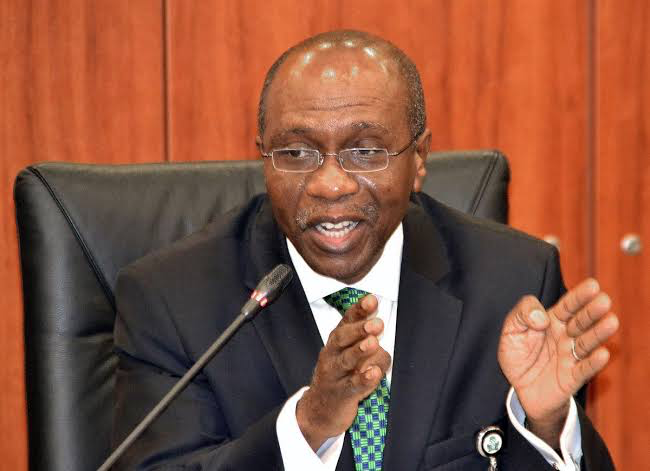
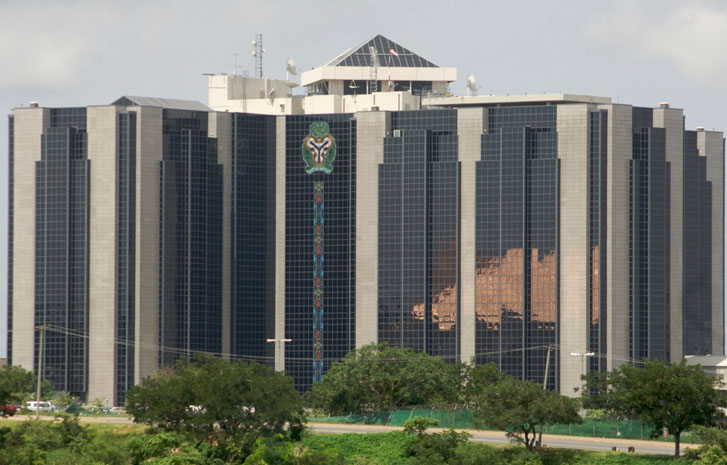
THE Governor of the Central Bank of Nigeria (CBN) Godwin Emefiele has said about N1 trillion of the old notes has been returned to the banking system following the introduction of new naira notes.
Emefiele disclosed this while responding to questions from State House reporters after briefing President Muhammadu Buhari on developments in the Nigerian economy, in Daura, Katsina State.
The CBN had earlier announced that the new notes will be released for public use on December 15. The new notes will circulate alongside the old notes until January 31, 2023, when the old notes would cease to be legal tender.
The CBN on Tuesday, December 6, further issued a directive to commercial banks and financial institutions limiting withdrawals for individuals and corporate organisations to N100,000 and N500,000, respectively.
Addressing journalists in Daura, Emefiele said a lot of electronic channels had been put in place in 10 years since the cashless policy was launched in 2012 to aid people in conducting banking and financial service transactions in Nigeria.
He said the cashless policy was stepped down on a number of occasions to fully prepare for its implementation, to deepen payment system infrastructure in Nigeria.
“I can only just assure you that it will go round, let us just be calm. Luckily the old currency continued to be legal tender till January 31, 2023. So, I want to crack a joke, both the painted (new notes) and unpainted (old notes) will operate concurrently as a legal tender. But by January 31, the unpainted one will not be useful to you again, so please take it to your bank as quickly as possible,” he added.
Emefiele said “about N1 trillion” of the old notes had been returned to the banking system.
Reacting to the Senate’s opposition to the withdrawal limit, he said: “The Senate of the Federal Republic is National Assembly. They are the legislative arm of the government and from time to time, we brief them about what is happening and about our policies and I am aware that they have asked for some briefings and we will brief them.
“We heard people talking about some of the people in the rural areas and the truth is that even online banking, as I was coming out to Daura, I saw a kiosk that has a super agent today. It is because of the way we felt that there was a need for us to deepen the payment system infrastructure. We have 1.4 million super agents that are all over different parts of the country, all local governments, and all villages in this country.”
When asked to speak on the President’s response to his briefing, Emefiele said: “He was very very happy and said we should carry on our work, no need to fear, no need to bother about anybody.”
NO less than 29 per cent of all deaths in Nigeria are caused by Non-Communicable Diseases (NCDs) according to the World Health Organisation.
This was disclosed on Thursday, December 8, by the WHO Country Representative, Dr Walter Mulombo, in Abuja at the sixth annual conference of the Association of Nigerian Health Journalists, themed ‘Health Security, Universal Health Coverage, and the National Health Insurance Act: How Can Nigeria Get It Right: The Role of the Media in Perspective’.
Mulombo, who was represented by the WHO’s Field Presence Cluster Lead, Ahmed Khedr, stated that non-communicable diseases account for 29 per cent of all deaths in Nigeria, with premature mortality from the four main NCDs — hypertension, diabetes, cancer and malnutrition.
He stressed that the premature mortality from the main NCDs account for 22 per cent of the deaths.
“Although the prevalence of malaria is declining (from 42 per cent to 23 per cent), the country contributes 27 per cent of global cases and 24 per cent of global deaths.
“NCDs account for 29 per cent of all deaths in Nigeria, with premature mortality from the four main NCDs (hypertension, diabetes, cancer, and malnutrition) accounting for 22 per cent of all deaths.*
He added that healthcare ‘out of pocket’ expenditure in the country was 70.5 per cent of the current health expenditure while government expenditure per capita was $14.6 in 2019.
“Here in Nigeria, healthcare is financed predominantly by households, who pay for healthcare out of their pockets. With healthcare out-of-pocket expenditure at 70.5 per cent of the current health expenditure in 2019, general government health expenditure as a percentage of the GDP was 0.6 per cent, while government expenditure per capita was $14.6 compared with the WHO’s $86 benchmark for universal health coverage.*
The Country Representative added that Nigeria homes about 50 per cent of Africa’s neglected tropical illnesses and has the highest rates of Tuberculosis, paediatric HIV and Malaria in Africa.
“Currently, the country bears the highest burdens of tuberculosis and paediatric HIV, while accounting for 50 per cent of neglected tropical diseases in Africa,” he said.
Mulombo further stressed that poorest households bear the heavy burden of the poor health outcomes and limited access to essential health services, noting that the negative externalities pose huge losses to the Nigerian economy.
“There is no single pathway to UHC. All countries must find their way, in the context of their own social, political, and economic circumstances,” he added.
CHATHAM House which recently hosted the presidential candidate of the All Progressives Congress (APC) Bola Tinubu, has also extended invitations to the flagbearers of three other leading political parties and the Chairman of the Independent National Electoral Commission (INEC) Mahmood Yakubu, sparking mixed reactions from Nigerians.
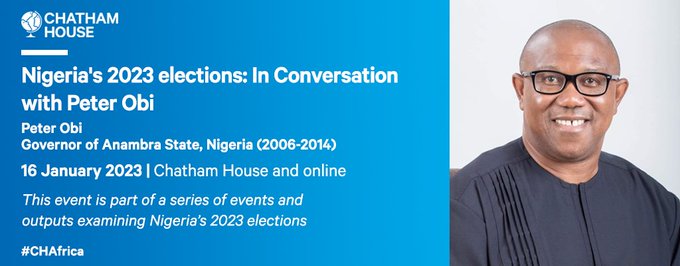
A former Governor of Anambra State, Southeast Nigeria and presidential candidate of the Labour Party (LP) Peter Obi, will be next to speak at the Chatham House in London, United Kingdom, on the country’s 2023 elections and political developments.
The meeting, a members and Africa programme designed as part of a series of events and outputs examining Nigeria’s 2023 elections and political developments, will take place on January 16, 2023.
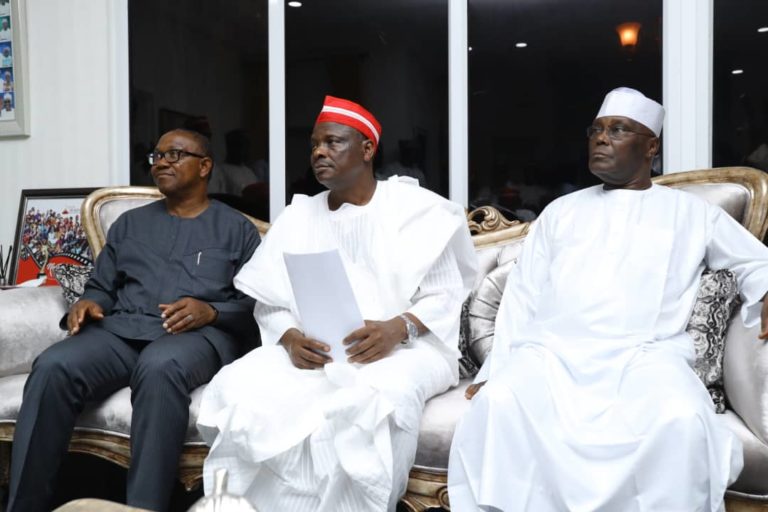
Director of Africa Programme at Chatham House, Alex Vines, disclosed during the hosting of Tinubu by the Royal Institute of International Affairs, that the presidential candidates of the Peoples Democratic Party (PDP), Atiku Abubakar, the New Nigeria Peoples Party (NNPP), Rabiu Kwankwaso and Labour Party’s Peter Obi, will also be invited to share their vision for renewing hope in Nigeria.
“Chatham House will host an event with INEC Chairman, Prof Mahmood Yakubu. We have invitations out to three other presidential candidates for this election in Nigeria,” Vines said.
While the dates for engagement with the other leading presidential aspirants are yet to officially be made public, The ICIR reports that this will be Atiku’s second outing, having made the first appearance in April 2018 ahead of the 2019 presidential election which he also contested.
Also, as a presidential hopeful, President Muhammadu Buhari was at Chatham House in February 2015 where he noted that peaceful alternation of power through competitive elections have happened in Ghana, Senegal, Malawi and Mauritius; adding that the prospects of democratic consolidation in Africa will be further brightened when the APC as an opposition took over power.
“While you can’t have representative democracy without elections, it is equally important to look at the quality of the elections and to remember that mere elections do not democracy make.
“It is globally agreed that democracy is not an event, but a journey. And that the destination of that journey is democratic consolidation – that state where democracy has become so rooted and so routine and widely accepted by all actors,” he said.
Some Nigerians are now questioning the rationale behind politicians going to Chatham House at each election season and whether it should be encouraged.
A curious Nigerian on Twitter BIshop ikmohit, wrote: “But why is Chatham House inviting Nigeria’s presidential candidates…will the candidates running for the office of PM honour the invitation of LCCI? Just thinking.”
Gerald Nduaguba shared the same sentiments when he said: “I have no problem with our leaders having interviews and debates, in fact it’s needed, or even going to foreign countries to talk to Nigerians and to share their ideas. But why do our leaders need to go to a British organisation to answer questions about leading our Nigeria?”
Another tweet by @Man_Nedu said it was a dangerous trend for African leaders to always see the need to speak on platforms hosted by European countries and advised the Labour Party candidate to boycott the meeting.
“I would prefer that PO doesn’t speak at this event. Why in the world should African politicians speak on platforms hosted by European countries? I honestly don’t get it,” he said.
However, some other Nigerians were of the opinion that such platforms would amplify the voices of African leaders in the diplomatic landscape, as it offers more visibility than the local organisations or institutions.
Jane Oiza said it is very exciting news that Obi has also been invited by Chatham House. “The world will see the difference, between the competence, preparedness, intelligence, the desire to serve and salvage what is left of our dear Country, and those who feel it is their entitlement to rule.”
In the same vein, Okoji Amarachukwu said: “Thank God we have another opportunity to redeem our image that was badly battered few days ago,” referring to Tinubu’s outing which has remained a subject of criticism.
The APC candidate has been slammed for delegating questions to his campaign members who were with him during his Chatham House address.
In the midst of mass layoffs in tech companies globally, some Nigerian companies are looking for employees.
According to Nairametrics, there is massive recruitment by IT firms in Nigeria seeking skilled employees.
Recruitments are ongoing in fintechs such as TeamApt, which runs Moniepoint and Monnify; and Flutterwave, Renmoney, and Carbon.
The Chief Executive Officer of Jidaw Systems, Jide Awe, said job opportunities would always be available in the Nigerian tech sector because there is currently a shortage of tech experts.
“Before the layoffs become a trend, many Nigerian companies have been losing their tech staff to the ‘japa’ trend, so they are really in need of tech hands.
“And aside from those going abroad, we now have many Nigerian tech bros resigning from the companies they work for to start remote work where they are working for more than one company and are earning far more than what a company can pay them,” he said.
Awe added that despite the layoff trends, vacancies abound in many companies that Nigerian tech experts can employ.
One of Tech4Dev’s co-founders, Oladiwura Oladepo, affirmed that amid job cuts, abundant opportunities await techies within and outside Nigeria.
“The tech layoffs won’t be the end for the tech industry. There are still abundant opportunities for people to be able to get tech jobs whether here in Nigeria or abroad.
“The fact is that as some organisations are laying off, some are recruiting. Technology has changed from being a support function for many organisations to being the enabler, so there will always be a need for tech experts. There will always be jobs for tech people,” Oladepo said.
He added that amid the economic crisis, more tech startups are springing up, while software creation and data analysis must continue as people need them, and technology is required.
THE Nigerian Electricity Regulatory Commission (NERC) has affirmed that it is not the responsibility of electricity consumers to buy or repair transformers, pole or any other assets, but that of the service providers, which are the electricity distribution companies (DisCos).
The NERC Commissioner for Consumers Affairs, Aisha Mahmud, stated this in Abuja at the ongoing three-day NERC/Abuja Electricity Distribution Company (AEDC) Customer Complaint Resolution Meeting.
The trend of customers acquiring or repairing some vital electricity components on their own has been a recurring concern, leading to blame game between the DisCos and their concerned customers.
Consumers often have to resort to self-help in sorting out issues of electricity assets when distribution companies are not forthcoming with solutions.
However, Mahmud, in a clarification, said, “It is not the responsibility of the consumers to buy meters, poles or any assets for the DisCos because we have already provided for that in the tariff of the utilities.
“But under any circumstances that you have to purchase these items and you cannot wait for the DisCos to make that investment, we have made provision for that under our ‘Investment Regulation.’ ”
She said the commission came up with a regulation called ‘investment in the network’ and based on that, if a customer has to purchase a transformer, it has to be done through an agreement.
According to her, the consumer has to sign an agreement with the DisCos stating when and how the consumer would be refunded the cost of that transformer.
“The agreement should contain dispute resolution clause and any other items that are expected of a standard agreement.
“What we expect from the DisCo is to use their internally generated revenue (IGR) to buy those assets, or rather use shareholders’ investment or borrow from the banks to purchase those assets,” she said.
She noted that in the event that the Discos were not able to buy those assets, customers can make a case and be refunded.
“What the consumers don’t know is that the regulation exists and they go about making all sorts of investment, which DisCos say is a donation to them because there is no agreement,‘’ she said.
The commissioner said it was part of NERC’s responsibility to also educate customers on their rights and obligations and all they are supposed to know about the electricity market.
Mahmud, saying the commission realised that most consumers in Nigeria did not know about the existence of the regulator and did not know their rights, added, “But it is our duty to tell them that it is their right to get a meter as Discos are not doing you any favour to issue you a meter.”
She said that NERC’s mandate was also to educate the consumers on their responsibilities such as the issue of meters, bypass or tampering with meters.
“They should know that the Discos are just merely collection agents and the revenue they collect is not entirely their own as they have to pay gas suppliers, pay the Transmission Company (TCN) and the generation companies, so customers should know that once they touch the utilities they are also shortchanging themselves, ‘’she said.
The Commissioner for Planning Research and Strategy at NERC, Yusuf Ali, said that the forum was an opportunity for customers’ voice to be heard and their rights upheld.
Alli said that customers always complained to NERC that whenever they complained to the DisCos, the resolution took too long.
“But with this forum, the expectation is that complaints will be resolved quickly,‘’ he said.
The Managing Director of Abuja Electricity DistributionCompany (AEDC), Adeoye Fadeyibi, said that the company was committed to meeting its customers’ demand.
Represented by Olajumoke Delonia, the Head, Regulatory and Government Relation at AEDC, Fadeyibi said the idea of the forum was to address customers’ complaints, as he commended NERC for the initiative.
“AEDC is prepared to look into the complaints of its customers quickly, ’ he assured.
ECONOMIC and financial experts are apprehensive that the decision by the Central Bank of Nigeria (CBN) to limit cash withdrawals when the newly redesigned naira notes go into circulation could disrupt the financial inclusion of small and medium-scale enterprises.
The CBN had on Tuesday, December 6, 2022, issued a directive to commercial banks and financial institutions limiting daily automated teller machine withdrawal to N20,000, while also limiting over-the-counter withdrawals for individuals and corporate organisations to N100,000 and N500,000, respectively.
Some analysts did not see the new policy as sitting well with small-scale businesses, saying small and medium scale enterprises (SMEs) would find it difficult to effect banking transactions.
“It will negatively impact on the informal sector of the economy. The sector is a significant part of the economy accounting for over 80 per cent of trade and commerce in the Nigerian economy, and controlling a substantial component of jobs in the economy,” an economist and former Director-General of the Lagos Chamber of Commerce and Industry, Muda Yusuf, told The ICIR.
Yusuf: ‘Limited cash withdrawals will impact negatively on SMEs’
Yusuf explained that many informal businesses are in remote locations where there are no bank branches, and transact business largely in cash.
He added, “The distributive trade accounted for N23.3 trillion of the country’s GDP in 2021. This was about 15 per cent of GDP. This restrictive policy will pose a major risk to this very critical sector of the economy.”
He further mentioned that the policy would negate the financial inclusion objective of the CBN itself, saying, “Some of the informal sector operators may begin to avoid the banking system entirely.”
The economist noted that the policy could infringe on the fundamental rights of the unbanked, stressing that the CBN needs a proper rethink of the policy to avoid creating more problems than it was meant to solve.
‘The policy is not well thought-out’
To a lawyer and development expert, Eze Onyekpere, who is Lead Director for the Centre for Social Justice (CSJ), the policy initiative was not well thought-out and could eventually attract legal tussle.
Onyekpere: fears withdrawal limits could attract legal action
Onyekpere said, “The policy looks more like a knee-jerk reaction. With the level of taxation in the restrictive transaction, it is going to increase cost of doing business, which will be passed on to consumers.
“There are still tele-density concerns and IT coverage problems in Nigeria, which would create more problems for the rural unbanked as a result of this policy announcement.”
He argued that while doing cashless was justifiable, the CBN should consider 40 per cent of the population who are not into the banking regime.
He also wondered, “If you look at the value of money, N20,000 a day is peanuts. How will business people and those engaging in huge daily transactions cope with this?”
More economic concerns
A development economist, Kelvin Emmanuel, told The ICIR that placing limits on cash withdrawals is not a priority in an economy where the records showed 119 million people were unbanked.
Emmanuel said, “Available records showed that 52 per cent of Lagosians earn between N50,000 and N70,000 a month. That means they are competing with so many things like house rent, food, and school fees. In that same money, you want them to get internet data and do internet banking.”
He stressed that the system is already killing agency banking, popularly known as PoS, which he pointed out has created employment in different districts accross the country.
“Explain to me how PoS operators will operate in this era where people don’t like going to the bank anymore,” he said.
What real sector operatives say
The Director-General of the Nigeria Employers’ Consultative Association (NECA), Wale-Smart Oyerinde, posited that the new approach serves only as a diversion from the pressing problems facing the country.
Oyerinde said that the government should refrain from further impeding economic activities. “It goes without saying that business sustainability and many people’s livelihoods will be affected,” he said.
He added that the timing of the policy, which he said did not allow adequate preparation and sensitization of the critical mass that drives the economy (the SMEs and MSMEs), could prove counter-productive and further push many citizens below the poverty line.
The NECA chief emphasised the importance of getting all bankable individuals and businesses into the banking system and promoting the CBN’s cashless policy.
Suspension of the policy
The House of Representatives has asked the CBN to suspend its order, which the apex bank had slated to commence on January 9, 2023, pending compliance with the provisions of the Act establishing the bank.
National Assembly Complex
The House also summoned the CBN Governor, Godwin Emiefele, in accordance with the provisions of the Central Bank Act, to brief the legislators on the several policies of the bank in recent times.
The Representatives took turns to condemn the proposed cash withdrawal limit, saying it would grossly affect small businesses and the economy since most rural communities do not have access to banks.
Following a point of order raised by Mark Gbillah on the provisions of the CBN Act, the House directed Emefiele to appear before it on Thursday, December 15, 2022 to brief it on why the policy should be allowed to stand.
What tax experts are saying
The Africa Tax Leader at Pricewaterhouse Coopers (PWC), Taiwo Oyedele, noted that the new cash withdrawal limits would have tax implications, especially for individuals and MSMEs.
Oyedele: ‘withdrawal limits will trigger various tax obligations’
According to Oyedele, the initiative would trigger various tax obligations, including income tax.
“If your business is registered as a company, you may be liable to CIT (company income tax), depending on your annual turnover (i.e. no CIT if your turnover is below N25 million; 20 per cent if your turnover is between N25 and N100m; and 30 per cent if your turnover is more than N100m), in addition to Education Tax at 2.5 per cent.
“If your business is not registered as a company, then you will be liable to personal income tax based on graduated taxable income bands between 7 per cent and 24 per cent,” he said.
On how it will affect the individuals, he explained, “The more transactions you make electronically, the more the tax authorities will get the intelligence to track your income and networth, making it easier to fish you out if you are a tax evader.”
JOURNALISM awards have been created in honour of two distinguished journalists Ibanga Isine and late Nelson Etukudoh.
Isine, a veteran journalist has won many journalism laurels for investigative and impact reporting including the CNN Multichoice African Journalist of the Year Award 2015 and the the Wole Soyinka Award for Investigative Reporting in 2019.
Etukudoh, now late, was a former editor of the The Nigerian Chronicles, a publication of the Cross River State government.
An award for impact reporting was instituted in honour of Isine while the award for best local newspaper was initiated in honour of late Etukudoh.
The two awards come with prize money of N500,000 each and will commence in 2023 and run for three years.
Some of Isine’ award winning investigations include a report on how bribe-taking Nigerian security officials were contributing to high cost of livestock in Southern Nigeria, how the Kaduna state government was sanctioning killings of Christians in Southern Kaduna and a report on killings by soldiers at a Dangote Cement Company in Benue.
Managing Director and Chief Executive Officer, XL Communications Limited. Utibe Ukim is the sole sponsor of the Isine Impact Award while Ukim, and Moffat Ekoriko, a Nigerian/British journalist and publisher of NewsAfrica and The Moment are co-sponsors of the Nelson Etukudoh Award for Best Local Newspaper.
Ukim announced both awards at a lecture to mark the 2022 press week of the Akwa Ibom State Council of the Nigeria Union of Journalists.
At the event, he emphasised the need for journalists from Akwa Ibom to “move from the fringes to the centre court of journalism excellence so they can champion causes” of the state.
He paid tributes to other great journalists from Akwa Ibom including Ray Ekpu, Ekaete Ekpo, Nnamso Umoren, Etim Anim, Effiong Essien, Martins Usenekong, and Brenda Bassey,
Ukim applauded their contributions in the struggle for Nigeria’s independence, the return to civilian rule, creation of Akwa Ibom State and development of journalism in general.
He noted that Akwa Ibom State and Nigeria are facing many economic and social problems which have placed a challenge on journalists to stand up and drive the needed change.
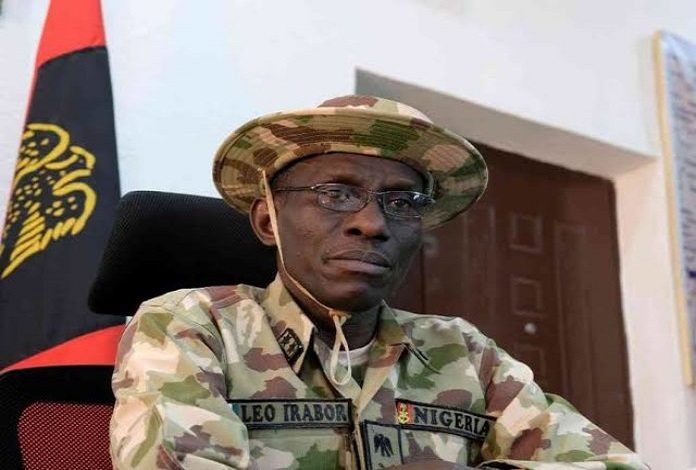
THE Chief of Defence Staff (CDS) Lucky Irabor has denied a report by Reuters which accused the Nigerian Army of carrying out secret, illegal abortions on pregnant victims of terrorism in the North-East.
While responding to questions on the issues raised by the report at the State House ministerial briefing on Thursday, December 8, Irabor described the report as nonsense and untrue.
“That is outright nonsense. Their allusion is news to me. It never occurred. I never saw anything like that from Maiduguri down to Maimalamari Cantonment where I lived; that is a major hospital for our personnel and their family. I am disappointed, to say the least. So it is not true.
“I was informed by the Director of Defense Information about a mail from Reuters requesting an interview with me. And he gave me a letter written by one Alexander making allegations that have now been published by Reuters. I simply said he should go back to the person and answer their questions but I’m not going to dignify such a report,” he said.
The ICIR reported that an investigation published by Reuters had indicted the military for running a secret program that has ended at least 10,000 pregnancies without the consent of the women involved who had been kidnapped, raped or forcefully married to terrorists in the North-East.
Reuters reported that the victims, some as young as twelve, were deceived into taking pills and injections that ended their pregnancies under the false assurance that the medication was to restore health.
Some women who resisted were beaten, threatened with guns or drugged into compliance. Reuters also noted that the operation had been running since 2013 and resulted in many casualties.
But the CDS said that an email sent to him by Reuters before the publication pegged the number of abortions at 12,000, which was different from what was published. He cited this as a pointer that the report was fabricated.
“You’re saying the military since 2013 has been engaged in a planned abortion programme. And he said that is part of the government’s design. In that letter, he said that 12,000 abortions have been conducted. But in the published report, we saw ‘at least 10,000’ ” he said.
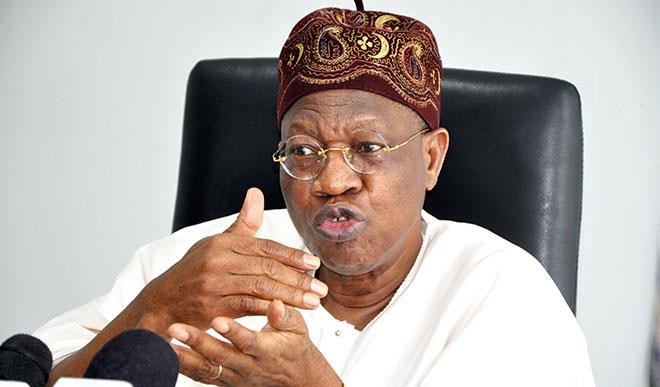
MINISTER of Information and Culture Lai Mohammed has said President Muhammadu Buhari’s policy on agriculture saved Nigerians from hunger.
The minister made the claim on Thursday, December 8, at the 9th edition of the ”PMB Administration Scorecard Series (2015-2023)” in Abuja.
According to the News Agency of Nigeria (NAN), the scorecard series was launched in October as a programme to showcase and document the numerous achievements of the Buhari administration.
In an opening remark, Mohammed noted that in spite of the crises affecting the cost of living globally, the administration had done well since assuming office in the area of self-sufficiency in most basic needs.
“I am sure many of us have seen video clips of empty supermarket shelves in the Western world, especially in the wake of the COVID-19 pandemic, Russia-Ukraine war and the economic uncertainty, which have all combined to disrupt global supply chains,” he said.
“Long before these crises, however, President Muhammadu Buhari had, in a statement that has now turned out to be prescient, admonished Nigerians to grow what they eat and eat what they grow.
“Then, many neither understood the importance of that admonition nor appreciated its relevance.
“Well, it turned out that the consequence of that statement made Nigerians look inward and relied less on imports.
“This has saved Nigerians from hunger, especially during the prolonged global lockdown, when exporting nations shut their ports and borders and nations that relied on imports were struggling to meet their needs.”
Mohammed also said the worst could have happened if the country had, during the period of the crises, relied on imports to feed itself.
The minister added that the presidential fertiliser initiative was a successful policy that made the production and distribution of fertiliser to the farmers effective.
According to him, the number of fertiliser blending plants in the country increased from 10 in 2015 to 142, while the number of rice mills also rose from 10 in 2015 to 80 integrated rice mills.
This, he added to have aided food sufficiency.
“Our farmers are now part of our economy. Companies and factories are coming up to manufacture, process and distribute food,” he added.
“If you visit our markets and supermarkets today, what you will see mostly are ‘made-in-Nigeria’ products. This is a huge progress in such a short time.”
Speaking further on the high prices of food items, the minister assured that as the country engaged more in local food production and moved closer to achieving food security, prices would begin to fall.
“For now, we must acknowledge the success we have achieved in the area of food production and in scaling up made-in-Nigeria products’’ he said.
THE World Health Organization (WHO) has said more than half of the world’s population lack access to essential health services.
The organization said health is a right for all, irrespective of economic and social standing, adding that poverty should not be a barrier for people to get the health services they need.
WHO Country Representative Walter Mulombo said at the Sixth Annual Conference of the Association of Nigeria Health Journalists (ANHeJ) in Akwanga, Nasarawa State, on Thursday, December 8, that the poorest households felt the heaviest impact of inefficiencies and poor health outcomes because they had limited access to essential health services.
The three-day conference has the theme, ‘Universal Health Coverage (UHC): How Can Nigeria Get it Right? – the Role of the Media’.
Mulombo explained that almost 100 million people are pushed into extreme poverty yearly because of the costs of paying for care out of their pockets.
Represented by the agency’s Field Presence Cluster Lead, Ahmed Khedr, Mulombo rued the low universal health coverage for health and investments in health in Nigeria.
However, he lauded the Nigerian government’s efforts since the enactment of the National Health Act (birthing Basic Health Care Provision Fund (BHCPF)) and the Presidential Summit on universal health coverage in 2014.
He also described the National Health Insurance Authority Bill signed by President Muhammadu Buhari in May this year as a landmark effort to make health insurance mandatory for all legal residents in Nigeria and designating states as the implementers of health insurance.
The Act created the Vulnerable Group Fund to cater to over 83 million poor and vulnerable citizens.
ANHeJ
Mulombo said UHC helps everyone access quality promotive, preventive, curative and rehabilitative health services at an affordable cost, without the financial hardship of paying for care.
He added, “In Nigeria, healthcare is financed predominantly by households, who pay for healthcare out of their pockets. With out-of-pocket healthcare expenditure at 70.5 per cent of the Current Health Expenditure (CHE) in 2019, General Government Health Expenditure as a percentage of the GDP was 0.6 per cent, while Government Expenditure per Capita was $14.6 compared with WHO’s $86 benchmark for universal health coverage (UHC).
“Currently, the country bears the highest burdens of tuberculosis and paediatric HIV while accounting for 50 per cent of neglected tropical diseases in Africa. Although malaria prevalence is declining (from 42 per cent to 23 per cent), the country contributes 27 per cent of global cases and 24 per cent of global deaths. NCDs account for 29 per cent of all deaths in Nigeria, with premature mortality from the four main NCDs (Hypertension, Diabetes, Cancers, Malnutrition) accounting for 22 per cent of all deaths.”
Mulombo opined that there was no single pathway to UHC, as all countries must find their own way in the context of their own social, political and economic circumstances.
“But the foundation everywhere must be a political commitment to building a strong health system, based on primary care, with an emphasis on disease prevention and health promotion.
“Such health systems do not only provide the best health outcomes; they are also the best defence against outbreaks and other health emergencies. In this sense, UHC and health security are truly two sides of the same coin.”
He said if well implemented, the Nigerian BHCPF would provide a great opportunity to turn political commitment into tangible gains while rallying development partners and the private sector around revitalizing primary health care as the foundation of UHC.