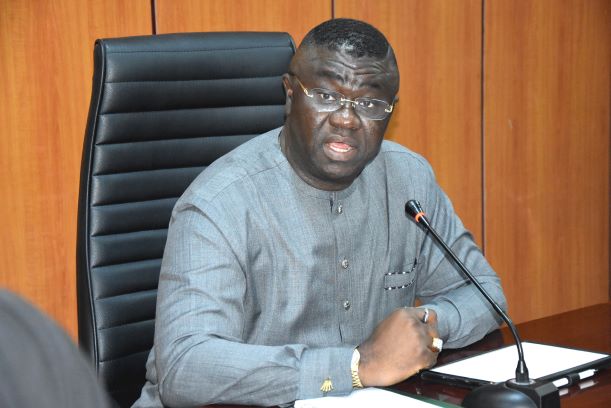
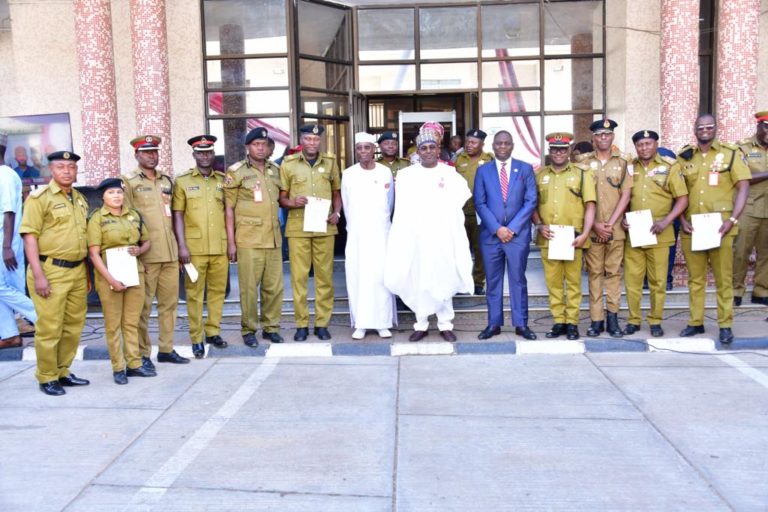
Kunini, elected Speaker in 2019, cited personal reasons for his resignation in a letter transmitted to the lawmakers earlier on Wednesday.
There were reports that Kunini has been having disagreements with the state governor Darius Ishaku over the non-payment of seven years of outstanding allowances of the staff of the state assembly, under the umbrella of Parliamentary Staff Association of Nigeria (PASAN), Taraba State chapter.
Also, under Kunini, the state assembly rejected the governor’s plan to sell some state-owned properties including the Highland Tea company located at the Mambilla Plateau, in the Sardauna Local Government Area.
Hamman Adama, who stood as the Speaker pro-tempo during the emergency sitting, called for the nomination of the new Speaker.
Members unanimously elected Bonzena as the new Speaker.
Speaking to newsmen shortly after the emergency sitting, Bonzena promised to do his best to carry everyone along.
Bonzena, from Zing Constituency, was the former chairman House Committee on Education, as well as the Chief Whip of the 9th Assembly before his election as Speaker.
Inside Ogun’s Abandoned 32 Kilometre Road Where Owners of Demolished Properties, Businesses Have Become Helpless, Hapless
Three decades after it was first conceived, the 32-kilometre Sango-Agbado-Akute-Alagbole-Berger road means excruciating pains for property owners, with the government itself undecided about how best to carry the burden of a route that has thrown people into life-threatening hardship.
Residents, property and business owners of the entire stretch of Ota-Agbado-Olambe-Akute-Alagbole Road in Ogun state recount their losses, as they never envisaged their properties and sources of livelihood would be taken away from them.
Seventy-years old Elder Abdulrauf Fatunibi, the immediate past chairman of the Ogunlowo-Alagbole community and a landlord, while speaking with the NPO Reports, recalled the sad moment when his building, which had 14 rooms and mainly put out for rent as shops, were bulldozed.
Narrating on the verge of shedding tears, Fatunibi said that in 2016, government officials initially came, claiming they wanted to work on the roads.
But it was suspended, and then they later came again in 2017, marked buildings and gave them a notice of demolition.
However, just three days after they were notified of the demolition, the exercise began with Fatunibi’s building affected.
This plunged him into emotional instability, depression and frustration.
He recalled how he was assisted and consoled by a neighbour who accommodated him for a period till he could find his feet again as he said he almost committed suicide.
He further told the NPO Reports, “My building was demolished! Fourteen rooms! We didn’t get a dime from the government.
“We protested, all to no avail.
“They told all of us that were affected to come to Abeokuta, but we didn’t get anything afterwards.”
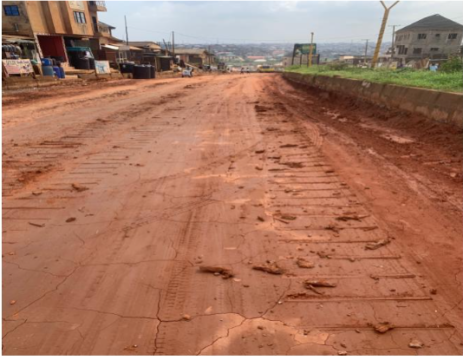
Abandoned Road Project at Ogunlowo-Alagbole, Ogun State. Photo: NPO Reports
The NPO Reports, however discovered in the course of this report that many buildings had indeed been demolished in the same manner under the administration of Governor Ibikunle Amosun, with the road project abandoned for years.
There are many others, like Fatunibi, who have been plunged into the same heart-wrenching experiences of financial instability, agony, depression and despair.
Another resident (who however, preferred not to be named), further took the NPO Reports down his own journey of the loss.
He confirmed the demolition, explaining that he also had four shops which were all affected by the demolition. However, he said that they were instructed to fill out forms for compensation, stating the amount they wanted but were still not compensated after the struggles.
With teary eyes and a trembling voice, he narrated that since he retired from his job in November 2016, he has not had any other means of livelihood aside the money his wife makes from the wares she sells to people in the neighborhood.
He stated that he used to receive rent on his four shops before the demolition, but after the buildings were brought down, he had to use the rent of three years to reconstruct another shop, moving it backwards, for the tenants who were occupying his building at the time. He has not collected any more money from the tenants ever since.
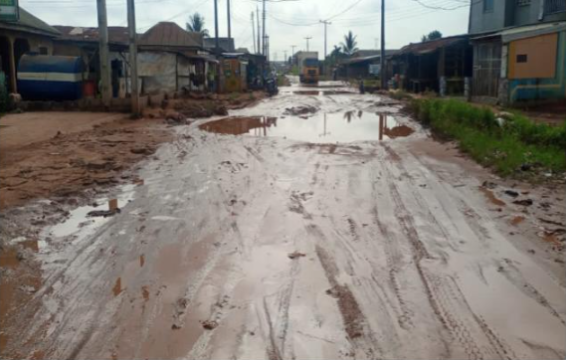
Apart from the pangs of losses, many residents are burdened by the environmental challenges the mass demolition has brought upon them.
“It gets dusty during the dry season, and the roads become slippery during raining season. During both seasons, life is miserable,” he said
Part of the affected areas worsened due to rain. Photo: NPO Reports
Despite all efforts and struggles to secure their compensation for lost properties, all have proved abortive, the CDA Chairman, Bisi Badejo, confirmed this to the NPO Reports.
He explained that they have not gone to meet the present administration officials of Governor Dapo Abiodun to push for the compensation. Their reason for this is that it was not his administration that commenced the demolition and left it halfway.
He said that part of the innumerable losses since the loss of their properties is that the sizes of their lands have reduced; sources of livelihood have been lost, and the values of the buildings have drastically gone down.
Business owners in the community are not left out in the pains. Since the demolition of many structures alleged to be standing on the right of way for the road expansion, many schools, hotels, event halls, and mini-shopping complexes have been affected.
A shop owner who gave his name as Sikiru Hamed in the Lambe area of Ogun state narrated how his building materials business was affected.
He said in 2016, when the demolition exercise began, it started with a zeal that suggested that the road expansion project would come onstream immediately. There were high expectations.
“Many of us were initially convinced that the pains of moving our businesses inward for a better road would eventually create a better environment that would enhance our businesses.
“Sadly, that has not happened. Rather, our businesses have suffered and there are no signs that there is an end to all these,” Hamed said.
“The roads are bad, and it’s affecting businesses. People cannot ply the road to come and buy especially now that it’s rainy season, customers are not coming,” said Mr. Gbenga Ajetumobi, a tricycle rider, who also had a lot to share with the NPO Reports on the sufferings of the people.
He disclosed to the NPO Reports that he has been a tricycle operator in the area for close to 18 years just as he explained that the roads were not as deplorable as it is now.
“When the Governor, Senator Ibikunle Amosun came, we all liked him, because before, when you were going to Agbado in the morning and evening, there was always heavy traffic. Thee same thing happened at Akute and we later discovered that most of the powerful people had buildings constructed very close to the road side. But he came and cleared everything.
“When they started to erect the bridge, we were all excited but suddenly, after the second term election, when he was supposed to continue with the construction of the roads, we noticed it was put on hold. So, what we heard was that the next person as governor would be the one to complete the work and that is Dapo Abiodun. But he has done nothing so far.
Ajetumobi further revealed that many vehicle owners have had to abandon their vehicles to opt for public transport due to the poor state of the roads. He explained how he has to take up extra expenses almost every day on maintenance and repairs of his tricycle and the prices of replacing spoilt parts. It is extremely high.
“It has really affected not only me but everybody. We repair nearly every week, particularly when there is rain and all these things are very expensive,” he said.
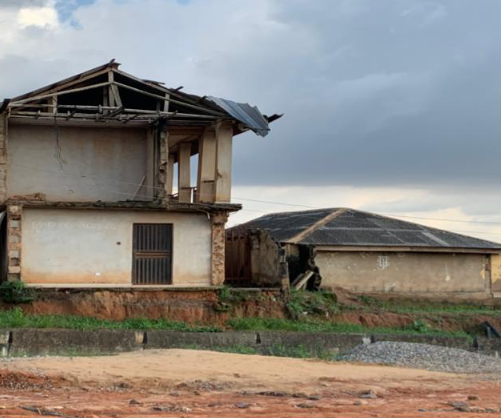
An abandoned demolished building along Lambe road. Photo: NPO Report
The Blame Game
Commissioner for Works and Infrastructure in Ogun State, Ade Akinsanya, said NPO Reports’ inquiries are better handled by the Offices of Public Procurement and Budget which must necessarily have data since the commencement of the project apparently under the administration of former Governor Olusegun Osoba in his first coming.
While Amosun wanted was believed to be the original design of the road, a six-lane as conceived by the administration of former Governor Segun Osoba, the Dapo Abiodun administration said they have re-scaled the project from its formerly ambitious scope to what the administration believes it can manage.
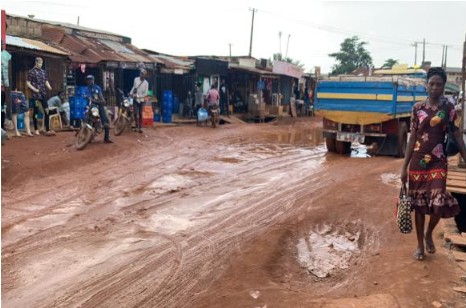
Abandoned Road Projects in Lambe axis of Ogun State. Photo: NPO Reports.
The Commissioner for Works and Infrastructure had been quoted in the media to have said during one of the tours of the site recently that “the Sango-Akute-Alagbole road is a 32-kilometre road awarded by the previous administration and unfortunately abandoned. What we are doing now is that instead of six lanes, we have re-scoped the road, and our contractor is moving to the Sango-Ijoko area, working on that and, of course, the Lagos end.
“The segments one and six have been awarded. Included in the work is the palliative work that will ensure that from phase 2 to phase 5 should be motorable all the way from Sango to Yakoyo end.”
It was that palliative measure that many saw in August 2022 with construction equipment moving to some areas such as Yakoyo that angered many who claimed that patching was not what the Governor promised when he visited the area.
Perhaps, as a possible indication that the project might not go the way it was originally conceived when it was first started by the Osoba administration, and pursued under the Amosun administration before he exited government, Governor Abiodun had in August said that his government would now embark on the reconstruction of only one lane of the project.
The Governor said, “One lane of the 32 kilometres road from Sango through Ijoko to Alagbole will be done between now and December to ensure that motorists and other road users who ply the road daily, do so without stress which has been their lot for years.”
NPO Reports gathered that the decision to reduce the scope of the project amounts to the Governor facing the reality of economic crunch, which has compelled him to pick only some out of the very bad roads that dot Ogun State.
According to findings, the first phase of the reconstruction will gulp about N300 million. And that, for now, is the only publicly quoted monetary value being attached to the project.
Before then, the deplorable state of the road had caused a series of condemnations for the administration. In a way, many seem to be waiting for the next election in the state to punish the governor for the alleged abandonment of his electoral promise when campaigning for office.
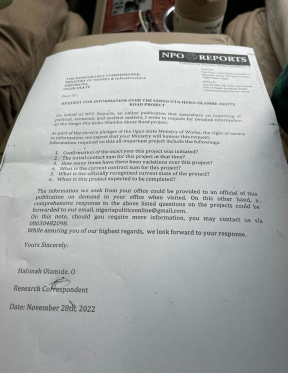
*Copy of the letter addressed to the Government of Ogun State
Inquiries over the exact appropriations for this project from the Government have not been responded to.
After a letter which was addressed to the Commissioner for Works and Infrastructure was received, NPO Reports learnt that the letter was forwarded to the Budget Office and the Office of Public Procurement, which, according to findings, have a better understanding of the time the project was conceived, how funds were appropriated and what has been spent so far.
The State’s Commissioner for Information, Waheed Odusile, who was also contacted to ensure the response to the NPO Reports’ letter of inquiry, promised to ensure that the Office of Budget and that of the Bureau of Public Procurement respond. No response was received.
This report is part of a collaborative investigative series by HumAngle, the International Centre for Investigative Reporting (The ICIR), NPO Reports and TheCable, facilitated by the Wole Soyinka Centre for Investigative Journalism (WSCIJ) under its Collaborative Media Engagement for Development, Inclusivity and Accountability (CMEDIA) project, with support from the John D. and Catherine T. MacArthur Foundation.
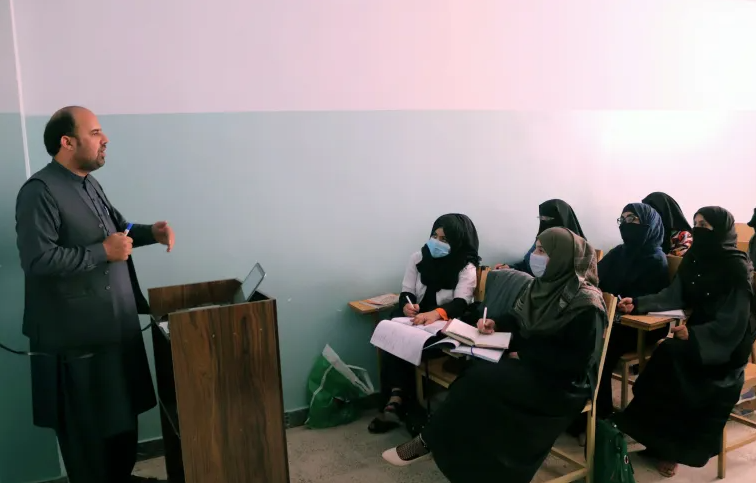
AFGHANISTAN’S Taliban-run education ministry has instructed its public and private universities to suspend access for female students immediately until further notice, in accordance with a Cabinet decision.
About a year ago, the government had requested higher education institutions to present their proposals on how to implement a gender-segregated education system in the country, where male and female students would not be able to take classes together, just as male teachers could not be allowed to teach female students.
A letter signed by the Minister for Higher Education Neda Mohammad Nadeem and published by the Ministry on Tuesday, December 20 read: “You all are informed to immediately implement the mentioned order of suspending the education of females until further notice”.
This comes after girls were barred from returning to secondary schools in March, after the Taliban ordered schools for girls to shut just hours after they were due to reopen following month long closures imposed after the Taliban takeover in August 2021.
The announcement banning university education for women by the Taliban came as the United Nations Security Council deliberated on issues in Afghanistan at a meeting in New York.
Foreign governments have said that a change in policies on women’s education is needed before it can consider formally recognising the Taliban-run administration, which is also subject to heavy sanctions.
“The Taliban cannot expect to be a legitimate member of the international community until they respect the rights of all Afghans, especially the human rights and fundamental freedom of women and girls,” United States Deputy UN Ambassador Robert Wood told the council, describing the move as “absolutely indefensible.”
Britain’s UN Ambassador Barbara Woodward said the suspension was “another egregious curtailment of women’s rights and a deep and profound disappointment for every single female student.”
“It is also another step by the Taliban away from a self-reliant and prosperous Afghanistan,” she told the council.
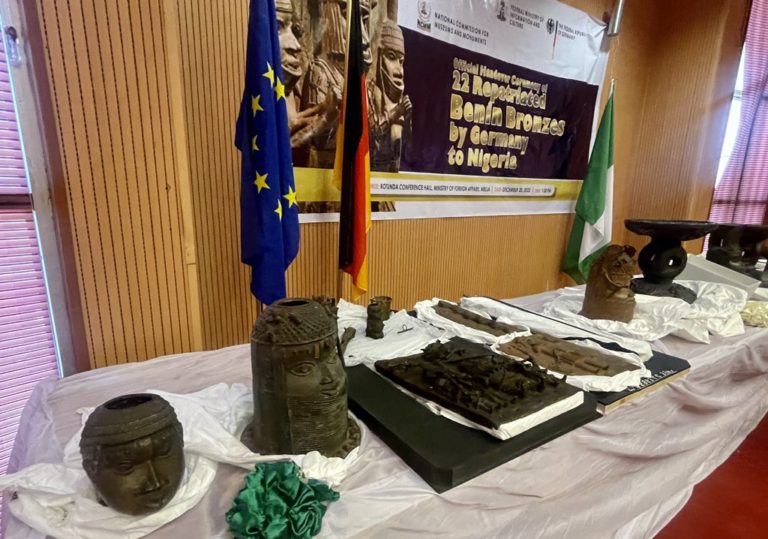
THE Nigerian government has called for the immediate return of all artefacts that were illegally exported from the country and held in various countries.
The call came on the heels of the repatriation of 22 Benin bronzes from Germany. The Benin bronze works were looted in the 19th century.
Nigeria’s Minister of Information and Culture Lai Mohammed, thanked the Government of Germany for “doing the right thing”, noting that the art pieces were not mere decorative works but “the true essence of our being”, as they symbolise the culture and heritage of Nigerians.
“We call on all other nations, institutions, museums and private collectors still holding on to Nigerian antiquities to release them. Particularly, we call on the British Museum to release the more than 900 Benin Bronzes in its hold,” Mohammed said.
He disclosed that Nigeria had submitted an official letter to the British Museum demanding the return of Nigerian antiquities in the museum, but was yet to get a reply more than a year after.
“I visited in July this year hoping that the success recorded with the Germans will nudge the British Museum to do what is right. But I met a brick wall. It is upon returning these artefacts that true justice will be seen to have been done,” the minister added.
Germany’s Foreign Minister Frau Annalena Baerbock said the return of the stole artefacts was part of efforts to deal with a “dark colonial history” and an opportunity to right some of the wrongs of the past.
“Officials from my country once bought the bronzes, knowing they had been robbed and stolen. After that, we ignored Nigeria’s plea to return them for a very long time. It was wrong to take them and it was wrong to keep them,” Ms Baerbock was quoted as saying by German broadcaster DW.
It would be recalled that a declaration signed in July between Germany and Nigeria for the release of all 1,130 Benin Bronzes in German public museums, had sparked controversies of custodianship between Oba Ewuare II of Benin and the Edo State Governor Godwin Obaseki.
Wading into the matter, the Federal Government said it will take possession of the returned Benin bronzes in line with extant laws, as the return of the artefacts was being negotiated bilaterally between the national governments of Nigeria and Germany.
THE Federal government says states will not be forced to join the Open Government Partnership (OGP), which the Federal government committed itself to at the London Anti-corruption Summit in 2016.
The Minister of State for Budget and National Planning, Clems Agba, who disclosed the Federal government’s position on Monday December 19 in Abuja, said that rather than force states to join, the government would encourage their participation to grow transparency and accountability in governance.
Agba said, “Nigeria is a federation and governors have their choices to make. Those who have joined could testify to the enormous benefits of the scheme.”
Available statistics showed that 24 states out of the 36 had subscribed to the OGP in Nigeria, with the Abuja Municipal Area Council (AMAC) the only municipal area council in the country to have subscribed.
Benefits of the OGP include a budget support facility that enables states grow their developmental projects.
President Muhammadu Buhari had told a delegation from the OGP Support Unit, led by its Chief Executive Officer, Sanjay Pradhan, which had visited him in July this year, that the Partnership had improved Nigeria’s budgeting transparency.
Buhari said, “Our budgeting processes have become more open, citizens-centred and participatory. In accordance with the objective of fiscal transparency, all stakeholders, including the public, are involved in the country’s budget-making process, have access to the details of our budgets, and have the opportunity to make input into it. As proof of our progress, Nigeria was ranked among the best-improved countries for transparency in the latest global Open Budget Survey.
“We have made significant progress in the beneficial ownership transparency in Nigeria. We produced a roadmap of Beneficial Ownership Reporting in 2016. By December 2019, we established Africa’s first Beneficial Ownership Register in the extractive industry. In 2020, we amended our laws to expand Beneficial Ownership Reporting to all sectors of the economy.”
Agba confirmed that besides the 24 states that had subscribed to the OGP, the Oyo State government had submitted a consent letter expressing willingness to join the Partnership.
He also noted that the Federal government would continue to support programmes and policies of sub-national governments geared towards promoting transparency and accountability in governance.
The OGP is a global partnership for reformers from both the government and the civil society who work together to make the governance process open, accountable and citizen-driven.
Nigeria joined the OGP in 2016 as the 70th member as part of its efforts to fight corruption and improve governance in the country.
The government said that Nigeria, since joining in 2016, had developed and implemented two national action plans organised around critical thematic areas like fiscal transparency, access to information, anti-corruption, citizen engagement, service delivery, inclusion and extractive transparency.
The letter reads, “Dear Peter, you will recall that I briefed you yesterday about my personal travails in seeking justice and clearing my name using the Nigerian legal system to pursue the same.
A copy of Doyin Okupe’s resignation letter credit: @doyinokupe
“I have invested too much in your campaign to allow my personal travail to become a source of distraction.
“In the circumstances, I have opted to step aside and plead that you appoint a new campaign DG who can continue the assignment with zero distraction. God bless you.”
Okupe was convicted on Monday, December 19, for money laundering to the tune of N240 million.
He was, however, released on the same day after paying a fine of N13 million.
Meanwhile, the LP and Obi are yet to react to Okupe’s resignation as of the time of filing this report.
THE Nigerian Bar Association (NBA) has condemned repeated attacks on lawyers and courts in Imo State.
The NBA reacted to attacks on courts in Imo State in a statement released by its National Publicity Secretary Akorede Lawal on Tuesday, December 20.
“The Nigerian Bar Association (NBA) has confirmed the report that some yet-to-be-identified arsonists burnt down the High Court of Imo State building in Orlu, Imo State, on Friday, 16th December 2022. In the process, all the Court’s files, exhibits, and records books were completely razed.
“The NBA strongly condemns this crime on the court.
“We cannot build a virile justice system that upholds the rule of law if we continue to destroy the structures upon which justice stands. The NBA is concerned that this suspected arson on the court was premeditated, as eyewitnesses (including a court official who lives close to the court in Orlu) confirmed that the perpetrators started by shooting sporadically to scare away everyone before wreaking havoc on the Court,” the statement said.
Noting that some court staff had been abducted in the course of carrying out their duties, the NBA said the attacks had affected the confidence of residents in the government and the judiciary.
“If the courts which are ‘Houses of Justice’ are not safe, no citizen will consider his or her life and properties to be safe. Equally, these attacks will cause unimaginable and inordinate delay in the administration of justice and impact negatively on the livelihoods of our members in Imo State, many of whom are litigators,” the NBA observed.
Calling on the state government to protect the judiciary and its officers, the association said it was making efforts to apprehend the culprits and bring them to justice. It also urged citizens to be vigilant and ensure that public properties are not destroyed.
“The NBA shall firmly resist the attempt to return the legal profession to the dark days where lawyers conducted their professional affairs in fear. Citizens need to be aware that lawyers are not their enemies or opponents. Lawyers only aid the administration of justice, and the law courts still remain the lawful and civil forum of resolving disputes,” the statement added.
Members of the NBA were urged to be security conscious while carrying out their activities.
The ICIRreported that a magistrate’s court in Owerri, Imo State, was razed during an attack on December 18.
About 24 hours earlier, a high court in the Orlu area of Imo state was burnt during an attack.
“Within the period under review, the Agency arrested 23,907 drug traffickers, including 29 barons. Our seizure was over 5,500 tons or 5.5 million kilograms of assorted illicit drugs, which together with cash seized are worth over N450 billion,” Marwa said.
He added that the NDLEA has taken the fight against drugs to the doorsteps of cannabis growers by destroying 772. 5 hectares of cannabis farms.
“In these 22 months, we have record convictions of 3,434 offenders. We have equally made good strides in our drug demand reduction efforts, where the number of those counselled and rehabilitated is 16,114.
“The figures are mere statistics until you view them through the lens of human impact and the good or harm that could have come to society, the impact on public health, security as well as law and order if those dangerous drugs had gone to the street.*
In the same vein, Marwa notes that the NDLEA management is committed to doing everything possible to improve productivity on the job.
“We usually calculate our performance as monthly, quarterly or yearly appraisals. But drug law enforcement is generally a continuum; hence, I want to always appraise our efforts from January 2021, when we began far-reaching reforms, reviewed our strategies and rejigged the existing systems to accommodate innovations,” he said.
The nominees confirmed include Samuel Ogbokwu, from Bayelsa State, as the Managing Director, who would serve for two years, in order to complete the term of his predecessor.
Other members are Dimgba Erugba (Abia), Emem Willcox Wills (Akwa Ibom), Denyanbofa Dimaro (Bayelsa), Orok Duke (Cross River) and Pius Odudu (Edo).
Also confirmed are Anthony Ekenne, (Imo), Gbenga Edema (Ondo), Elekwachi Dimkpa (Rivers), Mohammed Kabir Abubakar, (Nasarawa, North-Cenral), Sadiq Sami Sule – Ikoh (Kebbi, North-West) and Tahir Mamman, SAN (Adamawa State, North-East)
Charles Airhiavbere, from Edo, was also confirmed as the Executive Director, Finance, while Charles Ogunmola, from Ondo, was confirmed as the Executive Director, Projects.
Onochie is an indigene of Onicha-Olona, in Aniocha North Local Government Area of Delta State.
She was previously nominated by the President as a national commissioner of the Independent National Electoral Commission (INEC) but was rejected by the Senate.
Her eligibility as chairman of the NDDC board was a subject of controversy during the Senate committee screening after senators insisted that she was ineligible on the ground that she is not from an oil producing community.
During the screening, the senator representing Bayelsa West, Seriake Dickson, asked Onochie if she was from an oil-producing community.
“I would like to know your local Government in Delta State and your community and whether to the best of your knowledge the community you come from is an oil-producing community or it has oil facilities located therein,” he said.
Dickson, a former governor of Bayelsa State, noted that nominees for positions on the NDDC management should come from oil producing areas.
“I want to observe that this is a fitting moment to commend the President. Finally, we have nominations to properly constitute the board of the NDDC as required by the Act.
“We should add a clause calling on the President to ensure that their nominees come from oil-producing areas as required by the law.”
Meanwhile Justice JK Omotosho of a Federal High Court in Abuja had earlier ordered the President, the Attorney-General of the Federation and Minister of Justice, the National Assembly and others to stay action on the screening of the NDCC nominees pending the hearing of motion filed by some aggrieved persons representing the Itsekiri ethnic nationality of Delta State.
The plaintiffs in the suit are Edward Ekpoko, Engr Victor Wood (both representing Itsekiri leaders of thought) and Edward Omagbmi, representing Omadino Unity Forum while the defendants are the President, Attorney General of the Federation and the Minister of Justice, President of the Senate, the Senate, Lauretta Onochie and Chief Samuel Ogbuku.
In the originating summons marked FHC/ABJ/CS/2294/2022 the plaintiffs asked the court for a restraining order on the National Assembly from screening and confirming Onochie and other nominees.
The plaintiffs challenging the nomination of Onochie and Ogbuku on the grounds that it is the turn of the Itsekiri to occupy the positions of NDDC board chairman and managing director.
ONCE a beacon of learning and innovation that produced prominent engineers and public figures, Government Technical College (GTC) Kano has fallen into disrepair and neglect.
At around 5:00 p.m., when all of the students had gone home, Muhammad* emerged from a classroom carrying a physics textbook and wearing a blue overall that indicated he was a technical school student, but there was something worrying him.
His classroom was a chaotic mess, showing all signs of neglect, a sorry sight to behold for any concerned. Names and mathematical equations had been written in graffiti on the peeling, discoloured walls. The broken ceiling added to the chaos, with pieces of plaster and debris raining down on the floor.
The class was intended for 40 students, he said, but more than 200 from three different schools are crammed onto the few desks, making it cramped. Around 100 others sit on the bare floor, some sitting on their shoes, others on a large sack that has been converted into a mat like in traditional Almajiri schools.
One of the classes in GTC Kano. Credit: Aliyu Dahiru /HumAngle.
Despite the fact that many of the state’s secondary schools are experiencing the same infrastructural decay, Muhammad had hoped that his school would be an exception. “It’s a special school that was attended by the best engineers and prominent politicians from the state,” he said. “It’s the dream of many young students in Kano.”
He was correct; many well-known politicians, such as the former governor Rabi’u Kwankwaso an Engineer and the former deputy governor Abdullahi Gwarzo, also engineer attended the school. However, the standing of former students has not saved it from deteriorating facilities, overcrowded classrooms, and low staff morale. These are causing the institution to lose its former stature.
Government Technical College (GTC) Kano, Northwest Nigeria, was established in 1953 by the British colonial government as the day division of the three technical institutions in Kano State. Their purpose was to prepare students for careers in trade and vocational education. The college is less than a kilometre from the state government house on the State Road in Nassarawa Local Government Area.
In 1982, the Kano State House of Assembly added the three Technical Colleges to the list of special science schools under the Science and Technical Schools Board (STSB) in recognition of the value they offer to the improvement of Kano’s educational system, notably in the fields of technology and engineering. Other technical colleges that started from inception are GTC Wudil and GTC Bagauda.
The pathetic condition of GTC Kano that was attended by a former governor and former deputy governor. Credit: Aliyu Dahiru/HumAngle.
According to the STSB website, the schools were founded “with the sole aim of producing qualified secondary school students for admission into tertiary institutions to pursue related science and engineering courses.” For many years, they have been regarded as some of the top secondary schools in Kano, succeeding in their mission to produce the best engineers and doctors.
However, the future of these schools is now in jeopardy. GTC Kano has been neglected for years, and the education programme under the administration of Kano state governor a Abdullahi Umar Ganduje has not done much to improve its condition.
Despite budgeting substantial funding for them, ₦28 million in 2021, these schools are in a terrible state. According to the staff of STSB who spoke to HumAngle, preferring anonymity, this is “having a negative impact on the children and teachers who are compelled to work there with little resources.”
Through interviews with educators, including administrators, teachers, and students, we have unearthed a troubling picture of a complex issue.
Free but abandoned
A sizable billboard promoting free education in Kano hung close to the entrance of Gidan Murtala, a story building hosting the Kano state ministry of education. It featured a photograph of students from science and technical schools during an experiment in the school’s lab.
A billboard advertising free education in Kano state featuring STSB school students. Credit: Aliyu Dahiru /HumAngle
The schools chosen for the campaign were carefully considered. Many Kano indigenes aspire to attend science and technical colleges, and what could entice them more than having their dream realised for free? However, a member of the STSB staff claimed that this was the root of the entire problem.
“free education is a gigantic political swindle”
In Kano State, “free education is a gigantic political swindle,” he said to HumAngle. It is only intended to convey to outsiders that the state offers free education, despite the fact that doing so comes at a higher cost of neglect and having little money to maintain the schools, the man added.
In order to ensure that all children of school-going age, regardless of their backgrounds, have access to basic education, the Kano state administration reinstated free and compulsory education in 2019. However, this denied the Kano school administrators the ability to generate money for specific school initiatives through fees.
The initiative, which includes all of Kano’s schools, has drawn criticism from many just a year after its start since it has become evident that the state government is unable to meet their needs.
Although it is not unusual to see students in Kano secondary schools under the Kano Senior Secondary Schools Management Board (KSSSMB) sitting on the ground with no desks in classes, nobody thought that the STSB schools would be among the worst affected due to their history of excelling even under a hostile condition.
According to reports, the advent of free education left many schools, including those under State Universal Basic Education Board (SUBEB), KSSSMB, and STSB, impoverished, resulting in a lack of necessary supplies, including desks and other educational tools. The pupils are consequently battling to keep up with their coursework and are in danger of falling behind.
The member of staff who spoke to HumAngle said that the STSB itself is facing numerous problems, most notably not receiving adequate upkeep funding to operate its schools. Supervisors supposed to be overseeing the schools cannot easily travel between the institutions they administer. “There isn’t enough money to fuel cars for supervision, cars break down, and there isn’t money to fix them or replace them. Sometimes, even feeding students attending boarding schools becomes a major issue,” he said.
The entrance gate of the STSB. Source: STSB website
The situation has gotten so bad at the board’s headquarters, the official said, that none of the printers in the nine departments of the STSB is working. “We work on our phones, occasionally sending reports over WhatsApp.” He complained that whereas the schools’ board itself had over 10 automobiles and each STSB school had at least three cars, today’s STSB has just two and no funding for fuel purchases.
The employees sometimes have to fuel the cars themselves to conduct supervision in schools within the city, “but those in villages take one to two years without supervision, making both the students and teachers relaxed knowing there is no one to physically supervise them.”
A senior STSB employee who recently retired after stints as a teacher and principal said in his 35 years of employment at several science and technical schools, he had never witnessed a situation as bad as the last four years.
He explained, “You know STSB schools were among the best in the entire Kano state, but it was only possible because they had enough funding and they were regarded as financially autonomous.”
“But recently, since the free education programme was implemented in 2019, everything changed, with the Ministry of Education seizing control of everything without any prior knowledge of how these institutions are run,” he continued.
According to him, this led to the budget not receiving approval and not getting the money even if approved, leaving the building in disrepair and without instructional resources. “It got to the point where staff members were given the opportunity to become principals but refused the position due to the fear that they might not run it well and would later be accused of destroying the school,” he said.
GTC Kano example
Aminu Usman, a student in NTC 3 (senior year three) at the Radio, Television and Electronics (RTV) department, stated that no seats are available for any classes in junior 1 and NTC 1. The students of the remaining classes either bring their own prayer mats or sit on the ground. While confirming that teachers still attend classes, he admitted it is hard to control the students in large numbers, especially during classes that require enough desks, such as Technical Drawing.
There is no single desk in one of the classes built by Maltina in GTC Kano. Credit: Aliyu Dahiru /HumAngle.
For trade practicals, Usman said he purchases his own tools for experiments and academic assignments. “They are not expensive,” he said, “so they are not a big deal.” The Chemistry and Physics practicals, where he only took one experiment due to a lack of chemicals or apparatus, are his major concern.
However, Usman recalled that during a visit to the GTC Kano by the Commissioner of Education, Muhammad Kiru, who he said was once the head of the physics department in the school, promised to support bring in missing apparatus that would make learning easier.
Not all departments have cheap, practical materials like RTV. The departments that are worst hit are those in which big machinery is required for practicals, such as the Mechanical and Motor Vehicle departments.
In some classes, only a few students have access to desks. Others sit on a sack. Photo: Aliyu Dahiru /HumAngle
The frustration of working without tools or equipment affects both teachers and students.
Muhammad Abba, a former technical school student, explained that “a technical school with no equipment is an unpleasant and restrictive place to learn and work.”
“It is challenging for students to gain practical experience and completely comprehend the concepts they are being taught without access to the required tools and equipment. This may result in a lack of expertise and confidence in their chosen subject, which could have detrimental effects on their future professional lives,” Abba explained.
“Just picture a mechanic working on a vehicle without access to a lift or the right diagnostic equipment. Or a cook attempting to prepare food without access to a stove or oven. Without proper, students may find it difficult to realise their full potential and to completely engage in the learning process.”
More schools, more problems
It was the administration of Rabiu Kwankwaso, a previous governor of Kano, that expanded technical institutions to all 44 local government areas in the state in 2013. His government said that this was done to allow the youth who want to enrol in technical education access to the schools.
Nevertheless, despite the money spent on building those schools and the admission of thousands of pupils, not enough funding was available to support their operation. Aside from the shortage of basic tools and equipment, which made it impossible to teach various trade courses, the STSB employee who spoke to HumAngle said that funding for the schools had been reduced.
He explained that instead of the schools receiving at least one million Naira for vehicle upkeep and other minor operating expenses, the money was reduced to only ₦200,000. “And the way things are now, schools go two to three months without receiving a dime,” he continued.
As a result, extracurricular activities were discontinued. Even some practicals are not completed, along with the inter-school quizzes and debates that define the schools and contribute to student morale, leading to them working harder.
Because NABTEB has refused to accredit the new technical colleges for final year exams, when students reach their final year, STSB must combine at least three schools into one, which makes it difficult for one teacher to handle the packed classes of students numbering between 80 to 200 according to their departments.
According to a former principal of one of the colleges, “This is different from some schools that were closed under the premise of insecurity in villages but which, in truth, is about the inability to pay the operational cost of the schools.” To create two distinct schools in one location, schools like GTC Tiga and GTC Bagauda were amalgamated with GTC Warawa and GTC Ungoggo.
Schools left to the mercy of former students
Pictures of the dilapidated dormitory and classes of Science College Dawakin Kudu, one of the STSB schools attended by the current deputy governor of Kano state and the APC candidate for governor in Kano, went viral on social media a year ago.
Afterwards, the association of old students repaired the run-down dorms and students continued to reap the benefits of a potent old boys’ association. Not all colleges, though, have such a robust alumni organisation. The majority of them are still battling infrastructural gaps.
The support from the alumni isn’t also enough to meet the schools’ demands. At GTC Kano, for example, new classrooms were built. But without furniture, students are still forced to sit on the bare floor as they receive lectures.
_________
*Names have either been changed or not mentioned to protect interviewees who are still students or work for the government.
This report is part of a collaborative investigative series by HumAngle, the International Centre for Investigative Reporting (The ICIR), NPO Reports and The Cable, facilitated by the Wole Soyinka Centre for Investigative Journalism (WSCIJ) under its Collaborative Media Engagement for Development, Inclusivity and Accountability (CMEDIA) project, with support from the John D. and Catherine T. MacArthur Foundation.