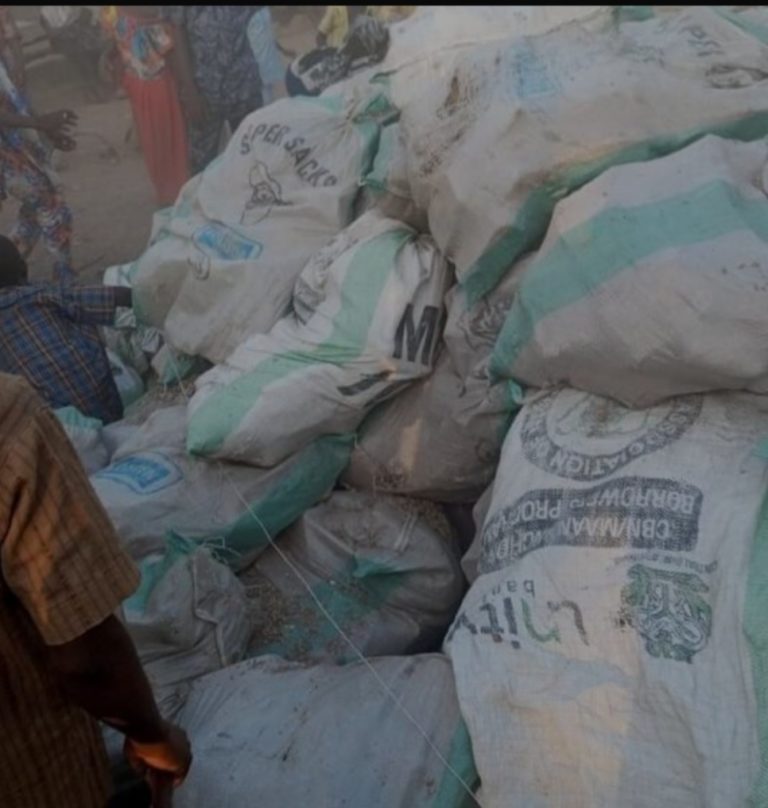
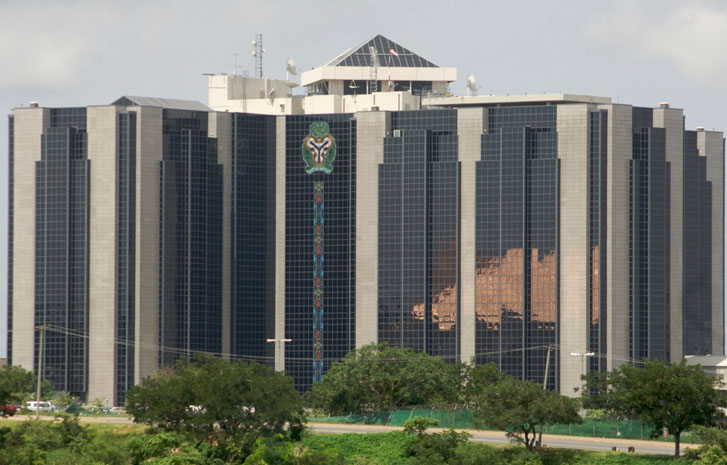
THE Benue State Police Command has reacted to a viral video showing bags of condemned naira notes discovered at a shop in Wadata, saying the shop-owner was licensed by the Central Bank of Nigeria (CBN) to be in possession of the notes.
According to a statement released on Tuesday, December 13, by the Public Relations Officer (PRO) of the Command Catherine Anene, the notes had been condemned by the apex bank as waste, and handed over to the shop-owner Isah Suleiman, to be used as raw materials.
“Police detectives sent on investigation to the scene recovered wasted papers in a shop close to Wadata Police Barracks, Makurdi.
“The owner of the shop, Mr. Isah Suleiman was invited for questioning and he tendered a licence issued to him by Central Bank of Nigeria (CBN) for waste management. He added that these wasted papers are usually gotten from CBN and processed in mosquito repellents.”
Anene also stated that the police had contacted the CBN for further investigations.
The Economic and Financial Crimes Commission (EFCC) also confirmed that the notes had been condemned by the CBN before being sold to Suleiman as waste.
A viral video had circulated across various social media platforms on Tuesday, showing bags of old naira noted discovered around the Police Barracks in the Wadata area of Benue State.
While basic education is free and compulsory in Nigeria, hidden fees demanded in government-owned schools hinder access to education for many children, worsening the current literacy crisis in the country.
THIRTEEN-YEAR-OLD Khalifa Abdullahi sat playing by a kiosk in Karon Majigi, a suburb within Nigeria’s Federal Capital Territory (FCT), on a sunny Monday morning.
Although Abdullahi was of school age, this had been his routine since he stopped schooling four years ago due to a lack of funds.
He told The ICIR that his father, a taxi driver, had an accident in 2018, and following the incident, neither he nor his siblings could continue their education.
“All my friends go to school. Many children in this area go too, but my brother and I do not go. My father said there is no money to pay our fees,” he said.
Khalifa Abdullahi
Confirming the story, Abdullahi’s mother, Khadijat, said it had been almost impossible to raise funds to enrol her children into any school, including those owned by the government.
She relocated from Kaduna with her husband and children in 2015 due to insecurity, and they earn a living through menial jobs.
“No child in this house goes to school. It is not that there are no schools around, but there is no money to send them to school. My oldest child was in school, but we could not afford to complete his education. He has been at home for the past four years,” she told The ICIR.
Every child in Nigeria has a right to basic education, governed by the Universal Basic Education Commission (UBEC) Act of 2004. It includes primary education and three years of junior secondary school.
Section 2 of the UBEC Act states that basic education should be compulsory and free.
“Every Government in Nigeria shall provide free, compulsory and universal basic education for every child of primary and junior secondary, school age,” the Act reads.
Though several government-owned schools exist across communities in the FCT, certain levies demanded from students are unaffordable for many Nigerian families.
Findings by The ICIR show that enrolling a child into most government-owned primary schools costs between N10,000 and N20,000, while junior secondary schools cost higher.
At the Local Education Authority (LEA) Primary School, Karon Majigi, enrolling a child as a fresh student into the primary section costs a total of N20,450.
During a visit to the school, The ICIR learnt that the sum covers registration which costs N500; Parents Teachers Association (PTA) fees, N1950; Uniforms, N2500; Pupil’s file N500; Online registration, N500; Sportswear, N2000 and some textbooks, among others.
Lea Karonmajigi
The school also demands an examination fee of N200 naira to conduct qualifying tests which determines what class the child will be admitted into.
Upon admission, children were also expected to resume with a moping stick and a small bucket.
It was a similar situation at the LEA Primary school, City Gate, Durunmi.
The ICIR discovered during a visit that enrollment into the school’s primary section costs a total of N18,600.
According to a list received at the school, the fees were broken down into registration which cost N1000, PTA, N1500; uniform, N3000; examination, N300; sportswear, N2000; online (registration), N300; Continuous Assessment, N500; and working materials, N1000.
Others on the list include a handwriting book which cost N600; security fee, N500 and another PTA levy, different from that earlier mentioned that cost N500.
Compulsory books, including Mathematics, English, Verbal and Quantitative Reasoning textbooks, summed up to N7400, bringing the total fees to N18,600.
At the LEA Primary School, Durunmi II, enrolment costs N25,400, which covers registration, uniforms, sportswear, relevant textbooks, a dozen exercise books, PTA fees and a Continuous Assessment book.
However, The ICIR also learnt that subsequent payments after enrolment are often less expensive as they are limited to PTA levies, which usually fall between N1500 and N5000, and the cost of books where necessary.
The situation is no different in other Area Councils within the FCT.
At the 1st UBE primary school, Pasali in Kuje, the sum of N10,000 is required as fees for new pupils. It covers registration, sportswear, school uniforms and a cardigan. This does not cover the cost of books, as parents are expected to source for books in the open market.
1st UBE Primary School, Pasali, Kuje.
In Nigeria, over 133 million people live in poverty, which is more than half of the estimated population.
The economic challenges faced by many families keep parents struggling to meet these fees, and, in most cases, they are left with no option but to withdraw their children from school.
A worsening literacy crisis
Nigeria has about 20.2 million children out-of-school, according to the United Nations Children’s Fund (UNICEF), the highest globally.
Several factors are responsible for the teeming population of children without education, including insecurity and poverty.
Rather than mitigate the effects of these challenges on education, hidden fees demanded in government-owned schools contribute to the number of Nigerian children without education.
Fourteen-year-old Fatima Aremu sells cold drinks by the Area 1 motor park. She told The ICIR that she had stopped attending school after her widowed mother lost her job.
“I finished primary school but could not continue because my mother did not have the money to pay the fees. She said I should stay at home for a while until she can afford it, but it has been more than three years now, and I am still at home,” she said.
This is worsened by the fees demanded for enrollment in secondary schools, which are often twice as much as those paid in primary schools.
Twelve-year-old Victoria John sells sachet water by Life Camp junction every day except Sundays to augment her family’s income.
She told The ICIR that her parents could not afford to pay tuition fees for herself and her siblings, so she was made to leave school so her brother could continue his studies.
“It is in primary six that I stopped; I’m about to enter JSS 1. She said she will send me to school next year if she has the money. Now, she has a lot to do with money, she has to pay my brother’s school fees first. He is in primary 3,” she said.
In the secondary school Junior Secondary School, Durunmi, the fees for enrollment into JSS 1 summed up to N28,450, which also covered several requirements, including Mathematics and English textbooks.
Students were also required to provide a big basket which cost an average of N2500 in the open market, and two bottles of hypo bleach, N1000 each, upon resumption.
Fees for the second and third terms were also less expensive, as it was limited to only PTA fees, which fall between 1500-2500 in the school.
For students seeking admission into the Junior Secondary School, Pasali, Kuje, the sum of N37,000 was required, which would cover school fees, N3,250, PTA N2,000, a pair of uniforms cardigan and sportswear N8900, online admission N2,500, fees for qualifying examinations N500, admission N1800, Textbooks N13,200.
Junior Secondary School, Pasali, Kuje.
The school also demanded implements, explained to mean a hoe, cutlass and detergent, which would cost N4,000, among other requirements.
At the Junior Secondary School Life Camp, prospective students were required to pay N19,200 for registration, PTA and other fees.
Physical items were also required, including a packet of refill markers, one basket, mopping stick and bucket each.
In the schools visited by The ICIR, no account numbers were given to pay these fees, as parents were required to pay in cash.
The ICIR also confirmed from some students that receipts were not issued after payment.
Punishable by law
Receiving payment from students in primary and junior secondary schools is a punishable offence under the UBEC Act.
According to section 3 of the Act, “the services provided in public primary and junior secondary schools shall be free of charge. A person who receives or obtains any fee contrary to the provisions of subsection (1) of this section commits an offence and is liable on conviction to a fine not exceeding NI0,000:00 or imprisonment for a term of 3 months or to both.”
But despite the provisions of the law, school authorities in the FCT still demand fees from children for basic education, making it beyond the reach of indigent citizens.
Chairman of the FCT Universal Basic Education Board (FCT-UBEB) Hassan Sule described these fees as illegal during an interview with The ICIR.
“PTA fees are between the parents and the teachers. But no head teacher or principal is allowed to collect any fees from any student. It is illegal. It is wrong,” he said.
He encouraged parents required to pay fees by authorities in government-owned schools to lay official complaints at the FCT-UBEB office.
Way forward
A significant reason why hidden fees exist in government-owned schools is the insufficient funding of the education sector.
While the international standard of funding for education, according to the United Nations Educational, Scientific and Cultural Organisation (UNESCO), is 15-20 per cent of a nation’s budget, Nigeria only designated 7.9 per cent of its budget for education in 2022.
In an interview with The ICIR, advocate for free basic education Joshua Arogunyo said to end hidden fees in Nigerian schools, governments in states across the country should make parents aware that basic education is free.
“First, the government should announce that enrollment for basic education is free and compulsory, and there are no fees attached. Let it be clearly spelt out that exam fees, result checking fees and others do not apply, and they are incurred by the government on behalf of the student,” Arogunyo said.
He also noted that the PTA had become an avenue through which students are extorted and urged the Ministry of Education to closely monitor the affairs of the association to resolve this.
“The PTA is not supposed to handle infrastructural development in schools or buy buses. It is supposed to be a meeting ground for parents and teachers. It is not their duty to build blocks of classrooms, it is the government’s responsibility because education is a right, except they are willing to,” he said.
He recommended that state governments should create toll-free lines or other reporting channels through which parents could lodge complaints when such fees are demanded.
“If there is that open communication, it will create transparency in the system such that schools, especially those who are merchants of hidden fees, will become more careful and cautious knowing that they could be reported at any time,” he said
Noting the role of insufficient funding, Arogunyo said the education budget should be improved upon and prioritised to encourage literacy in the country.
This report is a part of Youth Hub Africa’s Basic Education Media Fellowship 2022 with support from the Malala Fund and Rise Up.
DESPITE being aware of many diseases attributed to unhygienic menstrual practices, like using of rags to absorb blood, many young girls, especially in rural areas, still find it hard to purchase disposable pads. An approach by a non-governmental organisation (NGO) is, however, relieving young girls of this burden.
When 17-year-old Ogunnusi Olamide began her menstruation in 2020, her parents told her to cut clothes to absorb the blood. She could hardly remember if she had once used a sanitary pad, until 2021.
Olamide, a senior student at Seyindo Community High School, is one of the millions of girls facing the ‘period poverty’ problem and resorting to using rag, tissue paper and cloth.
Olamide explained to The ICIR that she misses school activities anytime she is in her menstrual period because of the pain accompanying the blood flow.
Staying out of school during the menstrual period is a setback for some of these children, that was before an intervention from the Yemi Adeyemi Reprohealth Foundation (YARF) also known as Yemi Foundation.
Menstrual hygiene management, according to the United Nations Children’s Fund (UNICEF), is the process where “women and adolescent girls use a clean menstrual hygiene management (MHM) material to absorb or collect blood that can be changed in privacy as often as necessary for the duration of the menstruation period, using soap and water for washing their bodies as required, and having access to facilities to dispose of used menstrual management material.”
Despite menstruation being a very important natural part of a woman’s life, over 500 million women across the world are battling menstrual poverty, according to the World Bank.
These women do not have access to basic sanitation during their periods, and often subject themselves to unhygienic practices.
Menstrual poverty is when a girl can’t afford the necessary materials to keep herself clean during her menstrual cycle, which is averagely four days a month. This can lead to poor menstrual hygiene by wearing a pad for more than a day or cloth to absorb menstrual blood. In some cases, girls resort to using tissue paper.
These unhealthy practices have been identified to cause fungal infections, bacterial infections, yeast infections and urinary tract infections (UTIs).
For instance, 17-year-old Sikiru Oluwapelumi, a Seyindo Community High School student, started her menstrual cycle not knowing what it was.
In 2019, when she first saw blood coming out from her private part, she consulted her mother, who told her to use some rag-like clothes to tidy herself up.
As a young girl who did not know the implications, all Oluwapelumi could think of was the pain that came with it.
She explained that for more than a year before getting to know about menstrual hygiene, she used rags, and sometimes wore more than one underwear, to contain the flow.
For Adeloye Oluwaseun, 16, an SS3 student of Remo Divisional High School, her family could not afford to buy her sanitary pad. She adopts unhygienic practices to absorb the blood.
This situation changed late last year when the Yemi Foundation visited her school to teach them menstrual hygiene and how to make reusable pads.
The ICIR gathered that, on average, a pack of 7-10 sanitary pads costs between N700 and N2,000, and this price varies based on the brand one intends to get. A pack is generally not enough, most especially for girls with heavy flow.
Accordingly, based on the menstrual flow, women may use more than one pack for a month, resulting in spending approximately an average of N1,400 in a month and N16,800 in a year.
This is quite a headache for many Nigerians, who have been identified to live below one dollar per day. About 40 per cent of Nigerians (83 million people), were estimated to be living below the poverty line, while another 25 per cent (53 million) were said to be vulnerable.
Menstrual Poverty – a reason why girls miss school
According to reports, period poverty is the primary reason schoolgirls leave school on a regular basis.
UNICEF indicated that 23 per cent of girls in Nigeria had missed school in the past 12 months because of their period.
The data stressed that 15 per cent of girls in Burkina Faso and 20 per cent in Ivory Coast also missed school, work and social activities due to menstrual hygiene.
Another data by UNESCO estimated that more than 500 million women and young girls experience period poverty every month due to their inability to afford menstrual products.
One study also says that women who experience period poverty are likely to suffer from anxiety or depression that may come from school bullying and stigmatisation.
These, among other major reasons, are why girl-children miss school. A schoolteacher, who spoke to The ICIR, confirmed that her pupils miss school during their menstrual periods.
“Yes, some of them miss school during their periods. They normally complain of stomach pain, but that’s not the only case. Most of them do experience non-stop blood flow from their body and don’t have the means of absorbing or stopping it,” Adam Fatimah said.
Experts who spoke to The ICIR agreed that difficulty in accessing water and proper hygiene facilities in school are some of the major reasons why girls miss school whenever they are having their period, especially in many low and rural communities.
They stated that if most of the girls could afford sanitary pads and/or reusable pads, schools will be recording less absence.
“There are many issues with Period poverty; there are infections, which is the most difficult part when talking about menstruation. However, we have heard and seen the reasons why girls, especially between the age of 16-18 miss school. Some of these schools do not have facilities that promote proper hygiene for females. Sometimes, there may be unavailability of water in school and even toilets.
“You can’t expect girls who practised open defecation as a result of lack of toilets to take care of blood coming out of their body. That kind of lady will prefer not going to school during the period because she wouldn’t want to be mocked by her male counterparts,” the Medical Director of Ayo Hospital, Ayo Salahudeen, said.
A flow game for menstrual hygiene teaching
When Adeyemi Opeyemi, a doctor, started the journey of menstrual hygiene teaching during her NYSC days, she didn’t understand the depth of period poverty till a few years ago when she started going to public schools in Moniya, Oyo State.
She was prompted to develop a flow game to start conversations with young people on menstrual management when she learnt about the depth of the menace and how it was putting young girls into uncompromising situations.
“Girls were using unhygienic products when menstruating, and some were put in an uncompromising situation just to get favour from their classmates to buy pads.
“Period poverty is when individuals have inadequate access to menstrual education and hygiene supplies. This could be due to socio-cultural stigmas or financial constraints,” Opeyemi who is also a medical doctor told The ICIR.
A flow game developed by Opeyemi Adeyemi to teach young girls about menstrual hygiene management and how to make reusable pads.
The Flow Game is a method used to reach out to school children on sex education and period poverty.
The board and the cards used in playing the game carry the names of menstrual-related terms and female private parts. This, according to the founder, is to make the girls easily comprehend and say those words boldly.
The Flow Game is a two-year project which was officially launched in March 2021. So far, the Foundation said it has visited more than 20 schools in the South-west region of the country.
“The Flow Game was created to address the misinformation and stigma attached to menstruation. My team and I realised that there were so many misconceptions around the topic. We also wanted to instil pride while making them comfortable with the subject matter. The Flow Game is really a fun way to make an awkward conversation a comfortable one.
“It is a board game. The decision to create a physical game was due to our intended population. Prior to the game, my organisation provides sex education classes to secondary schools in Lagos and Ogun states. We wanted a game that would spark conversation while teaching. We also considered that not all students had online access,” the medical doctor said.
The ICIR confirmed that Yemi Foundation has taken the outreach to several schools, which include; Christ Citadel International in Abeokuta, Earnest College, Remo Divisional High School, Abeokuta Grammar School, Soyindo Community High School and Batoro Community High School.
Through the approach, children are also exposed to the key components of female’s reproductive part.
According to her, the foundation uses the advantage of the flow game to engage children in two folds – Educational and Skilled Menstrual projects.
During the workshop, the schoolgirls are divided into groups. While some groups start with playing the game, the other groups learn how to make the reuseable pads, and then they switch.
The skilled workshop includes trainings on how to make reusable cloth pads.
Schoolgirls learning how to make reusable pads
Reusable sanitary pad is a cloth-type pad worn to absorb menstrual fluid as an alternative to disposable pads.
Reusable sanitary towels can be used for up to two years, making them ideal for people living in rural areas with no toilets, electricity or running water.
Speaking on the process, Opeyemi disclosed that the foundation covers, at least, a school in every three months to preach menstrual hygiene.
“We cover, at least, a school every three months with the help of sponsors and volunteers. We have meetings with the school heads to understand the needs of the school and decide on which workshop would fit best,” she said.
On the educational project, schoolgirls are exposed to the anatomy of the female reproductive system, personal hygiene, puberty and menstruation, and types of menstrual products, with a session of demonstration of each type.
“Our success story is the skills these girls learn, and knowing they could make a living if they choose from creating these pads on a large scale. The immediate response we get is knowledge transfer and teaching young girls menstrual hygiene. The testimonials from the students and teachers are endless,” Opeyemi said.
While noting that the team largely funds the projects, she added that they have gotten financial supports from some of the communities they visited.
A staff of Divisional High School Obadige Adenike explained to The ICIR that the flow game approach was fun and made learning how to make reusable pads easier for her students.
Adenike, when asked about the improvement over the years, replied, “There’s improvement because before they came, some of them said they were using tissue paper, clothes and rags, but now the story has changed. They taught us the effects of those things and how we can be infected if proper care is not taken.”
Limitations
While the flow game arm students with the skills to make reuseable pads, there is still the challenge of getting materials necessary for it production.
”Sometimes, the pupils can’t afford the materials, and that’s a big challenge for them. If we can get more people to donate materials, it will be more helpful,” the Agricultural Science Teacher of Seyindo Community High SchoolOgungbemi Folakemi Tokunbo told The ICIR.
Financial constraints is also another challenge millitating against the intervention. The founder Opeyemi believes it slows down their work.
”There’s financial constraint. We can only move at the speed we can afford,” she said.
On the other hand Opeyemi said they still have to battle community acceptability.
She said, ”Community acceptability. We still live in a community that will prefer that these conversations are in private. It takes a lot of convincing sometimes for a community and school leaders to see the benefits of being transparent and open with these conversations.”
THE Senate ad-hoc committtee investigating uneven disbursement of loans, grants, and interventions across the five geo-political regions has summoned the management of the Nigeria Incentive-Based Risk Sharing System for Agricultural Lending (NIRSAL) to appear before it on Thursday, December 15 over allegations of questionable practices in disbursements.
The chairman of the committee, Senator Sani Musa (Niger East, APC), issued the summon on Monday, December 12, 2022 when the minister of state for Industry, Trade and Investment, Ambassador Mariam Katagum, appeared before the committtee.
Musa said, “I think the committee is well guided on the reason why NIRSAL management must appear. We should write to NIRSAL to appear on Thursday. Failure to do so we shall not hesitate to invoke the constitution. We have heard what is going on in NIRSAL; the Managing Director has been suspended.”
NIRSAL Plc. is a $500 million non-bank financial institution wholly-owned by the Central Bank of Nigeria (CBN) and created to redefine, measure, re-price and share agribusiness-related credit risks in Nigeria.
NIRSAL has been in the news lately for the wrong reasons. Its managing director and chief executive officer officer, Aliyu Abbati Abdulhameed, has been suspended since December 2 for corruption allegations, including a N5.6 billion wheat fraud accusation, and following an advisory by the Attorney-General of the Federation (AGF) and Minister of Justice, Abubakar Malami (SAN).
Against this backdrop, the Human
Rights Writers Association of Nigeria (HURWA), has called for Abdulhameed’s arrest.
HURWA’s national coordinator, Emmanuel Onwubiko, condemned, in a statement, the secret sacking of Abdulhameed by President Muhammadu Buhari and the Governor of the Central Bank of Nigeria, Godwin Emefiele, after the alleged heist was uncovered.
Meanwhile, Senator Ayo Akinyelure (Ondo Central, PDP) has tasked Katagum on the manner of disbursement of survival funds, saying applicants from Ondo and Oyo states who applied for a grant of N3.2 million for small-scale enterprises got only N300,000 and N250,000 respectively.
“We were told at the point of disbursement that the state governments changed the name of the programme from NCares to OndoCares and OyoCares.
“We were told the state governments hijacked and reduced the amounts to N300,000 and N250,000 for Ondo and Oyo states respectively, and reduced the number of beneficiaries,” Akinyelure said.
Responding, the executive director of the Bank of Industry, Shekarau Omar, argued that the NCares was a World Bank intervention grant, saying, “We will get the details and come back. It is better for me to go back and get the details and come back within the week.”
Katagum also submitted that she wrote, at the inception of the disbursement, to state governments to appoint focal persons.
She added, “From my records, we did carry the Senate along. The leadership of the National Assembly at one point commended us over the survival fund.”
Senator Musa explained that what the committee was making efforts to do was like a fact-finding, so that they, the legislators, would be able to tell Nigerians how intervention funds were disbursed.
THE World Health Organization (WHO) has called on nations to tax sugar-sweetened beverages (SSBs) to provoke price hikes and reduce consumption.
The agency said regular consumption of SSBs, including soft drinks, flavoured milks, energy drinks, vitamin waters, fruit juices and sweetened iced teas, is associated with an increased risk of dental cavities, type two diabetes, weight gain and obesity in both children and adults.
It also said the products induce heart disease, stroke and cancer.
Speaking on its first-ever global tax manual for SSBs on Tuesday, December 13, in a statement, the agency said at least 85 countries were already implementing some SBB taxations.
It argued that SSB, tobacco and alcohol taxes had proven to be cost-effective ways of preventing diseases, injuries and premature mortality, stressing that SSB tax could also encourage companies to reformulate their products to reduce sugar content.
The WHO manual highlights the experiences of countries that have successfully implemented the tax, including Mexico, South Africa and the United Kingdom.
Evidence shows that implementing taxes on SSBs increases product prices and reduces demand, resulting in fewer purchases, said the agency.
It added that a one-time global SSB tax increase that raised prices by 50 per cent could generate additional revenues of US$1.4 trillion over 50 years.
“Taxes on sugar-sweetened beverages can be a powerful tool to promote health because they save lives and prevent disease while advancing health equity and mobilizing revenue for countries that could be used to realize universal health coverage,” the statement quoted Director of Health Promotion at WHO, Ruediger Krech, a doctor, as saying.
The statement noted that a recent Gallup Poll also found that most people across the United States, Tanzania, Jordan, India and Colombia supported taxes on SSBs, alcohol and tobacco.
OSUN State governor Ademola Adeleke has decried the adverse effects of illegal mining on the well-being of residents of the state.
Adeleke, who spoke while inaugurating a committee set up to monitor and regulate mining activities in the state, vowed to clampdown on all forms of illegal mining in the state within the ambit of the law.
He demanded that legitimate miners, whose activities have contributed to land degradation and water pollution in the state, must take immediate steps towards remedying the situation.
While emphasizing that he will ensure that the clean up becomes a continuous exercise, he added that mining
companies will be the ones to bear the cost.
“Osun State has been subjected to intense environmental degradation arising from activities of mining companies,” he said.
“River Osun has been polluted and our people are dying as related sicknesses are spreading. These are sad realities which none of the mining companies has raised a finger to address.
“My administration will insist on the companies paying for the cleaning up of our rivers and environment.
“Segilola and other companies operating in our state should take note that cleaning up of our environment is going to be a continuous exercise and the resulting expenditure is to be borne by the companies.”
The governor vowed that he will not allow Osun people to continue to be exposed to polluted river water and cheated by miners, whom he said have not paid any royalties to the state for the past 25 years.
He also said his administration will recover all the money owed by mining companies operating in the state.
“Osun State, according to extant laws, is entitled to 13 per cent derivation from every ounce of gold extracted from our gold and other solid mineral fields,” he said.
“Segilola and other operating companies are expected by law to pay Osun State 13 per cent derivation on the value of gold and other solid minerals produced in the last 25 years.
“Till date, we have no record of any payment made by Segilola and other mining companies to Osun State.
“My administration is determined to recover every penny owed Osun State by companies operating in Osun gold fields.
“For the sake of emphasis, denying Osun State of its legitimate revenue through refusal to pay derivation and polluting our environment with impunity will not continue under my watch. I was elected to protect and serve the economic interest of Osun State and that is one of my priorities.”
He directed that members of all illegal mining syndicates should be arrested and prosecuted in accordance with the law.
THE Senate has postponed the debate on the cash withdrawal policy introduced by the Central Bank of Nigeria (CBN) till Wednesday, December 14.
The development was due to absence of the Chairman of the Committee on Banking and Finance, Senator Uba Sani, who is away attending the All Progressives Congress (APC) presidential rally in Kaduna.
A member of the committee and Senator representing Ekiti North, Olubunmi Adetunmbi, while speaking on Tuesday, December 13, assured the Senate that the report on the CBN withdrawal policy is ready.
Senate President Ahmed Lawan, pointed out that that the committee was mandated to look into the CBN policy because of concerns expressed by Nigerians.
“We decided that we have an engagement with CBN so that we are able to hear from the horse’s mouth, and then go ahead and debate it or take whatever appropriate action we may need to take.
“And you know that our chairman of banking is the gubernatorial candidate of Kaduna State. And naturally, we shouldn’t expect him to be here at this time, because he needs to be there. But we also felt that we should hear from him.”
Lawan noted that the report will be presented during plenary on Wednesday.
He further explained that the chairman of the committee had informed him that the report is ready.
NIGERIA and India have agreed to exchange vital intelligence on the activities of drug trafficking syndicates operating vulnerable drug routes between both countries.
India has also agreed to strengthen the capacity of NDLEA officers with training.
This was part of recommendations and agreements reached at the end of a two-day bilateral meeting held in New Delhi, India, between an NDLEA delegation led by Chairman Mohamed Marwa and India’s Narcotics Control Bureau (NCB) led by Director General, Satya Narayan Pradhan.
The meeting also recommended the exchange of best practices in drug demand reduction and sharing of real-time information on the involvement of nationals of both countries in drug trafficking, as well as conducting joint operations while agreeing to hold another bilateral meeting in Nigeria in 2023.
According to a statement by the NDLEA spokesperson Femi Babafemi, another key objective of the meeting was the collaboration between NDLEA and NCB on controlling the importation of tramadol above 100mg as well as specific categories of precursors into Nigeria.
“In his presentation at the talks, Marwa expressed gratitude to NCB and its management for the warm reception accorded his delegation.
“He underscored the importance of the meeting to the global action against drug trafficking given the historical antecedents of both countries, the commonality of language, legal systems, population and the existing robust trade relations.”
The NDLEA chairman also reiterated the need for strengthened collaboration between the two agencies in the fight against illicit drug cultivation, production and trafficking.
While highlighting Nigeria’s drug use and trafficking challenges, Marwa noted the increased national efforts to adopt a balanced approach to addressing the drug supply and demand reduction.
He further underlined the importance of international cooperation and stakeholders’ engagement, adding that Nigeria has a “National Drug Control Master Plan as the veritable tool to drug control and enforcement, which has facilitated effective co-ordination at federal and state levels and is being encouraged at the local government level.”
He hoped that a Memorandum of Understanding (MoU) that would define the relationship between the two agencies concerning information sharing, assets tracing, and forfeiture of assets found to be connected to and proceeds of drug trafficking would be finalised soon.
In his remarks, Satya Narayan Pradhan of NCB welcomed the delegations of both countries for the meeting. At the same time, he highlighted the issues, particularly the trafficking of Heroin and Amphetamine Type Stimulants (ATS) in the country.
He said that drug trafficking through maritime and air routes is a challenge for both countries.
Pradhan elaborated on trends showing the emergence of illicit drug trafficking through couriers, dark-net markets and social media platforms, promising to share information about the latest machinery and technologies to fight the emerging threats.
Those on the NDLEA delegation include Minister-Counsellor, High Commission of Nigeria, New Delhi, Eucharia Ngozi Eze, Joseph Nbona Sunday, Director Prosecution and Legal Services of the Agency Ahmad Tijani and Commandant, NDLEA Academy Hamza Umar.
THE Logan Science Journalism Program at the University of Chicago’s Marine Biological Laboratory is inviting applications for its two days intensive workshops for journalists interested in learning the process of basic biomedical and environmental research.
The program will take place from May 30 to June 9, 2023 at Woods Hole, Massachusetts.
The biomedical research course is intended for science/health journalists, and the environmental hands-on research course is designed for environmental journalists.
NIGERIAN singer Temilade Openiyi, also known as Tems, has been nominated for Best Original Score for the ‘Lift Me Up’ song which she co-wrote with Rihanna for the Black Panther: Wakanda Forever soundtrack.
Tems was nominated for the award alongside Rihanna, Ludwig Göransson, and Ryan Coogler, who were all significant contributors to the song.
The song which was released on November 4, paid tribute to Chadwick Boseman, who played a lead role in the franchise before he died in 2020 after a battle with colon cancer.
The multiple award-winning singer has been nominated for at least 12 awards this year alone and has won half of them. Reacting to news of her nomination, Tems tweeted: “My God!! this one is too much.”
On April 29, she was featured alongside Drake on American rapper Future’s single, Wait for U, from the latter’s ninth studio album, I Never Liked You. The song debuted atop the Hot 100, making Tems the first African female artist to top the chart and more so debut atop the chart.
Tems also covered Bob Marley’s No Woman, No Cry for the upcoming Marvel movie Black Panther: Wakanda Forever soundtrack. On July 26, Tems gained her fourth Hot 100 when her song ‘Free Mind’ from For Broken Ears, debuted on the chart.