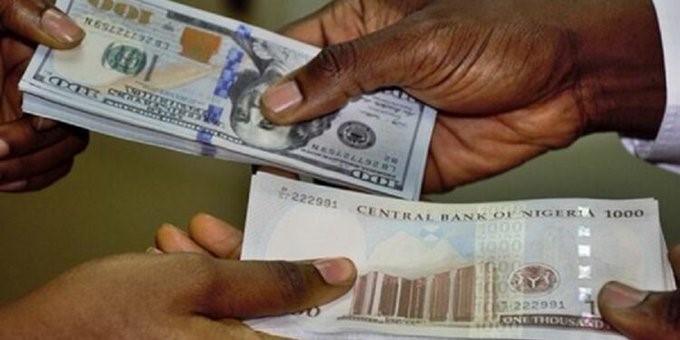
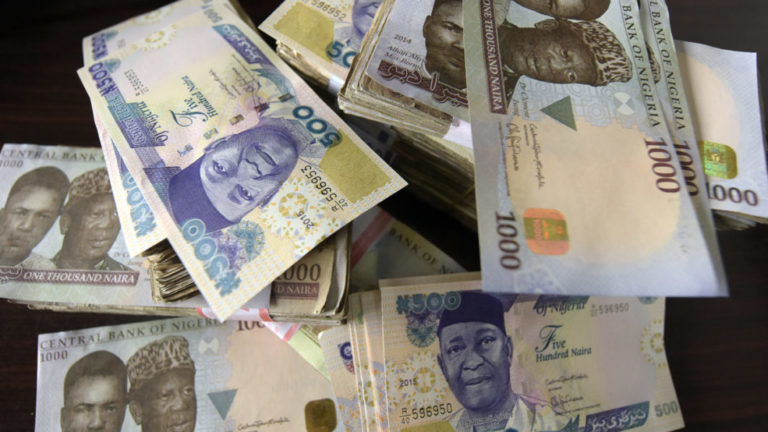
THE Nigerian currency, the Naira, has been appreciating since last week against the American dollar at the parallel market. Market analysts say there is no cause for cheer, as they do not see the advantage as sustainable.
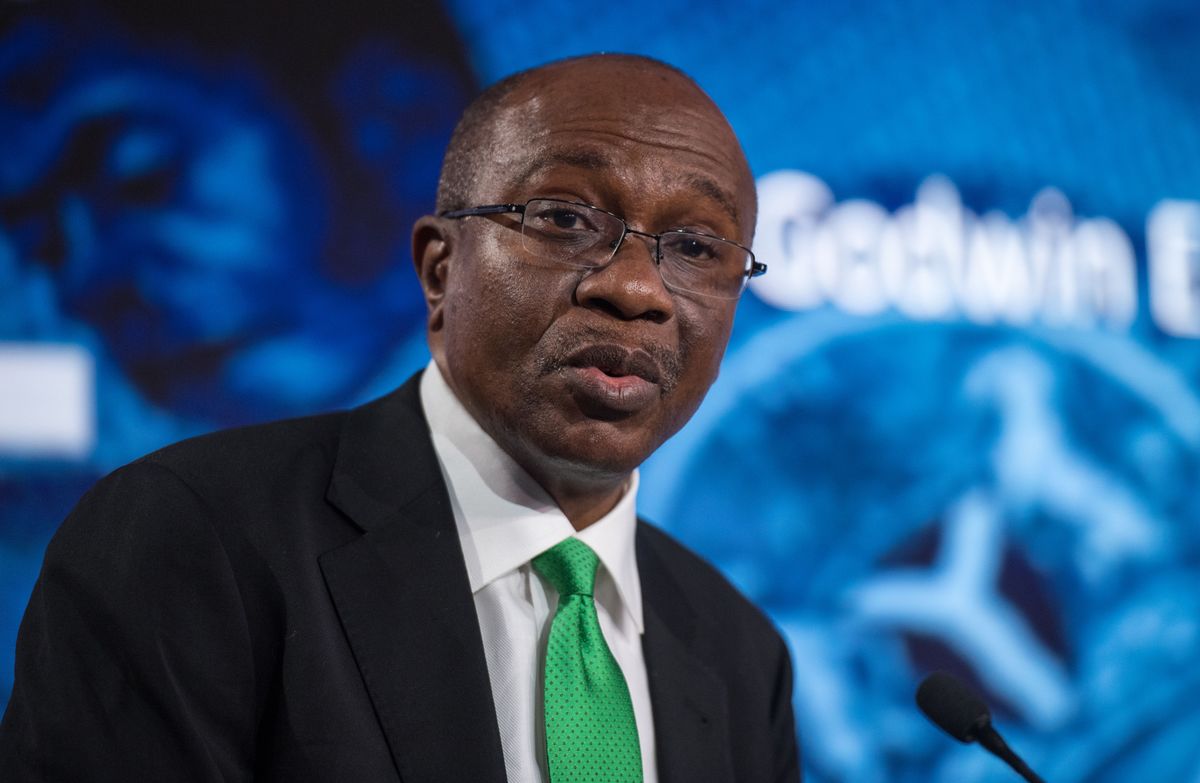
Godwin Emefiele, CBN Governor.
The naira depreciated against the dollar on Monday, November 14, trading at N760 to one dollar after gaining 26.24 per cent last week at the parallel market.
The local currency lost 8.24 per cent of its value after trading, as the dollar was quoted at an average of N768.33/$, as against N705/$ quoted last Friday at the black market.
Traders said the naira depreciation once again was as a result of dollar shortage amid rising demand. In Lagos, the dollar traded at between N750 and N770 per dollar, compared to between N700 and N710 traded on Friday at the black market.
Economic watchers said that the naira current appreciation against the American dollar, trading under N800/$, was not driven by fundamentals of oil market boom, foreign remittances and Nigeria’s capital importation.
They simply saw the naira as reacting to market sentiments of improperly regulated foreign exchange market and Nigerian government’s announcement on naira redesign.
“What ever we are seeing now is a fluke and not reliable, with regard to strengthening of the naira. The major fundamental drivers of our foreign earnings are oil sale proceeds, capital importation and foreign remittances. Our subsidy payments, oil theft, and weak policies on capital importation denied us gains from this,” a research analyst and chief investment officer with Afrivest, Richard Omotunde, told The ICIR.
The naira appreciation, Omotunde stressed, should not be celebrated yet, noting that they were not driven by known economic fundamentals.
The federal government had on Wednesday, October 26 disclosed its plan to redesign the naira, citing concerns of “illicit” funds in circulation, which it said bandits and kidnappers had been exploiting in perpetrating their crimes.
The apex bank will be introducing the redesigned notes into the financial system on December 15, 2022, and had given January 31, 2023 as the expiry date for legal tender of the notes being rested.
Bureau de change operators (BDCs) confirmed to The ICIR that the announcement had ignited more volatility into Nigeria’s currency market, while impacting on the naira.
Aminu Gwadabe, president of the Association of Bureau De Change Operators of Nigeria (ABCON)
The chairman of the Association of Bureau de Change Operators in Nigeria (ABCON), Aminu Gwadabe, told The ICIR that despite the appreciation of the naira, most of the licensed BDC operators were losing their capital on the back of exchange rate volatility.
Gwadabe, however, admitted that gradual dollar scarcity was helping the naira to appreciate in strength, but quickly advised Nigerian economic managers to create a “diaspora export window.”
This, he said, would help in providing window access for those who remit hard currencies from here, and businesses who may not be able to access the official window.
“Having an exchange rate with 100 per cent differentials between the official rate and the parallel market rate is unhealthy for investment into the economy. This development is disrupting the market,” he said.
He explained that the root cause of the problem was lack of availability of the dollar.
Gwadabe further noted that lack of confidence in the stability of the foreign exchange market had forced most Nigerians to hedge their funds in other stronger currencies.
“There is need for the government to allow independent funds through liberalising export proceeds and diaspora remittance instead of enforcing restrictions,” he stated.
He noted that the initiative, when implemented, would allow inflows and improve the supply side of the foreign exchange.
Experts’ suggestion on how to strengthen the naira
Financial experts argue that redesigning naira notes is not the right way to tackle monetary and fiscal policy. The redesign announcement, they posit, has given speculators and manipulators an all field, given the inflationary pressure on the economy.
Analysts insist the fundamentals must be addressed for Nigeria to make progress.
“The government must make its policies on ease of doing business impact on capital importation. Imagine investors struggling to repatriate their funds, as we saw with a particular airline in Nigeria. This is not good for the economy,” an economist, Kelvin Emmanuel, said.
Emmanuel noted that the uncertainty surrounding the exchange rate market, as well as high interest had been negatively affecting investment into Nigeria’s economy.
Agreeing with some experts who had maintained that now was the wrong time to redesign naira notes, the economist said, “The EFCC and other security outfits, not the CBN, are expected to fight the currency hoarders. The CBN can then use the open market operations to mop up excess liquidity in the system, not currency redesign.”
The government, he added, has only created opportunities for manipulators of the market, because of uncertainty.
“Speculators get dollars at official rate and sell at the parallel market. This creates an influx of cash into the economy that is not tied to service or assets. All these push up inflation and worsen the economy,” he said.
Omotunde remarked that the government must continue to fix the problem by taking the right steps.
“Exchange rate is tied to inflation in an import-dependent nation like Nigeria. If we allow market principles to operate, there will be no need for speculation. What we have done is that we have restricted the market, and the players in that market are looking at an alternative market,” he said.
He stressed that the government must do away with subsidy, and also allow a service reflective market.
“Let the interest rate be more market attractive to woo investors into the Nigerian market. Let’s not strangulate businesses; we should ensure that both the fiscal and monetary authorities do the right thing,” he said.
There are lots of violation of the Fiscal Responsibility Act with lending of over N20 trillion to the economy. These are some of the factors pushing inflation up, Omotunde noted.
Concerns of multiple exchange rate
The World Bank has persistently advised Nigeria to make a decisive move towards exchange rate unification and stabilisation.
The president, World Bank Group, David Malpass, had made this known during a meeting with Vice-President Yemi Osinbajo on Nigeria’s energy transition plan.
Nigeria, Africa’s biggest economy, currently operates a dual exchange rate system, which currently creates a volatile currency market for it.
While the investors and exporters (I&E) window is adopted at the official foreign exchange rate market, there is a parallel section of the market, also called the black market.
A parallel market (street market) is characterised by non-compliant behaviour, with its own set of rules.
Even though the Central Bank of Nigeria (CBN) has often maintained that the parallel market is not the true reflection of the naira, the sector has grown and continues to serve many Nigerians.
Industry analysts say this development also distorts the economy.
The presidential candidate of the Labour Party, Peter Obi, who is a businessman, had hinted of his intention to remove import and export restrictions, while insisting on a single forex market.
Peter Obi, businessman and Labour Party presidential flagbearer
Obi, in his tweet @PeterObi, said, “The current system penalises exporters who bring in forex by forcing them to sell at a rate that don’t pay them when they need to purchase.”
According to @PeterObi, this multiple exchange rate regime encourages capital flight and deters investment, which has further worsened Nigeria’s forex situation.
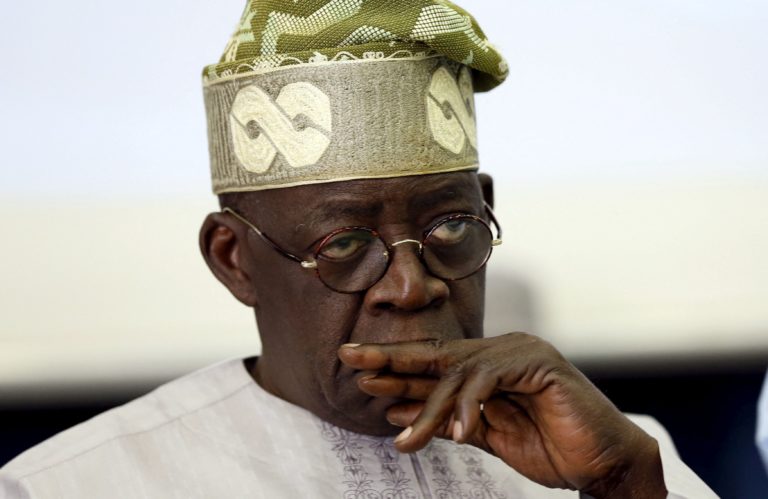
A LEGAL practitioner Mike Enahoro-Ebah has dragged the presidential candidate of the All Progressives Congress (APC) Bola Tinubu to court over alleged certificate forgery, falsification of age and lying on oath.
Enahoro-Ebah, a human rights activist, commenced the action against Tinubu in three direct criminal complaints he filed at the Chief Magistrate Court sitting at Wuse Zone 6, Abuja.
He alleged that Tinubu supplied false information and attached forged documents to his form EC-9 submitted to the Independent National Electoral Commission ( INEC) on June 17, 2022, in aid of his qualification for the 2023 presidential election.
While the legal practitioner is the complainant, Tinubu is the sole defendant in the cases marked: CR/121/2022, CR/122/2022 and CR/123/2022, respectively.
The matters, dated November 9 and filed on November 10, 2022, by the lawyer himself, were brought pursuant to Sections 88(1), 89(3), 109(A), 110(C) and 115(1)(B) and 119 of the Administration of Criminal Justice Act (ACJA), 2015; under the inherent jurisdiction and powers of the court secured by Section 6(6)(a) of the 1999 Constitution (as amended).
The complainant disclosed that there were contradictions between what Tinubu claimed and submitted to INEC and documents he obtained from institutions Tinubu claimed to have attended.
According to Enahoro-Ebah, he had applied for the said documents through his colleague, Mathew J. Kowals, a Chicago-based legal practitioner, who issued an attorney subpoena on his behalf against the Chicago State University in case number: 22-L-007289, on August 12, directing the school to mail him (Kowals) all documents and records about Tinubu in their possession.
He claimed that copies of his Chicago State University Certificate, academic records, undergraduate admission application form, University of Cambridge General Certificate of Education, and a copy of Southwest College Transcript (now City College of Chicago) were later sent to him, which he attached to the court documents as exhibits.
“Curiously, the information contained in the documents and school records received from Chicago State University contradicts material information provided by the defendant in his sworn Form EC-9 submitted to INEC,” he said.
The complainant further alleged that while Tinubu’s birth year according to Chicago State University records was 1954, the Form EC-9 submitted to INEC by the presidential candidate said 1952.
He also alleged that the Chicago State University Certificate released by the school “is radically different” from the copy attached to Tinubu’s sworn Form EC-9 submitted to INEC on June 17.
The lawyer added that a direct comparison of both certificates reveals different dates of issue by the University (June 22, 1979, and June 27, 1979); different university logos on both certificates; different grammatical construction on the faces of the certificates, and different signatures, among others.
He said in support of the defendant’s undergraduate admission application form submitted to Chicago State University in 1977 was a transcript from Southwest College, Chicago, bearing the name “Tinubu Bola A”, which belongs to a female student, contrary to Form EC-9 submitted to INEC which indicated that Tinubu is a man.
He further alleged that Tinubu indicated in his undergraduate admission application form that he graduated from Government College, Lagos, in 1970, while the defendant, in his Form EC-9 submitted to INEC, provided no information about his attendance at the said Government College, Lagos.
He said it is in the best interest of Nigeria, justice and equity to issue criminal summons to ensure Tinubu’s court attendance to respond to the issues.
The case before Chief Magistrate Emmanuel Iyanna is yet to be scheduled for a hearing.
Tinubu has recently been in the news over an allegation that he forfeited money from narcotic dealings worth $460.00 to the United States government in 1993.
The judgment docketed on July 26, 1993, and certified by Thomas O. Burton, the court clerk, indicted Tinubu for heroin trafficking in Illinois through a proxy organisation owned by Adegboyega Mueez Akande and subsequently forfeited the proceeds of the crime to the US government.
The former Lagos State governor’s campaign team has denied the allegation.
The certified copies of the judgment have been circulating in the social media in recent days.
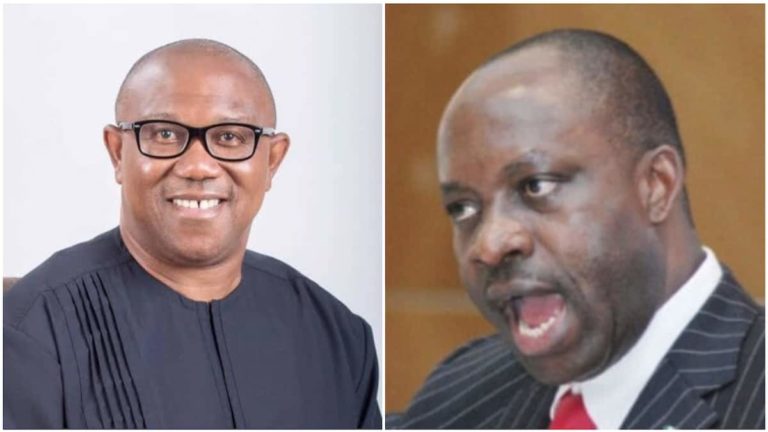
AHEAD of the 2023 general elections, the Labour Party Presidential Council (LP-PC) and Anambra State governor Charles Soludo are engaged in a war of words over the presidential ambition of LP candidate Peter Obi.
Responding to Soludo’s latest attack on Obi, the LP campaign team on Tuesday, November 15, said the outburst of the Anambra State governor against the presidential candidate was full of fallacies.
Soludo had, in a lengthy article on Monday, criticised and dismissed the chances of the former Anambra State governor in the 2023 presidential election.
The clash between Soludo and Obi’s supporters ensued when, during an appearance on Channels TV’s ‘Politics Today’ on Thursday, November 10, the Anambra governor said the investments in Anambra State credited to Obi were worth ‘’next to nothing’’.
He said Obi was playing a game with his election bid as he did not have the necessary structure in place to win the presidency on the LP platform.
Following the comments, Obi’s supporters launched attacks on Soludo on various social media platforms.
Reacting, Soludo described the attacks on him as an exhibition of desperation and intolerance.
Soludo noted that the attempt to bully everyone who expressed the slightest dissent against Obi’s presidential bid was reprehensible.
He claimed there were suggestions that the Saturday attack in which five security personnel died in his community, Isuofia, in the Aguata Local Government Area of the state, was carried out by those provoked by his comment on the LP candidate.
The Anambra governor further cited the attack on the Archbishop of the Anglican Church of Nigeria, Enugu Ecclesiastical Province, Emmanuel Chukwuma by Obi’s supporters commonly known as ‘Obidients.’
He described as tyranny the attempt to muscle out those who were not in support of Obi’s presidential ambition, stressing that this attitude might endanger the future political and economic interests of the Igbos, if not checked.
While acknowledging the anger of some youths in urban cities and the Diaspora over the trajectory of the country and with the candidates of the major parties, the governor lectured his adversaries on the tenets of democracy, stating that the minority would have their say, but the majority their way.
According to him, translating anger and social media agitation into political outcomes requires humongous work.
Weighing the LP standard bearer’s chances in the forthcoming poll, the governor said, “Let’s be clear: Peter Obi knows that he can’t and won’t win. He knows the game he is playing, and we know, too; and he knows that we know.”
The governor conceded that the LP candidate would get some votes in his home state of Anambra, but noted that this would not take him anywhere.
Dismissing claims that he was envious of his predecessor, Soludo said he and Obi had been friends for a long time, adding that he vowed never to leave APGA for another party.
Reacting in a statement on Tuesday, the LP-PCP spokesperson Ndi Kato said while the party noted the glaring fallacies and misrepresentations in Soludo’s treatise, it has no interest in an extended argument with him.
She said the governor was attacking Obi so he could secure a possible alignment with the two major political parties in the country.
Kato said the LP and its candidate were too focused in their bid to rescue the nation from consumption to production to be distracted by Soludo’s diatribes.
“It seems obvious that Professor Soludo is itching for the limelight, in this election season, perhaps fired up by possible understanding or alliance with our struggling political opponents,” she said.
“While we note the glaring fallacies, misrepresentations, personal insinuations and signs of personal vendetta in that long writeup, neither His Excellency Peter Obi, The Obi-Datti Presidential Campaign Organisation, nor the Labour Party, for that matter, has any interest in an extended engagement with Prof Soludo this critical time when there is a bigger fish to fry.
“His Excellency Peter Obi has his work well cut out for him, this campaign season.
“Primarily, he is accelerating his reach-out and influence to all Nigerians, rural and urban, in all areas, regions and states; and firmly engaging them, on his critical and visionary plans to take the country from consumption to production.
“In doing this, Mr. Peter Obi is firmly placing the youths, intensive agricultural revolution, and revamping of critical areas of the economy as part of the focal points in the drive to turn around our fortunes and take back our country.
“We, the youths, spreading across partisan political lines, have found reason to place the highest level of trust and confidence in HE Peter Obi, and we are committed to continuing to a partnership with him, transparently, vigorously and creatively, to bring to fruition, the vital changes urgently required in this our country, of so much potential.
“We strongly believe that A New Nigeria is possible… and together with Peter Obi, we are working to make this a reality.
“This is our focus; this is our occupation and we shall not be distracted!”
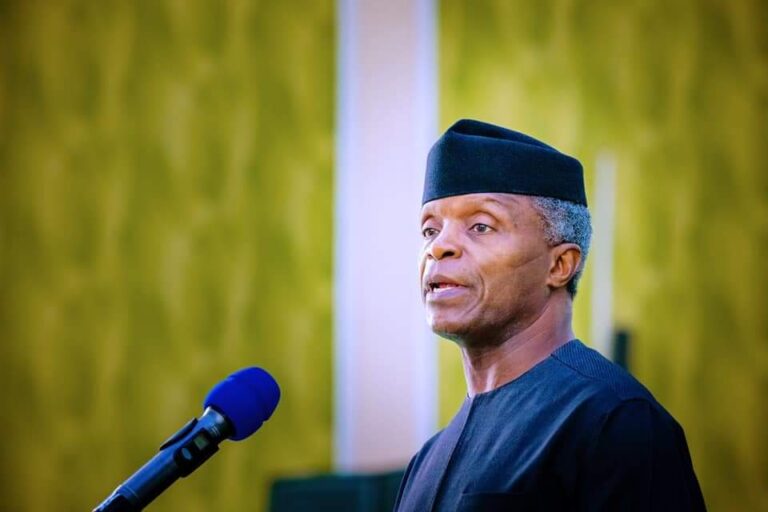
NIGERIA’S vice-president Yemi Osinbajo says Nigeria’s exchange rate regime remains a subject of worry to Nigeria’s investment climate, even as he cautions against arbitrage.
Osinbajo made the submission on Monday, November 14 at the ongoing 28th Nigerian Economic Summit Group (NESG), where he represented President Muhammadu Buhari.
The NESG organised the two-day summit, with the theme, ‘2023 and Beyond: Priorities for Shared Prosperity’, in collaboration with the Federal Ministry of Finance.
The vice-president said that real improvements had been seen in the non-oil revenues, but pointed out that focus must be on productivity and encouraging value addition.
He said, “Productivity and value addition means creation of traceable value. It means jobs and opportunities, and it means more tax revenues.
“To increase productivity, we must free up our environment for business, make local and international trade easier by fixing the ports, and effect the national single window.
“We should also revamp our customs processes and tariff codes to reduce delays and arbitrariness, and remove needless restrictions on imports to enable value-added processes.’’
The vice-president stressed that measures must be put in place to grow confidence and increase inflows of foreign exchange, while urgent steps should be taken to control Nigeria’s rising inflation.
According to him, addressing the exchange rate concern would entail finding a mechanism for increasing supply and moderating demand, which he urged should be transparent to grow business confidence.
He said, “I am sure most can recall that several efforts had been made in the past, like the Interbank Foreign Exchange Market, Retail Dutch Auction System and Wholesale Dutch Auction System.
“All of these discovery mechanisms were transparent, evidence for all to see, and they worked.
“So, I think that what we should be looking for is not necessarily any perfect rules, but we must certainly prevent the type of arbitrage that we have.”
He warned against arbitrage in the foreign exchange market, saying it does not grow investors’ confidence in the economy.
The World Bank had also often expressed concern on the exchange rate, with an advice that Nigeria should make a decisive move towards exchange rate unification and stabilisation.
The president, World Bank Group, David Malpass, had given the advice during a meeting with Osinbajo on Nigeria’s energy transition plan.
Nigeria operates a dual exchange rate system, which some economic analysts say is creating a volatile currency market.
While the investors and exporters (I&E) window is adopted at the official foreign exchange rate market, there is a parallel section of the market, also called the black market.
A parallel market (street market) is characterised by non-compliant behaviour, with an its own set of rules.
Even though the Central Bank of Nigeria (CBN) has maintained that the parallel market was not the true reflection of the naira, the sector has grown and continues to serve many Nigerians.
THE Inspector General of Police (IGP) Usman Baba has said that the police commands in Lagos, Ogun and Oyo states will deploy technology-based assets to prevent kidnapping and other crimes along the Lagos-Ibadan Expressway.
Police Public Relations Officer Olumuyiwa Adejobi disclosed this in an interview with journalists on Tuesday.
Adejobi said the IGP had ordered an immediate restructuring of the security architecture on the road to provide adequate deployment of officers, ensure the protection of lives and property and address criminal activities on the highway.
He stressed that the IGP had maintained that the police leadership is not thoughtless to the predicament of motorists on the Lagos-Ibadan Expressway.
“The Inspector-General of Police pledges adequate operational support in form of technology-based and tactical operational assets for the commissioners of Police in charge of Lagos, Ogun, and Oyo, and heads of tactical operational units in the area to combat the current trend of crimes and criminality on the Lagos/Ibadan Expressway”, he said.
“In the same vein, the Inspector-General of Police has therefore called on well-meaning Nigerians, particularly road users, hunters, community leaders and other stakeholders who ply the route to constantly expose known criminals who terrorize innocent Nigerians along the route and within adjoining communities to the police and other security agencies for immediate arrest and prosecution,” he added.
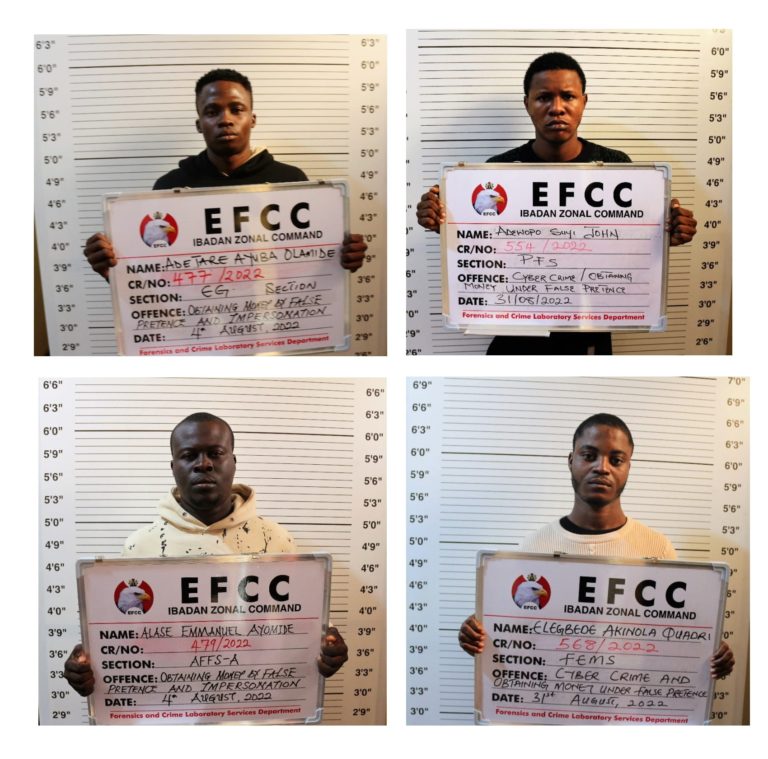
THE Economic and Financial Crimes Commission (EFCC) said it has secured the conviction of 11 cyber criminals in Oyo State.
According to a statement released by the commission, the presiding judge, justice Omolara Adeyemi of the State High Court, Ibadan convicted and sentenced the fraudsters to various jail terms on a separate one-count charge each.
The statement added that the cyber criminals all pleaded guilty to the charges filed against them by the EFCC.
The prosecution counsels upon hearing their pleas, urged the court to convict and sentence the defendants accordingly.
Consequently, Justice Adeyemi convicted and sentenced Sodiq Kazeem Abiodun to three months community service while others bagged six months community service each.
The court also ordered that the convicts restitute their various victims and forfeit all items recovered from them to the Federal Government of Nigeria.
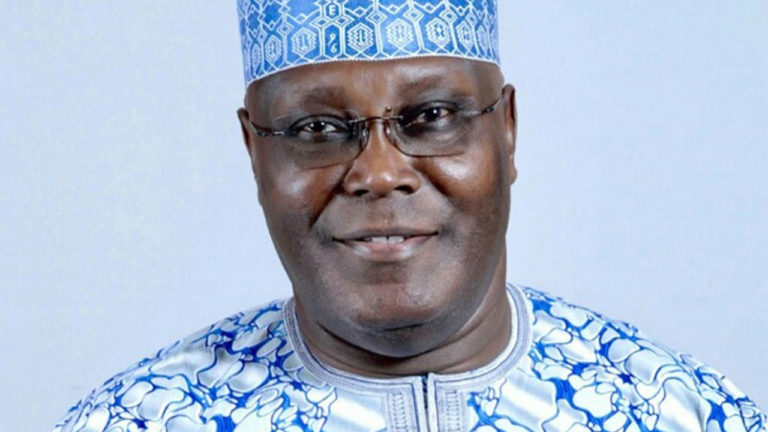
A SPOKESPERSON of the Atiku Abubakar campaign team Charles Aniagwu has said the presidential candidate of the Peoples Democratic Party (PDP) is managing the crisis in the party well.
Aniagwu, who is also Delta State Commissioner for Information, said this in an interview on Tuesday.
He said Atiku understands the need to realign the party’s structure and offices.
According to him, the presidential candidate was on the verge of resolving lingering and critical issues with the G5 governors.
“The differences are being sorted out and you can see everyone is on the same page.
“We have made a lot of progress because the G5 are more determined for the party to win the next presidential election apart from the fact that most of them are still contesting in the party”, he added.
Aniagwu said that Atiku has the ability to proffer sustainable and lasting solutions to Nigeria’s problems.
“Atiku Abubakar’s policies will bridge the gap between the rich and poor Nigerians,” he said.
Aniagwu further stressed that Atiku would resuscitate the power sector to revitalize Nigeria’s economy and provide job opportunities to the youths.
He also assured that Atiku will address the rising cost of governance in the country.
“The power sector is very relevant to reactivating our economy.
“Many Nigerians are aware that the size of government in Nigeria is over bloated and too heavy and as such funds which should have been freed for the purpose of revitalizing the economy and are being diverted to recurrent part of the budget”, he noted.
Nigeria’s grim poverty profile — with the World Bank projecting the number of poor citizens to hit 95.1 million in 2022 — makes access to justice for many low-income earners herculean. This is worsened by the police force’s many extortionist practices that continue to keep the agency out of reach of the common man. TheCable’s STEPHEN KENECHI went undercover to five police stations in Lagos and documented what it takes to get police help. He reports on how underfunding of the force deprives many of the rights to justice.
For a station in a hurly-burly neighbourhood, Pen Cinema Division in Agege was devoid of major activity on the cloudy evening of June 8, 2022, when this reporter walked through its unlatched main gate. At the security post, a few phlegmatic officers sat on a wooden bench. The reporter identifies as a victim looking to report a case.
One officer motions towards the reception desk manned by a slender policewoman of average height, a half-eaten serving of amala sitting on her desk in an uncovered Styrofoam container.
She would spend several minutes pacing back and forth before reemerging with a 20-leaf book that serves as a makeshift entry ledger. This journalist reports a case of non-payment for service rendered to a client but the officer scribbles “stealing” in her note alongside other details. She leads him past the counter towards a dark passageway, showing him to the entrance of the investigating police officers’ (IPOs) office.
The policewoman halts mid-way, her palm stretched out surreptitiously.
“You have to pay for my book. It is ₦3000,” she says.
The officer would decline electronic fund transfer, insisting that the reporter visits an ATM across the road to fetch the sum before assigning him an IPO. She takes the money on his return, crumples it into her knee-long black skirt, and tells him to see one IPO Moses.
Pen Cinema Division, Agege
Far from Agege is Abdul Abdul who used to be head honcho in one of Lagos’ police divisions. He would routinely command a team of investigators to smoke out the culprits in tough cases that often spanned murder, manslaughter, fatal road traffic accidents, and armed robbery. But nowadays, the retired ex-divisional police officer (DPO) shuttles between his home and the mosque where he is living out his years, pleading with his maker within intervals to overlook a handful of misdeeds that might have marred his streak of uprightness in a police outfit that has, by several indices, been rankedamong the world’s worst. His palms crossed; his back sinking further into his chair, Abdul shakes his head pensively and stares into the nothingness of the evening, bemoaning how “irredeemably deep” Nigeria’s police force had sunken.
Justice, even outside of Lagos, is not free. Reporting cases that require the Nigeria Police Force (NPF) to do an investigation often cost the victim a fortune that has, over the years, found its way into police lingo as “mobilisation fee”. This extortionist practice is pervasive and applies at every point of mobilising the police to act on a case. Yet, it is hardly called out, as victims fear harming their interest in such matters.
The illegal costs sometimes pass for bribes and, other times, for procuring immediate logistic needs.
“I usually don’t identify as a former officer because of the shame the current crop makes us feel. So when the police are criticised in public for obvious vices, I join in sharing my opinion and condemning such like any other layman would,” Abdul says, letting his guard down after seeking to be guaranteed anonymity.
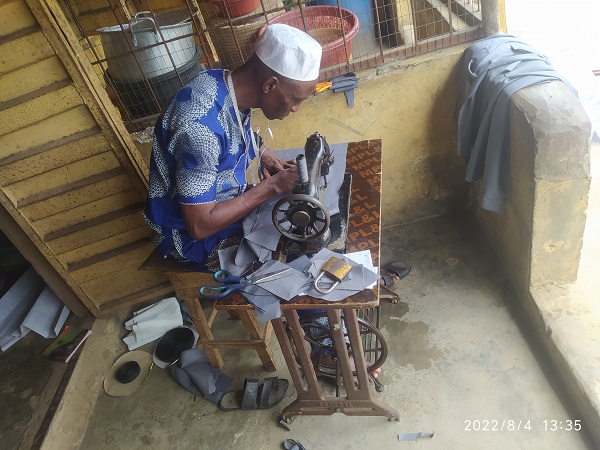
Tailor Misbahu
The NPF is a large security agency; its design takes cognisance of Nigeria’s complex nature with 36 state commands and an FCT further grouped into 17 zones and eight administrative organs headed by the inspector-general (IG). This is so that Lagos, for instance, would have a total of 13 area commands covering 110 police divisions/stations.
Citizens groan under weight of failing Police force
Enewa Obute was working as a sales attendant at a gift shop situated within Bariga, a Lagos community, when the teenager was subdued and raped by a deliveryman. The assault, her lawyer Sylvester Agih stated, happened in June 2020 on a day Obute attended to customers alone in the absence of her boss. Agih said the accused had muffled the screams of the teenager, taking her to the inner section of the shop, which was situated on the upper floor of the building.
“The man forced himself on her, dropped the sum of ₦1000 on the desk, and left,” the lawyer narrated.
On the shop owner’s return, Obute would be conveyed to a nearby hospital where she underwent tests with the case ultimately falling to the police command headquarters in Ikeja after it was transferred from the Bariga division. But the officers meant to probe the matter insisted they lacked the resources to do so.
“The police were supposed to begin an investigation but said they didn’t have the funds to track the rapist. This is even though we had furnished them with the address of the man,” Agih, who works with Gavel, a civic tech NGO, said. “We haggled over it and they eventually took ₦15,000 because we were an NGO.”
Gavel’s Sylvester Agih
As funds exchanged hands, the police tracked the assaulter but the results were generic, meaning that more legwork was needed to apprehend the suspect. The officers pointed out that they didn’t have a readily fuelled vehicle and other logistic necessities to convey their men to comb the mapped-out locality. At the time, the civic tech NGO Agih worked with had partnered with a sister organisation that, frustrated by police inaction, initiated an intelligence gathering exercise that the assaulter soon got wind of and fled.
The team handling the tracking would demand a fresh sum to determine the suspect’s new hideout. Overwhelmed by trauma, the victim would move to Benue, leaving behind the unsolved rape case.
The NPF’s ICT unit is charged with tracking and suspect interception but Olumuyiwa Adejobi, the police public relations officer, revealed in mid-2022 that the force had just one tracking device at its disposal in the IGP’s office. The same device is used by the NPF to locate bandits, kidnappers, and other criminals but it remained inactive for at least seven months in 2021. IPOs, as a result, are forced to consult private tracking firms, charging victims of such cases between ₦50,000 to ₦100,000 depending on their bargaining strength.
Obute’s case is far from being the first of its kind. In Onitsha, a city located on the eastern bank of River Niger, a bereaved father’s inability to pay ₦150,000 described as fuel money, stopped the police from moving its truck in a 37.3 km drive from Ukpo to Ọzụbulụ to probe the controversial death of a student.
Many such victims quickly resolve that seeking police intervention in certain cases is an exercise in futility.
Imposing Policing oscts on crime victims
By the time this reporter finished field rounds for this report, he had visited a total of five stations, each time following a valid case of a client evading payment for a rendered service. At the Alakara division in Mushin, another Lagos community, his cell phone is taken before he’s made to wait at the reception desk manned by three female officers. Shortly after, 11 men accused of theft are shoved in, with an officer who led them from behind violently booting the suspects in the torso to hasten movement. Two more cuffed together are nudged in, one drenched in the blood oozing from his head. The suspects, some protesting innocence, are then stripped to their pants one by one and led toward a holding room.
Shaken at the manhandling of citizens who, by law, are still innocent until proven guilty in whatever case is against them, this reporter signals one of the female officers to point out he was still on the wait. He is then ushered into an office labelled ‘DCB’ to see a non-uniformed woman identified as ‘Alhaja’. After Alhaja listened amid multiple interruptions and made the reporter write a statement, she points out he has to pay ₦30,000 for tracking, a task she said the Department of State Services (DSS) would handle.
“DSS tracks for us. If the client is arrested, put the cost in the money you want to recover,” she adds.
Arriving at C Division, Ojuelegba at mid-day on October 10 and recounting the same case to two female and a male officer at the reception desk, this reporter is motioned towards an IPO office to meet with an operative simply identified as ‘OC Surveillance’ who is also quick to point out that ₦50,000 is to be paid alongside subsequent costs to be incurred if tracking the evasive client takes the IPOs outside of Lagos.
She implied other logistic costs would be incurred when she told this reporter: “You have to mobilise”. As the reporter weighed the cost of recovering the money against how much he was looking to recover, the officer, like her Mushin colleague, offered the option of imposing those on the suspect if arrested.
Although debt recovery disputes are a civil matter, the legal basis on which the officers would suggest the imposition of the force’s own investigation costs on a potential crime subject remains unclear as no law in Nigeria justifies the practice of making an arrested suspect pay the cost of a police investigation. At this point, one thing is apparent; the NPF is strapped for resources, hence making suspects foot the bills.
Operation vehicles offer first look into NPF’s funding troubles
The National Bureau of Statistics, as of 2017, put the number of police stations, posts, commands, and headquarters in Nigeria at 5,556. Crime data hasn’t been released since then but the consensus is that the figure would have increased, given the growing need to situate police outfits closer to communities in response to a soaring crime rate.
The Nigerian police typically use pickup trucks and armoured vehicles for many of their domestic operations. Patrol vehicles with a team of officers are usually deployed to predefined locations across communities where they stay on standby daily until contacted by stations for emergency response when such cases arise. Others are often patrolling within a defined locale all day, consuming fuel and ultimately wearing out. An anonymous Lagos policeman who spoke on this stated that such vehicles should be constantly ready to move and fuelled with at least 20 litres of petrol, given the unpredictability of police operations.
Five-year budget for fueling police trucks
Of the ₦786.9 billion allocated to police affairs in 2022, ₦1.7 billion is to fuel operation vehicles. This leaves each station with ₦305,356 as fuel money, a sum translating to about ₦837 per day. If it is assumed that each station exhausts an average of 12 litres daily for operational vehicles alone, then this leaves them with a deficit of about seven litres per day or 2,555 litres for 2022 at ₦180 per litre. Note that this figure doesn’t take into account periods of scarcity when fuel sold for as much as ₦500 in the black market as well as the likely increase in the number of stations and unreleased allocations due to budget cuts, or misappropriation.
In late 2020, it was reported that the former inspector-general of police Mohammed Adamu said he would require a generous budgetary allocation of N24.8 billion to fund the fuelling of the force’s operation vehicles. He estimated that ₦22.5 billion would go to vehicles that are running on a petrol engine while motorcycles are to consume about ₦834.4 million. He added that ₦1.4 billion would cover vehicles running on diesel.
In 2021, the police affairs minister Maigari Dingyadi announced that the government had approved over ₦4 billion in the year’s budget to fuel operational vehicles across police commands, a figure that was described as the first of its kind intended to set a precedent for subsequent gestures in years to follow. An analysis would find that only ₦3.5 billion was set aside in the supplementary budget and ascribed to fuel, diesel, and lubricants as a whole, a figure that is still a far cry from what was considered enough. In light of these shortages, stations are forced to explore illegal alternatives to keep engines running.
Seated within a building close to Area F in Ikeja GRA is Saheed Muktar, a sergeant, who gives details of how officers could sometimes resort to billing themselves to fuel their patrol vehicle out of an already meagre salary.
“We do the same to buy spare parts if the truck is faulty. You can’t solely blame these officers who take bribes,” he said. “There’s a weekly target of about ₦120,000 that you have to meet at the station from the proceeds of each day’s [extortion]. If you fail, you are replaced for being unproductive, so to speak.”
Quizzed further, the officer noted that beyond fuelling, a cut of the fund “goes up” to the DPO and his assistant.
Fuelling is one thing; the adequacy of operation trucks is another. In the 2020 budget, ₦403.5 billion as a total was earmarked for police formations and commands, of which ₦389.2 billion was for recurrent expenditure and ₦14.5 billion for capital projects. In the sum for capital expenditure, ₦572.2 million was marked out for motor vehicles and trucks. If a new pick-up truck sold for ₦19 million in 2020, this budget can acquire no more than 30 operation vehicles for the police force with over 5,550 posts nationwide. The government’s inauguration of 200 buffalo trucks for the police in January 2022, though laudable, was hardly insufficient.
Shortage of Police uniforms and accoutrements
In July 2021, the NPF decried the unauthorised sale of police uniforms and accoutrements by non-force parties in a strongly-worded pronouncement issued by Alkali Usman, the inspector-general. It cited Sections 25 of the Criminal Code and 133 of the Penal Code as laws that criminalise the act while directing all commands, formations, the IGP monitoring unit, provost marshals, and X-Squad to ensure the arrest and immediate prosecution of offenders in their jurisdiction. But it would appear this is more of a formality than practice.
Regular NPF personnel buy uniforms, boots, and shoes on their own, often from private artisans. The backstreet route into Ikeja Police College in Lagos doubles as an abode for countless tailors catering to just anybody rich enough to visit their sheds & makeshift workshops to wave a couple of Naira bills, no brows raised.
Tailor Misbahu, a slim middle-aged man, routinely sews police uniforms, with an apprentice to his aid. When asked about his rates, the artisan is apprehensive, first asking if this reporter was a policeman. Another tailor close to the exit gate readily makes the outfits for traders who then resell them to “customers”.
The NPF makes use of three main outfits — a black-black, a blue-back combo, and the military-themed camo.
Making a durable camouflage outfit in Q3 2022, Misbahu confirmed, costs ₦22,000. Its designated pair of boots is pegged at ₦15,000. The blue-black and black-black combos cost ₦14,000 each. NPF officers are meant to get at least two sets of uniforms annually, often needing more to look neat, but this is not the case. This, Muktar noted, poses an enormous expense, especially for junior officers whose monthly salaries are no more than ₦80,000.
In Q1 2022, the IGP ordered the resuscitation of quarterly issuance of uniforms and kits to members of the inspectorate, non-commissioned officers (NCO), and constable cadres of the force in a move he said would engender reforms and evolve new people-friendly police.
Vendor taking consignment of uniforms for resale
“Don’t be surprised if a long-serving officer says they’ve never received uniforms from NPF. By the time NPF shares, it never goes around. I buy with my money. Don’t let them deceive you,” says Johnson Adewale, a Lagos police inspector.
In 2022, ₦32.3 billion was budgeted in the appropriation bill as capital expenditure for police formations and commands; to buy or maintain fixed assets like buildings, vehicles, and equipment. In 2021, ₦13.99 billion was set aside for the same. Yet, the interviewed serving officers say they purchase accoutrements like tear gas, torches, whistles, handcuffs, batons, and even bullets from in-house police vendors or the open market — sometimes out of their salary.
Boot vendor at Police College Ikeja barracks
The budgetary allocation for the ministry of police affairs amounts to ₦555.47 billion in 2022 and ₦455.1 billion in 2021 but, with disbursement data not publicly available, a public security pundit with ties to the government, who spoke anonymously, stated that just about 60 percent of such monies are often released.
Meagre salaries, decrepit barracks
On September 7, the police special constabularies in Osogbo, Osun state took to the streets to protest non-payment of their 18-month salaries with placards reading “we’re hungry & dying”. In August, about 1056 special constables protested across Ilorin, alleging that the Kwara state government also owed them for 18 months. The NPF had hedged, arguing that their appointment was voluntary to augment community policing. It added that the officers were at liberty to disengage rather than wilfully embarrass the force.
Police protest in Osun
Nigeria’s per capita income still hovers at $2085 and it’s no new fact that the NPF is underfunded in both operations and salary. As of 2020, a recruit took home ₦9,019 in basic salary. After conversations about police pay during the civilian protests of 2020, the federal executive council approved a 20 percent raise, with implementation slated to commence in January 2022. But it was until August before this took effect, a delay that was attributed to insufficient funds on the police cost line, at which time the NPF was already owing supplementary salary arrears stacking up to six months. Police sources who opened up on this lamented that, although the increase reflected in what was paid in August, the upgrade was below the 20 percent that was promised. An inspector, for instance, noted that they were to earn ₦254,000 but got ₦158,000 instead. Others similarly pointed out unexplained irregularities in the sum paid across states.
Basic Salary of Junior Officers
Rank
Old Scale (₦)
Old Scale + 20% (₦)
Recruit
9,019.42
10,823.3
Constable – Grade Level 03
43,293.83
51,952.6
Constable – Grade Level 10
51,113.59
61,336.3
Corporal – Grade Level 04 (01)
44,715.53
53,658.6
Corporal – Grade Level 04 (10)
51,113.59
61,336.3
Sergeant – Grade Level 05 (01)
48,540.88
58,249
Sergeant – Grade Level 05 (10)
55,973.84
67,168.6
Sergeant Major – 06 (01)
55,144.81
66,173.8
Sergeant Major – 06 (10)
62,204.88
74,645.9
Conversations with serving officers reveal deep-seated frustrations. Without a sustainable salary, they enter debt and barely have enough to pay bills. Many are forced to extort citizens to augment their monthly pay. As members of the rank-and-file who engage directly with the citizenry, constables at level 3 earned ₦43,293.83 monthly as the basic salary before the new pay scale. A 20 percent bump leaves them at ₦51,952 in basic salary, an increase that hardly improves the current living standard of these officers.
A block of apartments inside Police College Ikeja barrack
Beyond salary, officers don’t have it easier on housing either as barracks, where thousands of constables reside with their families, are often in a decrepit state. For example, a tour of the Police College Ikeja in Lagos showed residential buildings reserved for police operatives bearing cracked walls and rusty roofs. A few decent blocks within the vicinity, this reporter would learn, were renovated by private individuals. Newly posted officers unable to afford the cut-throat Lagos rent make do with these or sleep in stations.
In 2016, two inhabitants of such buildings including a sergeant were crushed to death while others were trapped in a heap of rubbles after the W Block of the barracks within the college came crumbling down.
“We don’t have enough barracks. Available ones are hardly renovated. So before you move in, you pay the previous occupant, possibly for repairs they did. A friend of mine was asked to pay ₦800,000. These are government buildings that are meant to be free and maintained by the police force,” an officer said.
Funds are annually budgeted for capital projects like construction and renovation but how much of these are disbursed remains to be known. Akali Omeni writes in his 2022 book titled ‘Policing & Politics in Nigeria’ that, of the ₦17 billion budgeted by NPF for this purpose in 2018, only ₦6 billion was released.
Repeated budget cuts of this nature leave the force making tradeoffs year after year, amassing a backlog of accommodation-related projects that, in the course of years, become almost impossible to address.
Alausa, a principal district in Ikeja, hosts a major joint where men of the Rapid Response Squad (RRS) in Lagos stop for a quick gulp of paraga, the locally distilled liquor some say helps them forget their worry. There, you will find uniformed men with arms often loitered, queueing for “lucky numbers” at a nearby gambling stall.
The cost of reforming NPF
With the prevalence of insurgency, kidnapping, banditry, and organised crime making a pretty strong case for reforming the NPF to boost its capacity, President Muhammadu Buhari signed the Police Trust Fund Bill in 2019.
The act establishes the Police Trust Fund (PTF) to be financed with 0.5 percent of the total revenue accruing to the federation account, 0.005 percent of the net profit of business firms in Nigeria, government grants, budget allocations, NGO donations, private sector aid, gifts of any kind from any source, and PTF investments.
Also, the ministry for police affairs was created to re-tool the NPF, remodel policing infrastructure, and drive increased commitment to duty among officers by bettering their welfare and condition of service.
Maigari Dingyadi, the minister, during a presidential briefing in mid-2022, said the fund delivered on its 2020 and 2021 budgets, purchasing vehicles, ammunition, bulletproof vests, and other accoutrements for police operations. The minister said the fund gave a “facelift” to police accommodation nationwide. But a juxtaposition of NPF’s needs and how much resources are provided mocks the burden weighing down on the force, so much that each state intervention could become nothing more than a quick fix.
Security is in the exclusive legislative list, hence, policymaking pertaining to policing is a domain reserved for the federal government to preside over while individual states can only influence such. In Lagos, for instance, the chronic resource shortage burdening the force prompted the creation of the Lagos Security Trust Fund (LSSTF) in 2007 which can only do so much, since its funding is largely charity-based, where a significant economic shakeup that impacts the finances of private sector donors could cripple the outfit.
In 2021, LSSTF declared ₦1.4 billion in funds from private-sector donations and spent ₦1.16 billion, but Abdurrazaq Balogun, its executive secretary, didn’t mince words in admitting to the force’s struggles.
“There is a serious resource problem that appears to be unending,” he said at the 15th annual town hall meeting on security in Lagos. “We cannot continue doing the same thing and expect a different result.” He goes on to add: “Our security agencies require more equipment that will support an intelligence-led approach to crime prevention [like] drones, trackers, scanners at gates, and gunshot detection devices.”
Balogun further stated that kitting one police officer with a uniform, a taser, police tactical gear, helmet, bullet-proof vest, push-to-talk on cellular communication equipment, rain gear and other accoutrement costs ₦3 million per head, hence, covering 33,000 officers in Lagos would amount to about ₦99 billion.
Five-year budget for police formations & commands
An evaluation of the PTF Act showed that NPF conducted a priority needs assessment and concluded that the force needs a minimum of ₦1.8 trillion for optimal performance in one year, adding that NPF had yet to receive any actual funding from the PTF as of November 2021 to augment its insufficient budgetary allocations.
Funding gaps won’t go away overnight
Osaigbovo Ehisienmen, an aide to the police affairs minister, explained that effort is still ongoing to furnish the force with arms and ammunition while renovations would still take their course within the six-year timespan of the PTF. He insisted the fund had already intervened in fuel supply for NPF trucks, and that citizens asked to pay mobilisation fees should report such infractions to the police public complaint committee (PPCC).
“Also, at the divisional police level, there are mechanisms where you can lodge complaints. At the state, zonal, and force headquarters level, there are police public complaint bureaus there,” Ehisienmen said.
“But you would agree with me that some of these things won’t fizzle away overnight. It will take a while and will come in the order of priority. We’re hopeful that the fund will generate the desired results.”
That NPF is deeply underfunded isn’t in doubt. What is disturbing, however, is that citizens at the lowest rung of the socio-economic ladder, like Obute, would be bearing the brunt until reforms truly take hold.
Editor’s note: Some names, especially those of the officers who shared intelligence for this report, have been changed to protect their identities.
This is a special investigative project by Cable Newspaper Journalism Foundation (CNJF) in partnership with TheCable, supported by the MacArthur Foundation. Published materials are not views of the MacArthur Foundation.
THEGombe State Police Command have beefed up security around Independent National Electoral Commission (INEC) facilities across the state.
The state Police Public Relations Officer ASP Mahid Muazu disclosed on Tuesday, that the development followed a directive by the Commissioner of Police, Oqua Etim.
He said the commissioner ordered the immediate deployment of the Command’s operational apparatus to safeguard INEC’s critical assets and facilities.
The commissioner issued the directive in line with orders given by the Inspector-General of Police Usman Baba.
“To ensure that enemies of the state do not destroy the ongoing peaceful political process towards the 2023 general election in the state, the deployments are to deter all criminal elements from having access to INEC facilities and to prevent any attempt to undermine the security around INEC facilities and to coordinate a swift response to emergencies,” a statement released by the Gombe State police spokesman said.
Divisional Police Officers and their supervisory Area Commanders were also directed to ensure strategic deployment of tactical teams at INEC offices within their respective areas of responsibility.
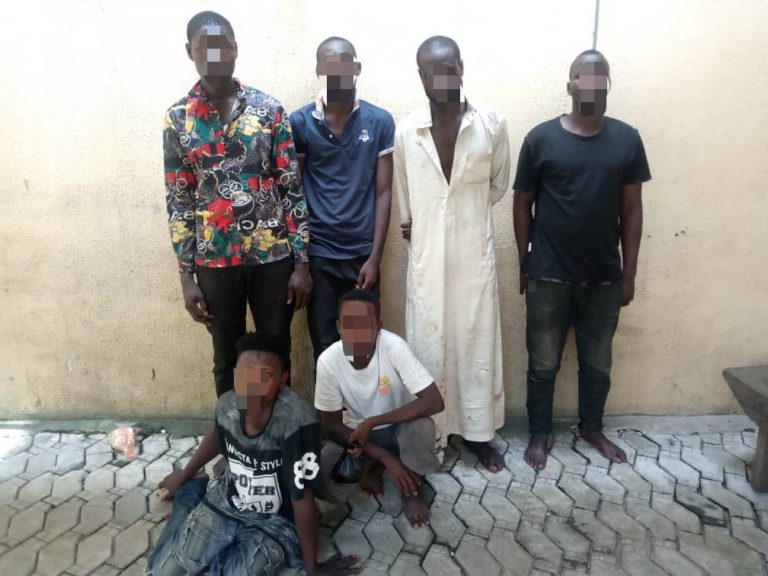
Hundeyin added that investigations by the police have proved that all six kidnappers are colleagues of the victim’s father in the same district.
“These six conspired and kidnapped the eight-year&old child of a BDC operator.
“The child was released three days later bound hands and feet in a sack. Preliminary investigation reveals that all the suspects are fellow BDC operators in the same business district of Lagos, ” he tweeted.
He, however, stressed that the six suspects will be charged to court at the end of investigations.