Home Blog Page 1165

2023: Obi seeks campaign donations from Nigerians

0

THE presidential candidate of the Labour Party (LP), Peter Obi has made campaign fundraising accounts public with a plea to Nigerians to donate towards making the “New Nigeria Dream’ a reality.

Obi who released the account details via his official twitter handle – @PeterObi – appreciated the OBIdient Family and all supporters for their support.


READ ALSO:
My rift with Peter Obi is political – Soludo

Ogun LP chapter calls for dissolution of Obi’s campaign council

I have no regret promising Obi support for his campaign in Rivers – Wike

2023: Wike pledges logistics support for Peter Obi’s campaign


The statement which Obi personally released reads:

“Fellow Nigerians, I thank every member of the OBIdient Family and every supporter for their immeasurable support in our march to a new Nigeria. We would not have gotten this far without your support.

“We call on you once again to donate to our campaign fundraising accounts attached, to help make the new Nigeria of our dreams a reality.

“Together we can do it. – PO.”

PVCs collection starts December 12, include weekends – INEC

0

THE Independent National Electoral Commission INEC says the collection of Permanent Voter Cards will be available from December 12 to January 22, 2023.

The commission disclosed this in a statement by its National Commissioner and Chairman, Information and Voter Education, Festus Okoye, on Friday, December 2.

According to INEC, the collection of PVC will be available at its offices in each of the 774 local government areas across the country from Monday, 12 December 2022.


Read Also:

The commission further stressed that it will devolve the collection to the 8,809 Registration Area/Wards from January 6th to 15th.

Festus Okoye said the INEC officials concluded on the procedure and the timetable for collecting PVCs in its recent retreat in Lagos.

“The commission has fixed Monday, December 12, 2022, to Sunday, January 22, 2023, as the dates for the collection of PVCs in all the 774 Local Government Offices of the Commission throughout the Federation.

“The Commission also resolved to devolve PVC collection to the 8,809 Registration Areas/Wards from Friday 6th to Sunday 15th January 2023. Those that are unable to collect their PVCs at the Local Government Offices of the Commission can do so at the Registration Areas/Electoral Wards. After the 15th of January 2023, the exercise will revert to the Local Government Offices of the Commission until 22nd January 2023.

The statement added that eligible registrants can get their PVCs from 9.00 am to 3.00 pm daily, including Saturdays and Sundays.

The Commission also said the RECs and Electoral officers have been directed to convene a meeting with the critical stakeholders in their States and Local Government Areas, including traditional and religious leaders, civil society groups, community-based organisations and the media to brief them on the modalities for the collection of the PVCs in order to sensitise the public and ensure seamless exercise.

 “Similarly, RECs and EOs have also been directed to set up help desks to assist registrants with complaints about their PVCs or with the PVC collection procedure for immediate redress,” it added.

The ICIR had reported that by December 30, all contesting political parties for the Presidential elections should have submitted the names of their polling agents. The report stressed that the electoral officers of each local government will receive the details. 

Meanwhile, the deadline for submitting agents’ names for the Governorship election is on January 6, 2023.

According to section 10(4), INEC is also expected to release the official Voters’ Register on January 12 next year.

On January 30, INEC will publish the notice of the poll. According to Section 44 of the Electoral Act 2022, the document should specify the “(a) days and hours fixed for the poll; (b) persons entitled to vote; and (c) location of the polling units.”

The Presidential campaign ends two days before the presidential election which is expected to hold on February 25.

The Governorship election will, however, hold on March 11 across the 36 states, while the Governorship campaigns end a week before March 9.

Amid dwindling oil revenue, non-oil sector contributes 73% to FG’s account – Finance Minister

0

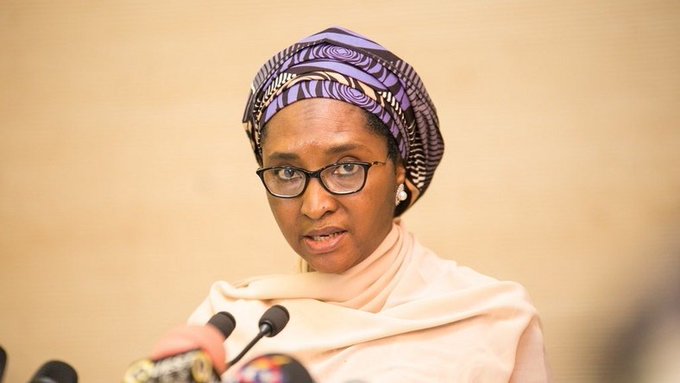
THE Federal Government has lauded the non-oil sector for contributing 73 per cent to the government purse, stressing its importance in Nigeria’s economic diversification.

The Minister of Finance, Zainab Ahmed, disclosed this in Abuja on Thursday December 1 while presenting the ministry’s score card of 2015-2023.

Ahmed said the non-oil sector had been contributing 30-35 per cent to Federal government revenue, but the figure had appreciated to 73 per cent, according to latest records.


READ ALSO:

Buhari flags off oil drilling in North, confirms discovery of over a billion barrels 

NEITI in advanced talks to recover outstanding $2.674bn from oil companies

Oil theft: NSCDC arrests suspect, impounds carrier trucks in Rivers

Oil output: Nigeria takes 4th position, falls behind Libya, Algeria, Angola in October


She also informed that crude oil production had moved up to 1.3 million barrels per day (bpd), from a low of 800,000 bpd.

According to her, “We’ve introduced the annual finance acts which are the main fiscal instrument we use to carry out fiscal policy programmes and to amend fiscal laws that have either been problematic for businesses or unfair to businesses, or bring in more revenue to government.

“We’ve been able to enhance it among several tax laws and improve tax administration efficiency. We’ve also been able to increase taxes. For instance, the VAT increased from 5 per cent to 7.5 per cent. We’ve been able to reduce taxes for small businesses.”

Ahmed explained that the federal government was set to establish the Ministry of Finance Incorporated, which will be an investment arm of the federal government.

“If the government is going to be in any business, the Ministry of Finance Incorporated is the investor standing on behalf of the government.

“Ministry of Finance Incorporated used to sit as a department in the treasury, but now we have the President’s approval to turn it into a world-class investment company. The Ministry of Finance Incorporated currently has 130 corporate entities and it has various investments in these entities,” she said.

The minister also disclosed that the road infrastructure tax credit scheme had attracted 33 road projects across the country approved by the government. She noted that N78.7 billion had so far been disbursed under the tax credit scheme.

“One of our major functions is to support the states. The ministry facilitates the implementation of various federal government intervention schemes to the sub-national governments.

“These interventions include the Commercial Agricultural Credit Scheme, Healthcare Support Facility, Differentiated Cash Reserve Facility, and Several Bonds Issuance Programmes,” Ahmed added.

Qatar 2022: Ghana’s penalty woes return, but Uruguay still fall short

ANOTHER crucial penalty miss paved the way for Ghana’s group-stage exit.

In 2010, the Black stars were memorably knocked out of the quarter-finals of the 2010 edition of the FIFA World Cup by Uruguay. In that game, Luis Suarez, who contributed to two goals today, blocked a game-winning shot with his hand in the final minutes of the extra time—the second ‘hand of god.’

Asamoah Gyan stepped up for the penalty but ballooned it into the crowd behind the goalpost, after which he vowed not to take another penalty.

Suarez was Uruguay’s self-proclaimed hero that day, claiming, “I made the save of the tournament,” and his actions sparked a decade-long cross-Atlantic rivalry. While he contributed to Uruguay’s goals today, they were ultimately not enough to see his side through. Korea Republic’s 2-1 win over Portugal in the other group game knocked out Ghana and Uruguay.

State of play

Both teams came into the game needing a victory to give themselves a chance of qualification.

It seemed like Ghana would draw first blood after starlet Mohammed Kudus took a deft touch over goalkeeper Sergio Rochet and won a penalty. After a lengthy video assistant referee (VAR) review, Andre Ayew took even longer before striking the ball from the penalty spot. Like Gyan in 2010, the pressure caught up, and he scuffled his chance.

Gyan, who was on punditry for the game, expressed his condolences after history repeated itself. In reality, the miss also meant that his failures from 12 years ago would continue to occupy Ghanaian minds for another few years.

The miss unnerved the Black Stars players, and their defensive lines lost structure. Uruguay exploited the gaps; Luis Suarez’s fired a shot that Lawrence Ati Zigi parried into the path of a perceptive Giorgian de Arrascaeta. The Uruguayan followed through and poked the ball in at the goal line.

Uruguayan players celebrating after a goal

A few moments later, Suarez drew blood again. His intricate combination with de Arrascaeta gave the latter a chance to volley home his second for the game. Jordan Ayew grabbed all the attention after his possession loss at the center of the pitch led to the goal: his third error leading to a goal in the tournament.


READ ALSO:


The rest of the game played out at a snail’s pace, with neither team having the delicacy or energy to string a decent move together.

Eventual Disappointment

After word broke about Korean Republic’s exploits against Portugal, Uruguay needed to score another to qualify. Unfortunately for them, that goal never came.

Luis Suarez in tears during the game

Ghanaian fans rejoiced after the broadcast cameras captured Suarez’s tears on the bench. Their cries and celebrations erupted, and despite the results meaning an early departure for them, their sorrows were soothed.

Both teams left the game disappointed, but Ghana’s revenge, albeit diluted, still came.

Nasarawa employs 300 health workers after ICIR’s reports

THE Nasarawa State Government has employed 300 health workers to boost primary healthcare services in the state.

Executive Chairman of the state’s Primary Healthcare Development Agency, Mohammed Adis, a doctor, stated this while defending the agency’s 2023 budget before the State House of Assembly Committee on Health on Friday, December 2, The Punch reported.

The recruitment followed two investigations by The ICIR in September, which exposed how the state had run its primary health centres for decades with casual workers, comprising community health and extension workers, midwives, and laboratory technicians, among others, who were paid between N4,000 and N10,000 monthly.


READ ALSO:

[SPECIAL REPORT] We are at risk – Matron decries state of health centre donated to Abuja community by a corps member

Kwara State Govt approves recruitment of medical practitioners to boost healthcare delivery

Estates of Death? How property developers use Dangote Refinery to lure potential home owners despite future health hazards

Despite BHCPF, Oyo PHCs face many challenges in delivering health care


Most PHCs in the state have no nurses and midwives, crippling services and stifling patronage. The ICIR’s reports showed that the Federal Government’s Midwife Service Scheme (MSS) failed in the state.

The chairman of the state chapter of the National Association of Nigerian Nurses and Midwives (NANNM), Tammah Shawulu, a nurse, told this newspaper that there were less than 10 nurses and about 30 midwives in the state’s PHCs as of late 2020.  

The state Commissioner for Health, Ahmed Yahaya, a pharmacist, admitted there was a shortage of human resources across the state PHCs. 

He said the governor, Abdullahi Sule, an engineer, had directed his ministry to improve access to primary health care services across the 13 local government areas by engaging more midwives. 

“His Excellency has directed that over 200 workers, worth over N800 million, will be taken in batches to fill in the gaps across the board over time. We have taken the first batch of graduates from the School of Midwifery. Their names have been sent to the Primary Health Care Development Agency so they can be deployed in PHCs across wards in the state. 

“We have a midwifery school; the state has absorbed the first set. We are also picking the next three sets. We are sending our memo to the governor for their absorption. Our target for the absorption of these midwives is for them to be posted into the primary health care facilities.” 

He also promised the government would engage the casual staff at the PHCs.

Meanwhile, the state adopts the Federal Government’s Basic Health Care Provision Fund (BHCPF), and the programme fares well in the state, according to The ICIR’s findings, though inadequate manpower remains a challenge. 

The BHCPF services exist in at least one PHC in every ward in the state and have been supporting people enrolled on the scheme in the state.

Fielding questions from the state House of Assembly on Friday, Adis said the newly recruited workers were community health extension workers, junior community health extension workers, midwives and other casual workers who had worked many years in the state PHCs. 

He gave the assurance that their engagement would boost the state health services.

Ekiti to establish special courts to end gender-based violence – Governor’s wife

0

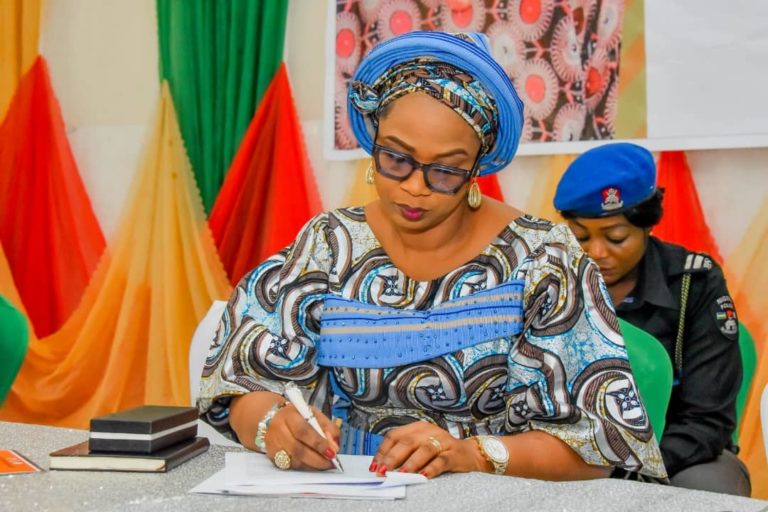
WIFE of Ekiti State Governor, Olayemi Oyebanji, has said that gender courts will be established across the state to deal with and end (GBV).

The governor’s wife stated this during an interview with newsmen in Ado-Ekiti, the state capital on Friday, December 2.

The interview was part of the activities marking the 2022 edition of the 16 days of activism against violence on women and children.


READ ALSO:

ICIR engages experts on advocacy against gender-based violence

Gender-Based Violence: NGO sensitises IDPs in Wassa Camp

A review of Gender-Based Violence Reporting Handbook

Gender-Based Violence can be tackled during early education – Semenitari


Oyebanji, who described gender-based violence as a hydra-headed problem, said the menace required a multidimensional and multi-sectoral approach to resolve.

“We will ensure that we gazette all our public policy laws and also review some of our laws to include whistleblowers and sexual violence crime protection, and mandatory reporting, among others,” she said.

The governor’s wife noted that her office is engaging all stakeholders in the state, including the Ministries, Departments and Agencies (MDAs) of government, civil society organisations, gender experts and vulnerable persons in the state to mark this year’s event.

“Some of the activities include, but are not limited to, sensitisation of key and relevant stakeholders on GBV, media engagement, awareness creation across the state, and community dialogue sessions.”

She, however, reiterated her determination to work in the footsteps of her predecessor, Bisi Fayemi, who she said, left beautiful legacies in her determination to end violence against women.

Oyebanji expressed gratitude to the state governor, Abiodun Oyebanji, for creating an enabling environment and ensuring that the global event is observed in Ekiti state.

“He has shown himself not only as a leader but also as a person who has passion for the development of women in Ekiti State as we commemorate the 16 days of activism,” she said.

IGP files motion to stop 3 months imprisonment

0

THE Inspector-General of Police (IGP) Usman Alkali Baba has filed a motion to set aside the committal order issued against him by an Abuja Federal High Court.

The court presided by Justice Mobolaji Olajuwon had on November 29 sentenced the IGP to three months in prison for contempt.

The order followed a suit filed by a former police officer, Patrick Okoli, who claimed he was unjustly and unlawfully retired from the Nigeria Police Force.


Read Also:

The court sentenced the IGP for failing to comply with a court ruling which ordered the reinstatement of the former police officer.

In a motion filed before an Abuja Federal High Court on December 1, the IGP stated that he had not been appointed at the time the case was instituted and the reinstatement order in question granted.

The Force Public Relations Officer, Olumuyiwa Adejobi disclosed this in a statement issued on Friday, December 2.

Adejobi emphasised that the IGP has affirmed that the contempt proceedings were served via substituted means in November 2018 and January 2019 respectively, on the then Inspector-General of Police, and not on him as the incumbent.

The IGP, in his deposition, further noted that even before he assumed office, official steps had been taken by his predecessors towards complying with the reinstatement of the plaintiff, as ordered by the court.

He noted that this was evidenced by an official letter addressed to the Police Service Commission (PSC), on the approval of the then Inspector General of Police, as far back as 2015 and before the court order of November 29, 2022, requesting the Commission to issue a reinstatement letter to the plaintiff and also effect his promotion.

The IGP argued that the grounds for the contempt proceedings ought not to have existed ab initio.

The IGP assured Nigerians of his commitment to upholding the rule of law and respecting the country’s judicial authorities.

ICIR engages experts on advocacy against gender-based violence

0

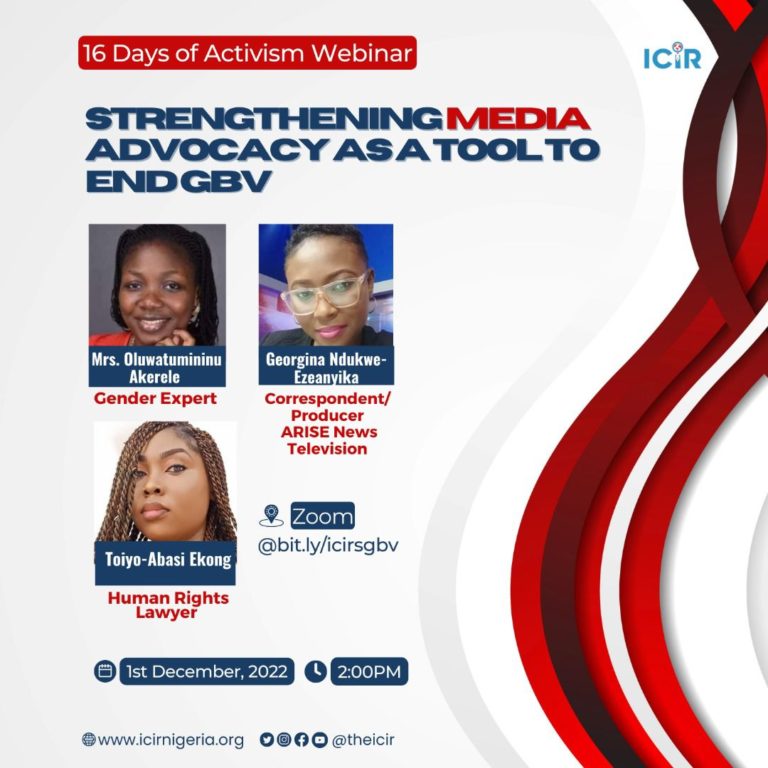
THE International Centre for Investigative Reporting (ICIR) on Thursday, December 1, held a virtual webinar in commemoration of the 16 Days of Activism against Gender-Based Violence (GBV).

Participants at the webinar include gender, legal and media experts who proffered solutions to issues relating to violence against girls and women.

The webinar themed ‘Strengthening Media Advocacy As A Tool To End GBV’ was aimed at exploring the significant impact of the media as a viable means of reporting GBV stories in Nigeria.


Read Also:

The 16 Days of Activism is an annual international campaign organised by the Center for Women’s Global Leadership (WGL) after it was launched at the inauguration of the WGL Institute in 1991.

The campaign commences on 25 November, the International Day for the Elimination of Violence against Women, and runs until December 10, Human Rights Day.

Giving the opening remarks, the Editor of The ICIR, Bamas Victoria, noted that the webinar was one of the series of activism the organisation was engaging in to advocate against GBV.

“Over time, The ICIR has been at the forefront of reporting issues, what to do and how the media can help in carrying out the campaign,” she said.

Speaking on the possible entry points to addressing social norms that promote GBV, a gender expert, Oluwatunmininu Elizabeth Adedeji, stressed the need to start from the family which she described as the first unit of contact in society.

“Social norms is the general belief of a particular set of people around a particular issue. It has its roots in our culture, power relations, religious practices, understanding and societal attribution of gender roles to both women and men.

“To address the social norms that are promoting gender-based violence in our community, we need to start thinking about where it starts from and how we got into some of the things that have become normal for us in the society,” she said.

Adedeji added, “When we talk about gender roles, who brought the gender roles? Who are the initiators of these gender roles that make the men to be seen in a manner and the women to be seen in another manner?

“In addressing them, we’ll start from the community where the norms start from. We will look at the first unit of contact.

“We need to start from our family to address gender issues from the family.”

Adedeji further called on parents to mentor their children on what roles are and how they can do away with them.

According to her, “Gender roles does not really help anybody or society as far as it is not biological roles like pregnancy.”

She explained that gender-based violence comes from gender roles, adding that “everything about gender based violence is majorly about power relations”.

“Everybody wants to show that I am powerful. In this part of the world, much power is being given to the men above the women.

“Power should not be the focus. The focus should be seeing everybody as human and be treated as such.”

Adedeji also noted that traditional practices like female genital mutilation promote dehumanization of women.

She stated that the Nigerian law does not acknowledge rape in marriage.

“According to the Marriage Act, it is believed that once you sign the marriage document in the court that you have given your consent for sex,” she noted.

A parliamentary correspondent and producer with Arise News TV, Georgina Ndukwe Ezeanyika, who said the media has been trying in creating awareness against GBV, called for more efforts from the grassroots including religious houses.

“We need to be able to stand up and speak up against gender based violence. We need to start from the roots.”

She called on lawmakers in State Houses of Assembly to domesticate the Child Rights Act, Women Empowerment Act as well as the Gender-based Violence Act.

She also urged the Ministry of Women Affairs to respond to the GBV issues at the grassroots level.

Speaking on how the judiciary and the legislature can work together to bring an end to GBV, a human rights lawyer, Toiyo Abasi Ekong, said both arms of government should have it as part of their programs to educate the people.

“It should be part of their programs to educate these people because just trying to pass a law, especially in the North, that has something to do with violence against women, something that they perceive as gender inequality, is very difficult. It’s not a walk in the park,” Ekong said.

She stressed the need for the legislature and judiciary to make people understand the laws and their importance for them to comply and make the implementation process feasible.

Adedeji highlighted two models – multi-sectoral and multi-level – through which GBV can be eradicated in society.

The multi-sectoral model, she said, includes action plans across all sectors of the economy against GBV.

The multi-level model involves efforts by all levels of society to bring an end to gender-based violence.

Osun APC justifies looting of govt properties by Oyetola’s appointees

THE Osun State chapter of the All Progressives Congress (APC) has justified the looting of government properties by appointees of the former state governor, Gboyega Oyetola, saying the aides of other former governors also did the same.

The ICIR reported that the governor Ademola Adeleke-led administration had said that the top officials of his predecessor diverted and eloped with various government properties, including official cars assigned to their respective offices.


READ ALSO:

The governor said that most Ministries, Departments and Agencies (MDAs) were stripped of operational assets like vehicles, computers and even residential fittings.

He directed the officials to return the looted items within 48 hours or they will be made to face the full weight of the law.

However, reacting to the governor’s directive on Thursday, December 1, Osun State APC Director of Operations, Sunday Akere, who confirmed the allegation, said it had become a tradition in the state that governors and their appointees leave offices with their official vehicles.

According to the Guardian newspaper, Akere said it was not wrong for the officials of the immediate past APC-led government to take away their official vehicles since such gifts were approved by the state governor.

He contended that removing building fittings and sundry items from official residences was also right because such items, according to him, were bought with government money but in the personal names of their occupants.

Court jails Senator 42 years for corruption

0

A SERVING Senator representing Akwa Ibom North-East Senatorial District, Bassey Albert Akpan, has been sentenced to 42 years in prison for corruption.

Akpan is the governorship candidate of the Young Progressives Party (YPP) in Akwa Ibom for the 2023 general elections.

Justice Agatha Okeke of an Uyo Federal High Court convicted the candidate on six counts bordering on money laundering, including graft.


READ ALSO:

NIS sacks eight personnel over alleged corruption, redeploys 100

Anti-corruption academy offers ‘power of the pen’ corruption reporting training

Corruption, irregularities mar BHCPF Scheme in Kano

1956 Audit Law too weak to fight corruption, concerned Nigerians tell Buhari


The judge committed Akpan to a federal correctional facility in Ikot Ekpene, where he will serve the jail term.

Akpan, the current chairman of the Senate Committee on Petroleum Upstream, committed the crime in connivance with Jide Omokore, an oil marketer and known associate of former petroleum minister Diezani Alison-Madueke.

In May 2010, Akpan, who was then the Commissioner for Finance, Akwa Ibom State, was alleged to have received from Omokore a BMW X5 (bullet-proof car) worth N50 million. In December 2012, he allegedly received another Infinity QX56 (bullet-proof) worth N45 million from the same source.

Also, in November 2013, he received a Toyota Landcruiser V8 (bullet-proof) valued at N40 million from Omokore.

In the same vein, Akpan, in March 2014, received a Range Rover valued at N40 million and in September 2014, another Toyota Hiace High Roof bus valued at N27 million was obtained from the businessman.

Akpan was also alleged to have received, at different times between 2012 and 2014, Toyota Hiace High Roof buses valued at N16 million and six units of Toyota Hilux vehicles valued at N36 million.

He was first arrested and prosecuted in the Ikeja Division of the Lagos State High Court in 2018 after repeatedly refusing to honour invitations by the Economic and Financial Crimes Commission (EFCC).

His lawyers blocked the court from trying the matter, citing jurisdictional limitations

After the case was dismissed, the EFCC, in 2019, filed fresh charges at the Uyo Division of the Federal High Court to bring Akpan to justice.

Delivering judgment on Thursday, December 1, Justice Okeke ruled that Akpan must serve seven years in prison for each of the six counts.

The jail term is to run concurrently.